

What if the number in a narrow-gauge label describes the track, not the size of the model? That distinction is the key to understanding OO9, On30 and HOn3, but it’s easy to miss when scale and track gauge are treated as if they mean the same thing.
If you’ve been looking for narrow gauge scales explained, the confusion is understandable. Labels may combine a scale ratio, a track gauge and a regional naming convention. As a result, two models running on the same width of track can represent prototypes of very different sizes. Once you know what each part of a label means, comparing options becomes much easier.
This guide separates model scale from track gauge, then compares popular combinations using consistent terms. You’ll see how British OO9 differs from American On30, and where O-16.5 and GN15 fit into the picture. You’ll also learn what to check when choosing a combination for your available space, preferred subject and kit-building plans, before browsing locomotive, wagon or scenery kits.
Key Takeaways
- Decode a label by identifying the model scale, the track gauge and the prototype it represents.
- Compare labels such as OO9, O-16.5, GN15, On30 and HOn3 without treating their names as interchangeable.
- Match a modelling combination to your available space and preferred subject, then check curve and operating requirements before planning a layout.
- Before choosing kits, verify that their intended scale and track combination suits your plans. Narrow Minded Railworks offers kits for OO9, GN15 and O-16.5 modelling.
Narrow Gauge Scales Explained: What Do Scale and Track Gauge Mean?
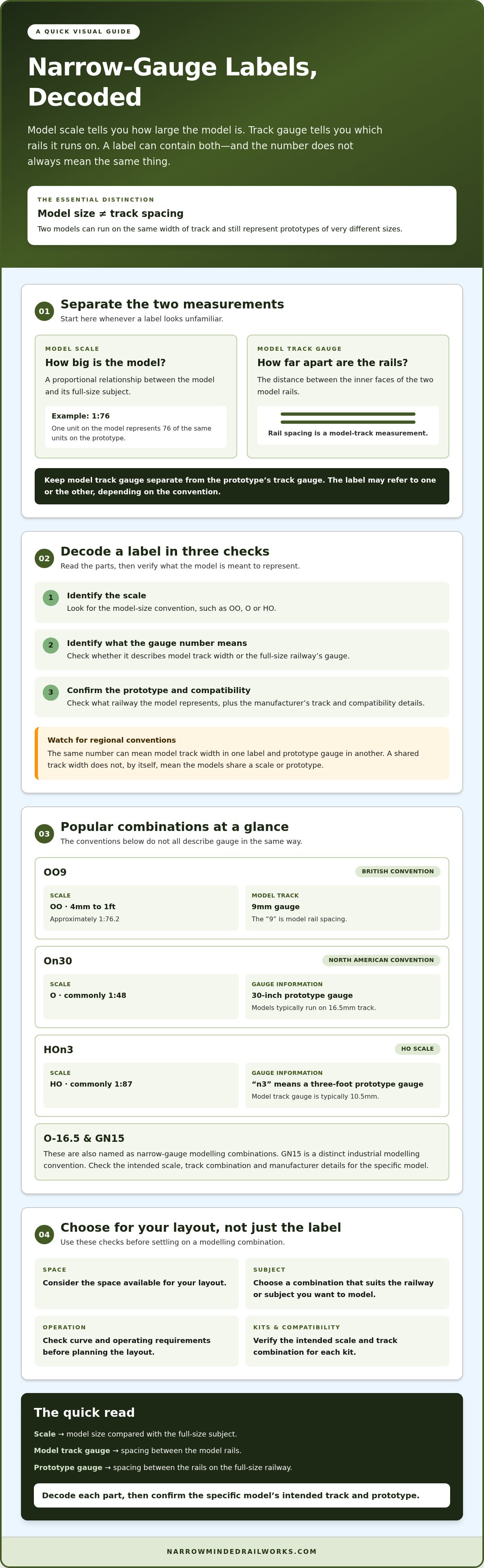
If labels such as OO9 or O-16.5 seem difficult to interpret, start by separating two measurements: the size of the model and the spacing of its rails. Once you know which part of a label describes each, narrow gauge scales explained becomes a much more manageable topic. This distinction also helps you compare models without assuming that those running on the same track must be the same scale.
Narrow-gauge models pair a chosen model scale with a track gauge to represent larger vehicles running on narrower-than-standard prototype railway tracks.
What does model railway scale describe?
Scale describes the proportional size of a model compared with its full-size subject. A ratio such as 1:76 means that one unit on the model represents 76 of the same units on the prototype. In British modelling, scale is also often written as millimetres to the foot. For example, 4mm to 1ft means that each real foot is represented by 4mm on the model, equivalent to approximately 1:76.2.
Scale affects the dimensions of the locomotive, wagons and other features. A 4mm-scale locomotive is smaller than an O-scale locomotive representing the same full-size design. But scale alone doesn’t set the space between the rails. That’s a separate measurement, and narrow-gauge labels often combine the two. For an overview of different naming approaches, see this reference to narrow-gauge model railway scales.
What does track gauge describe?
Track gauge is the distance between the inner faces of the two model rails. It describes the model track, not the distance between the rails on the full-size railway. The prototype has its own track gauge, measured between its rails. Model track gauge is selected to represent that prototype at a particular scale or to follow an established modelling combination.
For instance, OO9 combines 4mm scale with 9mm model track. The 9mm figure is the model rail spacing, not a claim that the full-size railway was 9mm wide. Keeping these measurements distinct is especially useful when comparing British labels with conventions used elsewhere. If you’re new to the prototype idea behind narrow-gauge railways, read this narrow gauge railway beginner guide.
In short, check the model’s scale to understand how large its subject will look, then check the track gauge to find out which rails it is designed to run on. This two-part check makes unfamiliar labels easier to interpret. For a kit or layout, also confirm the intended prototype and the manufacturer’s compatibility details.
How to Decode Narrow Gauge Scale Labels Like OO9 and On30
Labels use different regional conventions, so don’t assume every letter or number has the same meaning. Decode the parts separately, then confirm what the model is intended to represent. This makes narrow gauge scales explained useful in practice, rather than just a list of abbreviations to memorise.
Use this three-step check:
- Identify the scale. Look for the model-size convention, such as OO or O.
- Identify the gauge information. Check whether the number refers to model track width or the prototype’s track gauge.
- Check the prototype. Confirm what railway or gauge the model represents, then check the manufacturer’s track and compatibility specifications.
The same number can mean different things in different labels. It may give the model track measurement in millimetres, as in OO9, or refer to the full-size railway gauge, as in On30. Regional conventions also affect how the letters are read. A shared model track width doesn’t, by itself, mean two models depict the same prototype or use the same scale.
What do the numbers and letters in OO9 mean?
In the British OO9 convention, OO identifies the modelling scale, commonly expressed as 4mm to 1ft, or approximately 1:76.2. The 9 refers to 9mm model track gauge. These are established conventions, but they don’t guarantee that every OO9 product will suit every layout. Before planning a purchase or track connection, check the specific model and track details.
That distinction is central to the label: OO tells you about model size, while 9 describes the rails beneath it. For a broader comparison of naming systems, consult this reference to narrow-gauge model railway scales.
How do On30, HOn3 and GN15 labels differ?
On30 follows a North American convention: O scale is commonly 1:48, and 30 refers to a 30-inch prototype gauge. Models typically run on 16.5mm track. HOn3 uses HO scale, commonly 1:87, with “n3” indicating a three-foot prototype gauge; its model track gauge is typically 10.5mm.
GN15 is a distinct industrial modelling convention, commonly using 1:22.5 scale to represent 15-inch-gauge railways on 16.5mm track. Its label shouldn’t be read as though it follows the same format as OO9 or On30. For more about this modelling approach, see the complete GN15 scale guide.
Once you’ve confirmed the scale, gauge and intended subject, you can compare suitable kit options. Narrow Minded Railworks offers OO9 locomotive and wagon kits, alongside kits for other narrow-gauge modelling combinations.
Popular Narrow Gauge Scales Compared by Model Size and Track
This comparison brings the labels together using the same two measures: model scale and model track gauge. The figures below describe commonly used conventions, not a guarantee that every manufacturer uses identical specifications. Check the details for the model and track you plan to use, especially if you intend to connect track or mix equipment.
| Label | Model scale | Model track gauge | Regional context | Typical modelling interest |
|---|---|---|---|---|
| OO9 | 4mm to 1ft, approximately 1:76.2 | 9mm | Predominantly British | British narrow-gauge railways in a relatively compact model size |
| O-16.5 | 7mm to 1ft, approximately 1:43.5 | 16.5mm | British | Larger-scale narrow-gauge and industrial subjects |
| GN15 | Commonly 1:22.5 | 16.5mm | Industrial and freelance modelling | Detailed industrial scenes, small railways and dioramas |
| On30 | O scale, commonly 1:48 | 16.5mm | Predominantly North American | American narrow-gauge prototypes, including logging and mining themes |
| HOn3 | HO scale, approximately 1:87 | 10.5mm | Predominantly North American | Three-foot-gauge prototype railways modelled in HO scale |
These are standard or commonly cited combinations. Confirm the scale, gauge and intended prototype against current manufacturer specifications. Product dimensions and compatibility can vary.
Which narrow-gauge scales are common in British modelling?
OO9 and O-16.5 offer different ways to model narrow-gauge subjects. OO9 uses smaller 4mm-scale models on 9mm track, while O-16.5 uses larger 7mm-scale models on 16.5mm track. Consider whether you prefer a compact layout or larger, more prominent models, then check which convention suits the prototype you want to represent. For help assessing kit-building, see this beginner guide to OO9 locomotive kits.
How do American and industrial modelling combinations compare?
On30 and HOn3 both model North American narrow-gauge subjects, but they differ in scale, track gauge and the prototypes represented. Their track isn’t interchangeable simply because a label includes a familiar number. GN15 takes a different approach, using larger models for industrial and freelance scenes. For a size comparison, imagine models on the same 16.5mm track: GN15 models are larger than O-16.5 and On30 models. That shared track width doesn’t make their subjects or scales equivalent.
Each combination suits different interests and modelling plans. Compare the scale, track and prototype together rather than treating any one label as universally best.
How to Choose a Narrow Gauge Scale for Your Layout
There isn’t one narrow-gauge scale that suits every modeller. The right choice depends on what you want to represent, the room available and the models or kits you can source. Now that narrow gauge scales explained means separating scale from track gauge, use this checklist to turn those terms into a practical decision:
- Measure your space. Include room for curves, scenery, buildings and access, not just the straight sections of track.
- Choose a prototype or theme. A particular railway, region or industrial subject may point you towards a suitable modelling convention.
- Consider model size. Larger models can make details easier to see, but occupy more of the layout, leaving less room for scenery and track.
- Check what you can source. Look at the kits, track and other components available for the combination you’re considering.
How should available space and model size affect your choice?
Sketch your layout area and mark likely track routes, buildings and scenic features before settling on a scale. Include access for handling and maintenance, and consider how you’ll view the models. A larger scale may suit a focused industrial scene with detailed structures, while a smaller model size can leave more room for a broader setting. Narrow-gauge equipment may suit tighter curves than some standard-gauge subjects, but the locomotive, rolling stock and operating plan still matter. Check each model’s guidance rather than assuming a particular curve radius will work.
How can you check whether kits and track will work together?
Compare the kit’s stated scale and intended track gauge with your layout specifications. Then check wheel standards, curve requirements and any chassis requirements in the product information. A familiar or similar label doesn’t guarantee that components from different makers will work together. If a kit is designed for a commercially available chassis, confirm the stated requirements before choosing one. Don’t assume compatibility based on scale alone.
Finishing is another practical consideration when choosing a kit-building project. For advice on preparing and painting 3D-printed models, see this guide to finishing 3D-printed kits.
Make the decision in order: choose a subject, check the model size against your available space, then verify track and component specifications. This helps you avoid choosing a combination that looks right on paper but doesn’t suit your layout. To compare options for your plans, browse narrow-gauge locomotive, wagon and scenery kits.
Where to Start with Narrow Gauge Scale Kits and Modelling
Understanding narrow gauge scales explained gives you a useful starting point, but choosing a kit still means checking the details of the specific project. First settle on the subject you want to model, then decode its scale label and confirm that the kit and track are intended to work together. This avoids assumptions based on a familiar name or a similar-looking model.
What should a beginner check before starting a kit project?
Read the kit listing carefully before you begin. Confirm its scale, intended track gauge and any stated chassis requirements. Narrow Minded Railworks’ 3D-printed kits are designed to fit commercially available chassis, but the required chassis is a separate consideration. Check the individual listing rather than assuming a particular chassis, motor or other component is included.
Also consider what the build involves. Look for information about assembly and finishing, then compare it with your experience, available tools and the time you want to spend on the project. A locomotive body, wagon or scenic structure may each involve different tasks. If the listing doesn’t make an important requirement clear, clarify it before making plans around that kit.
Keep a short project checklist nearby:
- Scale and subject: Does the model represent the railway or scene you want?
- Track: Does the stated track gauge match your layout?
- Components: Are chassis, motor or other parts listed as included, or will they need to be sourced separately?
- Build: Do the assembly and finishing requirements suit your skills and tools?
How can you explore kits by narrow-gauge scale?
Once you know your preferred modelling combination, browse the categories that match it. Narrow Minded Railworks offers 3D-printed kits in OO9, GN15 and O-16.5 / 7mm scale. The range includes locomotive and wagon kits, as well as buildings and scenery, though the product types available vary by scale. Check each listing for its specific contents and requirements rather than assuming every category includes every type of kit.
A kit isn’t automatically a complete, ready-to-run model, and compatible chassis are not products the business sells. Confirm what you’ll need for your chosen build before starting, especially if you’re combining components from different sources.
With your subject, scale and track requirements in hand, you can explore the relevant options with clearer expectations. Explore narrow-gauge model kits in OO9, GN15 and O-16.5 / 7mm scale.
Choose Your Scale and Start Planning
The key to choosing a narrow-gauge model is to read its label in parts. Scale tells you how large the model is, while track gauge describes the spacing of its rails. Check both alongside the prototype the combination represents. With narrow gauge scales explained, you can compare options more confidently and weigh your layout space, modelling interests and the specifications of individual kits.
Before starting a project, confirm the kit’s intended track gauge and any chassis requirements. Narrow Minded Railworks offers kits in OO9, GN15 and O-16.5 / 7mm scale, including 3D-printed locomotive, wagon, building and scenery kits. Check each listing to understand what it includes and what your build may require.
Ready to explore options for your chosen direction? Explore narrow-gauge model kits and take the next step towards a layout that suits your interests. With the scale and track details clear, you can plan your first project with confidence.
Frequently Asked Questions
What is the difference between model railway scale and track gauge?
Scale describes how large a model is compared with its real-world subject; track gauge is the distance between the rails on the model track. Narrow-gauge modelling combines a particular model scale with a track gauge chosen to represent a narrower prototype railway. The terms are related, but they aren’t interchangeable. Check both when comparing a model, kit or layout, then confirm the intended prototype and product specifications.
What does OO9 mean in model railways?
OO9 is a British narrow-gauge modelling convention. OO identifies the modelling scale convention, while 9 refers to the nominal model track gauge in millimetres. The combination is used to represent narrow-gauge subjects at OO scale. If you’re comparing kits or planning track, check reliable references and manufacturer specifications for exact measurements and compatibility. A shared OO9 label alone doesn’t guarantee that every component will work with every layout.
Is On30 the same as O-16.5?
No. On30 and O-16.5 use the same nominal model track width, 16.5mm, but refer to different modelling conventions and model scales. On30 is associated with O scale at 1:48, while O-16.5 is a British convention in 7mm scale, approximately 1:43.5. Their models therefore differ in size, even on the same track width. Check product specifications before combining models, track or other components.
How do you choose a narrow-gauge model railway scale?
Start with the real railway or modelling subject that interests you, then consider your available layout space and how large you want the models to appear. Decode both parts of each label before selecting track or kits. These narrow gauge scales explained in terms of scale, gauge and prototype make comparison easier, but the practical choice also depends on what you can source. Check chassis and component requirements before committing to a project.
Can different narrow-gauge scales use the same track?
Yes, different scale conventions can use the same nominal track width to represent different prototype gauges. That doesn’t make their models the same scale or ensure their rolling stock, wheels or chassis are compatible. Before combining equipment, check each product’s stated scale, track gauge and relevant standards. If specifications aren’t clear, consult a specialist modelling reference or ask the manufacturer rather than assuming that shared track width means a match.
What is the difference between GN15 and OO9?
GN15 and OO9 describe different narrow-gauge modelling approaches, with different model sizes and conventions. OO9 is associated with OO-scale models on nominal 9mm track. GN15 is an industrial modelling approach, so check the particular standard or product description for its scale and track details. Compare the intended subject, model dimensions and track requirements directly instead of relying on the labels alone.
Is narrow-gauge modelling suitable for a small layout?
It can suit a compact layout because some narrow-gauge subjects can be modelled with tighter curves and smaller scenes. However, the result depends on the chosen scale, track system and locomotive requirements, as well as the space needed for scenery. Measure the available area and check recommended curve radii and product specifications before planning. Don’t assume every narrow-gauge combination will fit every small layout.