

A convincing Lynton and Barnstaple Railway model depends less on reproducing the whole route than on capturing its character. When modelling the Lynton and Barnstaple Railway, it’s easy to focus on locomotives and coaches, but the line’s identity also comes from its narrow-gauge track, big-railway atmosphere and distinctive Devon setting.
That’s a useful starting point if space is limited or prototype information feels scattered. You don’t need to recreate every mile to make a scene recognisably L&B. A considered choice of landscape, railway features and train can tell the story convincingly. This guide will help you turn the railway’s history and setting into a practical OO9 modelling plan, balancing accuracy with the scales, materials and space available to you.
We’ll look at what to research first, how to suggest the route’s landscape in a compact layout, and which details can give a station or stretch of line a clear L&B identity. We’ll also consider practical approaches to track, scenery and rolling stock, including OO9 locomotive and wagon kits as project components to compare with your prototype references.
Key Takeaways
- Capture the L&B’s narrow-gauge character with carefully chosen railway and landscape details, rather than trying to reproduce the entire route.
- When modelling the Lynton and Barnstaple Railway, start with reliable prototype research and choose a scene or station area that suits your available space.
- Compare a compact station scene, a scenic route section and a larger operational layout before settling on a practical OO9 plan.
- Work step by step from research to track sketch, scenery plan and operational testing. Keep prototype evidence distinct from your own modelling choices.
- Use OO9 locomotive, wagon and scenery kits as project components, checking each against your chosen scene rather than assuming it is an exact L&B replica.
What makes the Lynton and Barnstaple Railway distinctive to model?
The Lynton and Barnstaple Railway was a narrow-gauge line linking Barnstaple with Lynton across the northern edge of Exmoor. Its appeal for modellers lies in the contrast between modest track gauge and substantial railway character: passenger trains, goods traffic, purpose-built stations and locomotives set within a rural landscape. That combination lets a small scene suggest a much larger railway.
The original line opened in 1898 and closed in 1935. It ran for about 19 miles, crossing varied countryside between the market town of Barnstaple and the hilltop resort of Lynton. For an overview of its history, route, locomotives and rolling stock, see Lynton & Barnstaple Railway History. The historic railway is distinct from today’s preservation and restoration efforts, which continue to keep the line’s story in view.
Where did the Lynton and Barnstaple Railway run?
The route connected Barnstaple, in North Devon, with Lynton, above the coast, passing through the rural Exmoor setting between them. Stations such as Chelfham, Bratton Fleming and Woody Bay provide useful reference points, but each represents a different scene, not a template for the whole line. Mark station locations and landscape changes on a route sketch to help narrow your choice to a manageable section.
Which prototype features make an L&B model recognisable?
Look beyond the locomotive. The line’s identity comes from the relationship between narrow-gauge track, substantial passenger stock, rural stations and open or steeply rising countryside. Its Manning Wardle 2-6-2T locomotives and elegant bogie coaches are particularly recognisable features. Use photographs and historical records to guide details such as proportions, liveries and station structures, and avoid treating every station or stretch of track as identical.
The L&B’s modelling appeal is its blend of narrow-gauge proportions, big-railway presence and a distinctly rural Exmoor setting. Use that combination as a design principle: select a few well-supported prototype details, then let terrain, buildings and train composition establish the scene. Modelling the Lynton and Barnstaple Railway doesn’t require compressing the entire route into one layout. A carefully researched station or landscape section can communicate its character more clearly.
How to turn the L&B route and Exmoor setting into model scenery
Exmoor gives an L&B-inspired scene more than a backdrop. Changes in elevation, open views and rural boundaries can shape the track’s path and determine what the viewer sees first. Instead of squeezing the entire route into a small layout, choose one scene or station area and use its terrain to suggest a wider journey beyond the baseboard.
Selective compression preserves atmosphere better than indiscriminate miniaturisation. Keep the relationships that define a place, such as a line running beside a rising slope or a station set within open countryside, and simplify less important distances. A bend, cutting or change in level can hide the track’s return and imply that the railway continues beyond the scene.
Which landscape details should an L&B-inspired scene foreground?
Start with references for your chosen location, not a generic idea of Exmoor. Compare photographs, maps and archive material to understand the ground profile, vegetation, boundaries and nearby buildings. Note how slopes meet the railway, whether the view opens across fields or is enclosed by banks, and how paths or roads relate to the track. These local clues will guide the scenery more convincingly than applying the same mix of grass, scrub and stone across the whole layout.
Use elevation and sightlines with purpose. A gently rising track can draw the eye towards a station, while a foreground embankment can conceal a curve and create depth. Build the landform first, then add vegetation and surface texture in layers that follow the terrain. Vary the palette and density to suit your references rather than making every stretch look like open moorland.
How can a modeller represent a station or route section?
Choose a documented location if you want a named prototype scene. If you’re combining features creatively, describe the layout as L&B-inspired. Before laying track or adding scenery, note the relationships between platform, rails, station buildings and surrounding ground. An annotated plan can record which details are supported by your sources and which you’ve adapted to fit the space.
For current heritage-era context, the Lynton & Barnstaple Railway Official Site is a useful reference. Base historical scenes on period photographs and records. Keep a short source note with your model or its captions, separating observed prototype details from your own design choices. This makes your interpretation clear without limiting your creativity.
Once the landform and track plan are established, scenery materials and diorama tools can help you build the terrain in manageable stages. OO9 locomotive and wagon kits provide components for the chosen scene. Explore OO9 kits and scenery supplies to find building blocks for your project.
Which scale and layout approach suits modelling the L&B?
There’s no single correct layout size for modelling the Lynton and Barnstaple Railway. Choose according to what matters most: a convincing station scene, the feeling of travelling through the countryside, or the operating interest of trains moving between several locations. OO9 is a practical starting point for many British narrow-gauge projects, but your available space and preferred level of detail should guide the final plan.
Is OO9 a practical choice for an L&B-inspired model?
OO9, also written 009 or OO-9, uses 4mm-to-the-foot scale models on 9mm-gauge track. The track gauge is a modelling convention for representing narrow-gauge railways, not an exact match for every prototype. OO9 can fit narrow-gauge trains into a compact space, though track geometry, vehicle proportions and available models may require compromises. For an introduction to the terminology, see What is a Narrow Gauge Railway? A Beginner’s Guide to the Model Hobby.
Before committing, test the curve radii and train lengths you plan to use against your proposed track plan. A tighter footprint can make a layout easier to accommodate, but it may affect how realistically trains negotiate bends and how much room remains for scenery. The Exmoor National Park Scenery resource can help you consider the landscape character you want to evoke, even if your model represents only a small section.
Should you model a station, a route section or a whole railway?
Each layout scope offers a different balance of scenic depth, operation and research. Use this comparison to match your ambition to your space and modelling time:
| Layout scope | Strengths | Constraints | Suitable for |
|---|---|---|---|
| Single station scene | Room for detailed buildings, platforms and landscape | Limited distance for trains to travel | Modellers prioritising a well-finished location |
| Scenic route section | Shows track, terrain and changing views together | Needs careful composition to avoid a narrow, flat strip | Those seeking movement and scenic depth |
| Larger operational layout | More scope for train movements and varied scenes | Requires more space, planning and prototype research | Modellers focused on operation and a broader railway story |
If space or time is limited, begin with one well-researched station or route scene. You can suggest a larger railway with a curve, a concealed track exit or a train that appears to have travelled beyond the layout. OO9 locomotive and wagon kits provide useful project components, while scenery kits and diorama materials help shape the setting around them. Explore OO9 modelling kits when choosing components for your plan.
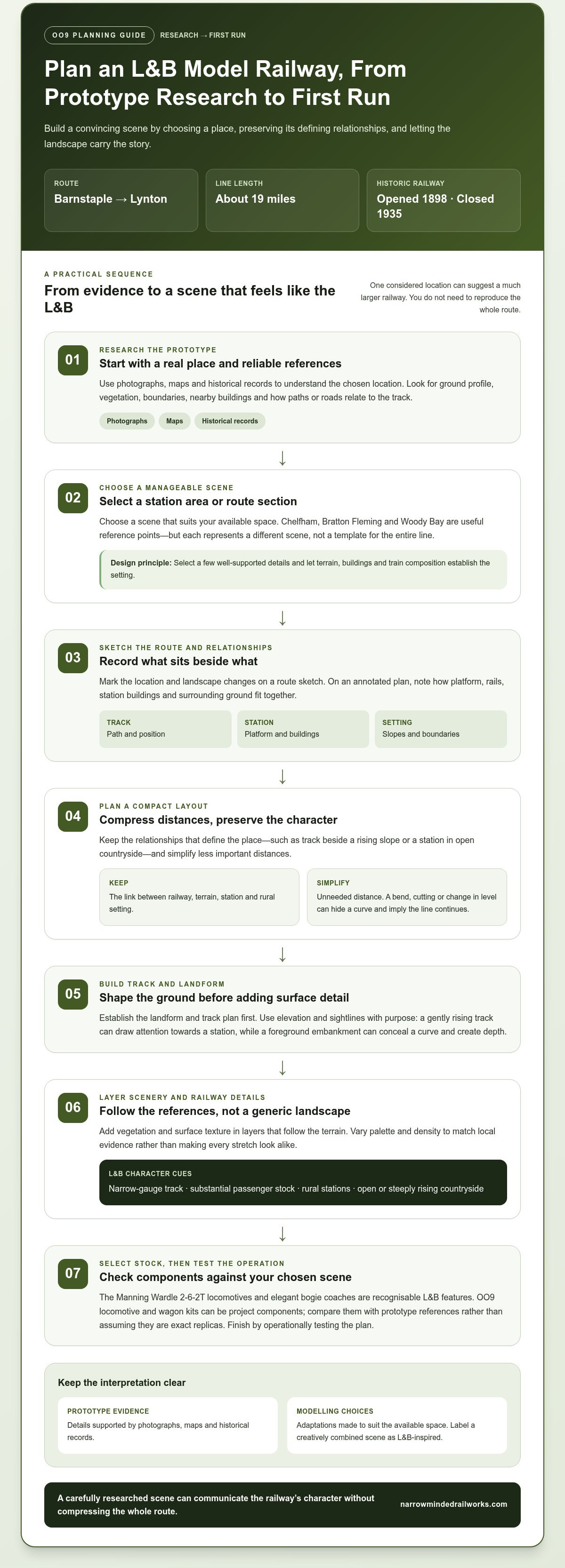
Planning an L&B Model Railway: Research to First Run
A clear plan turns prototype research into a layout that works as well as it looks. When modelling the Lynton and Barnstaple Railway, keep a record of what the evidence shows and what you’ve chosen to adapt. This makes it easier to balance historical character with the practical limits of your space, track and materials.
What should you research before drawing a track plan?
Gather maps, photographs, station plans and locomotive references from credible railway histories and archives. Check the date and context of each source, since buildings, track arrangements and rolling stock can differ between periods. Create a short evidence sheet with three columns: the detail, its source, and whether it’s confirmed or an assumption. This helps prevent a plausible modelling choice from being mistaken for a documented prototype feature.
A practical workflow from research to first run
- Research: Collect references for a particular location, period or type of operation, and note where details vary.
- Choose a scene: Select a station, goods-handling area or stretch of route that fits your available space and interests.
- Sketch the track: Mark track, turnouts, platforms and operating access. Check that curves and clearances suit the trains you plan to run.
- Plan the scenery: Add landform, buildings and boundaries around the track plan, leaving room to reach points and track for maintenance.
- Test operations: Run trains over a temporary arrangement before fixing scenery in place. Adjust awkward moves or inaccessible sections first.
Decide what the layout should let you do. A simple goal, such as arriving at a platform, departing or moving a goods wagon, gives even a compact scene an operational purpose. Scenic breaks, concealed track exits and carefully chosen viewing angles can imply a longer railway without crowding the layout.
Before committing, check these practical constraints:
- Space: Does the plan fit its intended location?
- Access: Can you reach track, turnouts and scenery for building and upkeep?
- Storage: Is there room to keep the layout and loose components safe?
- Viewing angles: Can you see the key features from where you’ll operate?
- Operating goals: What movements should the layout support?
Plan your kits alongside the track and scenery. Match locomotive and wagon choices to the scene and intended operation. The guide Your First OO9 Loco Kit: A Beginner’s Guide to Choosing and Buying can help structure that decision. Browse OO9 locomotive and wagon kits, then test your plan before adding detail.
Bring an L&B-inspired narrow-gauge project to life with suitable kits
Once you’ve chosen a scene and period, kits can help turn the plan into a practical build. OO9 locomotive and wagon kits provide components for the trains, while scenery items support the landscape and railway setting. Compare each kit with your prototype references and decide how it fits your interpretation, rather than assuming it is an exact L&B replica.
How can OO9 kits support an L&B-inspired scene?
Start with what the layout needs to show. A passenger-focused scene may call for a locomotive and suitable train, while a goods-handling area may benefit from wagons that support the intended activity. Match your choices to the documented period where possible, and note any deliberate departures from the prototype.
Read the kit instructions before planning the build. Some kits are designed around a compatible commercially available chassis, which is a separate component. Check the specified requirements and dimensions before selecting a chassis, so the completed model suits both the track plan and its intended use. For practical wagon-building advice, see Building OO9 Wagon Kits: Top Tips for Success.
What finishing choices help unify the finished model?
Use photographs and period references to guide colour, weathering and presentation. A consistent approach across the locomotive, wagons and scenery helps the whole scene feel coherent, even when individual components come from different sources. Focus on evidence for visible details, including the general finish of railway stock and the degree of weathering, rather than adding decorative features simply because they look appealing.
For printed components, preparation and paint application affect how clearly details read at model scale. Painting 3D Printed Models: A Beginner’s Guide to a Perfect Finish offers a useful next step for planning this part of the build. Keep the result tied to your references, while allowing room for your own modelling choices where the evidence is incomplete.
When modelling the Lynton and Barnstaple Railway, the strongest result comes from making the kit, finish and scene work together. No single component establishes the railway’s identity on its own. Explore the OO9 locomotive and wagon kit categories, then choose pieces that suit your project’s period, operation and level of prototype fidelity.
Start shaping your L&B-inspired layout
A convincing model doesn’t need to reproduce the full railway. Choose a scene you can research well, use Exmoor’s terrain and railway details to establish its character, then plan track and operations around your available space. Keep documented prototype features distinct from your own modelling choices. That gives you room to create while keeping the result credible.
OO9 locomotive and wagon kits provide useful building blocks, alongside scenery and diorama items that help bring the setting together. Treat each kit as a component to fit to your chosen scene, not automatically as an exact L&B replica. Narrow Minded Railworks specialises in narrow-gauge model railway kits and accessories, including OO9 locomotive and wagon kits, and ships worldwide.
Ready to choose components for your plan? Explore OO9 locomotive and wagon kits for your narrow-gauge project. With a clear scene, thoughtful research and a practical build plan, modelling the Lynton and Barnstaple Railway can become a rewarding project at a scale that suits you. Start with one detail, then build the railway around it.
Frequently Asked Questions
What was the Lynton and Barnstaple Railway?
The Lynton and Barnstaple Railway was a narrow-gauge railway in North Devon, running between Barnstaple and Lynton through countryside on the edge of Exmoor. The original line opened in 1898 and closed in 1935. It carried passengers and goods, and was known for narrow-gauge trains with a substantial railway presence. Today’s preservation activity is distinct from the original railway’s operation, so choose the era you want your model to represent.
What scale is best for modelling the Lynton and Barnstaple Railway?
OO9 is a practical option for modelling the Lynton and Barnstaple Railway, particularly if you want narrow-gauge trains in a compact layout. It uses models made to 4mm-to-the-foot scale on 9mm-gauge track. That convention supports a range of narrow-gauge modelling choices, but it isn’t an exact representation of the L&B’s track gauge. Consider your available space, preferred level of detail, and suitable track and kit options before deciding.
Can I model the Lynton and Barnstaple Railway in a small space?
Yes. A small layout can focus on one station area, goods scene or scenic stretch instead of attempting to represent the whole railway. Choose a clear subject and use a curve, embankment or concealed track exit to suggest that the line continues beyond the model. Test the track plan and train movements before building scenery, and leave enough access to reach track and points and maintain the layout.
How do I make an L&B model railway look authentic?
Base the scene on references for a particular place and period. Use photographs, maps and railway records to guide the relationships between track, platform, buildings and landscape, as well as the appearance of locomotives and rolling stock. Avoid treating every location as identical. A few accurate, well-chosen details usually establish the railway’s character more effectively than unsupported features or an attempt to reproduce the entire route in miniature.
Is OO9 track an exact match for the L&B’s real track gauge?
No. OO9 uses 9mm-gauge track with models built to 4mm-to-the-foot scale, while the L&B’s prototype gauge was about 1ft 11½in. The model track gauge is therefore a convenient convention, not an exact scale match. This needn’t prevent a convincing layout. Focus on suitable proportions, rolling stock, track arrangement and landscape, and note where practical modelling choices differ from the prototype.
What should I research before building an L&B layout?
Start with a specific location or type of scene and decide which historical period you intend to represent. Gather maps, photographs, station information and locomotive or rolling-stock references from credible sources, checking each item’s date and context. Record confirmed details separately from assumptions or creative adaptations. This evidence sheet will help you plan track, buildings and scenery consistently, and explain which parts are documented and which are your interpretation.
Can I use OO9 locomotive and wagon kits for an L&B-inspired layout?
Yes. OO9 locomotive and wagon kits are useful components for an L&B-inspired project. Compare their appearance and intended use with your chosen scene and period, since a kit isn’t necessarily an exact L&B replica. Read the instructions and check any chassis requirements before planning the build, as a compatible chassis may be a separate component. Scenery and diorama items can help complete the scene around your chosen models.