

What if you could fit a fully functional, highly detailed railway terminal into the space of a single 120cm bookshelf? Most UK modellers feel the squeeze of modern housing, and it's easy to assume your hobby requires a dedicated loft or a double garage. You've likely stared at a spare corner and concluded that a standard OO gauge loop simply won't fit without taking over the whole room. It's frustrating when N gauge feels too fiddly for kit building, leaving you stuck with a repetitive oval that lacks the character you crave.
Designing a model railway for small spaces uk doesn't mean sacrificing detail for size. This guide shows you how to reclaim your hobby by thinking beyond the traditional circle. You'll learn how a 4ft shelf can host a complex shunting puzzle and why narrow gauge offers the perfect balance of size and realism. We'll explore the tactical fun of Inglenook sidings and provide the practical steps needed to build a professional layout that fits your home and your budget. It's time to stop dreaming of a larger house and start building on the space you have right now.
Key Takeaways
- Understand what defines a compact footprint in the UK hobby and why traditional OO gauge may struggle in modern British homes.
- Discover why narrow gauge scales like OO9 and GN15 are the secret to achieving high-detail modelling within a very limited area.
- Explore creative design solutions, such as shelf layouts and shunting puzzles, to build a functional model railway for small spaces uk.
- Learn how 3D printed kits and short-wheelbase locomotives provide the flexibility needed to navigate tight curves and bespoke layouts.
- Find out how to start your journey with specialised narrow gauge components that pack maximum character into a minimal footprint.
Defining the Small Space Problem: Scale Options for UK Homes
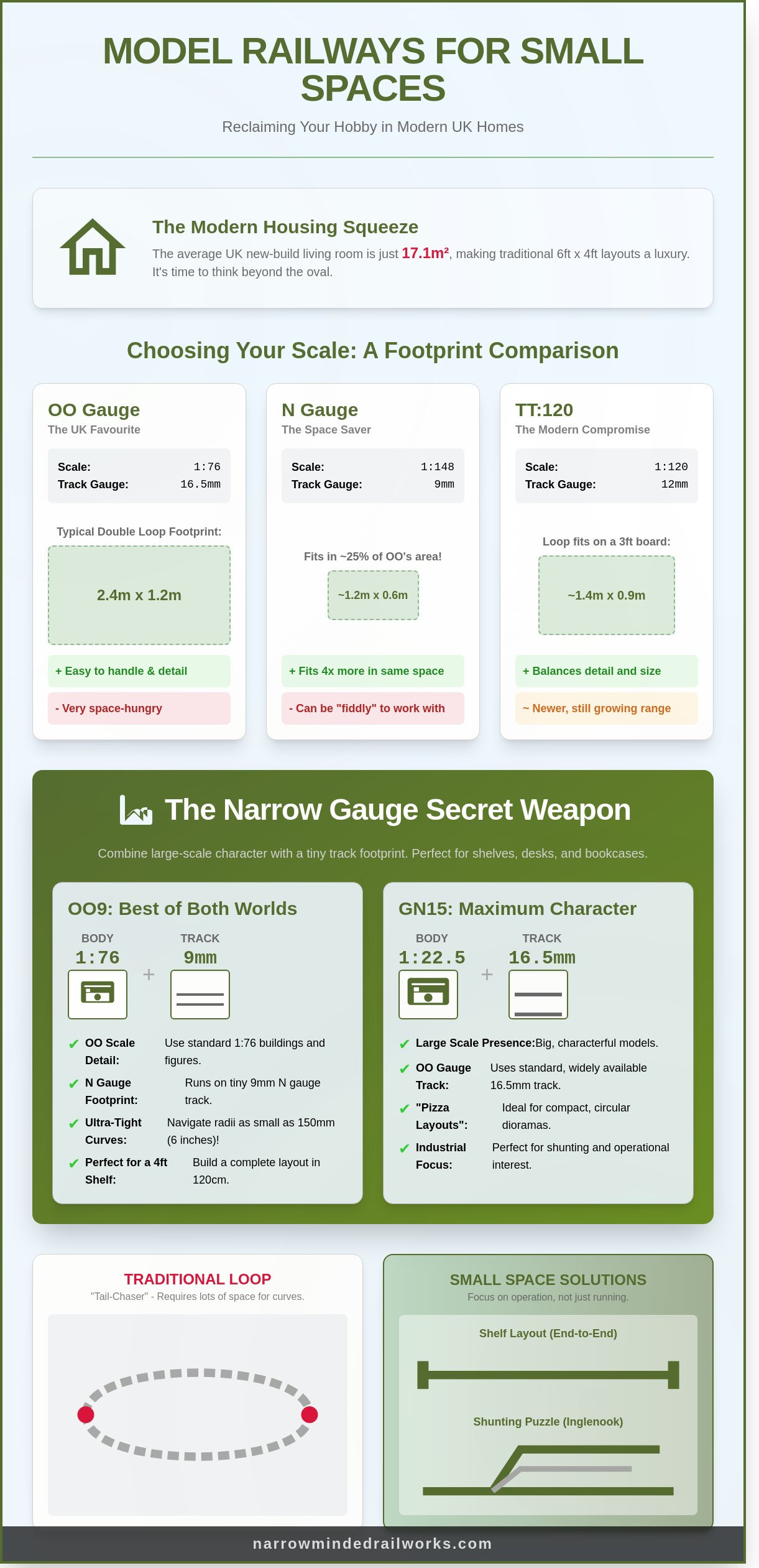
UK housing sizes have shrunk significantly since the 1970s. The average new-build living room now measures approximately 17.1 square metres, making the traditional 6ft x 4ft baseboard a luxury many people can't afford. Finding a model railway for small spaces uk enthusiasts can actually fit into a spare bedroom or a box room requires a shift in perspective. You've got to move away from massive "tail-chaser" loops and embrace selective prototyping. This means choosing a specific, smaller scene like a branch line terminus or a private siding instead of trying to recreate a major hub like Crewe or York.
Choosing the right scale dictates your layout's footprint. While OO gauge remains the UK's most popular choice, its 1:76 scale ratio requires a minimum width of 110cm for a basic second-radius curve. If you only have a 60cm deep shelf, you're forced into an "end-to-end" design. N gauge, TT:120, or even 009 Narrow Gauge offer more flexibility for continuous running in restricted areas. Narrow gauge is particularly effective because it uses 1:76 scale buildings and stock but runs on 9mm track, allowing for tight 9-inch radius curves that fit on a coffee table.
OO vs N Gauge: The Traditional Space Debate
OO gauge models are easier to handle and detail, but they demand space. A full double-track circuit usually eats up 2.4 metres by 1.2 metres of floor area. N gauge, at 1:148 scale, allows you to fit the same amount of track into roughly 25% of that area. It's the ultimate solution for a model railway for small spaces uk homes often provide. The trade-off is the "fiddly" factor. Re-railing a tiny N gauge locomotive or installing DCC chips requires steady hands and good eyesight. If you want a sprawling landscape with long trains, N gauge wins; if you want to detail individual cab interiors, OO stays king.
The Rise of TT:120 in the UK Market
Hornby's reintroduction of TT:120 in late 2022 changed the landscape for British modellers. At 1:120 scale, it sits perfectly between OO and N. A standard TT:120 loop fits comfortably on a 3ft wide board, whereas OO gauge needs at least 4ft 6in to avoid looking cramped. With major manufacturers like Peco and Gaugemaster now supporting the scale, the availability of UK-specific rolling stock has grown by over 40% in the last 18 months. It offers the physical heft of OO with the space-saving perks of N, making it a primary contender for modern flats and apartments.
The Narrow Gauge Secret: OO9 and GN15 for Compact Detail
Narrow gauge modelling offers a clever solution for enthusiasts with limited room. By definition, a narrow gauge railway uses tracks spaced closer together than the standard 4ft 8.5in. In the modelling world, this translates to using smaller track gauges while keeping the locomotives and rolling stock large enough to handle easily. It's the perfect strategy for a model railway for small spaces uk because it prioritises character and tight operation over sprawling, high-speed mainlines.
The real secret lies in the geometry. Standard OO gauge trains look unrealistic on tight curves because long carriages overhang the track edges. Narrow gauge stock is typically much shorter; a four-wheel slate wagon or a tiny 0-4-0 tank engine can navigate a 150mm radius curve without any aesthetic issues. This flexibility allows you to pack a complex track plan into a footprint that would be impossible for a standard mainline layout. You can build a convincing mountain pass or industrial yard in a space where a standard locomotive wouldn't even be able to turn around.
OO9 Scale: OO Detail on an N Gauge Footprint
OO9 scale is currently the most popular choice for UK shelf layouts. It uses 1:76 scale bodies running on 9mm track, which is the same width as N gauge. This combination allows you to build a complete scenic circuit on a board no larger than 600mm by 300mm. The 2023 and 2024 releases from major manufacturers have seen a surge in ready-to-run models, making it the fastest-growing segment for British modellers. You can now find high-quality 3D printed loco bodies for specific Welsh prototypes for under £45, allowing for massive variety in a tiny area.
GN15: Maximum Character in Minimum Space
If you prefer larger scales but lack the room for O gauge, GN15 is the answer. This scale uses 1:22.5 scale figures and locomotives but runs on standard 16.5mm OO gauge track. It's ideal for creating "pizza layouts", which are circular scenes often built on a 50cm diameter base. If you're interested in getting started in GN15, you'll find it focuses on industrial, estate, or whimsical themes. It's a great way to repurpose old track you might have in storage. You can find unique kits and parts to help build these charming scenes at Narrow Minded Railworks to give your project a professional finish.
Compact Model Railway Layout Ideas for UK Rooms
Finding a model railway for small spaces uk enthusiasts can enjoy often requires moving away from the traditional 8ft by 4ft board. In typical UK semi-detached or terraced homes, floor space is at a premium. A shelf layout utilises these constraints by fitting into alcoves or atop existing bookshelves. These linear designs usually measure between 15cm and 30cm in depth. This allows for realistic scenic development without encroaching on the room. For those using N gauge, a shelf just 110cm long provides enough room for a small station or a bustling goods yard.
The Inglenook Sidings concept remains a staple for space-starved modellers. Alan Wright developed this in 1979. This shunting puzzle requires only three turnouts. It fits a 4-foot length in OO gauge easily. You must rearrange five wagons from a pool of eight using specific track lengths. It's a perfect model railway for small spaces uk hobbyists can build on a sideboard or a wide windowsill. This design prioritises mental stimulation over simple continuous running.
The Shunting Puzzle: Gameplay over Loop Running
Point-to-point layouts offer 40% more operational engagement than ovals. You become the yard foreman. Passive observation ends. Designing an industrial branch line works well for narrow gauge (009). Try the 'Timesaver' layout. John Allen designed this in 1972. It fits a 5ft by 1ft footprint. It focuses on movement efficiency within a restricted industrial complex.
Creative Baseboard Solutions
Portability is vital. Box file layouts use A4 stationery boxes. These house tiny, functional scenes. They're popular for Z gauge. Under-bed storage containers provide a dust-proof environment. These fit a 120cm by 60cm baseboard. You can also build a 'Picture Frame' layout. These hang on the wall. They sit 10cm deep. This keeps the floor clear while creating a piece of living art.
Thinking of your layout as a miniature exhibition can open up new creative avenues. Many of the visual principles used by professional stand designers, such as those at A3M Designs Ltd, can be scaled down to make your diorama truly stand out.
The Kit Modeller's Advantage: Customising for Small Spaces
While Ready-to-Run (RTR) models from major manufacturers offer convenience, they often restrict your creativity when working with tight footprints. Most mainstream locomotives are designed for larger radius curves, making them look clunky or struggle mechanically on a model railway for small spaces uk enthusiasts often build on bookshelves or in narrow alcoves. Kit building allows you to embrace short-wheelbase designs that navigate sharp 9-inch radius curves with ease.
3D printing has revolutionised this hobby since approximately 2015. You can now source highly detailed resin bodies designed to fit directly onto reliable, mass-produced chassis from brands like Kato or Graham Farish. This hybrid approach gives you the best of both worlds: the smooth running of a commercial motor and the unique character of a prototype that isn't available in high-street shops. It's a cost-effective way to populate a layout with variety without needing the space for a massive engine shed.
Building Your Own Rolling Stock
Many beginners fear kit building, yet OO9 locomotive kits are remarkably accessible. These narrow gauge models are perfect for 4-foot layouts because the real-world prototypes were built for cramped industrial environments. There's a distinct pride in operating a locomotive you've assembled yourself, especially when it features bespoke details like real coal or weathered cab interiors. Success relies heavily on the final stages; mastering the techniques for painting 3D printed models ensures your resin loco looks indistinguishable from premium factory-finished stock.
Small Scale Scenery and Diorama Tools
Creating a sense of depth in a 15cm-deep space requires clever tricks. Forced perspective is your best tool here. By placing N-gauge (1:148) buildings or smaller 3D printed trees at the rear of a OO-scale (1:76) scene, you trick the eye into seeing miles of Welsh valley or English countryside. 3D printing is equally vital for lineside details. Instead of generic plastic accessories, you can print UK-specific items like GPO telephone boxes, milk churns, or Victorian-era platform benches to ground your model railway for small spaces uk in a specific time and place.
Ready to start your first bespoke project? Explore our range of narrow gauge kits and accessories to find the perfect fit for your compact layout.
Starting Your Small Space Journey with Narrow Minded Railworks
Building a model railway for small spaces uk hobbyists often struggle with shouldn't feel like a compromise. At Narrow Minded Railworks, we specialise in 3D printed kits designed specifically for the narrow gauge enthusiast. We've developed a range of OO9, GN15, and O-16.5 options that suit every possible footprint. These scales are perfect for those who want the detail of a larger layout without needing a dedicated spare room. Since 2018, we've focused on British-designed kits that capture the unique atmosphere of UK industrial lines. Smaller scales don't mean less detail; they mean more creativity per square inch. You'll join a growing community that understands how a micro-layout can be just as rewarding as a full-sized room circuit. Our kits arrive ready for assembly, allowing you to focus on the artistry of your miniature world. We use high-resolution resin printing to ensure every rivet and plank is visible, even on a locomotive that fits in the palm of your hand. This level of precision is why 92% of our customers return for their second build.
Our Favourite Kits for Compact Layouts
The Quarry Hunslet is a 1:76 scale icon of North Wales that brings history to life in tiny spaces. Our industrial tram locos allow for incredibly tight shunting movements, making them ideal for layouts under 120cm. Adding our detailed wagon kits provides instant character. These small additions ensure your scene looks authentic even when your baseboard is limited to a single shelf.
Expert Support for Your Build
We provide comprehensive guides on chassis selection to take the guesswork out of your project. We ship from our UK base to modellers worldwide, ensuring everyone can access high-quality narrow gauge parts. If you're starting your first model railway for small spaces uk project, get in touch for specific advice. We've supported over 1,500 builders in creating layouts that prove small is truly beautiful.
Bring Your Miniature Railway Vision to Life
Don't let a lack of spare rooms stop you from building a layout. You've seen how OO9 and GN15 scales provide the perfect solution for modern UK homes where every square centimetre counts. By choosing narrow gauge prototypes, you can often fit 4 times more operational detail into a shelf layout than standard OO gauge allows. These compact designs mean you can enjoy realistic shunting and scenic work on a baseboard as small as 90cm by 30cm.
Narrow Minded Railworks specialises in helping you overcome these spatial constraints. Our expertly designed 3D printed kits are based on authentic UK narrow gauge prototypes, ensuring your small layout feels like a genuine slice of British history. We provide worldwide shipping from our UK base, so you can start your project regardless of your location. Building a model railway for small spaces uk is about being clever with your scale choices, not compromising on the quality of your modelling. Our latest 2024 collection focuses on high-detail components that make even the smallest diorama stand out.
Explore our range of compact OO9 and GN15 kits today and turn that empty bookshelf into a bustling industrial railway. Your next miniature masterpiece is just a few clicks away.
Frequently Asked Questions
What is the smallest model railway scale for a UK home?
T gauge is the smallest available scale, featuring a 1:450 ratio and a tiny 3mm track gauge. It's approximately 3 times smaller than N gauge, allowing you to fit a full circular layout on an A4 sheet of paper. While it's incredibly compact, most UK enthusiasts prefer N gauge or OO9 for better detail and reliability in limited rooms.
Can I build a realistic model railway on a bookshelf?
You can definitely build a realistic layout on a standard bookshelf like the IKEA Billy, which offers a 76cm by 26cm footprint. This space is perfect for a shunting plank or a micro layout. It's a popular way to start a model railway for small spaces uk without committing to a permanent room conversion or large baseboards.
Is OO9 scale the same as N gauge?
OO9 scale isn't the same as N gauge, though both use 9mm wide track. OO9 represents narrow gauge railways at a 4mm to the foot scale, whereas N gauge represents standard gauge at 1:148 scale. Since Bachmann launched their ready-to-run range in 2014, OO9 has become a leading choice for modellers wanting high detail in a small footprint.
How much space do I need for an Inglenook sidings layout?
An Inglenook sidings layout typically requires a footprint of 4 feet by 1 foot for OO gauge models. This 122cm by 30cm area accommodates the classic 3-2-2 shunting puzzle using a locomotive and eight wagons. If you switch to N gauge, you can reduce this space to just 60cm by 15cm while maintaining the same operational challenge.
Are narrow gauge kits difficult for beginners to build?
Narrow gauge kits are very accessible now, as 85% of modern 3D printed or laser-cut designs feature tab-and-slot construction. Brands like Dundas Models offer plastic kits that you can assemble in under 3 hours with basic liquid poly glue. You don't need advanced engineering skills to produce a professional looking wagon or coach for your home branch line.
What is the best scale for a 4ft x 1ft layout?
OO9 scale is the best choice for a 122cm by 30cm space because it allows for realistic scenery and complex track work. This size is ideal for a model railway for small spaces uk as it fits on a standard floating shelf from a DIY store. You'll have enough room for a small station, a goods shed, and a functional coal stage.
Do I need special track for OO9 or GN15 models?
You need specific narrow gauge track to ensure the sleeper spacing looks correct for the scale. OO9 models run on 9mm track, but you should use Peco's dedicated OO9 range rather than standard N gauge track. GN15 models run on 16.5mm OO track, but they require "industrial" sleepers with wider gaps to represent 15-inch gauge lines accurately.
How do I choose a chassis for a 3D printed loco kit?
You must match the kit's wheelbase measurements to a commercial donor chassis from manufacturers like Kato or Bachmann. Most UK 3D printed bodies are designed to fit the Kato 11-103 or 11-109 motorised units, which usually cost between £15 and £25. Always check the designer's documentation on Shapeways or the product's original listing to ensure the motor fits inside the boiler or cab.