

What if you could enjoy the presence and detail of O gauge modelling without needing a spare warehouse to house your layout? Many enthusiasts feel restricted by the footprint of standard 7mm scale, yet they crave the character that smaller scales often lack. If you have ever wondered what is O-16.5 scale, you are likely looking for that perfect middle ground. It's a common frustration to feel caught between the desire for large-scale detail and the reality of limited shelf space. O-16.5 provides a proactive solution.
This guide clarifies the technical distinctions between O-16.5, On30, and standard 7mm scale to help you choose the right path for your workshop. You'll discover how to utilize accessible 16.5mm track and commercial chassis to build a unique narrow gauge world. Although finding unique rolling stock often presents a challenge, we will explore how 3D-printed body kits provide a proactive solution for your layout. We will examine specific scale-to-gauge ratios and provide the technical foundation you need to start your first project with confidence.
Key Takeaways
- Define what is O-16.5 scale by understanding the 1:43.5 ratio and its compatibility with standard 16.5mm track.
- Distinguish between British 7mm modelling and American On30 to avoid common scaling errors in your narrow gauge collection.
- Space limitations often hinder O gauge projects, but this scale offers a proactive solution by fitting detailed 7mm models onto a compact OO footprint.
- Learn how to source reliable commercial chassis that serve as the mechanical base for specialized 3D-printed locomotive and wagon kits.
- Explore the creative freedom of modelling unique industrial and forestry prototypes that are typically unavailable from mass manufacturers.
Understanding the Basics of O-16.5 Scale
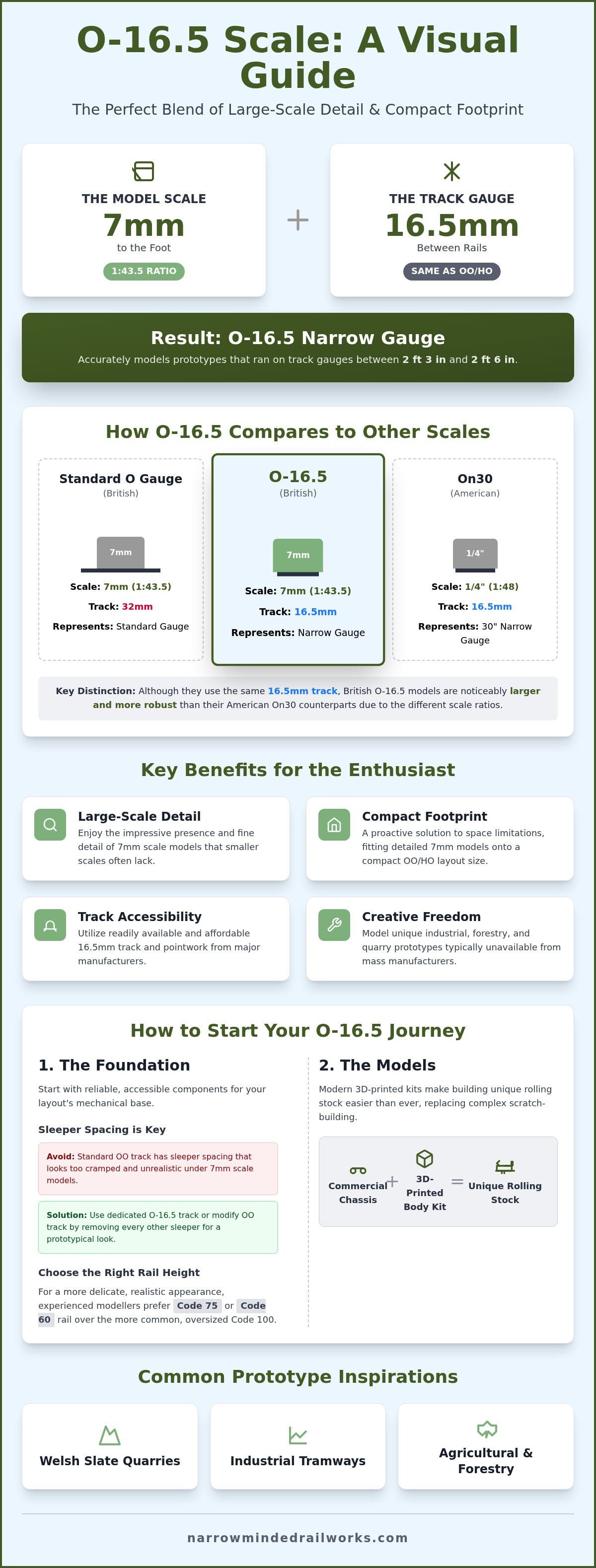
O-16.5 scale is a specific modelling standard used to recreate narrow gauge railways with precision and character. When newcomers ask what is O-16.5 scale, they are investigating a hybrid system that combines 7mm to the foot (1:43.5) scale models with 16.5mm gauge track. The "O" in the name signifies the scale, which is the standard for British O gauge. The "16.5" denotes the distance between the rails in millimetres. This setup allows you to model prototypes that ran on track gauges between 2 feet 3 inches and 2 feet 6 inches. It's a practical choice for those who want the impressive presence of larger models without the massive space requirements of standard gauge O.
The Relationship Between Scale and Gauge
Standard O gauge modelling typically utilizes 32mm track to represent standard gauge railways. While this provides excellent detail, it requires a significant amount of space that many home modellers simply don't have. O-16.5 offers a proactive solution by utilizing 16.5mm track, which is the same width used for OO and HO gauge layouts. By using this narrower track, you can represent narrow gauge lines from industrial, forestry, or quarry settings. The ratio is straightforward: you are placing 7mm scale models on OO/HO gauge track. This makes the scale highly accessible because you can use readily available track and pointwork from major manufacturers to build your narrow gauge world.
A Brief History of the Scale in the UK
The history of this scale in the UK is defined by a community of resourceful modellers. Early pioneers and groups like the Narrow Gauge Railway Society looked for ways to model the charm of light railways without custom-building every rail. They realized that OO gauge track was almost a perfect match for 2 foot 4 inch gauge lines in 7mm scale. This connection between O-16.5 and On30 highlights a global trend of using common 16.5mm track for narrow gauge projects. Initially, the hobby relied heavily on scratch-building locomotive bodies from brass or plasticard. Today, the landscape has changed significantly. The availability of high-quality 3D-printed kits and specialized rolling stock has replaced the need for complex metalwork, making it easier for beginners to enter the 7mm narrow gauge scene with confidence.
The Technical Breakdown: 7mm Scale on 16.5mm Track
When investigating what is O-16.5 scale, the technical precision of the 1:43.5 ratio is the defining factor. While the American On30 equivalent uses a 1/4 inch to the foot (1:48) scale, British O-16.5 adheres to the 7mm to the foot standard. This slight difference in scale means that British models appear larger and more robust than their American counterparts, even though they run on the same track width. The 16.5mm gauge is a universal choice in the hobby because it represents a prototype track gauge of approximately 2 feet 4 inches. This makes it the ideal technical solution for modelling famous lines like the Talyllyn Railway (2ft 3in) or the Welshpool & Llanfair Light Railway (2ft 6in) without requiring custom-built trackwork.
Rail height is another critical technical consideration for your layout. Most standard OO gauge track uses "Code 100" rail, which is durable but can look oversized for narrow gauge prototypes. Many experienced modellers prefer "Code 75" or even "Code 60" rail heights to achieve a more delicate, realistic appearance. The 7mm Narrow Gauge Association provides extensive technical documentation on these standards to ensure your rolling stock and trackwork remain compatible. Choosing the right rail profile from the start prevents clearance issues with older wheelsets and improves the overall visual weight of your scene.
Track Compatibility: Can You Use OO Gauge Track?
Standard OO gauge track is often the first choice for beginners because it's readily available. However, the sleeper spacing on standard track is designed for 4mm scale, which looks noticeably cramped beneath a 7mm locomotive. Using dedicated O-16.5 track with wider sleeper spacing provides a proactive solution for those seeking prototype accuracy. If you already own OO track, you can modify it by removing every other sleeper to improve the visual balance. For a broader understanding of how these measurements compare, see our guide on Model Train Track Gauges Explained Simply.
Common Prototype Inspirations
The versatility of O-16.5 allows you to model a wide variety of industrial and rural settings. Slate quarries in North Wales and industrial tramways often serve as the primary inspiration for many layouts. However, the scale is equally suited for agricultural and forestry railways, such as the specialized Hungarian Forestry lines. Finding unique rolling stock for these niche prototypes can be difficult, but our O-16.5 scale kits offer a proactive solution for modellers who want to move beyond mass-market offerings. Whether you are building a small estate railway or a heavy industrial line, the 7mm scale provides enough physical room to include working cab details and weathered textures that smaller scales can't match.
O-16.5 vs On30: Is There a Difference?
Many modellers initially assume that O-16.5 and On30 are interchangeable terms for the same hobby. While they share a common track width, understanding what is O-16.5 scale requires looking closely at the scale of the models themselves. O-16.5 is the British and European standard, built to a scale of 7mm to the foot (1:43.5). On30 is the American equivalent, utilizing a scale of 1/4 inch to the foot (1:48). This means a British O-16.5 locomotive is roughly 10% larger than its American On30 counterpart. Although this might seem minor, it becomes apparent when you place a British driver figure next to an American one.
Despite the scale discrepancy, the two systems are deeply linked by their shared use of 16.5mm track. In fact, many UK modellers use American On30 chassis as the mechanical foundation for their 7mm scale locomotive bodies. This is a proactive solution for those who want reliable running gear without the complexity of scratch-building a power unit. Because the track gauge is identical, you can run American stock on British layouts, but the visual "weight" of the models will differ because of the 1:43.5 versus 1:48 scale ratios.
Why the Confusion Exists
The primary source of confusion is the "16.5" and the "30" in the names. Both refer to the gauge of the track. In O-16.5, the number is the literal millimetre measurement. In On30, the "30" refers to the 30-inch prototype gauge the track represents in 1/4 inch scale. Because both result in 16.5mm between the rails, the track and wheels are compatible. However, the physical size of the buildings, figures, and rolling stock will differ. For a deeper look at the American side of this hobby, you can read An Introduction to On30 Gauge.
Choosing Your Standards
Deciding which standard to follow depends on your prototype interests. If you want to model a specific British quarry or a Hungarian forestry line, staying within the 7mm scale ensures your scenery and figures look correct. The 7mm Narrow Gauge Association offers excellent resources for those committed to the 1:43.5 ratio. While finding 7mm scale bodies for specific prototypes can be a challenge, utilizing 3D-printed kits provides a proactive solution for the discerning modeller.
Narrow Minded Railworks kits bridge this gap by providing 3D-printed bodies specifically scaled to 7mm that are designed to fit onto accessible OO and On30 chassis. This approach allows you to benefit from the mass-produced reliability of American or standard OO mechanics while maintaining the correct British scale for your rolling stock. Consistency is key; mixing scales in a single scene can break the illusion of reality. Choosing a primary scale for your figures and structures early in the process is a vital first step to ensuring a cohesive layout.
Why Model in O-16.5? Benefits for the Enthusiast
Understanding what is O-16.5 scale reveals why it's often called the "sweet spot" of the hobby. Standard O gauge presents a significant challenge for those with limited space, but O-16.5 provides a proactive solution. You gain the substantial presence of 7mm scale while using the footprint of a standard OO gauge layout. This allows for incredible cab detail, intricate weathering, and realistic figures that are much harder to achieve in smaller scales. The larger size makes it easier to install working lights or sound decoders, providing a more immersive experience for the operator.
The 16.5mm track gauge is inherently more robust than narrower alternatives. Smaller gauges can sometimes suffer from electrical pickup issues or sensitive trackwork, but the larger contact area of 16.5mm rail offers a more reliable operating experience. This stability is essential for slow-speed industrial shunting. Narrow gauge modelling also encourages a freelance approach. Because many prototype narrow gauge lines were improvised or built with second-hand equipment, you have the creative freedom to design quirky locomotives and rolling stock that reflect a unique history. It's a scale that rewards imagination over strict adherence to standard gauge rules.
The "Smiles per Mile" Factor
Narrow gauge railways are defined by their character. Small locomotives with oversized cabs and distinct personalities create what many modellers call the "smiles per mile" factor. This scale is particularly suited for micro-layouts or dioramas where space is at a premium. You don't need a massive room to build something impressive. If you're interested in specific locomotive types that fit this charming aesthetic, you can explore A Modeller’s Guide to Tram Locos. These compact designs allow you to build a complete, detailed world on a single bookshelf.
Accessibility of Parts
Finding the right parts for a niche scale can be difficult, but O-16.5 utilizes the abundance of the OO gauge market. Many modellers use affordable, second-hand OO gauge chassis as the power units for their 7mm builds. While big manufacturers often ignore niche prototypes, 3D printing has revolutionized the hobby by making specialized bodies accessible to everyone. Our O-16.5 / 7mm scale kits are specifically designed to fit these common chassis, offering a proactive solution for building a unique fleet without the need for advanced engineering skills. You can easily find 7mm scale figures and scenic accessories to populate your world, ensuring that your layout feels lived-in and authentic.
How to Start Your O-16.5 Journey with Narrow Minded Railworks
Starting a new project in a specialized scale can feel daunting, but following a structured approach provides a proactive solution for beginners. Once you understand what is O-16.5 scale and how it utilizes 16.5mm track, your first task is to define the "vibe" of your layout. Narrow gauge railways usually fall into three main categories: heavy industrial, rugged quarry, or rural forestry. Selecting a theme early helps you maintain a consistent look across your rolling stock and scenery. Sourcing a reliable chassis is often the biggest technical hurdle for newcomers. Utilizing a mass-produced unit like the Hornby "Smokey Joe" or a Bachmann On30 power frame provides a proactive solution that ensures smooth running without the need for complex engineering.
After securing your chassis, you can select a specialized 3D-printed body kit to complete the model. This process allows you to benefit from the reliability of commercial mechanics while achieving the unique look of a 7mm narrow gauge prototype. The final phase involves preparing and painting your model to a professional standard. While 3D prints require specific handling, following a clear preparation routine ensures a high-quality finish that rivals ready-to-run models.
Our O-16.5 / 7mm Scale Kit Range
Finding unique rolling stock for niche prototypes is often a challenge for modellers, but our range of 3D-printed kits provides a proactive solution. We specialize in subjects that major manufacturers typically overlook, such as the Hungarian Forestry Diesel Shunter and the Billard T75d. These kits are designed with precision to fit onto common commercial chassis, making the transition into 7mm scale much more accessible. Adding life to a larger 7mm cab can be difficult with generic figures, but our 3D scanned figures offer a proactive solution for achieving realistic poses and textures. We also provide specialized wagon loads and scenery items to ensure your industrial scenes feel authentic and detailed.
Finishing Your First Kit
Achieving a smooth finish on 3D-printed resin can be tricky if you aren't familiar with the material. The proactive solution is to thoroughly clean the print in isopropyl alcohol and ensure it is fully cured before you begin any assembly. Choosing a high-quality automotive primer is essential for hiding any minor layer lines and providing a stable base for your topcoat. For a detailed walkthrough on these techniques, you can consult our guide on Painting 3D Printed Models. Once your model is complete, we encourage you to share your build with the wider narrow gauge community. Sharing your progress is an excellent way to gain feedback and find inspiration for your next O-16.5 project.
Start Your 7mm Narrow Gauge Project
Transitioning to a larger scale often feels restricted by space constraints. O-16.5 provides a proactive solution by combining 7mm detail with the compact footprint of OO gauge track. You've learned the technical distinctions between British and American standards, along with the practical steps to begin your first build. Understanding what is O-16.5 scale serves as the foundation for creating a layout with genuine industrial character and impressive presence.
While sourcing unique rolling stock for niche prototypes presents a challenge, our 3D-printed kits offer a proactive solution. These bodies are specifically designed to fit popular commercial chassis, ensuring reliable performance from the start. We also provide 3D scanned figures for realistic detailing and offer worldwide shipping to support enthusiasts across the globe. There's never been a better time to bring the charm of narrow gauge modelling into your workshop.
Browse our O-16.5 / 7mm Scale Kits and start your layout today
Frequently Asked Questions
Does O-16.5 use the same track as OO gauge?
O-16.5 models run on 16.5mm gauge track, which is the same width as standard OO and HO gauge rails. While the track width is identical, standard OO track presents a visual constraint because the sleeper spacing is designed for 4mm scale models. A proactive solution is to use dedicated O-16.5 track with wider sleeper spacing to represent narrow gauge prototypes accurately.
What is the difference between O-16.5 and On30?
The primary difference lies in the scale ratio rather than the track width. O-16.5 follows the British 7mm to the foot (1:43.5) standard, while On30 follows the American 1/4 inch to the foot (1:48) standard. Although both use 16.5mm track, British 7mm models are physically larger than their American counterparts. This can lead to scaling issues if you mix figures or buildings from both standards on one layout.
Is O-16.5 scale 1:43 or 1:48?
O-16.5 is 1:43.5 scale, which is the standard for British O gauge modelling. When people ask what is O-16.5 scale, they are often looking for this specific 7mm to the foot ratio. In contrast, 1:48 is the American O scale standard used for On30. Choosing the 1:43.5 ratio ensures your models remain consistent with British prototype dimensions and scenic accessories.
Can I run O-16.5 trains on HO track?
You can technically run O-16.5 locomotives on HO track because the 16.5mm gauge is the same. However, HO track is built to a smaller scale, meaning the sleepers and rail profiles may look undersized beneath a heavy 7mm locomotive. A proactive solution is to check the clearances on HO pointwork, as larger 7mm cylinders or cab steps might catch on standard HO scenic items or point motors.
Where can I find chassis for O-16.5 body kits?
Most modellers source donor chassis from readily available OO or HO gauge locomotives. Narrow Minded Railworks provides the body kits and wagons, but we don't sell the mechanical chassis or motors. A proactive solution is to utilize accessible chassis like the Hornby "Smokey Joe" or Bachmann On30 units, as our kits are specifically designed to fit these reliable power frames.
Is O-16.5 suitable for small layouts?
O-16.5 is an ideal choice for small layouts and dioramas because narrow gauge prototypes often featured very tight curves. One of the main benefits of what is O-16.5 scale is that it allows you to enjoy the detail of 7mm modelling within the footprint of a compact OO layout. You can build a complete industrial scene or quarry tramway on a single shelf without sacrificing the presence of larger models.
What is 7mm narrow gauge?
7mm narrow gauge is the practice of modelling railways with a prototype gauge of less than 4 feet 8.5 inches at a scale of 7mm to the foot. O-16.5 is the most common variant, representing track gauges around 2 feet 4 inches. This scale is popular because it allows for high levels of detail in the locomotive cabs and rolling stock while maintaining a manageable layout size.
How do I paint a 3D printed O-16.5 kit?
Painting a 3D-printed resin kit requires careful preparation to ensure a professional finish. You must first clean the model in isopropyl alcohol to remove any residual resin that might hinder paint adhesion. A proactive solution is to use a high-quality automotive primer before applying your topcoat. This provides a stable base and helps to reveal any minor surface details that require further sanding or detailing.