

What if the most effective antidote to 2026 digital fatigue wasn't another meditation app, but a return to the physical workbench? As of June 2026, many enthusiasts find that choosing a narrow gauge model railway scale provides a unique solution to the lack of tangible creative outlets in a screen-heavy world. It offers a structured way to disconnect while building something lasting with your own hands. This hobby is about more than just trains. It's a blend of artistry and precision that fits perfectly into modern British homes where space is often at a premium.
You likely feel that modern pastimes are either too complex or too digital, leaving you without a real sense of accomplishment. We understand that the perceived complexity of traditional hobbies can be overwhelming, so we focus on providing accessible entry points for new makers. This article explores how the multi-disciplinary world of model railways enhances your mental wellbeing, develops practical engineering skills, and offers a unique creative outlet. We'll examine the shift from digital screens to detailed dioramas and the supportive community waiting to welcome you into this rewarding craft.
Key Takeaways
- Modern screens often cause digital fatigue, but tactile modelling induces a 'flow state' that reduces stress and improves mental wellbeing.
- While some hobbies lack tangible results, building locomotive kits develops a multidisciplinary 'maker' mindset through engineering and historical research.
- Social isolation is a growing concern, but the model railway community fosters meaningful connections across generations through shared projects and exhibitions.
- You can overcome typical space constraints by choosing a narrow gauge model railway scale such as OO9 or GN15 for detailed, compact layouts.
- Finding time for a new pastime is difficult, so identifying your specific creative goals helps you select the most rewarding scale for your lifestyle.
What are the Mental Health and Wellbeing Benefits of Model Railways?
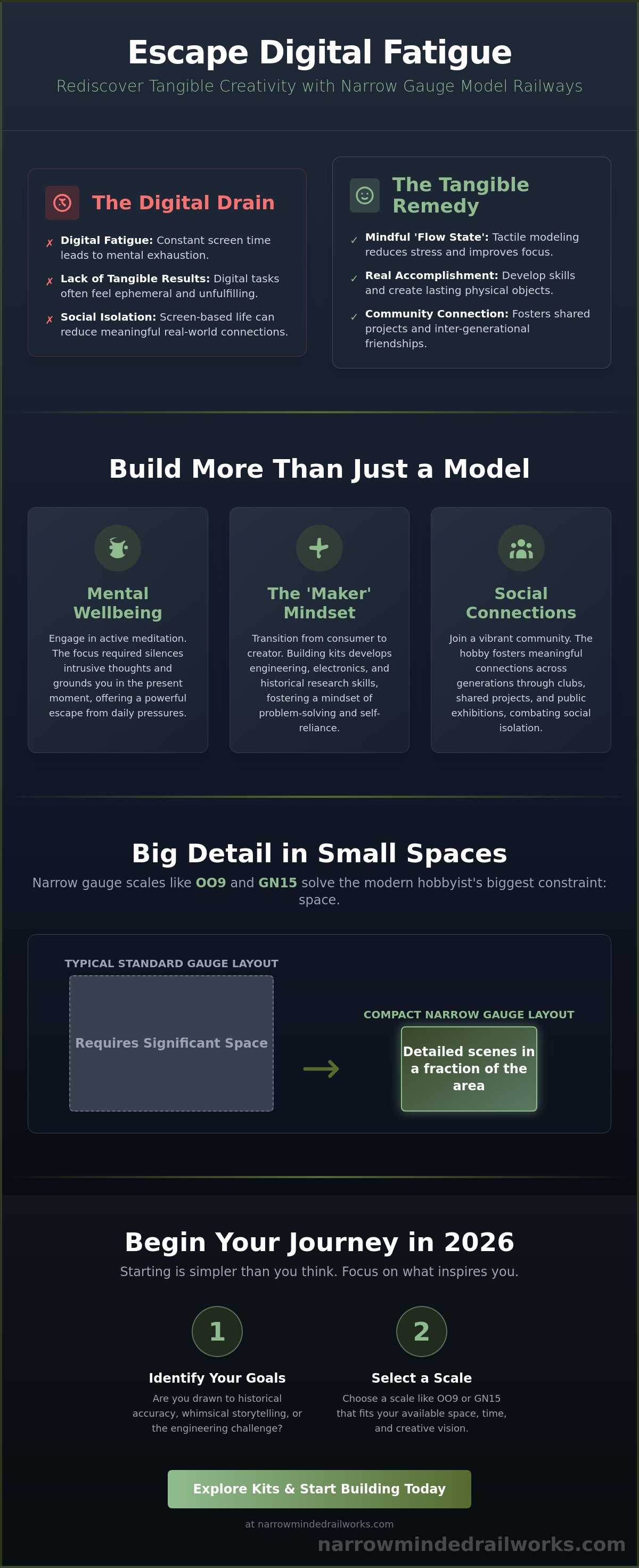
Standard model railways might seem too large for modern homes, yet narrow gauge scales allow for high detail in very small spaces. For many, the appeal lies in the psychology of the 'flow state'. This happens when a task is challenging enough to require full attention but achievable enough to avoid frustration. You can find a comprehensive overview of the model railway hobby that highlights how these operational aspects contribute to long-term engagement and cognitive health. By working with physical textures like resin and brass, you ground yourself in the present moment. This tactile engagement is a powerful tool for combatting digital fatigue, as it forces the brain to process three-dimensional space rather than flat pixels.
To better understand the different physical dimensions involved in this hobby, watch this helpful comparison video:
Mindfulness Through Miniature Detail
Focused tasks like painting 3D printed components or assembling delicate wagon kits act as a form of active meditation. Your brain stops worrying about work deadlines and starts focusing on the consistency of the paint or the precise alignment of a wagon chassis. There's a deep sensory satisfaction in feeling the weight of a white metal casting or the smooth finish of a laser-cut wood piece. This level of detail requires a quiet mind and a steady hand, which helps to silence intrusive thoughts. Modelling mindfulness is the intersection of intense focus and creative play.
The Escapism of Historical Storytelling
Escaping a chaotic world becomes much easier when you're researching a specific era or building a fictional narrow gauge line. You have total control over this miniature environment, which provides a therapeutic sense of agency. Whether you're recreating a 1920s slate quarry in North Wales or a whimsical estate railway, the process offers a sense of historical continuity. Completing a scene that tells a silent, miniature story provides an emotional reward that digital achievements simply can't match. Nostalgia in modelling isn't just about looking backward; it's about finding comfort and stability through creative expression in a fast-paced world.
Developing Cognitive Skills and the 'Maker' Mindset
Model railway enthusiasts often find that the hobby transforms from a simple pastime into a rigorous exercise in multidisciplinary learning. When you're choosing a narrow gauge model railway scale, you're essentially selecting a curriculum for self-improvement. You'll find yourself researching 19th-century civil engineering one day and soldering basic electronic circuits the next. This variety keeps the mind sharp; it builds a 'maker' mindset where you no longer see objects as fixed, but as things you can modify, repair, or create from scratch. Research into the Mental health benefits of hobbies shows that this type of active engagement is far more beneficial for cognitive health than passive consumption.
There's a distinct psychological shift when you move from buying ready-to-run models to building your own. While purchasing a finished train offers instant gratification, it lacks the long-term dopamine reward associated with the 'I Made This' effect. Assembling a kit requires patience and problem-solving, especially when fitting a detailed body onto a small power chassis. These constraints might seem frustrating initially, but they force you to think creatively about spatial limitations. Maintaining fine motor skills through precise assembly is a benefit that scales across all age groups, keeping hands steady and minds focused on the task at hand.
From Engineering to Artistry
Kit assembly provides a practical education in how locomotives actually function. You'll learn about the mechanical linkages of a steam engine or the cooling systems of a diesel shunter by physically placing the parts. This technical knowledge eventually blends with artistry. You'll develop skills in weathering to make resin look like rusted steel, or using forced perspective to make a small shelf layout look like a vast valley. This process encourages a growth mindset. If a paint finish doesn't work, you strip it and try again, refining your technique with every project.
The Satisfaction of Kit Building
Many beginners feel overwhelmed by the perceived difficulty of traditional brass kits. We acknowledge that complex soldering can be a barrier for those just starting out, but modern 3D printed kits offer a proactive solution that maintains the challenge without the frustration. There's a unique sense of pride in seeing an OO9 locomotive you assembled yourself navigate a curve for the first time. If you're ready to start your build, reading Your First OO9 Loco Kit: A Beginner’s Guide will help you select the right project for your current skill level. You don't need a massive workshop to begin; a simple desk and a few tools from our range of diorama tools and scenery are often enough to complete your first professional-looking model.
Social Benefits: Connecting Generations and Communities
Model railroading often starts as a personal interest, yet it quickly evolves into a social catalyst. You might worry that choosing a narrow gauge model railway scale is a lonely path, but the reality is quite the opposite. This niche attracts a dedicated community where sharing knowledge is the standard, not the exception. Whether it's through local clubs or national exhibitions, modelling provides a structured way to combat social isolation across all age groups. It's a hobby where the global market is valued at over £1.07 billion in 2026, reflecting a massive and active network of enthusiasts.
The mentor-apprentice dynamic is deeply ingrained in the hobby. Experienced modellers often take newcomers under their wing, passing down techniques that aren't always found in manuals. This interaction fosters cognitive skills and the 'maker' mindset by encouraging collaborative problem-solving. It's a hands-on way to learn about industrial history and mechanical principles while building lasting friendships. It's not just about the trains; it's about the shared pride of bringing a miniature world to life through collective effort.
Multi-Generational Project Planning
Shared layouts act as a family legacy that bridges the generation gap. You might face the constraint of differing interests between children and adults, but a railway project offers a proactive solution by providing diverse roles for everyone involved. A grandchild might enjoy the creative freedom of scenery composition, while a grandparent focuses on the historical accuracy of a specific narrow gauge line. This collaborative storytelling allows families to decide on a theme and era together, creating an evolving project that grows over several years and teaches younger generations about the UK's rich industrial heritage.
The Global Modelling Community
Solving the Modern Hobbyist's Constraints: Space and Technology
Many potential modellers in the UK abandon the idea of a layout because they lack a spare room or a dry loft. We acknowledge that modern housing often lacks the surplus space required for traditional standard gauge railways. However, narrow gauge modelling offers a proactive solution by prioritising character over track mileage. When you're choosing a narrow gauge model railway scale, you're opting for a hobby that thrives on a bookshelf or a single coffee table. This approach allows you to build a complete, detailed world without the need for a dedicated workshop or basement.
Micro-layouts have become a staple of the 2026 modelling scene, fitting into the gaps of a busy life. A typical OO9 layout can be as small as 2 feet by 1 foot, providing a fully operational scene in a space smaller than a standard computer monitor. This compact nature doesn't sacrifice detail; instead, it encourages you to focus on high-quality scenery and unique locomotive kits. By reducing the physical footprint, you also reduce the time and financial investment required to reach a finished, satisfying result.
Why Narrow Gauge is the Modern Choice
Narrow gauge railways are defined by their characterful, often whimsical nature. While standard gauge layouts often feel industrial or repetitive, narrow gauge scenes focus on rural charm and obscure prototypes. If you're wondering What is a Narrow Gauge Railway?, it's essentially a line built to a smaller width than the standard 4ft 8.5in, often used in quarries or estate grounds. In the modelling world, this means you can use larger scales like 7mm (O scale) on narrow tracks, giving you bulky, detailed models that still navigate tight curves. This makes it the perfect choice for a UK living room where every square inch of floor space matters.
3D Printing: The Future of the Hobby
High-resolution resin 3D printing has revolutionised the accessibility of this hobby. Previously, detailed narrow gauge locomotives required expensive brass etchings and advanced soldering skills. We recognise that these high costs and steep learning curves can be off-putting, so we utilise 3D printing to provide highly detailed locomotive bodies at a fraction of the traditional price. This technology allows for the creation of obscure prototypes from around the world that larger manufacturers often ignore. It makes the hobby more sustainable and accessible for a new generation of makers who value customisation and precision. If you're ready to see how these modern techniques can fit into your home, explore our range of OO9 and GN15 locomotive kits to find your perfect starting point.
How to Start Your Model Railway Journey in 2026
You must identify your primary motivation before investing in your first piece of rolling stock. Some enthusiasts are drawn to the historical research of the Welsh slate industry, while others prefer the artistic challenge of weathering a fictional estate railway. We acknowledge that the sheer variety of options in 2026 can be paralysing for a newcomer. To solve this, we suggest focusing on your primary interest first, whether that's engineering, art, or history. This focus ensures that your first project remains an enjoyable escape rather than an overwhelming chore.
When you're choosing a narrow gauge model railway scale, consider how much physical space you can realistically commit. OO9 is ideal for those wanting a traditional look in a compact area, while GN15 offers a larger, more whimsical scale that often uses 1:24 figures. Both scales are perfect starting points because they allow for high levels of detail on manageable baseboards. By selecting a scale that fits your current lifestyle, you ensure that the hobby remains a relaxing pastime rather than a source of frustration.
Starting small is the most effective way to build long-term confidence in the hobby. We recognise that the desire to build a complete, sprawling layout is strong, but a proactive approach involves completing a single wagon or building kit first. This 'Phase 1' goal allows you to master basic assembly and painting without the pressure of a massive project. It provides a quick win and a tangible result that you can hold in your hands, which is the perfect antidote to digital fatigue.
Choosing Your First Project
A simple wagon kit is the logical starting point for any beginner. It provides a low-risk environment to practice your assembly skills and experiment with different paint finishes. If you're leaning towards a larger, more unique scale, our guide on Getting Started in GN15 Scale provides a clear roadmap for your first build. Setting a realistic goal, such as finishing one piece of rolling stock per month, ensures early success and keeps your momentum high.
Essential Tools for the Modern Modeller
While specialised tools represent an initial investment, a proactive approach starts with the basics. You don't need a professional workshop to achieve a high-quality finish on 3D printed models. A sharp craft knife, a set of fine files, and some basic acrylic paints are often enough to begin. For those worried about the final look of their kits, our tutorial on Painting 3D Printed Models offers a step-by-step solution to achieving a perfect result. Ready to begin? Explore our range of 3D printed narrow gauge kits to start your journey.
Take the First Step Toward Your Miniature World
Model railroading is a multi-disciplinary pursuit that addresses the burnout of the digital age. By focusing on tactile assembly and historical storytelling, you can improve your mental wellbeing while developing tangible engineering skills. We acknowledge that the initial step of choosing a narrow gauge model railway scale can feel complex given the variety of gauges available. However, focusing on compact options like OO9 or GN15 ensures your hobby remains a practical addition to your home rather than a spatial burden.
As specialists in OO9, GN15, and O-16.5 scales, we provide high-detail 3D-printed locomotive and wagon bodies that simplify the build process without sacrificing quality. Our kits offer a proactive way to transition from a passive observer to a skilled maker. With worldwide shipping available, we support global enthusiasts in creating unique, characterful layouts that last for generations. Start your modelling journey with our beginner-friendly narrow gauge kits and discover the satisfaction of building something truly your own. It's time to clear the workbench and begin your first project.
Frequently Asked Questions
Is model railroading an expensive hobby to get into in 2026?
We acknowledge that purchasing everything for a large layout at once is a significant investment. A proactive solution is to start with high-detail wagon kits, which allow you to build your collection gradually over several months. Model railroading can be tailored to fit your budget, and focusing on narrow gauge scales often reduces the total spend. These smaller layouts require fewer materials to complete a convincing scene, making it more affordable to achieve a professional result.
I do not have a spare room; can I still build a model railway?
We acknowledge that traditional layouts often demand a loft or garage, but narrow gauge modelling provides a space-saving alternative. A micro-layout can sit on a 1.2-metre bookshelf or a side table in your living room. This proactive solution makes choosing a narrow gauge model railway scale like OO9 or GN15 ideal for those living in flats or smaller UK homes where floor space is limited. You can build a complete world without needing a dedicated room.
What is the best age to start a model railway hobby?
We recognize that fine motor skills and patience are necessary for kit assembly. A proactive approach for younger builders is to start with scenery and diorama projects under adult supervision. There is no single best age, though most enthusiasts find the hobby most rewarding from age ten upwards. For adults, the hobby serves as a vital creative outlet that helps maintain manual dexterity and cognitive sharpness throughout later life by providing complex, engaging tasks.
What is the difference between a train set and a model railway?
We acknowledge that train sets are convenient for quick play, but they lack the depth of a custom-built scene. A proactive solution for those seeking more than a toy is to build a diorama using individual locomotive and scenery kits. A model railway is a cohesive, artistic representation of a specific environment rather than just an oval of track. This allows you to focus on storytelling and historical accuracy, providing a much higher level of creative satisfaction.
Do I need to be good at electronics to build a model railway?
We understand that circuit diagrams can be intimidating, so we suggest starting with the physical assembly of wagon and locomotive kits. You don't need advanced electronic knowledge to begin. A basic analogue setup requires only two wires to the track, which is a simple and effective starting point. This proactive focus on the physical build allows you to enjoy the hobby's creative aspects without needing a degree in electronics or complex wiring skills.
What are the most popular scales for beginners in 2026?
We recognise that standard scales like OO and N can feel repetitive, so many enthusiasts are now choosing a narrow gauge model railway scale to stand out. OO9 and GN15 are the most popular choices for modern makers in 2026. These scales utilise 3D printing technology to offer unique prototypes that weren't accessible a decade ago. They provide a proactive way to balance high detail with space efficiency for the contemporary hobbyist living in a modern home.
How much time does it take to build a basic model railway kit?
We acknowledge that your first project might take longer as you familiarise yourself with the tools and resins. A proactive way to manage your time is to break the build into stages, such as assembly on one evening and painting on the next. A basic wagon kit typically takes between two and five hours to complete. This structured approach ensures a professional finish without feeling like a rushed task, making it easy to fit into a busy schedule.
Is it better to buy ready-to-run trains or build kits?
We acknowledge that building from scratch takes more effort than opening a box, but kits offer a deeper sense of achievement. A kit provides a proactive opportunity to customise your locomotive to a specific prototype or fictional line. Ready-to-run models offer instant gratification, yet they lack the 'I Made This' effect that defines the maker movement in 2026. This results in a more personal collection that reflects your individual skills and artistic vision rather than a mass-produced product.