

Narrow gauge modeling is the "indie" side of the railway hobby, prioritizing character and creativity over mass-produced, ready-to-run convenience. It's true that the path to a unique layout is rarely straightforward. You might struggle to find a kit that fits a specific donor chassis or feel overwhelmed by the subtle differences between OO9 and GN15 scales. While these technical hurdles can be frustrating, they provide the exact framework needed to build a truly distinctive scene.
This guide helps you navigate those choices with confidence. You will discover how to find, evaluate, and select the ideal narrow gauge locomotive and wagon kits for your specific layout and skill level. We explore the modern rise of high-resolution 3D-printed resin kits and provide a clear method for matching bodies to reliable donor chassis. Whether you're entering a "cake box" challenge or building a sprawling O-16.5 line, you'll gain a realistic plan to turn a collection of parts into a detailed, narrative-driven model that fits your space perfectly.
Key Takeaways
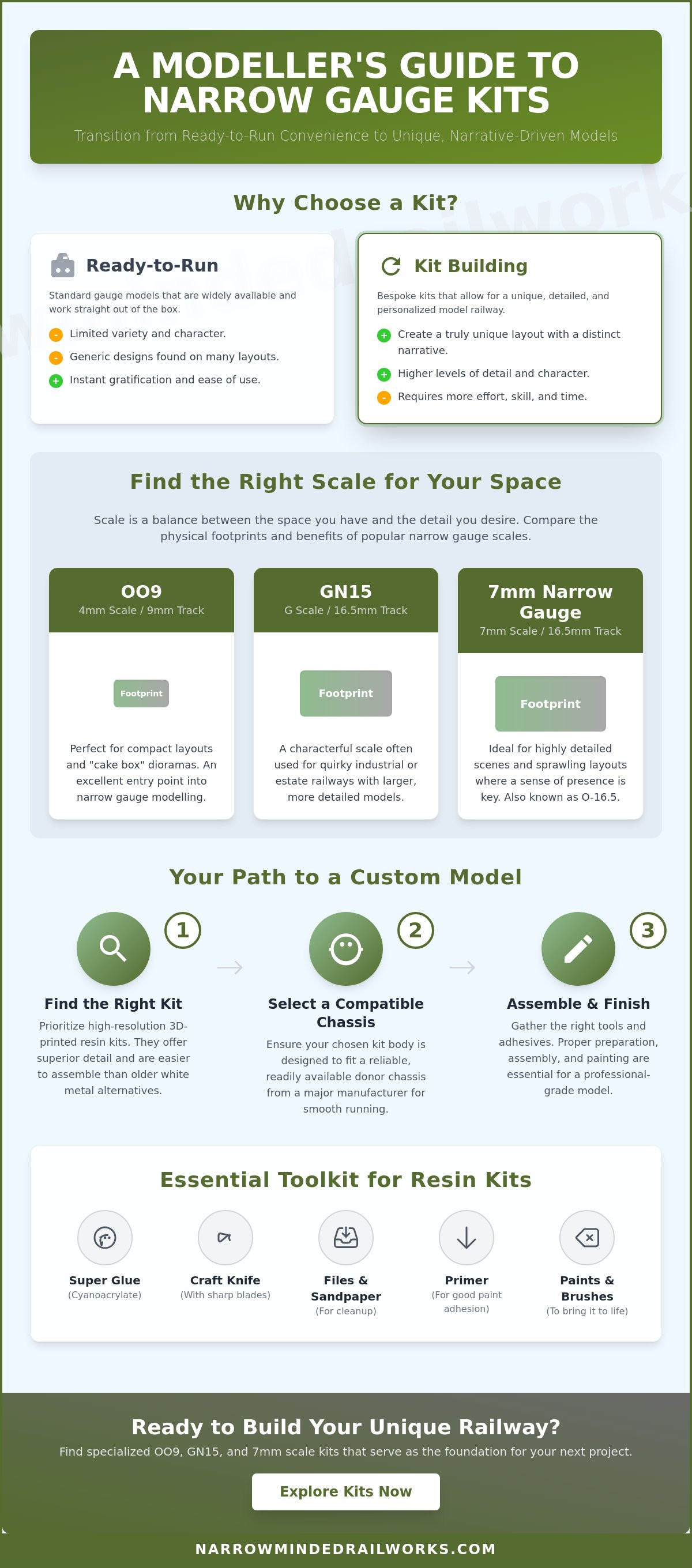
- Select the most appropriate scale for your space by comparing the physical footprints of OO9, GN15, and 7mm narrow gauge layouts.
- Learn how to find and verify compatible donor chassis from major manufacturers to ensure your 3D-printed locomotive kit runs smoothly.
- Identify the specific tools and adhesives required to successfully assemble and finish high-resolution resin models for a professional appearance.
- Transition from ready-to-run models to custom kit-building to create a unique railway narrative that standard gauge layouts cannot replicate.
The Challenge to Find Quality in Narrow Gauge Modelling
Finding your niche in the model railway hobby is often a transition from the generic to the specific. Standard gauge layouts dominate the commercial market, making it easy to buy a box and start running trains immediately. However, for those seeking a unique narrative, the challenge is to find something that stands out. Narrow gauge modeling is that "indie" alternative. It demands a more proactive search because these models aren't typically sitting on every high-street shelf. This proactive approach turns the hobby into a journey of discovery rather than just a transaction.
While you can easily find standard gauge models in any hobby shop, narrow gauge requires a more intentional search. The market has shifted away from mass-produced, ready-to-run items toward bespoke kits that offer higher levels of detail and character. Narrow Minded Railworks serves as a specialist source in this landscape, providing the unique locomotive and wagon kits that mainstream manufacturers overlook. We focus on providing the raw materials for creativity, acknowledging that while kits require more effort than a box-fresh model, the resulting unique layout is a proactive solution for the discerning hobbyist.
To better understand this concept, watch this helpful video:
Why Finding Kits Trumps Ready-to-Run
High-street availability for narrow gauge is inherently limited. While some manufacturers offer a few ready-to-run locomotives, they often lack the variety needed for a truly bespoke layout. Choosing to find a kit instead allows you to represent a specific prototype or a unique industrial line. This process is deeply tied to the history of the narrow gauge railway, where every line was built for a specific purpose. To navigate the diverse options available, you can consult a comprehensive list of narrow-gauge model railway scales to see how different proportions impact your search. Kits offer the freedom to build what you want, not just what is available in a catalog.
The 2026 Modeller: Searching for Quality 3D Prints
In 2026, the market is saturated with 3D-printed options, but quality varies significantly. Modellers now prioritize finding kits designed for ease of assembly and high-resolution detail. Traditional white metal kits are often heavy and difficult to bond; modern resin kits from specialists like Narrow Minded Railworks offer a cleaner, more precise alternative. You must handle the finishing and painting yourself, but this constraint allows for a professional-grade model that mass-produced products cannot match. It's a realistic plan for building a unique collection. We provide the specialized OO9, GN15, and O-16.5 kits that serve as the foundation for these unique projects.
How to Find the Right Scale for Your Layout
Finding the right scale often feels like a balancing act between the space you have and the level of detail you desire. It's common to feel uncertain when looking at various gauges, but identifying your primary goal helps narrow the search. If you want a sprawling network in a small area, your search will differ significantly from someone wanting a highly detailed industrial diorama. While every room has its physical limits, selecting a scale that matches your footprint is a proactive way to ensure your project reaches completion. You don't want to find yourself halfway through a build only to realize the curves are too tight for your chosen stock.
Understanding the relationship between scale and gauge is vital for ensuring compatibility across your layout. Organizations like the National Model Railroad Association (NMRA) help maintain the standards that ensure kits from different manufacturers can work together on the same track. While finding the perfect fit for your shelf or spare room might involve some compromise, it's a realistic plan for building a unique model. You can explore our range of OO9 and 7mm scale kits to see which size aligns with your vision.
Finding Your Way in OO9 (4mm Scale)
Many modellers find OO9 to be the perfect entry point because it uses 9mm track to represent narrow gauge in 4mm scale. This allows for incredibly compact layouts, such as the popular "cake box" dioramas which have seen a 15% increase in UK exhibition entries since 2021. If you're unsure where to start, our your first oo9 loco kit guide offers specific tips for your initial purchase. This scale is ideal for finding kits that replicate quarry-style or industrial settings where tight curves and small locomotives are the norm. It's a space-efficient solution that doesn't sacrifice the "indie" character of the hobby.
Exploring the Larger GN15 and O-16.5 Scales
If you prefer larger, more tactile models, you might find that GN15 or O-16.5 (7mm scale) suits your needs better. Both of these scales typically run on 16.5mm track, which is the same as standard OO or HO gauge. For a deep dive into the larger end of the spectrum, our getting started in gn15 scale article provides a comprehensive overview. While these scales require a larger physical footprint, they offer more room for intricate detailing and the use of 3D scanned figures. Searching for kits in these scales allows for a level of personalization and "kit-bashing" that is harder to achieve in smaller proportions.
Finding and Selecting a Compatible Chassis
The most common objection we hear from modellers is that they cannot find the chassis required for a specific body kit. We acknowledge that Narrow Minded Railworks provides high-quality locomotive and wagon kits but does not supply the internal motors or wheelsets. While this requires an extra step in your build process, it is a proactive solution that ensures you aren't tied to a proprietary, low-quality mechanism. Instead, you can source a high-performance donor from a reputable manufacturer that fits your specific budget and technical requirements.
Finding a donor chassis involves identifying a mass-produced model that shares a similar wheelbase with your chosen narrow gauge prototype. A donor chassis is the mechanical heart of a kit, providing the essential propulsion and electrical pickup. By following the standards established by the National Model Railroad Association, you can be confident that the mechanical components you locate will operate reliably on your layout's trackwork. We design our kits to accommodate the most popular and reliable donors currently available on the market.
Common Donor Chassis for OO9 Kits
OO9 kits are designed to sit on N gauge mechanisms. To identify the right match for our locomotive bodies, you should look for specific models that have stood the test of time for reliability and smooth running.
- Kato 11-103 or 11-109: These four-wheel chassis are the gold standard for small industrial shunters and "critter" locomotives.
- Graham Farish 08: This is a robust choice for larger OO9 engines that require a six-wheel arrangement and more weight for traction.
- Tsugawa Yokou: These are ideal for the smallest prototypes where space inside the resin body is extremely limited.
Finding Chassis for Larger Scale Kits
For GN15 or O-16.5 (7mm) projects, you will typically observe that OO or HO gauge chassis provide the best fit. Since these scales are larger, you have more flexibility with space, but the wheelbase remains the critical measurement for a realistic appearance. You can locate suitable donors by searching for "OO gauge power bogies" or "Hornby spares" on online marketplaces and auction platforms. If a specific donor is out of production, specialist retailers often stock modern equivalents that match the original dimensions. Always verify that the wheel diameter is appropriate for the scale to ensure the finished model sits at the correct height relative to the platform and couplings.
Finding the Right Tools and Accessories
Once you find the ideal kit and a compatible donor chassis, your focus shifts to the assembly and presentation phase. It's true that standard modeling tools often fall short when you work with specialized 3D-printed resin. We provide the structural components and scenery kits, but you must find the specific adhesives and finishing materials to ensure a professional result. Acknowledging the unique properties of resin is the first step; finding the right tools is the proactive solution that prevents damage during the build.
Preparation is essential for a smooth workflow. You can't rely on the same techniques used for mass-produced plastic models. Resin is a fantastic medium for high-resolution detail, yet it lacks the flexibility of injection-molded styrene. You can overcome this constraint by finding a high-quality primer that bonds specifically to resin surfaces, ensuring your paint job doesn't flake over time. You can view our full range of diorama tools and scenery to find the accessories needed to complete your project.
Essential Tools for Kit Builders
Resin requires different handling than traditional plastic. You'll find that standard plastic cement is useless here because it relies on melting the material to create a bond. Instead, you must find high-quality Cyanoacrylate (CA) glue, often called superglue. For a perfect surface finish, refer to our guide on painting 3d printed models. Before you start your first build, ensure you find the following items:
- Fine-grit sanding sticks (400 to 1000 grit) to remove support marks.
- Medium-viscosity CA glue for a strong, gap-filling bond.
- Precision tweezers for handling small 3D-printed details like handrails.
- A sharp hobby knife with fresh blades for clean trimming.
Finding the "Spirit" of the Railway with Scenery
Finding Your Next Project at Narrow Minded Railworks
The journey to find the perfect narrow gauge kit is a transition from being a consumer to becoming a creator. We acknowledge that the search for compatible components and the right scale can be daunting for beginners and experienced modellers alike. However, this complexity is precisely what allows for a unique, character-filled layout that stands out from standard gauge alternatives. Narrow Minded Railworks serves as the final destination in this search, providing the high-resolution resin kits that bring your industrial or rural vision to life.
Our 3D-printed approach allows us to produce models that were previously unavailable or prohibitively expensive in white metal or brass. You can now find niche prototypes that mainstream manufacturers simply cannot justify producing. This technology ensures that every kit is a proactive solution for modellers who refuse to settle for generic, mass-market designs. By focusing on high-quality resin, we offer the level of detail necessary for a truly professional finish that captures the "indie" spirit of the hobby.
Our Range of OO9 and GN15 Kits
We prioritize finding the right balance between intricate detail and accessible pricing. Our OO9 and GN15 kits are specifically designed to fit the most commonly found donor chassis, such as the Kato and Graham Farish units discussed in earlier sections. We also offer a selection of O-16.5 (7mm) scale kits for those who prefer a larger, more tactile project. We acknowledge that our customers are located across the globe; therefore, we provide worldwide shipping to ensure modellers can find our products regardless of their location. This accessibility makes it easier than ever to start a project that is truly your own.
Transparency and Support
Building Your Unique Narrow Gauge Vision
Narrow gauge modelling is a proactive pursuit that rewards those who look beyond mass-produced items. We acknowledge that the search for the right scale and a compatible donor chassis requires more effort than standard gauge projects. However, this challenge is the exact reason your finished layout will possess such a distinct character. By following a structured approach to selection and assembly, you ensure that every locomotive and wagon on your track tells a specific story rather than just filling a space.
You will find that the right foundation for your creative work is now easier to establish with our specialist 3D-printed kits. We design our models to fit the most popular chassis on the market, providing a reliable mechanical heart for your builds. With worldwide shipping and expert support for every kit-builder, we offer the resources you need to succeed regardless of your experience level. It's time to turn your layout plans into a reality and enjoy the creative freedom that narrow gauge provides.
Find your next narrow gauge project in our shop and start building a railway that is truly your own.
Frequently Asked Questions
How do I find out which chassis fits a specific OO9 loco kit?
Check the specific product description on the Narrow Minded Railworks website for a list of recommended mechanisms. We acknowledge that matching a kit to a chassis is a technical hurdle; our proactive solution is to provide clear recommendations for every locomotive kit we sell. Most of our OO9 bodies are designed around reliable Kato or Graham Farish donor units to ensure smooth operation.
Where is the best place to find second-hand donor chassis for model kits?
Online auction platforms and dedicated modelling forums are the most effective places to locate out-of-production or second-hand donor chassis. While these platforms offer a wide selection, you should always verify the mechanical condition of the motor before purchasing. A proactive solution is to search for "N gauge spares" or "non-runners" if you only need the mechanical frame for your kit.
Can I find narrow gauge kits that are suitable for beginners?
Yes, our OO9 wagon kits are specifically designed for those new to the hobby, and you can find these entry-level projects in our shop under the OO9 category. These models have fewer parts and larger bonding surfaces, making them an ideal starting point for practicing assembly and painting techniques. While locomotive kits require more precision, starting with rolling stock builds your confidence before moving to motorized models.
How do I find the correct scale for my small shelf layout?
Measure your total available track length and curve radii to determine which scale fits your physical footprint. OO9 is often the best choice for shelf layouts because it allows for tight turns and compact scenes in 4mm scale. If you have more vertical room but limited length, GN15 offers a larger, more detailed alternative on the same 16.5mm track width used by standard OO gauge layouts.
What should I do if I cannot find a specific wagon kit in stock?
Please contact us directly or sign up for restock notifications on our website if a specific kit is currently unavailable. We acknowledge that production schedules for 3D-printed resin can vary based on demand; our proactive solution is to maintain a rotating stock of our most popular designs. We can often provide an estimated date for when a specific wagon will return to the shop for purchase.
Is it easy to find painting instructions for 3D-printed kits?
We provide comprehensive painting guides on our blog that cover everything from priming to weathering 3D-printed resin. Traditional painting methods work well, but you must use a primer specifically formulated for resin to ensure proper adhesion. We acknowledge that finishing is a multi-step process; however, following our structured guides will help you achieve a professional finish on your first attempt without damaging the fine details.
How can I find Narrow Minded Railworks on social media for updates?
You can follow Narrow Minded Railworks on various social platforms to see our latest prototypes and customer builds, where you will find community inspiration and new kit announcements. We use these channels to share behind-the-scenes looks at our design process and announce upcoming releases. While our website is the primary hub for sales, our social profiles are the best place to interact with fellow modellers.
Where can I find reviews of your locomotive and wagon kits?
Reviews and build logs are frequently posted on specialized narrow gauge forums and within society journals like the 009 Society. We acknowledge that seeing a finished model helps you set realistic expectations for your own project. Reading these community accounts and customer feedback sections provides a transparent look at the assembly process and the high level of detail you can expect from our resin kits.