

What if the biggest hurdle to a smooth-running layout isn't the kit itself, but the donor engine hidden beneath it? While many modellers start with a clear vision of an industrial "critter", finding a reliable power unit often feels like a moving target. You've likely spent hours searching for a Tenshodo Spud only to find UK stock is limited, or perhaps you've struggled to squeeze a standard OO gauge chassis into a narrow gauge shell. This gn15 chassis guide acknowledges these sourcing constraints and provides proactive solutions to keep your project on track.
We believe that choosing a motor involves more than just matching a wheelbase; it requires balancing prototype accuracy with modern reliability. This article helps you select the right power unit for your specific locomotive type, whether you're using a Hornby Smokey Joe or a boutique power bogie. You'll gain a clear list of compatible chassis, step-by-step fitting advice, and knowledge of where to source parts. We'll show you how to optimise your setup to ensure your narrow gauge fleet performs with the slow, steady rhythm of the real thing; for those who also appreciate performance optimization in full-sized vehicles, you can visit MyChiptuningfiles to learn about custom ECU tuning.
Key Takeaways
- Identify why industrial "critters" require specific wheelbases and how to select a donor that maintains prototype accuracy.
- Compare the availability and performance of Tenshodo Spud and Hanazono power bogies using this gn15 chassis guide to ensure reliable running.
- Discover how to adapt the widely available Hornby 0-4-0 steam chassis for kits like the Pixie, even if you don't have extensive modelling experience.
- Master the preparation of donor units by removing unnecessary components to ensure a perfect fit within a 3D-printed resin body.
What Makes a Good GN15 Chassis?
GN15 modelling offers a unique perspective on narrow gauge railways by combining large-scale bodies with standard track. This gn15 chassis guide explores the technical requirements for these models, focusing on how to achieve a realistic industrial look. While the scale is 1:22.5 (G scale), the track is 16.5mm, representing a 15-inch minimum gauge line. This combination creates a "minimum gauge" aesthetic that is both charming and mechanically demanding.
The Scale and Gauge Relationship
Using 16.5mm track allows you to use standard OO or HO gauge components, which simplifies track laying and electrical wiring. However, the challenge lies in finding a chassis that fits the proportions of a G scale driver and locomotive body. Because the track is narrow relative to the body size, the power unit must be compact enough to hide beneath the floorboards or within a small engine hood. If you're new to this scale, our getting started in GN15 scale guide provides more context on the history and appeal of this niche.
Wheelbase and Prototype Accuracy
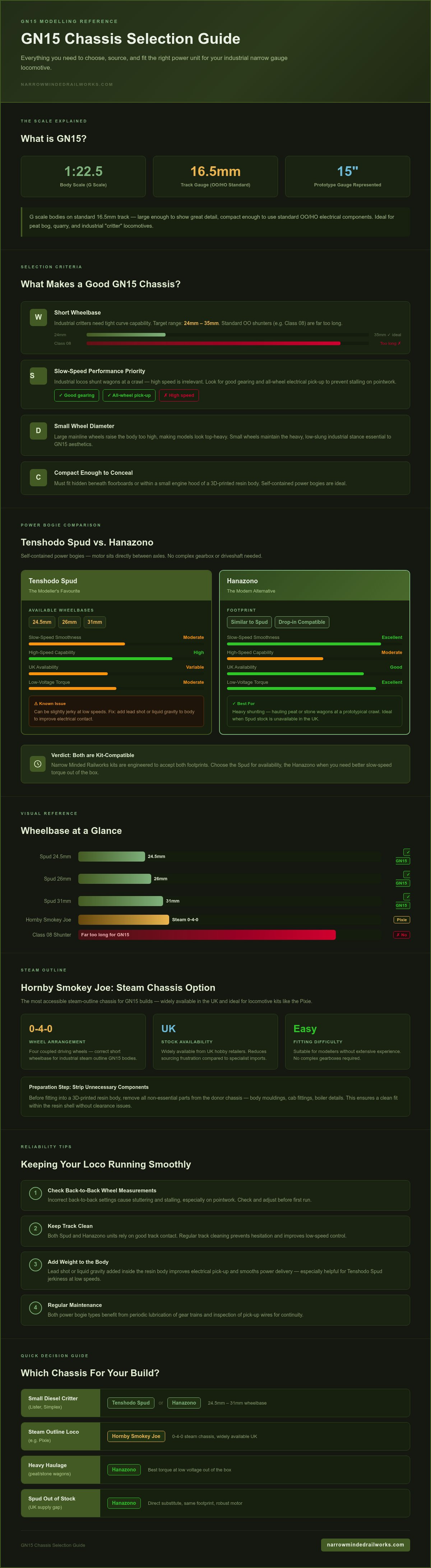
Industrial "critters" like those found in peat bogs or quarries were built for tight curves and uneven track. To replicate this, a good GN15 chassis needs a short wheelbase, typically ranging from 24mm to 35mm. Most standard OO gauge locomotives, such as a Class 08 shunter, have wheelbases that are far too long for a small Lister or Simplex body. Using a chassis with an incorrect wheelbase ruins the "low-slung" profile essential for prototype accuracy. By following a structured gn15 chassis guide, you can avoid the frustration of a model that looks great but stalls on every turnout.
We understand that sourcing specific power units in the UK can be difficult due to fluctuating stock levels at hobby shops. We address this constraint by engineering our kits to fit a variety of common donor units. Slow-speed performance is the priority here. Since these locomotives spend most of their time shunting wagons at a crawl, high-speed capability is unnecessary. You should look for units with decent gearing and pick-ups on all wheels to prevent stalling on pointwork. Wheel diameter also plays a vital role. Larger wheels from a mainline locomotive will raise the body too high, making the model look top-heavy. Smaller wheels help maintain that heavy, industrial stance that defines the GN15 aesthetic.
The Power Bogie Debate: Tenshodo Spud vs. Hanazono
For many years, the choice of power for small diesel "critters" was limited by the availability of compact motors. This gn15 chassis guide examines the two primary contenders for self-contained power bogies: the Tenshodo Spud and the Hanazono. These units house the motor directly between the axles, making them incredibly easy to fit under a resin body without the need for complex gearboxes or drive shafts. While the Tenshodo Spud has long been the default choice for the hobby, the Hanazono has gained traction as a reliable substitute with distinct advantages.
Tenshodo Spud: The Modellers Favourite
The Tenshodo "Spud" is often the first name modellers mention when starting a build. It's available in several wheelbases, including 24.5mm, 26mm, and 31mm, which covers the majority of small industrial designs found on 15-inch gauge lines. Its compact footprint is its biggest strength. You can easily hide it under the hood of a Lister or Simplex locomotive. However, we acknowledge that these units can be slightly jerky at low speeds. A proactive solution is to add lead shot or liquid gravity to the locomotive body. Increasing the weight improves electrical contact and smooths out the power delivery for more realistic shunting.
Hanazono: The Modern Alternative
Hanazono units serve as a high-quality alternative with a very similar footprint to the Spud. Many UK modellers prefer these for heavy shunting due to their gear ratios, which often provide better slow-speed control out of the box. Sourcing the Spud can be difficult when UK stock levels fluctuate. The Hanazono fills this gap effectively, offering a robust motor that handles continuous running well. We've designed our GN15 locomotive kits to be compatible with both footprints, ensuring you aren't stuck waiting for a specific brand to become available.
The mechanical differences between the two are subtle but important for your build. The Hanazono often features slightly different mounting points, sometimes requiring a small adjustment to the resin floor of your kit. While the Spud is known for its high-speed capability, the Hanazono is often praised for its torque at lower voltages. This makes it ideal for hauling heavy trains of peat or stone wagons across a layout at a prototypical pace.
Reliability remains a key concern for any small locomotive. Both units benefit from regular maintenance and clean track. If you find your locomotive stuttering, check the back-to-back measurements of the wheels. Ensuring the wheels are set correctly for your track gauge will prevent most running issues. This gn15 chassis guide recommends testing the bogie on its own before fitting the body to ensure the motor is running smoothly in both directions. Consider the following when making your choice:
- Tenshodo Spud: Best for absolute compact size and multiple wheelbase options.
- Hanazono: Best for slow-speed torque and consistent availability in the UK market.
Steam Outline Chassis: The Hornby Smokey Joe and Beyond
While power bogies suit diesel outlines, steam-powered industrial prototypes require a traditional coupled-wheel setup. This gn15 chassis guide wouldn't be complete without the Hornby 0-4-0 "Smokey Joe". It remains the most accessible donor for UK modellers due to its low cost and extreme durability. Beginners often choose these because they withstand heavy-duty industrial shunting without frequent mechanical failure. They provide a robust foundation that handles the weight of a resin body with ease.
The trade-off for this affordability is a lack of fine detail on the chassis itself. However, in GN15, the large resin body usually hides most of the donor's original features. We design our steam-outline kits to sit low over these units, using the robust motor to power through uneven track. Using this gn15 chassis guide to select a donor like the Smokey Joe ensures you have a reliable runner that is easy to repair if parts wear out over time.
Why the Smokey Joe is a GN15 Legend
The Smokey Joe has earned its reputation through sheer longevity. Its simple design makes maintenance straightforward, even for those new to the hobby. When fitting it into kits like the "Pixie" or "Huntsy Quarry", you'll need to remove the original plastic body and potentially trim some of the mounting tabs. This proactive approach ensures the 3D-printed shell sits at the correct height for prototype accuracy. You can easily source these units new from most UK model shops, or find pre-owned bargains through reputable second-hand retailers at very reasonable prices.
Alternative 0-4-0 Chassis Options
If the Smokey Joe doesn't fit your specific project, several other 0-4-0 donors provide different wheel spacings. The Bachmann "Percy" or "Greg" chassis offer reliable running but often come at a higher price point. For modellers seeking a lower-profile look, the Dapol Pug (formerly a Hornby design) is a viable alternative. It sits closer to the rails, which helps maintain the industrial "critter" aesthetic for smaller locomotives. These alternatives are useful when you need a specific wheelbase that the standard Hornby unit cannot provide.
While you might be tempted by a longer 0-6-0 chassis from a standard gauge locomotive, these are usually too long for a typical GN15 layout. The tight curves found on industrial lines require the short wheelbase of an 0-4-0 to prevent derailments. By sticking to these shorter donors, you ensure your locomotive remains functional on the "minimum gauge" trackwork that defines the scale. This focus on short wheelbases is what allows GN15 models to navigate the cramped spaces of a peat bog or quarry diorama successfully.
Installation and Fitting: A Practical Guide
Converting a donor engine into a functional model requires more than a simple swap. This gn15 chassis guide provides the practical steps needed to integrate mechanical parts with our 3D-printed resin shells. While we design our kits to accommodate standard footprints, you'll likely encounter small plastic protrusions or oversized couplings that interfere with the fit. Addressing these constraints early ensures a smooth installation process.
Modifying the Donor Unit
Start by carefully unscrewing the original locomotive body and setting the screws aside in a safe container. You won't need the plastic shell, but the screws are often the perfect size for reattaching the chassis to your new kit. Use side cutters to remove the standard OO gauge tension-lock couplings. These are far too large for narrow gauge prototypes and will prevent the body from sitting flush. Finally, give the wheels and gears a quick clean with an IPA-soaked cotton bud. Removing factory grease or dust now prevents electrical pickup issues later.
Mounting and Weighting
Securing the chassis doesn't always require permanent adhesive. We recommend using a small amount of Blu-Tack or tiny self-tapping screws for a non-permanent but secure fit. This allows you to remove the power unit for maintenance or wheel cleaning. Because resin is lightweight, adding mass is essential for reliable running. Strategically place lead shot or tungsten weights within the hollow sections of the loco body. Keep the centre of gravity low and centred over the drive wheels. This proactive weighting improves traction and ensures your locomotive can haul a full train of wagons without slipping.
Finishing Touches
Once the chassis is secure, focus on concealing the motor. Many of our kits include 3D-printed detail parts like floorboards or engine covers to hide the donor unit. These additions maintain the illusion of a working industrial engine while protecting the delicate gears from layout debris. Before you apply the final livery, refer to our guide on painting 3D printed models for professional results. If you're ready to start your build, explore our range of GN15 locomotive kits designed specifically for these popular chassis.
Basic wiring for DC is usually straightforward as most donors come pre-wired. If you're considering DCC, ensure there's enough space within the body for a small decoder. Most GN15 bodies are quite spacious, but you should always plan the decoder placement before permanently securing your weights. This gn15 chassis guide prioritises functionality, so keep wires tidy and away from moving parts to ensure long-term reliability on your layout.
Matching Narrow Minded Railworks Kits to Your Chassis
The challenge for many modellers is having a donor unit but not knowing which body will fit it. This gn15 chassis guide simplifies that decision by categorising our kits based on their intended power plant. While we don't sell the mechanical components, we've engineered our 3D-printed resin shells to ensure a seamless marriage between the motor and the body. Whether you have a spare power bogie or a classic steam donor, there's a specific kit designed to meet your needs.
Diesel and Electric Critters
If you're starting your journey into minimum gauge modelling, the Lister "Critter" is arguably the best entry point. It's designed specifically for the 24.5mm Tenshodo or Hanazono power bogies. This compact combination captures the essence of a peat bog locomotive perfectly. For those who prefer a more rugged, industrial appearance, the Spoorijzer diesel is a proactive choice for the Hanazono unit, as it accommodates the motor's height easily. If you're coming from a different scale, you might find our beginner guide for OO9 kits useful for understanding how these larger GN15 models compare in size to 4mm narrow gauge.
Beyond the standard bogies, versatile kits like the Clayton Electric and Simplex are designed with more internal space. This flexibility allows you to experiment with lesser-known donors, such as Kato or Life-Like chassis, which are often used for specialised "critters" or kit-bashed projects. These donors are sometimes harder to find in the UK, but they offer exceptionally smooth running for those willing to hunt for them on the second-hand market.
Steam and Quarry Locomotives
For fans of steam, the "Pixie" and "Huntsy Quarry" kits are engineered to fit the ubiquitous Hornby 0-4-0 chassis. The Pixie kit, when paired with a weathered Smokey Joe, creates a classic narrow gauge look that feels heavy and purposeful. The Huntsy Quarry offers a similar aesthetic but provides a slightly different footprint that suits the reliable OO gauge motor. Because these donors are widely available in model shops across the UK, they represent a cost-effective way to build a functional steam fleet without the need for complex engineering.
We understand that availability is the primary constraint when sourcing power units. By designing our range around the most common footprints, we ensure you can always find a suitable donor. You can browse our full range of GN15 Locomotive Kits to find the perfect match for your existing chassis collection. Following this gn15 chassis guide ensures that your finished model won't just look the part on the shelf, but will perform reliably on your layout for years to come.
Building Your Industrial Fleet
Success in minimum gauge modelling depends on the harmony between a high-quality body and a reliable power unit. We've examined how selecting a chassis with a short wheelbase and low-speed torque ensures your models capture the heavy, industrial feel of a working peat bog or quarry. This gn15 chassis guide has provided proactive solutions for sourcing and fitting donor units, helping you overcome the challenges of stock availability and mechanical modifications.
While we don't sell the motors themselves, our kits are specifically engineered for Tenshodo, Hanazono, and Hornby footprints to make your build as straightforward as possible. We provide high-detail 3D printed resin bodies and expert support for narrow gauge modellers to ensure your project reaches the finish line. If you're ready to start your next build, explore our GN15 Locomotive Kits designed for easy chassis fitting. With the right foundation beneath your resin shell, your layout will soon benefit from the steady, prototypical running that defines the best industrial dioramas. Happy modelling.
Frequently Asked Questions
Can I use a standard OO gauge locomotive as a GN15 chassis?
Yes, but only certain models fit the scale correctly. Most standard OO locomotives have wheelbases that are far too long for industrial prototypes. We recommend using 0-4-0 donors like the Hornby Smokey Joe or the Dapol Pug. While standard gauge bodies are too small, their chassis provide the 16.5mm gauge required for GN15. This gn15 chassis guide prioritises these shorter wheelbases to maintain prototype accuracy and ensure your model can navigate tight industrial curves.
Where can I buy Tenshodo Spud or Hanazono power bogies in 2026?
UK stock for Tenshodo units can be intermittent, so you should check specialist narrow gauge suppliers or international retailers. If local shops are out of stock, Hanazono units are a proactive alternative often available through online hobby marketplaces. We design our kits to be compatible with both footprints to ensure your project isn't delayed by supply chain issues. Always verify current shipping times and potential import duties when ordering from outside the UK.
Do I need to modify the 3D-printed body to fit the chassis?
You rarely need to modify our resin bodies, as we engineer them to fit specific donor units out of the box. However, you will need to prepare the chassis by removing original plastic bodies and couplings. If you use a non-standard donor, you might need to trim small internal resin tabs with a sharp hobby knife. We provide these clearances to ensure a snug fit while keeping the centre of gravity as low as possible for stable running.
Can GN15 locomotives be converted to DCC?
Yes, most GN15 locomotives have ample internal space for a small DCC decoder. While the donor chassis are often basic DC units, you can hard-wire a decoder to the motor and pickups. We don't sell DCC systems, but we recommend choosing a "nano" or "micro" decoder to leave more room for lead weights. This proactive approach ensures your industrial "critter" benefits from the superior slow-speed control that digital systems provide on complex layouts.
What is the best chassis for a very small industrial "critter"?
The 24.5mm wheelbase Tenshodo Spud or Hanazono power bogie is the best choice for small locomotives like Listers. These units are self-contained, which eliminates the need for complex internal drive shafts or bulky gearboxes. If these are unavailable, some modellers use a modified Kato 109 chassis, though these require more effort to fit. This gn15 chassis guide suggests sticking to the 24.5mm footprint for the most reliable results in tiny, industrial-style resin shells.
Why is my Tenshodo Spud stuttering at low speeds?
Stuttering is usually caused by insufficient weight or dirty track. Because these units are very light, they can lose electrical contact on uneven pointwork or plastic frog turnouts. A proactive solution is to add lead or tungsten weights inside the locomotive body to press the wheels firmly against the rails. Regularly cleaning the wheels with a cotton bud soaked in isopropyl alcohol will also prevent the buildup of carbon deposits that interrupt power delivery during shunting.
Are there any ready-to-run GN15 chassis that don’t require a donor loco?
Standalone power bogies like the Tenshodo or Hanazono are ready to run without a donor locomotive. These are sold as independent mechanical units rather than part of a complete model. While we don't sell these ourselves, they are the most efficient way to power a kit without dismantling a perfectly good Hornby engine. They provide a clean, professional foundation for any scratch-build or 3D-printed project where space is at a premium.