

Can a single technology finally solve the chronic shortage of prototype-accurate parts for niche scales like OO9 and GN15? For many modellers in the UK, finding high-quality 3d printed narrow gauge railway accessories that don't suffer from distracting print lines or poor fitment remains a significant challenge. You likely recognise the frustration of settling for generic parts because the specific wagon or building you need simply isn't available from major manufacturers. While these variety constraints have historically limited the realism of narrow gauge layouts, modern resin technology now offers a professional solution for those seeking museum-quality results.
This 2026 guide reveals how you can achieve a realistic, highly detailed layout by utilising the latest advancements in high-resolution printing. We promise to show you how to identify kits that match professional standards and provide a preview of the tools, such as Blender 5.1.2, that are making custom modelling more accessible than ever. We will explore the shift toward 14K resolution printing and explain how to source rare prototypes that fit your commercial chassis perfectly, ensuring your layout stands out for its accuracy rather than its compromises.
Key Takeaways
- Understand how 2026 resin technology overcomes traditional durability issues, offering a viable alternative to injection-moulded plastic for intricate scenery.
- Discover how 3d printed narrow gauge railway accessories bridge the gap for niche scales like OO9 and GN15, providing access to rare prototypes.
- Learn the essential preparation steps and tool selections, such as fine-grit sticks, necessary to achieve a seamless, professional finish on every kit.
- Identify how CAD-driven precision ensures your models maintain 100% scale accuracy, allowing for a layout that truly reflects historical prototypes.
3D Printing: A New Era for Model Railway Accessories
Traditional manufacturing methods often require high production volumes to remain cost-effective. This constraint has historically left enthusiasts of niche scales with limited choices for their layouts. While injection moulding provides durability, it frequently lacks the flexibility needed for rare prototypes. To solve this, 3D printing has emerged as a transformative technology. In 2026, the hobby has moved from generic plastic shapes to highly specific, prototype-accurate parts. This evolution is particularly visible in model railway layouts across the UK, where modellers now demand more than "close enough" representations of heritage lines.
To better understand this concept, watch this helpful video:
With resin printers now reaching resolutions of 14K, the visible layer lines that once plagued early models have largely vanished. While high-quality equipment can be expensive for an individual to maintain, professional kits provide access to 3d printed narrow gauge railway accessories without the need for personal technical expertise. On-demand production also means that rare industrial wagons or specific building details don't need to be stocked in massive quantities, ensuring that even the most obscure prototypes remain available to the modelling community.
The Advantages of Resin over Traditional Plastic
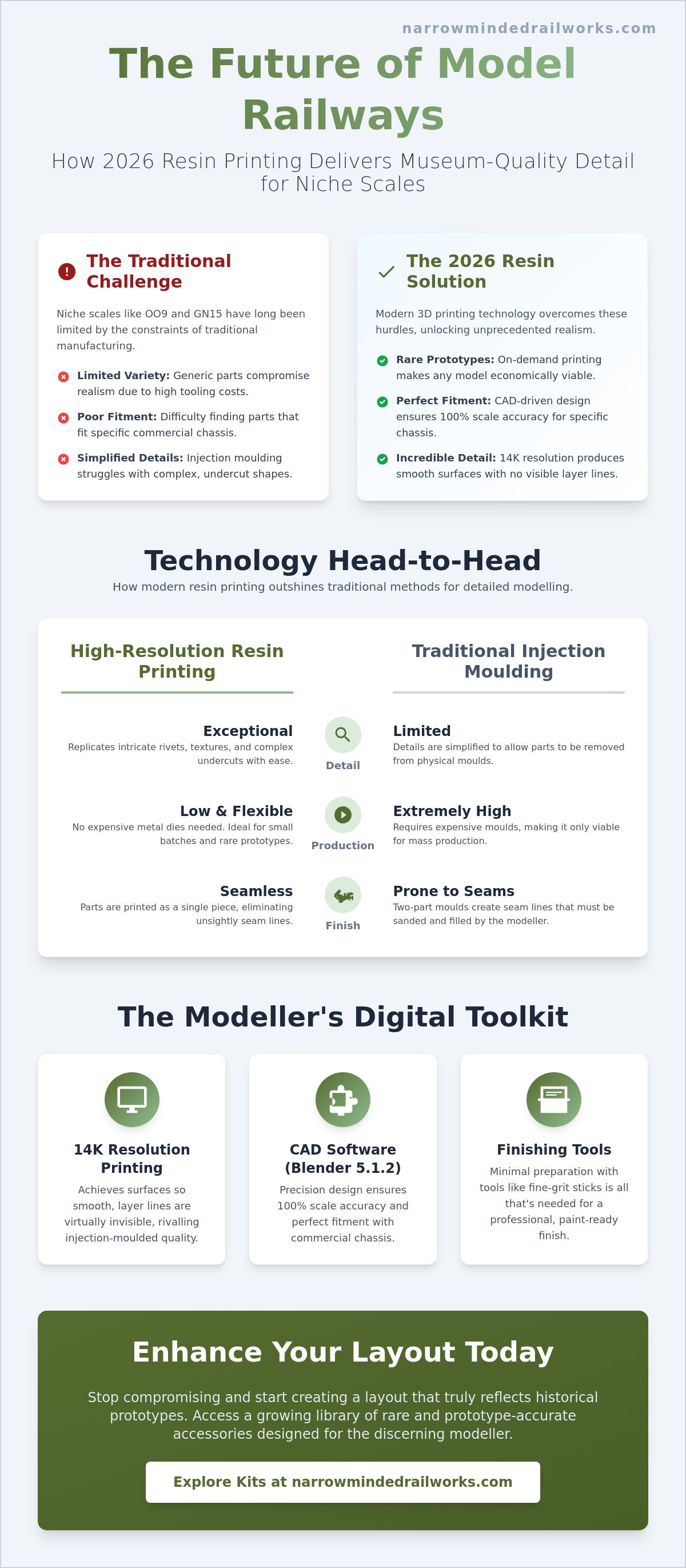
Injection moulding relies on two-part metal dies, which often creates unsightly seam lines and limits detail on complex surfaces. Resin 3D printing builds models layer by layer, allowing for intricate rivets, door handles, and fine textures that traditional methods cannot replicate. Because there are no physical moulds, it's possible to produce complex, undercut, and hollow shapes in a single piece. This results in a cleaner model that requires less sanding and preparation before painting.
Why Narrow Gauge Modellers Benefit Most
Narrow gauge scales like OO9 and GN15 have historically suffered from a lack of commercial variety. Major manufacturers focus on standard gauge because the tooling costs for niche items, such as Welsh slate wagons, are often prohibitive. 3D printing removes this barrier by making small production runs economically viable. While finding parts that fit specific commercial chassis was once a struggle, modern 3d printed narrow gauge railway accessories are frequently designed with these precise dimensions in mind. This ensures a perfect fit for locomotive kits, allowing modellers to focus on the aesthetic finish of their layout rather than mechanical troubleshooting.
Precision and Detail: Why 3D Printed Accessories Outshine Traditional Methods
Traditional die-cast and plastic injection methods have defined the hobby for decades. While these techniques offer durability, they often struggle with the extreme level of detail required for 3d printed narrow gauge railway accessories. Metal dies for injection moulding are incredibly expensive to produce. This constraint often forces manufacturers to simplify designs to ensure the part can be removed from the mould without damage. 3D printing provides a proactive solution by using additive manufacturing, which builds the object without the need for physical constraints like draft angles or parting lines.
Modern 2026 resin formulas have significantly improved the durability of these components. Previous iterations were often criticised for being brittle, but current engineering-grade resins offer a balance of flexibility and strength suitable for working layouts. When it comes to weight, resin is naturally lighter than white metal. This can be an advantage for rolling stock where lower mass reduces the strain on small locomotive motors. If extra weight is needed for tracking, internal cavities in the 3D design allow for the easy addition of lead shot or tungsten putty.
Additive manufacturing is also a more sustainable choice for the modern modeller. Traditional production often results in significant plastic waste during the setup and purging of machines. 3D printing uses only the material required for the model and its supports, which minimises environmental impact. If you are looking to upgrade your current project, exploring a range of OO9 and GN15 locomotive kits can provide the prototypical accuracy that mass-produced items lack.
Detail Comparison: 3D Resin vs. Injection Moulding
3D printing achieves 0.05mm layer heights for transitions, creating surfaces that appear perfectly smooth to the naked eye after a single coat of primer. This precision allows for the reproduction of incredibly fine brickwork and weathered wood grain that feels tactile. For small lineside scenery items, the cost-to-detail ratio is far superior to traditional methods. You can achieve museum-quality textures on items as small as a milk churn or a toolkit without the high price tag of bespoke brass castings.
Prototypical Accuracy in Narrow Gauge
CAD software allows designers to replicate specific historical items, such as the distinct Quarry Hunslet coupler, with absolute precision. By using 3D scans of real people, manufacturers can now produce hyper-realistic 7mm figures that avoid the "wooden" look of older plastic sets. This technology also makes it simple to offer multiple variations of the same wagon or building. You can choose between different door styles or planking patterns to ensure no two items on your layout look identical, mirroring the organised chaos of a real-world narrow gauge line.
Narrow Gauge Specialisation: 3D Printed Parts for OO9, GN15, and O-16.5
Narrow gauge modelling presents a unique set of challenges that standard gauge enthusiasts rarely encounter. While the "Big Four" railways are well-served by major manufacturers, those modelling industrial or heritage lines often face a significant lack of variety. This scarcity can make it difficult to build a layout that feels authentic to a specific region or era. 3d printed narrow gauge railway accessories offer a proactive solution by providing the niche components that larger companies overlook. Whether you are recreating a Welsh slate quarry or a rural estate line, these parts allow you to capture the specific character of your prototype without needing to scratch-build every single item.
The texture of narrow gauge environments is often more rugged and industrial than mainline railways. 3D printing excels at capturing these scale-appropriate textures, such as the rough-hewn stone of a sleeper block or the rusted metal of a skip wagon. By focusing on these fine details, you can transform a simple layout into a convincing miniature world that tells a story of industry and hard work. Because these models are produced on demand, you can access a range of designs that would be financially impossible for a traditional manufacturer to stock.
Essential OO9 Accessories for Every Layout
OO9 scale represents the narrow gauge lines that once thrived across the UK, most famously in North Wales. Recreating these lines requires specific rolling stock, such as slate wagons and narrow gauge signals, that fit the tight curves of 9mm track. Finding a locomotive that looks right but runs reliably is a common hurdle for many modellers. A helpful way to overcome this is to use a 3D printed body designed to fit a standard commercial chassis. if you are just starting, reading Your First OO9 Loco Kit will help you understand which chassis options provide the best performance for your project.
- Specific point levers and ground signals for quarry layouts.
- Industrial scenery like coal heaps and tool sheds.
- Wagon kits designed specifically for the 1:76 scale narrow gauge enthusiast.
The GN15 and O-16.5 Revolution
Modelling in larger scales like GN15 (1:24) or O-16.5 (7mm) allows for incredible detail, but the cost of traditional kits can be a barrier. 3D printing has revolutionised this area by making large-scale 3d printed narrow gauge railway accessories affordable and accessible. In these scales, every rivet and plank is visible, so the precision of resin printing is essential. For those curious about the possibilities of 1:24 scale on 16.5mm track, Getting Started in GN15 Scale provides the necessary context for your first build. From estate railway accessories to large-scale figures, these kits provide the high-impact detail that defines a professional-standard layout.
Mastering the Finish: Preparing and Painting Your 3D Printed Scenery
Achieving a professional finish on 3d printed narrow gauge railway accessories requires a slight shift from the techniques used for traditional plastic kits. While resin offers incredible detail, it also possesses unique surface characteristics that demand specific preparation. You don't want to rush the initial stages, as any remaining support marks will become glaringly obvious once the first coat of paint is applied. A proactive approach involves using high-quality sprue cutters to snip supports away from the model, followed by careful sanding with fine-grit sticks to restore a smooth profile.
Choosing the right primer is a critical step that many modellers overlook. Some heavy-duty automotive primers contain solvents that can react poorly with certain 3D resins, leading to a tacky surface that never fully cures. We recommend using a dedicated hobby primer, preferably an acrylic-based one, to create a stable foundation for your topcoats. This layer not only helps the paint adhere but also acts as a final check for any surface imperfections that need addressing before you move on to the creative stages. For the best results, you can explore our range of diorama tools and scenery designed specifically for these tasks.
Removing Support Marks and Cleaning
Removing print supports is a delicate process that requires patience. Start by identifying the "nib" where the support met the model and use your cutters to leave a tiny amount of material rather than cutting flush. This prevents pitting the surface of the resin. Once the bulk of the supports are gone, use a fine-grit sanding stick to level the surface. If you encounter minor pockmarks from the printing process, a small amount of fine modeller's filler will resolve the issue. For a deeper dive into these techniques, our guide on Painting 3D Printed Models offers a comprehensive look at achieving a flawless surface.
Professional Painting and Weathering
When you begin painting, focus on building thin layers to preserve the crisp details of your 3d printed narrow gauge railway accessories. Dry brushing is an excellent technique for highlighting 3D printed rivets and raised textures, as it catches only the highest points and adds instant depth. For wood and stone, use thin washes to settle into the 3D textures, mimicking years of industrial grime. If your kit includes decals, applying Micro Sol will help the film conform to complex resin surfaces, making the markings look painted on. Finally, a matte varnish will protect your work from the handling common on working layouts while unifying the various textures of your wagons and lineside buildings.
Enhancing Your Layout with Narrow Minded Railworks Accessories
Generic scenery often fails to capture the distinct, rugged charm of industrial and heritage lines. Narrow Minded Railworks offers a proactive solution by providing 3d printed narrow gauge railway accessories designed by active modellers who understand the specific needs of the community. We recognize that off-the-shelf parts frequently lack the character required for a convincing scene. To address this, our range focuses on the unique prototypes that defined British narrow gauge history, from heritage phone boxes to intricate lineside details that add narrative to your diorama.
While the narrow gauge community is global, our support remains personal and transparent. We offer worldwide shipping to ensure enthusiasts everywhere can access high-quality resin components. If your project requires a specific scale adjustment or a bespoke print, we are often able to accommodate these requests to ensure a perfect fit for your layout. We maintain a clear commitment to material quality, using high-resolution resins that provide the durability and detail discussed in previous sections of this guide.
Featured 3D Printed Kits and Scenery
Our flagship offerings include a variety of OO9 and GN15 locomotive and wagon kits, which allow modellers to build rare prototypes that are unavailable as ready-to-run models. These kits are designed to fit standard commercial chassis, providing a reliable mechanical foundation for a highly detailed resin body. Beyond rolling stock, we provide diorama tools and scenery that simplify the layout building process. Our range of unique figures and characters is particularly popular for adding a sense of life and scale to 7mm and 1:24 scale environments.
- OO9 Locomotive & Wagon Kits: Accurate representations of industrial prototypes.
- GN15 & O-16.5 Kits: Large-scale detail for estate and quarry railways.
- Diorama Tools: Specialized equipment to assist with track laying and scenery assembly.
Ordering and Customer Support
Because we utilize a print-on-demand production model, delivery times can be longer than those of mass-produced plastic items. This approach is a proactive choice that allows us to maintain a vast range of niche items without the constraints of traditional stockholding. We prioritize transparency regarding these timelines and provide regular updates on your order's progress. Our team is always available to offer technical assembly advice, ensuring you have the support needed to achieve a professional finish on your 3d printed narrow gauge railway accessories.
Explore our unique range of 3D printed narrow gauge accessories to find the perfect addition to your next modelling project.
Transform Your Layout with Next-Generation Modelling
The shift toward high-resolution resin has effectively removed the variety constraints that once limited niche scales. By utilizing 14K printing technology and precise CAD design, it's now possible to access prototype-accurate details that were previously impossible to manufacture at scale. We've explored how proper surface preparation and specialized painting techniques ensure these components blend seamlessly into your scenery. While finding rare parts for OO9, GN15, or O-16.5 layouts was once a difficult task, modern 3d printed narrow gauge railway accessories provide a proactive solution for the discerning builder.
At Narrow Minded Railworks, we remain committed to transparency regarding our print-on-demand process and material quality. Our kits are designed and tested by active modellers to ensure they meet the rigorous standards of a working layout. We offer worldwide shipping on our entire range of locomotive bodies and diorama tools, helping you achieve museum-quality results regardless of your experience level. Explore our unique range of 3D printed narrow gauge accessories and start building a more authentic miniature world today.
Frequently Asked Questions
Are 3D printed model railway accessories as durable as traditional plastic?
Modern resin components offer high durability, though they are generally less flexible than injection-moulded plastic. While early 3D prints were often brittle, the engineering-grade resins we use in 2026 provide a proactive solution for the rigours of a working layout. These 3d printed narrow gauge railway accessories will withstand normal handling and operation as long as you avoid excessive impact or extreme temperature fluctuations.
Do I need a special type of glue for 3D printed resin parts?
You must use cyanoacrylate, commonly known as super glue, or a two-part epoxy to bond resin parts. Traditional plastic cement won't work because it relies on melting polystyrene surfaces, which doesn't happen with 3D printed resin. Using a medium-viscosity super glue provides a proactive solution for gap-filling while ensuring a permanent, structural join between your kit components and any diorama elements.
How do I remove the faint print lines from 3D printed accessories?
Fine-grit sanding sticks or a high-build primer are the most effective tools for removing layer lines. While 14K resolution printing has made these lines almost invisible, a light sand with 400 to 600 grit paper ensures a perfectly smooth surface. Applying a dedicated hobby primer first helps highlight any remaining textures that need attention before you begin your final paintwork on the model.
What scales does Narrow Minded Railworks provide accessories for?
We focus exclusively on narrow gauge scales, including OO9, GN15, and O-16.5 (7mm). Large manufacturers often ignore these niche markets, so we provide a proactive solution for modellers who need high-quality 3d printed narrow gauge railway accessories for their specific layouts. Please note that we do not supply standard gauge models, ready-to-run items, or electronic systems like DCC.
Can I paint 3D printed models with standard acrylic hobby paints?
You can use any standard acrylic or enamel hobby paints once the model has been properly primed. Resin surfaces are non-porous, so a primer layer is essential to prevent the paint from peeling or chipping over time. Once the primer is dry, you'll find that resin takes paint exceptionally well, allowing for the fine weathering and detail work necessary for realistic industrial scenes.
Why should I choose 3D printed kits over ready-to-run models?
3D printed kits allow you to model rare, prototype-specific locomotives and wagons that are not available as ready-to-run items. While ready-to-run models offer convenience, they often lack the variety needed for authentic industrial or heritage scenes. Building from a kit gives you the flexibility to customise your rolling stock to match your specific prototype, ensuring your layout remains unique and historically accurate.
What should I do if my 3D printed part arrives with small support marks?
Small marks where print supports were attached are a normal part of the production process. You can easily remove these using a sharp hobby knife or fine sprue cutters to snip the excess material. Once the bulk of the support is removed, a quick pass with a sanding stick provides a proactive solution to restore the surface profile before you begin the priming and painting stages.
Are these 3D printed accessories compatible with standard Hornby or Bachmann track?
Compatibility depends on the track gauge of your chosen scale rather than the brand of track. OO9 models are designed for 9mm track, which is the same gauge as N scale track, while GN15 and O-16.5 kits run on 16.5mm track, the same gauge as standard OO track. Ensure your layout uses the correct gauge for the kit you are building to ensure reliable running and operation.