

What if the most rewarding part of model railroading wasn't watching a train circle a loop, but solving a complex logistical riddle instead? Many enthusiasts feel frustrated by a lack of space for a traditional continuous run, yet they often find that standard "roundy-roundy" operations lose their charm after a few minutes. If you find yourself in this position, you're likely asking: what is a shunting puzzle layout? While limited space might seem like a barrier to realistic operations, these compact designs turn that constraint into a proactive challenge by focusing on the art of the switch.
We understand that track planning can feel overwhelming when every inch counts. This guide promises to show you how shunting puzzles turn minimal footprints into maximum engagement through logic-based gameplay. You'll discover the mechanics behind famous designs like the Inglenook Sidings and the Timesaver. We'll also explore how narrow gauge scales, such as OO9 and GN15, allow you to pack incredible detail and character into a diorama that fits on a standard shelf. By the end of this article, you'll have a clear roadmap for building a layout that prioritizes tactical thinking over simple mileage.
Key Takeaways
- Space is often limited, so learning what is a shunting puzzle layout allows you to prioritize tactical problem-solving over simple continuous running.
- Compare the simple Inglenook Sidings with the complex Timesaver arrangement to determine which logic-based design suits your available area.
- While small layouts require tight tolerances, focusing on headshunt capacity and track quality prevents operational stalls and ensures smooth gameplay.
- Narrow gauge scales such as OO9 or GN15 provide a proactive solution for tight spaces, allowing for realistic curves and dense scenery in a compact footprint.
- Customize your layout using specialized locomotive and wagon kits to create a cohesive industrial or rural theme for your switching operations.
What is a Shunting Puzzle Layout?
Many hobbyists face the persistent challenge of limited square footage, which often leads to the assumption that a rewarding model railway is out of reach. However, if you've ever asked what is a shunting puzzle layout, you'll find it's a proactive solution that prioritizes tactical depth over track mileage. Unlike traditional layouts that focus on "roundy-roundy" continuous running, a shunting puzzle is a compact model railway designed for specific switching challenges. These layouts often occupy a minimum space, such as a bookshelf or a single four-foot timber plank, yet they offer an operational intensity that larger systems often lack. By focusing on a specific industrial scene or a small station, you can achieve a level of detail and character that is difficult to maintain on a massive layout. It turns the hobby from passive observation into an active, logic-based game.
To better understand how these compact designs function in practice, watch this helpful video showing how different track arrangements create unique challenges:
The Core Concept of Operations
The primary objective is to move wagons from a randomized starting order into a target sequence using a locomotive. It's a logic game where physical constraints, like limited siding length or headshunt capacity, create the "puzzle" element. On a classic Inglenook Sidings design, for instance, you must plan several moves ahead to avoid total gridlock within the yard. Ultimately, a shunting puzzle is a tactical exercise in locomotive management that rewards precision and patience over high-speed running.
Why Modellers Choose Puzzles
Space is often the primary hurdle for enthusiasts, but choosing a puzzle layout allows you to focus on quality rather than quantity. These designs fit into everyday living areas, such as flats or small home offices. They focus on the actual "work" of a real railway, such as sorting goods and arranging trains for departure. This realism provides a sense of purpose. Additionally, the lower cost of entry allows you to invest more in high-quality OO9 locomotive and wagon kits or detailed diorama tools and scenery.
Starting with a small-scale project is an excellent way to master the fundamentals of track laying and scenery without becoming overwhelmed by a massive room-sized endeavor. Because the scope is narrow, you can focus on perfecting every track joint and building every kit with care. This manageable scale ensures that your project reaches completion, providing a functional and beautiful piece of operational art that fits anywhere in your home while providing hours of mental stimulation. To ensure your home is as well-equipped as your workshop, you can visit Rohnson for a variety of essential household appliances and electronics.
Classic Shunting Puzzle Designs: Inglenook vs. Timesaver
Deciding on a track plan often feels restrictive when working with a small shelf, but selecting a proven template provides a proactive solution to this dilemma. When you research Classic Shunting Puzzle Designs: Inglenook vs. Timesaver, you'll find two distinct philosophies that have shaped the hobby for decades. While the Inglenook focuses on pure mathematical logic, the Timesaver emphasizes physical movement and technical dexterity. Both rely on specific mathematical constraints to ensure every problem is solvable, making them the gold standard for anyone exploring what is a shunting puzzle layout.
The Inglenook Sidings Explained
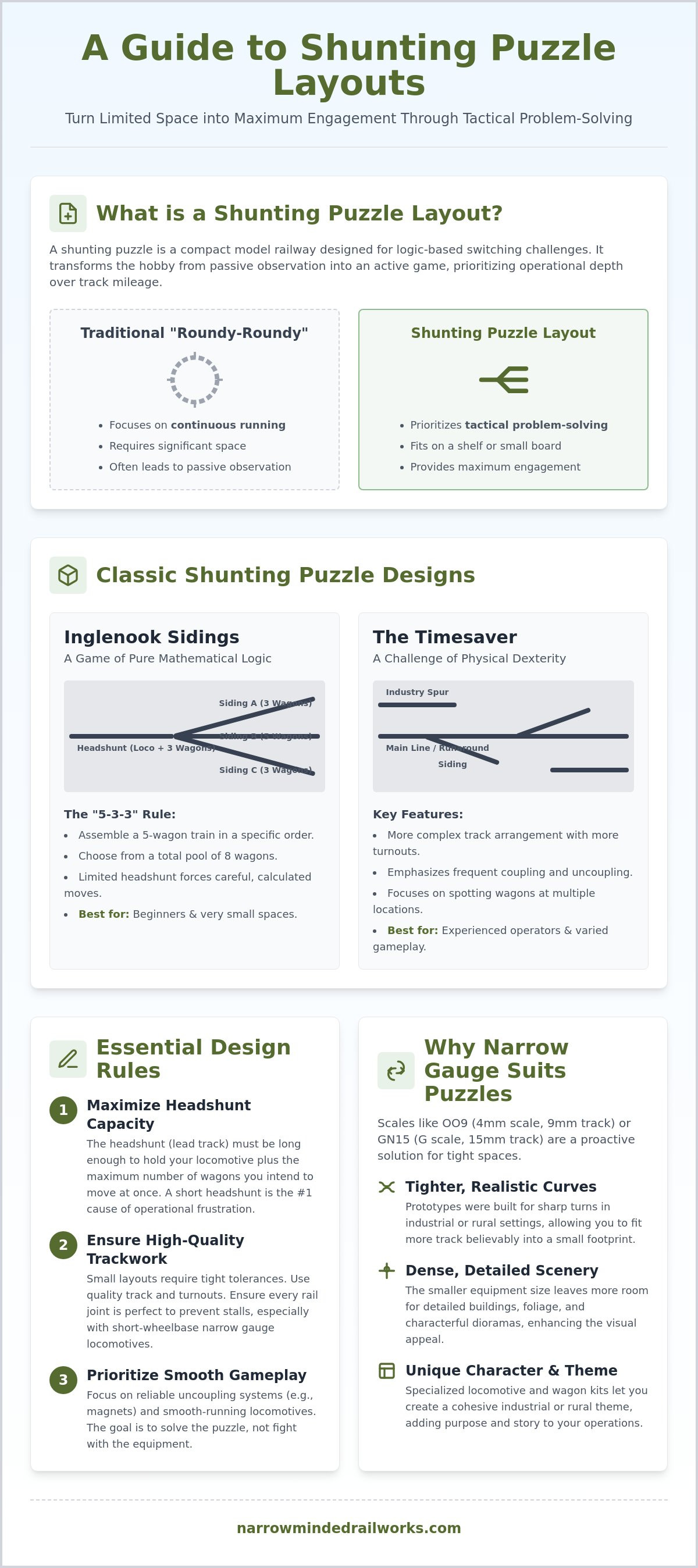
The Inglenook Sidings, designed by Alan Wright, is perhaps the most accessible entry point for a small-space project. It requires a very modest footprint, utilizing only two points and three sidings of specific lengths. The core of the challenge lies in the "5-3-3" rule: the longest siding holds five wagons, while the two shorter sidings hold three each. To operate the puzzle, you select five random wagons from a pool of eight and attempt to assemble them in a specific order. Because the headshunt is limited to a locomotive and only three wagons, you cannot move the entire train at once. This constraint forces you to calculate every move, ensuring that you don't accidentally "trap" a wagon you need later in the sequence.
The John Allen Timesaver
In contrast, John Allen's Timesaver introduces a more complex track arrangement that includes a run-around loop and several spurs. While the Inglenook is a game of logic, the Timesaver is often treated as a game of skill and speed. The goal is to move specific wagons between designated locations, often while playing against a clock. The inclusion of the run-around loop allows the locomotive to reach both ends of a wagon, but the limited length of the sidings and the loop itself means that clearance points are constantly under threat. This design requires slightly more space than an Inglenook but rewards those who enjoy the technicality of complex locomotive movements. Understanding these mechanics is essential when defining what is a shunting puzzle layout for your own workshop.
Choosing between these designs depends on whether you prefer solving a riddle or executing a series of technical maneuvers. If you enjoy the quiet contemplation of a logistical problem, the Inglenook is ideal. If you prefer the pressure of a timed challenge and more intricate trackwork, the Timesaver is the better fit. To bring these compact designs to life with a sense of realism, you can utilize specialized locomotive and wagon kits to build a fleet perfectly suited for these tight industrial scenes. By following these established rules, you ensure that your small layout remains a source of long-term operational interest rather than a static display.
Essential Design Rules for a Functional Puzzle
Building a compact layout presents unique technical challenges, but following a few strict design rules provides a proactive solution to potential operational frustration. When you understand what is a shunting puzzle layout, you realize that success isn't just about the track plan. It's about the reliability of the system. While a large loop layout might hide minor track imperfections through momentum, a puzzle layout demands perfection. Because your locomotive will spend its entire life moving at a crawl, any minor interruption in power will cause a stall on the points. Ensuring your track is perfectly level and clean is the first step toward a rewarding experience.
Reliable slow-speed control remains far more important than high-speed performance in this context. If a locomotive jerks or hesitates during a delicate shunting maneuver, the logical flow of the game is broken. Similarly, hands-free uncoupling is a necessity rather than a luxury. Using a manual uncoupling tool, often called the "big hand from the sky," disrupts the immersion and the logic-based flow of the puzzle. By integrating reliable uncoupling methods, you maintain the focus on the tactical challenge at hand.
Calculating Siding and Headshunt Limits
The headshunt acts as the gatekeeper of the puzzle's difficulty. It must only allow a specific number of wagons plus the locomotive to fit. If the headshunt is even slightly too long, the logical constraints vanish, and the puzzle becomes trivial to solve. To avoid this, you should measure your specific locomotive and wagon kits with extreme precision. Ensure that the headshunt accommodates exactly the number of units required by the rules of your chosen design, such as the Inglenook or Timesaver, and not a millimeter more. This physical limitation is what forces you to think three moves ahead.
Selecting the Right Couplings
Standard tension-lock couplings often prove unreliable for precision switching because they require a significant "buffer up" force to engage and can be difficult to trigger remotely. Utilizing specialized options like Spratt & Winkle or electromagnetic uncouplers provides a much smoother, proactive solution for hands-free operation. Consistent coupling height is also vital. Even a minor discrepancy in height can lead to accidental uncoupling or, worse, a failure to hook up when you're in the middle of a complex move. Taking the time to calibrate every piece of rolling stock in your fleet ensures that the mechanics of the layout never get in the way of the gameplay. When these technical elements are dialed in, you can fully appreciate what is a shunting puzzle layout as a true logic game.
Why Narrow Gauge Scales Suit Shunting Puzzles
While many modellers default to standard gauge for their projects, the physical size of OO or HO equipment can quickly overwhelm a small shelf. If you're still exploring what is a shunting puzzle layout, you'll find that narrow gauge scales offer a proactive solution by aligning the model with its real-world prototype. In reality, narrow gauge lines were built to navigate tight industrial environments, such as quarries, mines, and dockyards. These prototypes naturally utilized short trains and sharp curves, which are the exact elements required for a functional and visually convincing puzzle layout. By choosing these scales, you aren't just saving space; you're creating a scene that feels authentic to the operations you're trying to replicate.
Understanding the distinction between these systems is essential for any beginner. You can learn more about the fundamental concepts in our narrow gauge railway pillar, which explains how these smaller prototypes translate into versatile model scales. Because these railways were often temporary or built on a budget, they provide a wealth of inspiration for quirky trackwork that wouldn't make sense on a mainline layout. This flexibility allows you to prioritize character and operational interest over rigid adherence to mainline standards.
OO9 Scale: Maximum Detail in Minimum Space
OO9 scale, which uses 4mm to the foot scale on 9mm track, is perhaps the most popular choice for micro-layouts. It allows you to fit complex track arrangements into a footprint that would be impossible for standard OO gauge. Locomotives in this scale are diminutive yet full of character, making them perfect for industrial themes. Because the track can handle much tighter radii, you can design an Inglenook or Timesaver puzzle that feels expansive despite its small size. To get started with your own unique fleet, consider browsing our kit-009 guide to select your first locomotive project.
GN15 and Industrial Charm
If you prefer a larger scale but still have limited space, GN15 provides a unique alternative. This scale represents 15-inch gauge railways in 1:24 scale, but it runs on standard 16.5mm (OO/HO) track. This combination offers the heft and presence of O gauge while utilizing readily available track components. GN15 is ideal for those who enjoy modeling large figures and highly detailed, weathered industrial machinery. You can find inspiration for these charming, small-scale workhorses in our GN15 scale guide. When you focus on these specialized scales, you realize that what is a shunting puzzle layout becomes a canvas for high-level detailing that larger layouts simply cannot match.
Ready to start your next compact project? You can explore our full range of narrow gauge locomotive and wagon kits to find the perfect match for your small-space operations.
Building Your Shunting Puzzle with Kits and Scenery
Once you understand what is a shunting puzzle layout, the next step is choosing a theme that justifies the complex switching movements. Selecting a cohesive setting, such as a cramped dockside, a busy industrial yard, or a rural quarry siding, provides a proactive solution to the problem of visual clutter. A clear theme helps you decide which details are essential and which would simply distract from the operational challenge. Because these layouts are so compact, every square inch of scenery acts as a stage for your rolling stock, making the quality of your kits and diorama work more important than ever.
Locomotive and Wagon Kits for Puzzles
While finding the perfect locomotive for a tight industrial siding can be difficult, 3D-printed locomotive body kits offer a proactive solution for modellers seeking specific prototypes. These kits allow you to create a unique fleet that isn't available in standard ready-to-run ranges. For a shunting puzzle to function well, you should prioritize locomotives with short wheelbases, as they navigate tight points and sharp curves with much greater reliability. Using 3D-printed bodies also gives you the freedom to customize your power according to your specific era and industry.
Consistency is the secret to a smooth-running puzzle. Building your own wagon kits ensures that every piece of rolling stock has a consistent weight and rolling performance. If one wagon is significantly lighter than the others, it may derail during the frequent "buffer up" movements required by the game. After assembly, achieving a realistic look is the final hurdle. We recommend reviewing our guide on painting 3D printed models to ensure your fleet has a professional, weathered finish that matches the grit of an industrial setting.
Finishing Touches and Scenery
A shunting puzzle is more than just a track plan. It's a narrative diorama. Utilizing specialized diorama tools and scenery allows you to create realistic ground cover, from oily puddles to overgrown weeds between the sleepers. These small details ground the layout in reality and explain why the trackwork is so confined. Including scale figures, such as a shunter with a pole or a driver leaning out of a cab, adds a sense of life and purpose to the scene. Small accessories like petrol pumps, phone boxes, or discarded pallets provide a sense of scale that makes the micro-layout feel much larger than it actually is.
Ultimately, every piece of scenery should tell a story about why these wagons are being moved. Whether it's a delivery of coal to a small boiler house or the extraction of stone from a narrow gauge quarry, the environment should reinforce the logic of the puzzle. By focusing on high-quality kits and meticulous scenery, you turn what is a shunting puzzle layout into a masterpiece of small-space engineering that provides both a mental challenge and a visually stunning display. This level of craftsmanship ensures the layout fits perfectly as a focal point in your home, similar to the curated pieces available from Artistry Deco Shop.
Start Your Small-Space Operational Journey
A lack of room shouldn't prevent you from enjoying the complexities of realistic railway operations. By embracing the constraints of a micro-layout, you can focus on the tactical satisfaction of logic-based switching rather than just watching trains circle a loop. Now that you've discovered what is a shunting puzzle layout, you're ready to transition from planning to the workbench. Whether you choose the mathematical challenge of an Inglenook or the technicality of a Timesaver, these compact designs offer endless engagement in a manageable footprint.
Success on a small scale depends on the quality of your fleet and the reliability of your trackwork. We are specialists in OO9, GN15, and O-16.5 scales, providing high-quality 3D-printed kits specifically designed for enthusiasts who appreciate characterful, industrial prototypes. We offer worldwide shipping from the UK to ensure you have access to the right tools for your project. Explore our range of narrow gauge locomotive and wagon kits to start your puzzle layout today and discover how rewarding a minimum-space railway can be. With the right kits and a bit of creativity, your shelf will soon become a vibrant center of industrial activity.
Frequently Asked Questions
How much space do I need for a shunting puzzle layout?
You typically require a footprint of approximately 4 feet by 1.5 feet for a standard Inglenook design in OO gauge. However, narrow gauge scales such as OO9 allow for even more compact dimensions, often fitting comfortably on a 3-foot bookshelf. This small size provides a proactive solution for enthusiasts who don't have a dedicated railway room but still want a functional project.
Can I use any locomotive for a shunting puzzle?
You should prioritize locomotives with a short wheelbase and reliable slow-speed performance. Large mainline engines are generally unsuitable because they cannot navigate the tight curves or fit within the restricted headshunt lengths typical of these designs. Utilizing a specialized industrial locomotive kit ensures your power unit is physically compatible with the puzzle's specific track constraints.
What is the '5-3-3' rule in an Inglenook Sidings puzzle?
The '5-3-3' rule defines the wagon capacity of the three sidings used in an Inglenook track plan. One siding must hold exactly five wagons, while the other two hold three each. This mathematical constraint, paired with a headshunt that only fits a locomotive and three wagons, creates the tactical challenge inherent in what is a shunting puzzle layout.
Are shunting puzzles suitable for beginners in model railroading?
Shunting puzzles are an excellent starting point because they offer a manageable scope for track laying and scenery. Instead of becoming overwhelmed by a massive project, a beginner can focus on perfecting a single diorama. This smaller scale allows for a higher success rate in completing a functional and visually detailed layout without a significant initial investment.
Do I need DCC (Digital Command Control) for a shunting puzzle?
You don't need DCC for a basic shunting puzzle, as operations usually involve only one locomotive at a time. A high-quality analog controller with excellent slow-speed sensitivity is often sufficient. While modern app-based systems are popular, traditional DC control remains a reliable and cost-effective proactive solution for these simple, single-engine switching layouts.
What are the best track gauges for a shunting puzzle?
Narrow gauge scales like OO9 or GN15 are often the most practical choices for these projects. They allow for much tighter radii and more complex trackwork in a limited area compared to standard OO gauge. These scales also align perfectly with the industrial prototypes, such as quarries or dockside lines, that naturally fit the theme of a switching challenge.
How do I make a shunting puzzle more challenging?
You can increase the difficulty by strictly limiting the headshunt length or by adding "off-spot" rules where specific wagons must be delivered to certain locations. Using randomized wagon cards or a timer also adds operational pressure. Refining the logic of what is a shunting puzzle layout ensures that even a small track plan remains mentally engaging for years.
Can I incorporate a shunting puzzle into a larger layout?
Yes, many modellers integrate a shunting puzzle as an industrial siding or a small goods yard within a larger continuous run system. This provides a proactive solution for adding operational interest to a layout that might otherwise be limited to watching trains circle a loop. It allows you to switch between passive observation and active gameplay whenever you choose.