

What if the secret to building a character-filled railway in a tiny space isn't choosing a smaller scale, but simply narrowing the tracks? Many modellers feel a sense of hesitation when they first look into narrow gauge model railway scales because the terminology often feels like a coded language. You might worry about the distinction between scale and gauge, or perhaps you've hesitated to start a project because you aren't sure which kits will actually fit a commercial chassis. It's a common hurdle that stops many great layouts before the first piece of track is laid.
We understand that the technical barrier can feel steep, but we're here to provide a clear path forward. This guide will help you master the relationship between scales like OO9 or O-16.5 and the tracks they run on. You'll gain the confidence to choose a scale with a thriving community and learn how to use 3D-printed kits to breathe life into standard chassis. We don't supply the motors or ready-to-run models, but we do offer the specialized kits and scenery you need to build something remarkable. Let's explore how these unique scales can transform your modelling experience.
Key Takeaways
- Learn the fundamental difference between scale and gauge to ensure your rolling stock and track are perfectly matched.
- Identify the most popular narrow gauge model railway scales, including OO9 and O-16.5, to find the best fit for your available space.
- Understand how to utilize 3D-printed kits to model rare prototypes while leveraging reliable, commercially available power units.
- Gain the confidence to start your first narrow gauge project by focusing on scales with strong community support and kit availability.
- Discover how narrow gauge modelling enables the creation of character-rich layouts, such as slate quarries or peat bogs, in very small footprints.
Understanding Narrow Gauge Model Railway Scales
Narrow gauge modelling captures the essence of railways where the rails are positioned closer together than the standard 1435mm (4ft 8.5in). While standard railways dominate the landscape, these specialized lines once served as the lifeblood of industries like slate quarrying, timber harvesting, and mountain transport. By choosing narrow gauge model railway scales, you can recreate these unique environments without requiring a massive layout room. The core appeal lies in the contrast; you're often running relatively large locomotive bodies on surprisingly narrow track. This combination permits much tighter curves and more intricate detail in a compact footprint.
What Makes a Gauge "Narrow"?
In the real world, narrow gauge is defined as any rail system with a track width narrower than 1435mm. Historically, these systems were built to save costs or to navigate terrain where standard gauge trains simply couldn't turn. While early engineers managed these projects with manual logs, modern construction sites rely on platforms like GoBuid for streamlined documentation. Common prototype gauges include 2ft, 2ft 6in, and 3ft. When we translate these into the modelling world, we're looking at specific ratios that allow us to use existing track standards to represent these smaller prototypes. This creates a fascinating bridge between history and engineering.
The Relationship Between Proportion and Track
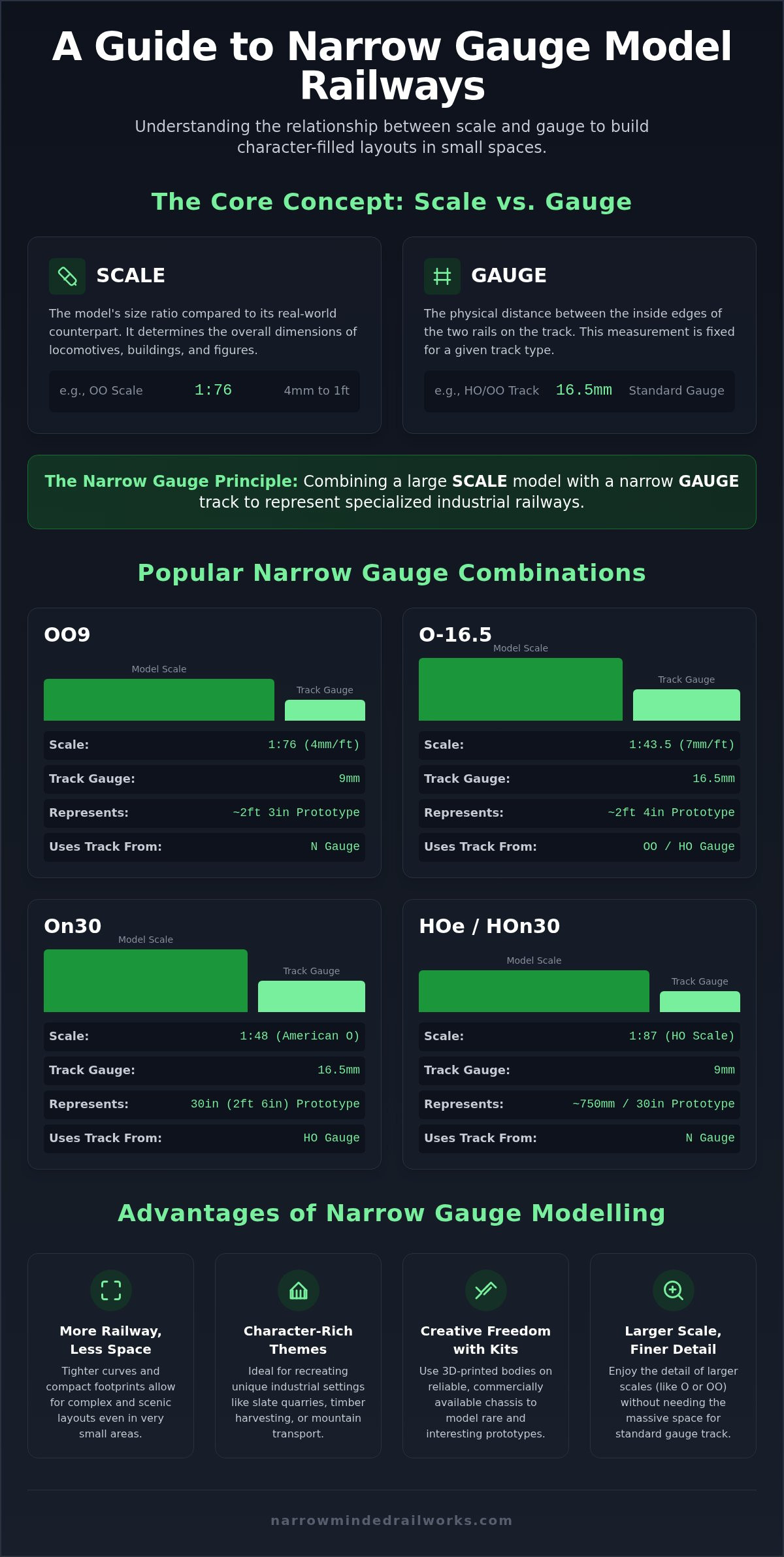
Understanding the difference between scale and gauge is the first step toward a successful build. Scale refers to the proportion of the model compared to the real thing, such as 4mm to 1ft (1:76). Gauge refers specifically to the distance between the rails. A common point of confusion is why a locomotive body looks so large compared to its wheels. This happens because the model is built to a larger scale but runs on "narrower" track to represent its industrial heritage.
For example, OO9 scale uses 1:76 scale bodies but runs on 9mm track. While this track width is the same as N gauge, the two aren't interchangeable in terms of scenery or rolling stock. The 9mm gauge represents roughly 2ft 3in in the real world when viewed at 1:76 scale. If you're looking for a comprehensive list of narrow-gauge scales, you'll see that naming conventions like "OO9" or "On30" always highlight the track width. This naming convention helps modellers quickly identify which track they need for their chosen scale.
Modellers often find the lack of ready-to-run narrow gauge stock a challenge, yet this provides the perfect opportunity to explore 3D-printed kits. By focusing on the kit aspect, you can create a unique fleet that fits onto reliable commercial chassis. This approach ensures your models have the character of the prototype while maintaining the smooth running of modern engineering.
Scale vs. Gauge: Clearing the Confusion
Scale and gauge are often used interchangeably, but they represent two distinct measurements. Scale is the ratio of the model to the real world, such as 1:76 or 1:43. This ratio determines the size of your locomotive body, the height of your miniature figures, and the dimensions of your buildings. Gauge is simply the distance between the rails. In the world of narrow gauge model railway scales, these two elements often cross over in creative ways. The golden rule for modellers is that you can have different scales running on the same track gauge, provided the proportions look correct for the prototype you're representing.
While we provide the scale-accurate bodies for your projects, the gauge is ultimately determined by the chassis you select. We don't sell the motors or ready-to-run chassis, but our designs are engineered to fit popular commercial power units. This approach allows you to achieve a high level of detail while benefiting from the reliable performance of established track standards. If you're just starting to explore these technical standards, the NMRA Beginner's Guide to model railways provides an excellent foundation for understanding how these measurements interact.
The UK Standard: 4mm and 7mm Modelling
British modellers typically use "mm to the foot" measurements rather than ratios. In 4mm scale (OO), using 9mm track creates OO9. This combination represents a 2ft 3in narrow gauge prototype. If you prefer a larger presence on your layout, 7mm scale (O) uses 16.5mm track to create O-16.5. This clever reuse of standard OO/HO track widths is a practical way to model narrow gauge without needing specialized track components for every project. If you're ready to start your first build, our OO9 and O-16.5 locomotive kits offer a straightforward entry point into this rewarding hobby.
International Standards: HOe, HOn3, and On30
International standards offer even more variety. HOe is common in Europe, utilizing 3.5mm scale on 9mm track. In North America, On30 has gained significant popularity by using 1:48 scale bodies on 16.5mm track. Some modellers prefer the "purist" approach of HOn3, which uses a specific 10.5mm track gauge to represent 3ft prototypes exactly. However, most enthusiasts find that using common gauges like 9mm or 16.5mm provides the best balance between prototype accuracy and the availability of parts. Choosing a combination with a strong community ensures you'll have access to the support and kits needed to complete your vision.
Popular Narrow Gauge Combinations and Their Track Gauges
Transitioning from the theoretical definitions of scale and gauge into practical application is where the hobby truly begins. Selecting from the available narrow gauge model railway scales requires a balance between the space you have and the visual impact you want to achieve. Most modellers find success by choosing a combination that utilizes standard track widths, which simplifies the construction process and ensures a wide variety of available parts. While we don't sell ready-to-run locomotives, our 3D-printed kits allow you to build unique prototypes that fit perfectly onto these standard chassis.
OO9: The King of Small Layouts
OO9 stands as the most popular choice for British modellers. It uses 1:76 scale bodies on 9mm track, which is the same width as N gauge. This allows you to build extensive layouts in very small spaces while using standard OO scale buildings and figures. The availability of track is a significant advantage; you can use standard N gauge track or specialized narrow gauge track with wider sleeper spacing for more realism. If you're ready to begin your journey, Your First OO9 Loco Kit provides a detailed roadmap for choosing your initial project and identifying compatible Kato or Bachmann chassis.
GN15: Large Scale in Small Spaces
GN15 offers a unique alternative for those who enjoy larger models but have limited room. It represents 15-inch "minimum gauge" railways at 1:24 scale, running on 16.5mm track. The result is a chunky, characterful locomotive that runs on standard HO/OO track. This scale is perfect for industrial dioramas, estate railways, or "micro-layouts" that fit on a bookshelf. While finding ready-to-run GN15 stock is difficult, we provide the locomotive and scenery kits needed to create a professional finish on a standard power unit. You can find more details in our guide on Getting Started in GN15 Scale.
O-16.5 and On30: The 7mm and 1:48 Powerhouses
For modellers who prioritize detail and presence, O-16.5 and On30 are the primary choices. O-16.5 uses 7mm scale (1:43.5) on 16.5mm track, representing roughly 2ft 3in gauge. This is a staple of British narrow gauge modelling. Conversely, On30 uses American 1:48 scale on the same track width. Both scales provide ample room for intricate kit-building, weathering, and adding interior cab details. These scales are particularly well-suited for 3D printing because the larger size allows for even finer surface textures. Our Introduction to On30 Gauge explains the nuances of this scale and how it differs from its British counterpart.
Why Model Narrow Gauge? Space, Character, and Complexity
Choosing between different narrow gauge model railway scales isn't just a technical decision; it's an aesthetic one. While standard gauge modelling often focuses on speed and vast distances, narrow gauge is about character and atmosphere. This shift in focus has fueled the "Micro-Layout" revolution, where enthusiasts build complete, functional railways on bookshelves or even in small suitcases. These projects prioritize the charm of the railway over the sheer size of the track plan.
One of the most charming expressions of this is the "Pizza" layout. These are tiny, circular tracks that fit in a footprint no larger than a dinner plate. They prioritize industrial charm over mainline efficiency, recreating the tight, clattering turns of a slate quarry or a peat bog. We recognize that finding ready-to-run models for these specific scenarios is nearly impossible. To solve this, we specialize in 3D-printed kits that allow you to build these quirky prototypes yourself. This ensures your layout doesn't look like a carbon copy of everyone else's while utilizing reliable commercial power units.
Maximum Detail in Minimum Space
The primary physical advantage of narrow gauge is the ability to use extremely tight radii. While a standard gauge HO or OO locomotive might struggle on anything less than an 18-inch curve, many narrow gauge model railway scales thrive on 9-inch or even 6-inch curves. This geometric flexibility completely changes your scenic-to-track ratio. Instead of track dominating the board, you have more room for detailed dioramas, weathered buildings, and dense foliage. You aren't just building a train set; you're creating a miniature world where the railway is a natural part of the landscape.
The Character of Quirky Prototypes
Narrow gauge lines like the Ffestiniog or Talyllyn weren't built for elegance; they were built for utility. This heritage gives the locomotives an undeniable personality that modern mainline diesels often lack. From the squat, powerful engines used in Welsh quarries to the coastal trams of the Isle of Man, these prototypes offer a level of visual interest that rewards the kit-builder. If you're still wondering what is a narrow gauge railway in a historical sense, it's helpful to view them as the rugged off-road vehicles of the rail world.
Embracing the kit-building aspect is the best way to capture this unique vibe. By moving away from the uniformity of ready-to-run models, you gain the freedom to customize every rivet and handrail. If you're ready to bring this level of detail to your own workbench, browse our collection of narrow gauge locomotive and wagon kits to find your next project.
Getting Started: Kits, Chassis, and 3D Printed Solutions
Moving from theory to practice in narrow gauge model railway scales requires a shift in mindset. Unlike standard gauge modelling, where ready-to-run locomotives are the norm, narrow gauge thrives on the kit-building tradition. This process allows you to create a unique fleet that isn't limited by what major manufacturers choose to mass-produce. By following a structured approach, you can bridge the gap between technical track standards and the creative freedom of the hobby.
The first step is to choose your scale based on your available footprint and visual preference. Once you've decided on a scale like OO9 or O-16.5, you must identify a reliable commercial chassis. We don't sell the motors or chassis ourselves; however, we design our kits to fit perfectly onto power units from established brands like Kato, Bachmann, or Oxford Rail. After securing your chassis, you can select a 3D-printed body kit that matches its dimensions. The final step involves painting and finishing, which transforms the raw resin into a professional-grade model ready for your layout.
The 3D Printing Advantage
Modern 3D printing has fundamentally changed how enthusiasts approach niche prototypes. In the past, modellers relied on white-metal kits that were often heavy and required significant filing to achieve a good fit. Modern resin prints offer a level of "cleanliness" and surface detail that was previously impossible to achieve at this scale. This technology allows us to produce rare industrial locomotives that major manufacturers typically ignore. While the assembly is simpler than traditional kits, the finishing process is vital for a realistic look. Our guide on Painting 3D Printed Models provides the techniques needed to achieve a perfect finish on these specialized surfaces.
Finding Your First Project
For those new to the hobby, we recommend starting with a simple wagon kit or a locomotive body designed for a Kato 109 chassis. These projects are forgiving and provide an excellent introduction to the assembly process. We recognize that sourcing your own motors and chassis adds an extra step to your build, but this is a proactive solution that ensures your models run on high-quality, reliable mechanisms. By providing the scale-accurate bodies and scenery, we help you focus on the creative aspects of the build while leveraging the best engineering the wider hobby has to offer.
Narrow gauge modelling is ultimately about creativity rather than following a strict rulebook. It's a hobby that rewards experimentation and personal expression. Whether you're building a tiny quarry line or a sprawling coastal tramway, the combination of 3D-printed kits and commercial chassis makes it easier than ever to get started. Don't worry about getting everything perfect on your first attempt. The joy of the hobby lies in the learning process and the satisfaction of seeing a unique locomotive of your own making traverse your tracks.
Build Your Own Unique Narrow Gauge World
Mastering the technical side of narrow gauge model railway scales is the first step toward creating a layout with genuine character. You now understand how to distinguish between scale and gauge, and how to leverage standard track widths to represent industrial prototypes. While ready-to-run models for these specific niches can be difficult to find, we provide a proactive solution through our specialist 3D-printed designs. We focus on OO9, GN15, and O-16.5 kits that are specifically engineered for easy fitment on popular commercial chassis.
Our kits allow you to move beyond mass-produced uniformity and build a railway that reflects your own creative vision. Whether you're modelling a Welsh quarry or a coastal tramway, we offer worldwide shipping to support your project no matter where you're located. It's time to take the knowledge you've gained and turn it into a physical model on your workbench. Explore our range of 3D printed narrow gauge kits today and start your next build with confidence. Your perfect miniature railway is just one kit away.
Frequently Asked Questions
What is the most popular narrow gauge model scale?
In the United Kingdom, OO9 is widely considered the most popular among narrow gauge model railway scales. This combination uses a 1:76 scale body running on 9mm track; it represents a prototype gauge of roughly 2 feet 3 inches. Its popularity stems from the vast availability of compatible scenery and the ability to build detailed layouts in small spaces. While we don't provide ready-to-run locomotives, we offer specialized kits to help you create unique rolling stock.
Can I run OO9 trains on N gauge track?
You can run OO9 trains on N gauge track because both systems utilize a 9mm track width. However, standard N gauge track often features sleepers that are too small and closely spaced for an authentic narrow gauge appearance. We don't sell track ourselves; however, we recommend using specialized narrow gauge track with wider sleeper spacing to achieve a better look. This proactive step ensures your larger 1:76 scale models look balanced against the rails.
What is the difference between OO9 and HOe?
The primary difference lies in the scale ratio rather than the track width. OO9 is a British standard using 1:76 scale, while HOe is a European standard using 1:87 scale. Both run on 9mm track, but the physical size of the locomotive bodies and figures will differ between the two. While we specialize in 1:76 scale OO9 kits, many of our scenery items and wagons can be adapted by modellers who prefer European standards.
Do I need special tools to build 3D printed narrow gauge kits?
You don't need specialized industrial equipment to assemble our 3D-printed kits. Standard modelling tools such as fine-grit sandpaper, a sharp hobby knife, and high-quality cyanoacrylate are sufficient for most projects. Because resin prints are cleaner than traditional white-metal kits, they require less preparation work before painting. We don't provide the adhesives or paints, but we do offer comprehensive guides to help you select the best finishing materials for a professional result on your workbench.
What chassis do I need for Narrow Minded Railworks kits?
Each of our kits is designed to fit a specific commercially available power unit. For many of our OO9 locomotive kits, we utilize the Kato 109 or Bachmann 0-6-0 chassis as the primary drive system. We don't sell these motors directly; however, we clearly state the required chassis on every product page. This allows you to source a reliable mechanism while we provide the scale-accurate body that gives your model its character.
Is On30 the same as O-16.5?
On30 and O-16.5 are not the same, although they both run on 16.5mm track. On30 follows the American O scale of 1:48, representing 30-inch gauge prototypes. O-16.5 follows the British 7mm scale of 1:43.5, representing roughly 2-foot 3-inch gauge lines. While the track is interchangeable, the size of the locomotives will be different. We offer specific kits for both narrow gauge model railway scales to ensure your project maintains consistent proportions during the build.
Why is narrow gauge track often called "crazy track"?
The term crazy track refers to the intentionally uneven and rustic appearance of industrial narrow gauge lines. Unlike mainline railways, these tracks were often laid quickly over rough terrain; this resulted in wobbles and varied sleeper spacing. While we don't manufacture track, many modellers use our diorama tools and scenery to recreate this weathered look. This approach adds significant character to a layout, provided you ensure your chassis remains reliably on the rails during operation.
Can I use standard OO scale buildings with OO9 trains?
You can use standard OO scale buildings with OO9 trains because both share the same 1:76 scale ratio. This is a significant advantage for modellers, as it provides immediate access to a massive range of ready-made structures and accessories. While we don't sell standard gauge buildings, we provide specialized narrow gauge scenery kits to complement these larger items. Using a mix of scenery helps ground your narrow gauge line in a realistic, shared-scale environment.