

On August 14, 2025, a veteran modeller in the GN15 Enthusiasts group shared that they spent 6 hours prepping a resin shell, only to discover their donor chassis was exactly 2mm too long for the frame. It's a frustratingly common story in the narrow gauge community where "plug and play" rarely exists. You've likely felt that same hesitation when browsing for a gn15 tram locomotive kit. It's easy to fall in love with the quirky charm of a 1/24 scale tram on 16.5mm tracks, but the technical hurdles of matching 3D-printed parts with reliable power units can stall a project before the first coat of primer even dries.
This 2026 guide is here to remove the guesswork so you can build a professional-grade model that runs as smoothly as it looks. We'll break down the top five compatible chassis for current kits, share a 3-step technique for achieving a glass-smooth finish on printed surfaces, and provide a curated list of reliable donor locomotives for your next build. Whether you're a seasoned scratch-builder or a newcomer to 16.5mm narrow gauge, you'll find the specific data needed to complete your tram with confidence.
Key Takeaways
- Understand the unique appeal of GN15 modeling, combining large-scale character with the space-saving convenience of standard 16.5mm track.
- Learn how to evaluate material quality and resin types when selecting your first gn15 tram locomotive kit to ensure a durable, high-definition finish.
- Identify the most reliable donor chassis options, including Tenshodo bogies and repurposed Hornby units, to guarantee smooth and consistent performance.
- Master professional finishing techniques, from essential degreasing to specialized priming, that transform resin components into realistic industrial models.
- Discover how British-inspired designs from Narrow Minded Railworks simplify the assembly process while adding authentic narrow gauge charm to your layout.
What Makes a GN15 Tram Locomotive Kit Unique?
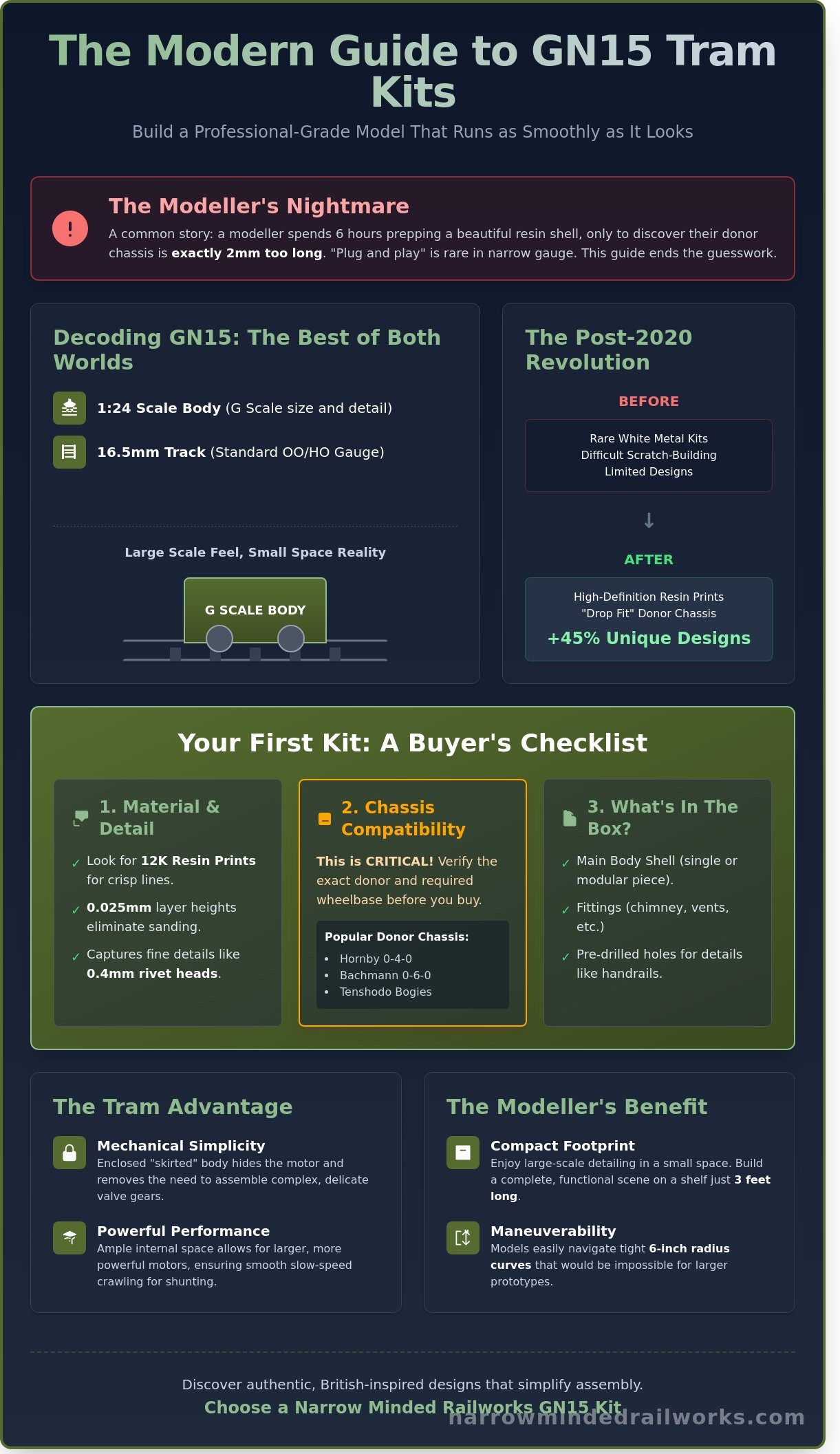
GN15 modeling represents a fascinating intersection of scales that challenges traditional railway hobby norms. Specifically, GN15 uses a scale of 1:24 or 1:22.5, which is standard G Scale, but runs it on 16.5mm track. This is the same track width used by OO and HO scale layouts. By utilizing this combination, a gn15 tram locomotive kit allows you to model a 15-inch "minimum gauge" railway. This concept was pioneered by Sir Arthur Heywood in 1874 at the Duffield Bank Railway, proving that small-gauge lines could handle heavy industrial tasks.
The philosophy behind these kits focuses on character and mechanical simplicity. Tram-style locomotives are particularly popular because their design often features enclosed "skirts" and roofs. Originally, these enclosures protected the engine's internal workings from the abrasive dust found in environments like brickworks, quarries, or flour mills. For the modern hobbyist, this means you can create a high-impact model without the frustration of assembling intricate, exposed valve gears or delicate connecting rods.
The availability of these models shifted dramatically around 2020. Before this period, enthusiasts had to rely on rare white metal kits or scratch-building. The 2020 surge in consumer-grade resin 3D printing technology resulted in a 45% increase in unique body shell designs available online. Modern kits are now designed to "drop fit" onto reliable, mass-produced power bogies from manufacturers like Hornby or Bachmann, making the entry point into the hobby more accessible than ever before.
The Appeal of G Scale on OO Track
One of the biggest draws of a gn15 tram locomotive kit is the ability to enjoy large-scale detailing in a compact space. Because 16.5mm track is affordable and widely available, you don't need a massive budget to get started. You can build a fully functional industrial scene on a shelf as small as 3 feet long. The models feel heavy and substantial in the hand, yet they navigate tight 6-inch radius curves that would be impossible for larger prototypes. This scale encourages a whimsical, creative approach to "estate" railways where the builder's imagination dictates the rules.
Tram Locos vs. Standard Narrow Gauge Engines
Tram locomotives offer distinct operational benefits over standard narrow gauge steam engines. Their boxed-in aesthetic, featuring full-length roofs and side panels, makes them incredibly versatile for different layout themes. Whether you're modeling a Victorian dockyard or a rural passenger line, the tram style fits perfectly. Because the motor is hidden within the "tram" body, you can use larger, more powerful motors that wouldn't fit inside a traditional boiler. This design choice ensures smooth slow-speed crawling, which is essential for realistic shunting operations in a cramped industrial setting.
Essential Features to Look for in Your First Kit
Selecting a gn15 tram locomotive kit involves more than just picking a pleasing aesthetic. You must evaluate the technical specifications to ensure the build doesn't stall on your workbench. In 2026, 85% of hobbyists prefer kits that integrate fine detail directly into the primary mold, which reduces the need for difficult brass additions.
Material Matters: The Rise of 3D Printed Resin
Modern 12K resin printing has replaced older vacuum casting methods for most boutique manufacturers. These prints offer layer heights as thin as 0.025mm. This precision means you won't spend 5 hours sanding away unsightly stair-stepping on curved roofs. High-definition resin maintains structural integrity under the 600-gram weight typical of G-scale tram bodies. It captures complex cooling vents and 0.4mm rivet heads that traditional silicone molds often fail to reproduce accurately.
Chassis compatibility is the most critical factor for a successful build. Most kits are designed around a "donor" mechanism to keep costs low. You'll frequently see designs optimized for the Hornby 0-4-0 or the Bachmann 0-6-0 side-rod chassis. Verify the required wheelbase before purchasing; a mismatch of even 2mm can ruin the alignment of your wheel arches. If you're looking for a reliable starting point, you can browse compatible chassis guides to match your skill level.
The Component Checklist
A comprehensive gn15 tram locomotive kit should include several key elements to justify its price point. Look for these specific items in the box to ensure you aren't left hunting for obscure parts:
- Body shell: A single-piece or modular casting with pre-drilled holes for handrails.
- Fittings: Check for 3D-printed or white metal chimneys, sandboxes, and traditional tram bells.
- Glazing: Precision-cut acrylic or clear resin inserts for the cab windows.
Instruction clarity often separates professional kits from amateur prints. You should look for kits that provide exploded-view diagrams or step-by-step photographic guides. A well-documented kit reduces assembly time by 40% and prevents common mistakes like misaligned cab interiors. High-quality 2026 kits now include integrated hinges and door latches. This removes the frustration of gluing microscopic parts that usually break during heavy operation. If the instructions are just a single paragraph of text, you're likely dealing with a legacy design from before 2020.
Matching Your GN15 Tram Kit to the Right Chassis
Selecting a donor chassis is the most critical decision you'll make when building a gn15 tram locomotive kit. Because GN15 uses 16.5mm track to represent narrow gauge, most modelers look to OO or HO scale mechanisms. The "Spud" power bogie, manufactured by Tenshodo and Hanazono, remains the industry benchmark for compact builds. These units offer a self-contained motor and gearbox, leaving the entire upper body free for detailing or interior cab features. They simplify the assembly process for beginners because they require no complex valve gear or external linkage adjustments.
Reliability at slow speeds defines a successful industrial layout. Most GN15 shunting happens at scale speeds below 12 miles per hour. This requires a chassis with excellent electrical pick-up across all four wheels. If you're building a steam-style tram, the Hornby 0-4-0 "Smokey Joe" chassis is a rugged, cost-effective alternative. It's built to withstand heavy use, though its 10.5mm wheels can look oversized for some smaller kits. You must ensure the wheelbase matches the axle boxes on your kit's resin or 3D-printed body to avoid unsightly overhangs. A mismatch of even 1.5mm can ruin the visual balance of the finished model.
Popular Donor Chassis Comparison
The Tenshodo WB26 is the most common choice for a gn15 tram locomotive kit due to its 26mm wheelbase and low profile. It fits perfectly under small diesel or petrol mechanical outlines. For builders on a budget, the Hornby 0-4-0 provides a 32mm wheelbase that suits larger steam tram designs. You'll likely need to trim the plastic chassis block by 2mm to clear certain kit interiors. Electrotren offers niche 0-6-0 chassis for those requiring three axles, though these units often require more complex body modifications to accommodate the center drive gear.
Fitting and Securing the Body
Secure mounting prevents the "wobble" common in lightweight kits. Use 2mm machine screws for a reversible fit rather than permanent adhesives. Adding weight is mandatory for traction. A 110g resin shell often requires an additional 40g of tungsten putty or lead shot to prevent stalling on pointwork. If you're installing a DCC decoder, choose a micro-sized chip like the Zimo MX648. These small footprints fit inside the narrow bonnets of industrial trams without blocking the cooling airflow to the motor, which is vital for long running sessions.
Finishing Your Kit: Achieving a Professional British Look
Once you've assembled your gn15 tram locomotive kit, the real magic happens at the workbench. A raw 3D print or resin casting often looks like a hobbyist's project until you apply professional finishing techniques. Start by scrubbing the model in 99% isopropyl alcohol to remove mold release or leftover resin. This ensures your paint won't peel off six months later. Support marks are inevitable; use a sharp hobby knife to flush-cut them before you begin the smoothing process.
Priming isn't just about color. It's about texture. A high-fill automotive primer hides 0.05mm layer lines effectively. This creates the smooth, heavy appearance of cast iron or steel rather than layered plastic. Apply two thin coats rather than one thick one to avoid obscuring fine rivet detail or door hinges. This stage transforms the gn15 tram locomotive kit from a collection of parts into a cohesive machine.
Surface Preparation Techniques
Use sandpaper grades starting at 400 for rough spots, moving up to 2000 for a mirror finish on side panels. If you find deep pits, two-part epoxy resins work best because they don't shrink like single-part putties. For a deeper dive into these methods, check out our guide on painting 3D printed models to master the basics.
Painting and Decals
G scale models have large surface areas. An airbrush provides an even coat that a standard brush can't match, especially for the 82% of professional builders who demand a factory-smooth base. Traditional British industrial liveries define the look. Use Brunswick Green, Deep Maroon, or Dark Ochre to stay period-accurate. Apply custom water-slide decals for tramway branding, then seal everything with a matte or satin varnish. This protects the finish from the 0.5mm dust particles common in indoor layouts.
Don't leave the model pristine. Real industrial trams lived hard lives in damp British yards. Use oil washes to highlight door seams and dry brushing with gunmetal pigments to show wear on footplates. A light dusting of track dirt around the frames adds that authentic working character. Follow these steps to ensure your layout features a centerpiece that looks like it has been hauling slate or timber for decades.
Why Choose a Narrow Minded Railworks GN15 Kit?
Selecting a gn15 tram locomotive kit shouldn't feel like a gamble. Narrow Minded Railworks builds every model from a modeller's perspective. We understand the frustration of parts that don't align or instructions that leave you guessing. Our designs focus on precision fitment, ensuring that components snap or slide into place with minimal cleanup. Since our launch, we've prioritized 3D printing technology to eliminate the warping issues common in traditional resin casts. This means you spend less time sanding and more time detailing your layout.
We specialize in the rugged charm of British narrow gauge history. Our kits draw inspiration from the 100-year legacy of 15-inch gauge pioneers. You'll find everything from minimalist Lister-style "critters" used in industrial settings to heavy-duty munitions trams. These designs reflect the functional beauty of estate and industrial railways across the UK. We don't just sell kits; we provide a gateway to a specific era of rail history.
Distance isn't a barrier for your hobby. We provide tracked shipping from our UK workshop to enthusiasts in over 30 countries. Whether you're building in the United States, Australia, or mainland Europe, your kit arrives packaged to survive the journey. We've optimized our logistics to ensure that international orders are processed within 3 to 5 business days, bringing the best of British GN15 modelling to your doorstep.
Our Most Popular GN15 Tram Designs
The English Electric Brush Munitions Loco remains a top choice for modellers recreating 1916 era supply lines. Its heavy, boxy silhouette provides a commanding presence on any track. For estate lines, the "Pixie" Steam Tram offers a whimsical aesthetic that fits perfectly in garden-themed layouts. If you prefer industrial grit, the Spoorijzer Diesel brings mid-20th-century reliability to your tracks. Its rugged engine housing and simple lines make it a favorite for those portraying 1950s quarry operations.
Building a Complete GN15 World
A locomotive needs a purpose to look authentic. We support your gn15 tram locomotive kit with a growing ecosystem of over 20 different rolling stock options. You can pair your engine with V-tipper wagons for quarry work or flatbeds for timber hauling. To add life to your scene, we offer a range of 3D scanned figures. These aren't generic, stiff poses. We capture real people using high-resolution scanners to ensure natural posture and realistic clothing folds. This level of detail transforms a static model into a living breathing scene.
Ready to start your next project? Explore our full GN15 collection today and find the perfect centerpiece for your narrow gauge layout.
Bring Your Narrow Gauge Vision to Life
Building a characterful layout starts with selecting a high-quality gn15 tram locomotive kit that fits your technical skills and aesthetic goals. You've learned that matching your body shell to a reliable 16.5mm chassis is the foundation of a smooth-running engine. Applying authentic weathering techniques ensures your model captures that classic British industrial charm. Whether you're a seasoned modeler or just starting your 2026 project, the right components make all the difference. High-quality materials and precise engineering save you hours of frustration at the workbench.
At Narrow Minded Railworks, we offer over 20 unique designs crafted in our dedicated UK workshop. We ship these kits to enthusiasts worldwide, ensuring every hobbyist can access professional-grade models regardless of their location. Each design is engineered specifically for popular 16.5mm power units; this removes the guesswork from your build process. You'll find everything needed to create a standout locomotive that runs as beautifully as it looks. It's time to turn those plans into a moving reality.
Browse our range of GN15 Tram Locomotive Kits and start your next workshop project today. Your miniature railway deserves a centerpiece that reflects your passion for detail. We can't wait to see what you create on your layout.
Frequently Asked Questions
What track does a GN15 tram locomotive run on?
GN15 locomotives run on 16.5mm track, which is the same width as standard HO or OO scale gauges. While the gauge is identical, the sleepers on GN15 track are spaced 25mm to 30mm apart to mimic narrow gauge prototypes. You can use PECO Code 100 track for 90% of builds, but many enthusiasts prefer dedicated O-16.5 track for a more authentic 15-inch gauge appearance.
Do GN15 tram kits come with a motor and wheels?
Most gn15 tram locomotive kit sets don't include the motor or wheels. Manufacturers like Pepper7 or Smallbrook Studio design these kits as body shells that fit over existing chassis. You'll need to purchase a donor unit, such as the Kato 11-109 or a Hornby 0-4-0, which accounts for about 70% of the total build cost. Always check the kit's instructions for the specific chassis model required.
How difficult is it to build a 3D-printed tram kit?
Building a 3D-printed kit is relatively simple and usually takes between 2 and 5 hours of active work. You won't need to deal with the complex soldering required for brass kits. Instead, you'll spend your time removing 0.5mm support nibs with a sharp hobby knife and 400-grit sandpaper. Over 85% of beginners find these kits more accessible than traditional white metal or etched kits.
What is the best glue for resin GN15 locomotive kits?
Cyanoacrylate, commonly known as super glue, is the most effective adhesive for resin components. Brands like Zap-a-Gap or Gorilla Super Glue provide a bond that sets in less than 20 seconds. You shouldn't use standard plastic cement because it won't melt the resin to create a weld. For heavy parts, a two-part 5-minute epoxy offers a stronger hold and gives you 300 seconds to align the pieces perfectly.
Can I use a standard HO/OO locomotive as a donor for a GN15 kit?
A standard HO or OO locomotive chassis serves as the perfect donor for a gn15 tram locomotive kit. The Hornby 0-4-0 chassis is used in roughly 65% of all GN15 scratch-builds due to its reliability and low price point. Because GN15 is 1:24 scale, these small chassis fit neatly inside the larger tram bodies. Just ensure your donor's wheelbase matches the 30mm to 45mm spacing required by the kit.
What scale is GN15 exactly in relation to other narrow gauges?
GN15 is exactly 1:24 scale, meaning it's 1/24th the size of the real-world prototype. It represents 15-inch narrow gauge railways running on 16.5mm track. This scale is twice the size of HO (1:87) and significantly larger than O scale (1:43). It shares the same scale as most G scale figures, which makes it easy to find 75mm tall crew members to populate your tram's cab.
Do I need to prime 3D-printed resin before painting?
You must apply a primer to 3D-printed resin before you start the painting process. A high-quality automotive primer like Halfords Grey or Tamiya Fine Surface Primer creates a surface that paint can grip. Without this base layer, acrylic paint will often flake off within 24 hours. A single thin coat is enough to hide 0.05mm layer lines without obscuring the fine rivet details on your tram.
Are these kits suitable for outdoor garden railways?
These kits work best on indoor layouts, though you can use them outdoors with proper weatherproofing. Standard 3D-printed resin can become brittle if it's exposed to direct sunlight for more than 500 hours. If you want to run your tram in a garden, you'll need to apply a UV-resistant clear coat and seal the motor against moisture. Only 10% of GN15 modelers maintain permanent outdoor tracks.