

You might assume that using 9mm track always results in a tiny, shelf-sized layout, but the choice between OO9 vs GN15 scale proves that the same rails can support vastly different worlds. While both scales share the same track width, they represent entirely different proportions of the real world. One focuses on the sweeping landscapes of Welsh narrow gauge, while the other brings the intricate, chunky detail of industrial estate railways into your home.
It's understandable to feel frustrated when scale and gauge terminology starts to blur, particularly if you're working with limited space. You need to know if a model will be too fiddly to handle or too bulky to store before you invest your time. This article breaks down the technical differences, creative potential, and physical footprints of both scales. We'll explore which donor chassis work best for each and how 3D-printed kits make these unique narrow gauge paths accessible for every modeller. By the end, you'll know exactly which scale matches your physical dexterity and your vision for a perfect layout.
Key Takeaways
- Understand the fundamental technical difference between scale and gauge to avoid common purchasing mistakes.
- See how OO9 allows for dramatic scenery and long train runs while remaining compatible with standard OO scale accessories.
- Explore the creative freedom of GN15, which offers a larger 1:24 scale for easier handling and intricate mechanical detailing.
- Determine which path fits your home by comparing the physical footprints and space requirements of an OO9 vs GN15 scale layout.
- Find out how 3D-printed resin kits provide a high-detail, accessible entry point into narrow gauge modelling without the need for complex scratch-building.
Scale vs. Gauge: Decoding the OO9 and GN15 Technical Divide
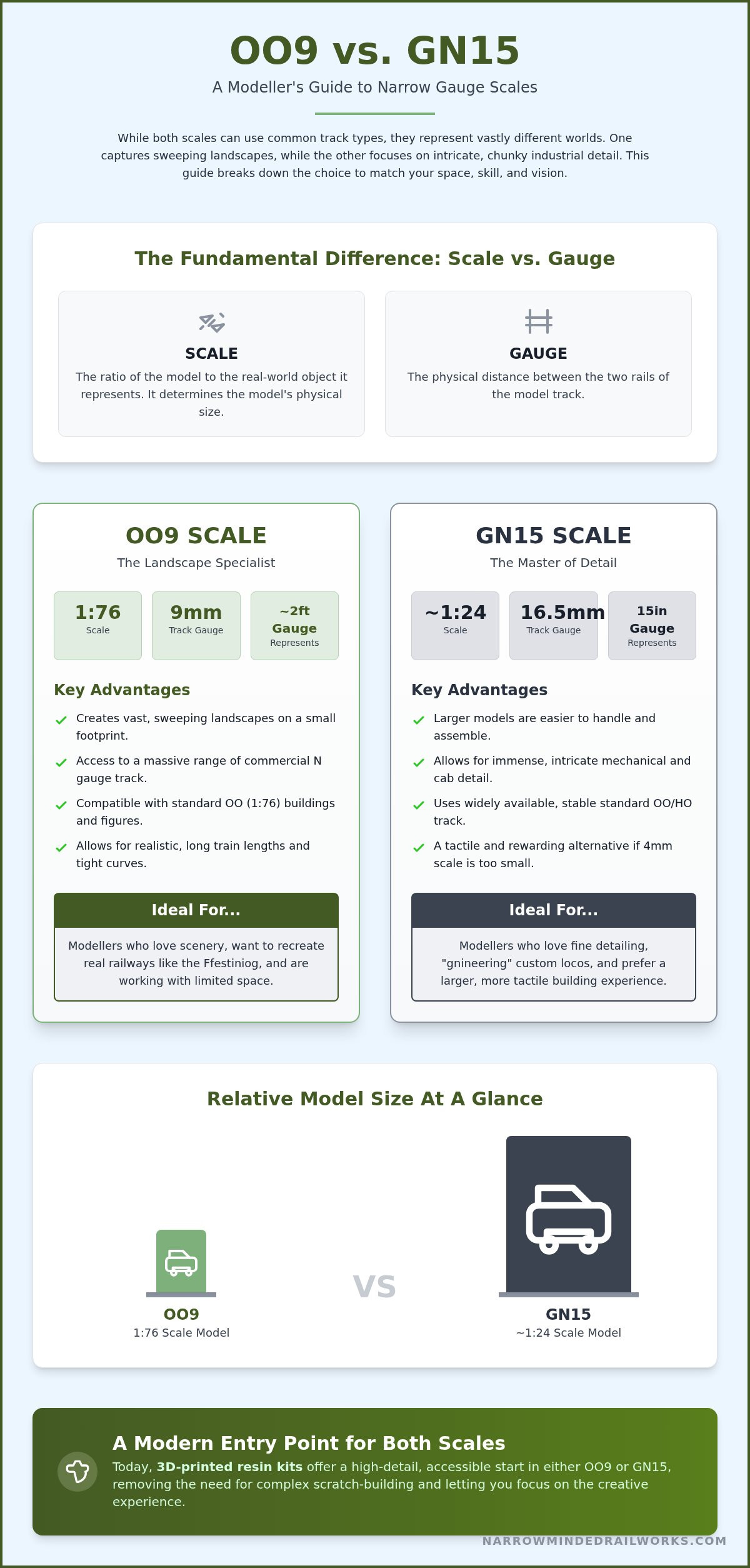
Understanding the technical nuances of an OO9 vs GN15 scale project starts with a simple distinction. Scale refers to the ratio of the model to the prototype, while gauge is the physical distance between the rails. In narrow gauge modelling, enthusiasts often borrow track from other scales to represent different prototypes. This creates a fascinating paradox where the larger physical track actually models a narrower real-world railway because the scale of the figures and buildings is so much bigger.
Most narrow gauge prototypes fall into the "minimum gauge" category, representing railways between 15 inches and 2 feet wide. These were rarely used for long-distance travel, instead serving as industrial workhorses for quarries, mines, or private estates. By choosing between OO9 and GN15, you're deciding which of these unique histories you want to recreate on your workbench. Each path offers a different solution to the challenge of modelling narrow gauge without scratch-building every single component.
The 9mm Track Advantage for OO9
The OO9 scale uses a ratio of 4mm to the foot (1:76) and runs on 9mm track. Since 9mm is the standard for N gauge, modellers can access a massive range of commercial track, points, and crossings. This makes it a highly accessible entry point for those transitioning from standard OO layouts. You don't need to worry about hand-laying sleepers or soldering complex turnouts; you can simply buy Peco or Kato track and start building.
The compact nature of 9mm mechanisms allows for incredibly tight curves and intricate layouts in small spaces. Because the scale is 1:76, you can use standard OO scale buildings, vehicles, and figures to populate your scene. This compatibility reduces the cost and effort of sourcing scenery, letting you focus on the unique locomotives and rolling stock that define the narrow gauge experience.
GN15 and the 16.5mm Standard
GN15 takes a different approach by using 16.5mm track, which is the standard for OO and HO gauge. However, the scale is much larger, typically 1:24 or 1:22.5. This means a GN15 locomotive is significantly bigger than an OO9 equivalent, even though it represents a narrower 15-inch gauge prototype. This scale is often referred to as "Gnineering," a term that highlights the creative culture of repurposing standard OO gauge chassis and components for large-scale narrow gauge models.
Using 16.5mm track provides a stable and reliable foundation for your layout. It's arguably the most accessible starting point because almost every model railway shop in the UK stocks OO gauge track. For modellers who find 4mm scale parts too small to handle, the 1:24 scale of GN15 offers a tactile and rewarding alternative. You gain the ability to add immense detail to your locomotive cabs and scenery without needing the steady hands of a watchmaker.
OO9 Scale: Capturing the Grandeur of the Narrow Gauge Landscape
When deciding between OO9 vs GN15 scale, the primary draw of OO9 is the ability to model vast, sweeping environments. Because the trains are physically small, a standard four-foot baseboard can represent a sprawling Welsh slate quarry or a remote peat bog railway. This scale excels at showing the relationship between the train and the rugged terrain it traverses. It's the premier choice for modellers who want to recreate the atmosphere of the Ffestiniog or Talyllyn railways without needing a dedicated outbuilding to house the layout.
One major advantage is the overlap with standard OO gauge. You can populate your layout using the enormous range of 4mm figures, vehicles, and structures available from mainstream manufacturers. Resources from The Model Railway Club often highlight how these shared resources help beginners build a convincing world without needing to scratch-build every fence or shed. While working in 4mm scale presents challenges with tiny components, using 3D-printed bodies provides a stable, highly detailed alternative to older, heavier white metal kits.
Landscape and Perspective in 1:76
OO9 allows for realistic train lengths that would be impossible in larger scales. A six-wagon slate train looks proportional and impressive even on a modest shelf layout. This perspective is the defining factor in the OO9 vs GN15 scale debate for many enthusiasts. You have the vertical space to include dramatic features like stone viaducts or deep cuttings, creating a sense of "place" rather than just a simple oval of track. It transforms the layout from a mere train set into a miniature window into the British countryside.
OO9 Kit Building Essentials
While older kits were often difficult to assemble, modern 3D-printed resin bodies are designed for simplicity and precision. These kits are engineered to fit directly onto reliable donor chassis from N gauge manufacturers. This approach solves the historical problem of poor running quality in small-scale narrow gauge. If you're ready to start your first project, Your First OO9 Loco Kit: A Beginner’s Guide provides a detailed walkthrough of what to look for.
- Donor Chassis: Look for Kato or Graham Farish N gauge mechanisms for the best performance.
- Weight Management: Small resin locos need internal weighting to ensure consistent electrical contact.
- Detailing: Use fine brass wire for handrails to add a professional finish to your 3D-printed body.
If you're looking for an accessible way to build your fleet, browsing our range of OO9 locomotive and wagon kits is a great way to see the variety of prototypes available for your next project.
GN15 Scale: The Art of Gnineering and Large-Scale Detail
If OO9 is about the journey, GN15 is about the machine. This scale focuses on the "minimum gauge" philosophy pioneered by Sir Arthur Heywood, who believed 15-inch gauge railways were the ideal solution for serving large British estates and industrial sites. By choosing 1:24 scale, modellers can celebrate the mechanical quirks and individual character of these small but mighty engines. While the OO9 vs GN15 scale debate often focuses on track width, the real difference lies in the tactile experience of the build.
The 1:24 scale provides a significant advantage for enthusiasts who find 4mm scale components difficult to manage. If limited dexterity or failing eyesight makes handling tiny N gauge parts a chore, the larger proportions of GN15 offer a proactive solution. You gain the freedom to add individual rivets, detailed cab controls, and highly expressive figures that would be almost invisible in smaller scales. Even though The 009 Society remains a cornerstone of the narrow gauge community, many members find themselves drawn to the chunky, hand-crafted aesthetic that only GN15 provides.
The "Pizza" Layout: GN15 in Small Spaces
A common misconception is that larger scales require larger rooms. GN15 challenges this by excelling in "pizza" layouts, which are circular tracks built on a base no larger than a medium-sized pizza box. Because 16.5mm track is wider and more stable than 9mm track, it allows for surprisingly tight curves when paired with short-wheelbase locomotives. This makes it possible to build a highly detailed industrial or estate scene on a bookshelf or a small coffee table. You don't need a spare bedroom to enjoy large-scale narrow gauge; you just need a creative approach to your layout's footprint.
Donor Chassis and Kit-Bashing for GN15
The term "Gnineering" perfectly describes the creative culture surrounding this scale. Most GN15 locomotives are built by repurposing reliable OO gauge donor chassis, such as the ubiquitous Hornby "Smokey Joe" or similar 0-4-0 mechanisms. This approach provides a robust and affordable foundation for your models. There are fewer rigid rules in GN15 compared to traditional scales, encouraging a spirit of kit-bashing and modification. If you're eager to pick up your tools, Getting Started in GN15 Scale: Your Complete Guide offers practical advice on selecting your first project and donor components.
Our range of GN15 locomotive and scenery kits is designed to bridge the gap between standard OO components and the unique world of 1:24 scale narrow gauge, making it easier than ever to start your "Gnineering" journey.
The Modeller’s Dilemma: Comparing Space, Cost, and Complexity
Choosing between these two paths involves balancing your available room against your preferred level of detail. The most immediate difference lies in the physical size of the inhabitants of your world. A 1:76 scale figure used in OO9 stands roughly 24mm tall, while a 1:24 figure for GN15 is approximately 75mm. This discrepancy impacts every decision you make in the OO9 vs GN15 scale journey, from the height of your shelves to the size of the brushes in your toolkit.
Cost and complexity also scale differently. OO9 requires precision and a steady hand to handle tiny components, but it benefits from the massive economy of scale in the 4mm market. GN15 models use more material and resin due to their volume, yet they are often more forgiving to build. The "fiddle factor" is a genuine consideration; if you enjoy the challenge of microscopic detailing, OO9 is rewarding. If you prefer a more tactile, robust building experience where parts are easy to grip, GN15 provides a proactive solution to those frustrations.
Space Requirements: Long Runs vs. Micro Scenes
A standard 6ft by 4ft baseboard allows an OO9 modeller to create a complete railway system with multiple stations and long scenic runs. However, if your domestic space is limited to a small shelf or a 2ft square corner, GN15 excels. A GN15 micro-layout can feel like a complete, busy industrial scene in a footprint that would look empty in a smaller scale. You must also account for vertical space. GN15 locomotives and buildings are significantly taller, requiring more clearance between shelves than an OO9 equivalent.
Sourcing Parts and Scenery
Finding accessories used to be a significant barrier, but 3D printing has effectively solved the sourcing issue for both scales. OO9 modellers have the advantage of using the enormous range of OO gauge buildings, vehicles, and figures found in almost any UK hobby shop. GN15 modellers find their niche by repurposing 1:24 dollhouse items, G scale garden railway accessories, or even high-quality vehicle models; you can visit Diecast Cartel to find 1:24 scale cars and trucks that fit perfectly into a larger-scale layout. This creative sourcing is part of the charm of the larger scale, allowing you to find unique details that aren't typically seen on standard layouts.
If you are still weighing up which size fits your workspace, browsing our range of detailed narrow gauge kits can help you visualise the physical presence of each scale before you start laying track.
Choosing Your Path: Why 3D Printed Kits are the Perfect Entry Point
Narrow gauge modelling often suffers from a lack of ready-to-run locomotives, which can deter newcomers who aren't ready for scratch-building. 3D-printed resin kits provide a proactive solution by offering high-quality bodies that require minimal assembly. Unlike traditional white metal kits, resin is lightweight and captures exceptionally fine detail, allowing for crisp rivets and panel lines that remain sharp even after several coats of paint. Whether you choose OO9 vs GN15 scale, these kits remove the need for complex metalwork and the specialized soldering tools that once made the hobby inaccessible.
Preparing and finishing your first kit is a straightforward process, though it requires a methodical approach. You may occasionally find minor support marks on the resin, but these are easily removed with a fine sanding stick. By addressing these small imperfections early, you ensure a perfect surface for priming. This modern manufacturing method bridges the gap between the simplicity of standard gauge sets and the bespoke nature of narrow gauge, giving you a professional result without years of engineering experience.
Simplicity for the Beginner
Many modellers hesitate to start a project because they fear the mechanical complexity of building a chassis. Our kits utilize a "drop-on" design, where the 3D-printed body is specifically engineered to fit directly onto a reliable commercial chassis. This ensures your locomotive runs smoothly from day one, avoiding the common pitfalls of poor electrical pickup or jerky movement. Once you've secured the body to the mechanism, you can focus on the artistic side of the hobby. If you're nervous about the final look, Painting 3D Printed Models: A Beginner’s Guide walks you through the steps to achieve a flawless finish.
Customisation and "Gnineering"
While the base kit provides the structure, the real joy of narrow gauge comes from adding your own unique touches. You can use diorama tools and scenery materials to bed your railway into its environment, adding personality through weathering or additional brass fittings. This is especially true in GN15, where the "Gnineering" spirit encourages you to modify and adapt parts to suit your specific industrial theme. 3D printing acts as a stable foundation, giving you the confidence to experiment with custom details without the risk of ruining an expensive, one-off model.
Your final decision in the OO9 vs GN15 scale debate should depend on your ultimate goal. If you want to watch a train disappear into a miniature forest or traverse a steep mountain pass, OO9 is your best path. If you prefer the tactile satisfaction of a chunky, characterful machine that you can easily handle and detail, GN15 is the superior choice. Both scales offer a rewarding escape from the world of standard gauge. Explore our range of OO9 and GN15 kits today!
Start Your Narrow Gauge Journey Today
Choosing between OO9 vs GN15 scale doesn't have to be a source of frustration. If you desire the sweeping vistas of a Welsh slate line, OO9 offers the perfect landscape-to-train ratio. For those who prefer the chunky, mechanical charm of an estate railway, GN15 provides a tactile and rewarding building experience. While the lack of ready-to-run models in narrow gauge can seem like a constraint, our 3D-printed kits offer a proactive solution that gets you modelling immediately.
We provide expertly designed kits for both scales, alongside detailed figures and scenery scanned from real people to bring your scenes to life. Whether you're building a shelf-sized micro-layout or a larger system, we support your hobby with worldwide shipping for all locomotive and wagon kits. Browse our collection of 3D-printed narrow gauge kits and find the perfect starting point for your next layout. There's never been a better time to discover the unique character of narrow gauge railways.
Frequently Asked Questions
Is OO9 the same as N gauge?
No, they are different scales that happen to share the same 9mm track gauge. OO9 is modelled at 4mm to the foot (1:76 scale), while British N gauge is 2.06mm to the foot (1:148 scale). While you can use N gauge track for your layout, an OO9 locomotive is significantly larger than an N gauge equivalent. This allows for much more detail in the cab and bodywork while maintaining a compact footprint.
Can I run GN15 locomotives on my existing OO gauge track?
Yes, GN15 is specifically designed to run on 16.5mm track, which is the standard for OO gauge. However, you must account for the much larger 1:24 scale proportions. While the wheels fit the rails, the locomotive bodies are much taller and wider than standard OO trains. You will likely need to increase clearances for tunnels, bridges, and station platforms to accommodate the larger scale of the rolling stock.
What is the best donor chassis for a GN15 locomotive kit?
The Hornby 0-4-0 "Smokey Joe" or similar small industrial chassis remains the most popular choice for GN15 projects. These mechanisms are robust, affordable, and readily available across the UK. Their short wheelbase allows them to navigate the tight curves common on narrow gauge layouts. If you require a different wheelbase, many modellers also repurpose Bachmann or Oxford Rail shunter chassis to provide a reliable foundation for their kits.
Are OO9 models too small for beginners to build?
While the components are small, modern 3D-printed kits provide a proactive solution to the complexity of traditional metal kits. You don't need to master soldering or heavy filing to achieve a professional result. If you find 4mm scale parts too fiddly to handle, GN15 offers a more tactile alternative. However, many beginners find OO9 perfectly accessible when starting with a simple body kit designed for a reliable commercial chassis.
What scale is GN15 exactly?
GN15 is typically modelled at 1:24 scale, though some modellers use 1:22.5. It represents a 15-inch narrow gauge railway running on 16.5mm track. This large scale is what defines the OO9 vs GN15 scale choice for many. While OO9 focuses on the landscape at 1:76, GN15 prioritises the mechanical detail and presence of the machinery itself. This makes it an excellent choice for those who enjoy intricate detailing and characterful figures.
Do I need a special controller for narrow gauge model railways?
No, you can use any standard 12V DC analogue controller or DCC system that matches your chosen donor chassis. Narrow gauge locomotives use the same motor technology as standard gauge models. If you're using a modern N gauge chassis for an OO9 project, a standard controller provides smooth slow-speed running. Always check the specific voltage requirements of your motor, as some very small industrial mechanisms may require a lower voltage output.
How do I remove support marks from a 3D printed railway kit?
You should use a fine sanding stick or a sharp hobby knife to gently level any remaining pips from the printing process. Resin is a stable material but can be brittle, so it's best to work slowly with light pressure. Once you've sanded the area smooth, a quick coat of primer will reveal if any further work is needed. This proactive preparation ensures a flawless finish when you eventually apply your final topcoat and weathering.
Where can I find 1:24 scale figures for my GN15 layout?
You can find suitable figures within the 1:24 dollhouse market or from specialist large-scale railway suppliers. We also produce a range of figures specifically designed to match our GN15 kits. Many of these are scanned from real people to provide natural poses and realistic clothing textures. Using correctly scaled figures is essential for establishing the true size and "minimum gauge" feel of a GN15 industrial or estate railway scene.