

A layout without the rhythmic clatter of a Hudson tipper isn't a true industrial narrow gauge railway. While the terminology surrounding o-16.5 Hudson skip wagon kits often creates unnecessary confusion for modelers, identifying the right scale is the first step toward an authentic scene. Whether you refer to it as O-16.5, NG7, or On30, the goal remains the same: capturing the rugged spirit of Robert Hudson Ltd's iconic "V-skip" designs in 7mm scale.
We recognize that achieving a realistic, weathered finish can be difficult when kit instructions are sparse or materials feel unfamiliar. This guide provides the proactive solutions you need to master the art of building and detailing these kits for a professional result. You'll learn the history of these industrial workhorses, compare the merits of 3D-printed and laser-cut assemblies, and discover weathering techniques that bring resin and wood to life. By the end of this article, you'll have the confidence to build a fleet that looks like it has survived decades of hard labor in a rugged quarry environment.
Key Takeaways
- Understand how 7mm scale modeling utilizes 16.5mm track gauge to create a convincing narrow gauge environment on standard infrastructure.
- Choosing materials is often a trade-off, but comparing 3D-printed resin with laser-cut wood helps you prioritize fine detail over assembly speed.
- Alignment issues can ruin a build, but dry-fitting your o-16.5 Hudson skip wagon kits ensures every component sits correctly before permanent bonding.
- Weathering industrial models is a delicate task, but using specific primers and prototypical colors like oxide red ensures a durable and authentic appearance.
- Discover why high-detail 3D-printed designs offer superior prototypical accuracy for modelers seeking to move beyond mass-market standards.
What Are O-16.5 Hudson Skip Wagon Kits?
Industrial narrow gauge modeling often suffers from a lack of clarity regarding scale standards. This confusion can stall a project before it begins. By focusing on o-16.5 Hudson skip wagon kits, modelers can utilize standard track components to represent specialized industrial equipment. These kits recreate the "V-skip" or "tipper" wagons that were once the backbone of heavy industry, allowing for efficient material transport across uneven terrain. They're the essential building blocks for anyone looking to move beyond generic scenery and into authentic industrial history.
To better understand this concept, watch this helpful video:
Understanding the O-16.5 Scale and Gauge
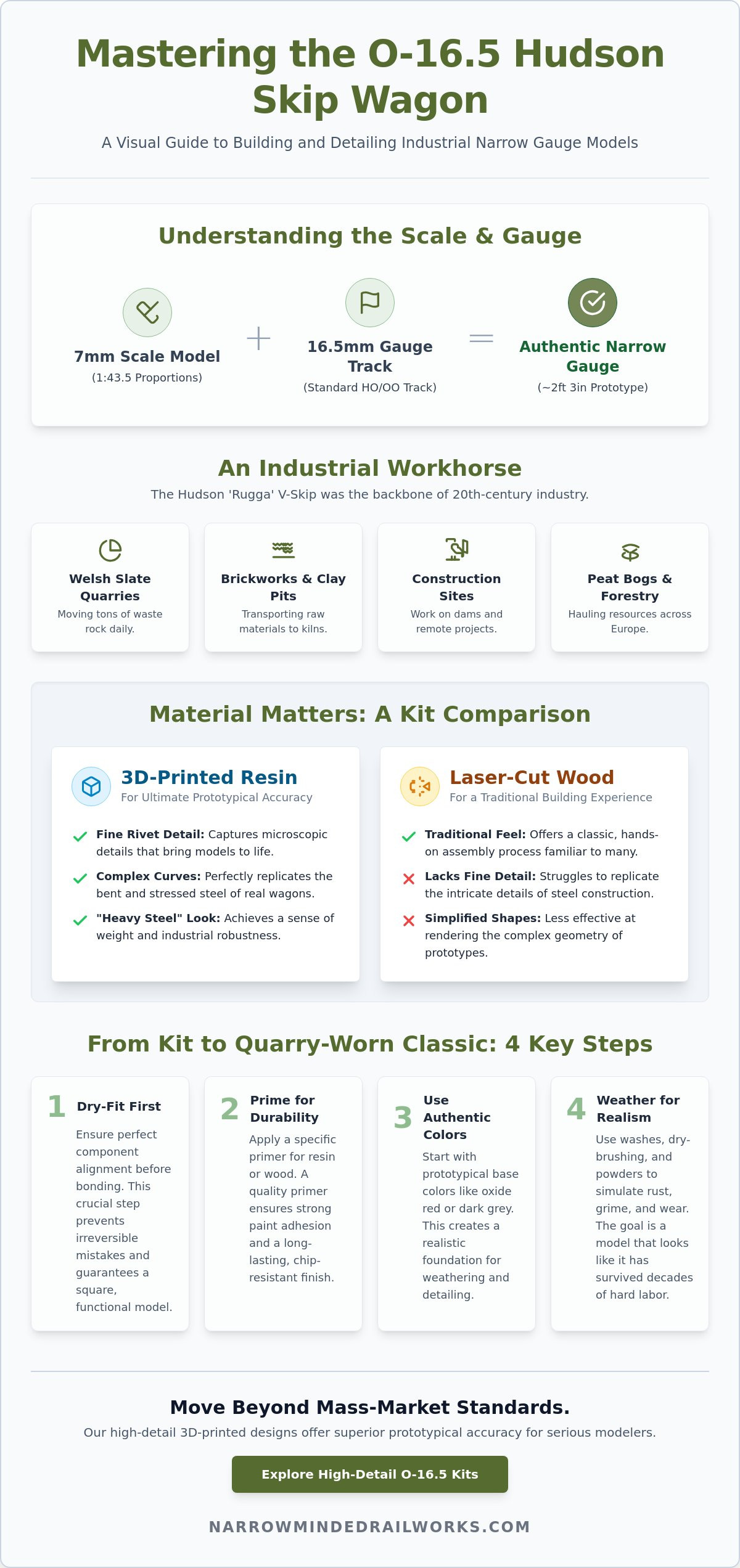
O-16.5 modeling involves building to 7mm scale (1:43.5) while using 16.5mm gauge track, which is the same width as standard HO or OO gauge. This combination represents a prototype track gauge of approximately 2 feet 3 inches. It's a practical solution for those who want the presence of O scale models without the space requirements of standard gauge. You'll often see this referred to as NG7 in the UK. While it's closely related to the American On30 standard, you should read our introduction to On30 gauge to understand the subtle differences in scale and proportions between these modeling traditions.
A Brief History of the Hudson 'Rugga' Skip
The history of these wagons is inseparable from the Robert Hudson Ltd history of Leeds. Founded in 1865, the company became the premier global supplier of light railway equipment. Their most famous contribution was the 'Rugga' skip, a design featuring a V-shaped body supported by a robust steel frame. This design allowed workers to tip heavy loads of earth, stone, or clay to either side of the track with minimal effort. It was a revolutionary improvement over earlier wooden designs that often required manual unloading.
These wagons served in various demanding environments:
- Welsh slate quarries where they moved tons of waste rock daily.
- Brickworks and clay pits for raw material transport to the kilns.
- Large scale construction sites and hydroelectric schemes in remote areas.
- Peat bogs and forestry operations across Europe and the colonies.
The Robert Hudson 'Rugga' skip was the most ubiquitous industrial wagon of the 20th century. Its simple construction and extreme durability made it the primary choice for any operation requiring a portable, high capacity railway.
Key Features to Look for in O-16.5 Wagon Kits
Selecting the right o-16.5 Hudson skip wagon kits requires more than just looking at a price tag. You need to evaluate how a kit's construction impacts both its visual fidelity and its performance on your layout. We recognize that choosing between different manufacturing styles can be confusing, so we prioritize kits that offer a balance of prototypical accuracy and buildability. High-quality kits should feature crisp axle box details and visible frame reinforcements, as these are the defining characteristics of the rugged Hudson design. If you're looking for prototypical accuracy, exploring our range of O-16.5 / 7mm scale kits can help you find a high-detail starting point for your fleet.
Coupling compatibility is another critical factor. Many modern kits include NEM pockets, which allow for quick and easy coupling with standard equipment. However, advanced modelers often prefer prototypical link-and-pin systems for a more authentic industrial appearance. Before you buy, check if the kit is designed for beginners or requires advanced soldering and filing skills. For those seeking deep technical standards on gauge and scale compatibility, the 7mm Narrow Gauge Association provides invaluable resources and documentation to guide your selection.
Material Matters: Resin vs. Laser-Cut
3D-printed resin has transformed the hobby by capturing fine rivet detail and complex curves that laser-cut wood struggles to replicate. While laser-cut kits offer a traditional building experience, they often lack the "heavy steel" look essential for a Hudson skip. Resin kits provide superior surface texture but are often lighter than their plastic or metal counterparts. You'll likely need to hide small weights within the chassis or under the skip body to ensure your wagons stay on the track when running empty. This proactive step prevents the frustration of frequent derailments during operation.
Wheelsets and Bearings
Smooth running is the foundation of any successful industrial layout. We recommend looking for kits that utilize brass bearings, as these significantly reduce friction and prevent wear on the chassis over time. While plastic wheels are an affordable entry point, metal wheels provide a lower center of gravity and better "free-running" characteristics. This is particularly important on narrow gauge tracks where gradients and tight curves are common. Ensuring your skip wagons have high-quality wheelsets from the start saves you from the labor-intensive process of retrofitting them later.
How to Build Your O-16.5 Hudson Skip Wagon Kit
Assembling o-16.5 Hudson skip wagon kits requires patience and precision, but following a structured workflow prevents common assembly errors. We understand that vague instructions often lead to frustration, so we recommend a "measure twice, glue once" approach. Before you begin, prepare a dedicated workspace with high-quality diorama tools and scenery equipment, including a sharp hobby knife, fine-grit sanding sticks, and a small engineer's square.
Dry-fitting every component is essential. This proactive step allows you to identify any casting blocks or laser-cut tabs that might interfere with a flush fit. Once you're satisfied with the alignment, select the appropriate adhesive. We suggest using a medium-viscosity Cyanoacrylate (Super Glue) for 3D-printed resin or plastic kits, while a quality PVA is better suited for laser-cut wood components. Taking the time to test the fit before applying glue ensures a professional finish and prevents permanent mistakes.
Step-by-Step Chassis Assembly
The chassis serves as the foundation for your model. Start by carefully removing any 3D print supports or laser-cut tabs. If you're working with resin, use a fine saw rather than snips to avoid shattering the delicate material. It's vital to ensure the chassis is perfectly square; even a slight twist can result in a "wobbly" wagon that derails on uneven track. After the main frame is set, fit the axle boxes. Check that the wheelsets spin freely and sit parallel to each other before the glue fully cures to guarantee reliable running.
Assembling the Skip Body
The skip body, or "bucket," is the most visible part of the wagon. If your kit uses a multi-part "V" section, join the plates carefully to create a seamless interior. This is where dry-fitting is most critical, as the angles must be precise for the skip to sit correctly on the chassis supports. Once the body is assembled, attach the end supports and handles according to the prototype's design. Gently rock the skip body on its trunnions to test the tipping mechanism for smooth prototypical movement.
If the movement feels gritty, use a small file to smooth the contact points. Finally, consider the operational weight of the wagon. While many skip wagons are light, adding a small amount of lead shot or tungsten putty inside the chassis frame ensures reliable operation when the wagon is empty. This extra step provides the "heft" needed for realistic tracking across complex pointwork and industrial sidings.
Painting and Weathering for Industrial Realism
Transforming o-16.5 Hudson skip wagon kits from sterile models into weathered workhorses is arguably the most rewarding phase of the build. Industrial railways were rarely clean environments. Skips endured constant impact from falling rocks, abrasive dust, and relentless exposure to the elements. To capture this accurately, you must look beyond a single coat of paint and consider the layers of history each wagon carries. We recognize that starting the painting process on a complex kit can feel daunting, so we prioritize a layered approach that builds realism from the primer up.
Priming and Base Coating
While 3D-printed resin provides incredible detail, its smooth surface can often resist standard acrylic paints. To solve this, we recommend starting with a high-quality matte primer that creates a mechanical bond between the material and your base coat. For a deeper dive into these initial steps, refer to our guide on painting 3D printed models for professional tips on surface preparation. While brush painting is suitable for small details, airbrushing is the superior choice for skip wagons. It allows for thin, even layers that won't obscure the fine rivet detail or the "Rugga" branding often found on the chassis.
Choosing prototypical colors is essential for authenticity. Hudson Grey is the traditional factory finish for many of these wagons, but oxide red was also common for older stock or those refurbished by specific quarry firms. If you're modeling a railway in its later years, a base coat of dark, mottled brown can simulate heavily rusted steel. Once the base coat is dry, you can apply decals or hand-painted markings to represent specific industrial owners. To ensure your finished models look at home in their environment, you might consider browsing our diorama tools and scenery to find the perfect weathering pigments for your region.
Advanced Weathering Techniques
The "battered" look of a skip wagon is best achieved through multi-stage weathering. Techniques like "salt chipping" or the "hairspray method" are effective for showing paint that has been scraped away by falling rocks. By applying a rust-colored base, a layer of chipping fluid, and then your final color, you can physically scratch away the top coat to reveal the "metal" beneath. This creates a level of depth that paint alone cannot replicate. Don't forget to add physical dents to the top rim of the V-skip using a small file or hobby knife to simulate decades of heavy loading.
Finally, utilize weathering powders to ground the wagon in its specific industry. For a slate quarry layout, a fine dusting of light grey powder around the chassis and inside the skip is vital. If your railway services a brickworks, focus on orange and red clay tones. Adding a permanent "load" of real crushed stone or coal, secured with diluted PVA, provides the final touch of authenticity. This extra weight also serves a practical purpose, helping your o-16.5 Hudson skip wagon kits track more reliably across uneven industrial sidings.
Why Choose Narrow Minded Railworks for O-16.5 Kits?
While mass-produced plastic models offer a quick start, they often lack the intricate textures required for a truly convincing industrial scene. We recognize that discerning modelers demand higher fidelity, which is why we specialize in high-detail 3D-printed designs that surpass the limitations of injection molding. Our o-16.5 Hudson skip wagon kits are designed by modelers, for modelers. This ensures that every rivet, reinforcement rib, and casting mark is captured with prototypical accuracy while maintaining an assembly process that remains accessible to both beginners and veterans.
The narrow gauge community thrives on character and variety. We prioritize versatility across our entire range, offering everything from rolling stock to locomotives and specialized scenery. We understand that finding reliable parts can be difficult, so we provide global shipping and dedicated support to ensure your project stays on track. Whether you're building a small quarry diorama or a sprawling industrial network, our kits provide the authentic foundation your layout deserves.
The 3D Printing Advantage
Traditional materials like laser-cut wood or plastic often struggle to replicate the complex curves and minute details found on original Robert Hudson equipment. We solve this by utilizing advanced resin printing technology. Our kits capture subtle features like manufacturer casting marks on the chassis, which are nearly impossible to achieve with traditional methods. The resin we use is specifically selected for its balance of strength and durability, ensuring your wagons survive the rigors of exhibition running or home operation.
Customization is another core benefit of our approach. Because our designs are digital at their core, we can adapt and refine our kits based on community feedback. If your specific layout needs a variation on the standard Hudson design, our resin components are easy to modify with standard hobby tools. This flexibility allows you to create a unique fleet that doesn't look like every other "out-of-the-box" railway.
Completing Your Industrial Scene
A fleet of skip wagons is only one part of the puzzle. To create a functioning railway, you need reliable traction and immersive surroundings. We recommend pairing your skip wagons with our OO9 and O-16.5 locomotive kits to ensure your motive power matches the quality of your rolling stock. Adding figures and specific scenery accessories from our collection helps transform a simple loop of track into a living, breathing quarry environment.
We're committed to helping you master the art of narrow gauge modeling. If you're ready to upgrade your industrial fleet with superior detail and prototypical accuracy, explore our full range of O-16.5 wagon kits today. From the first layer of primer to the final dusting of quarry waste, we're here to support every step of your modeling journey.
Elevate Your Industrial Layout
Mastering the assembly of o-16.5 Hudson skip wagon kits is a significant milestone for any narrow gauge modeler. By focusing on historical accuracy and precise assembly techniques, you can transform simple components into a convincing industrial scene. We understand that finding prototypical detail can be difficult, so we offer expertly designed 3D-printed kits that bridge the gap between basic models and museum-quality replicas. Whether you're fine-tuning your weathering process or just beginning your first build, the right tools and materials make all the difference.
We provide specialist narrow gauge support and worldwide shipping to ensure your modeling project succeeds regardless of your location. If you're ready to expand your fleet with authentic, high-detail rolling stock, Browse our latest O-16.5 Hudson Skip Wagon Kits today. Your layout deserves the rugged, hard-working character that only a well-built Hudson skip can provide. We look forward to helping you bring your industrial vision to life.
Frequently Asked Questions
What is the difference between O-16.5 and On30?
The primary difference lies in the scale used to represent the prototype. O-16.5 uses a 7mm to the foot scale (1:43.5) to represent British narrow gauge railways of approximately 2 feet 3 inches. On30 utilizes a 1:48 scale to represent American 30-inch gauge prototypes. While both standards run on the same 16.5mm track gauge, the physical size and proportions of the models differ to reflect their specific regional histories.
Do O-16.5 Hudson skip wagon kits come with wheels?
Most of our kits are supplied as body and chassis components without wheelsets included. We recognize that modelers have strong preferences for specific wheel brands or materials, so we leave this choice to you. To ensure your model is ready for the rails, you'll need to purchase standard 16.5mm diameter wheels separately. This approach allows you to prioritize metal wheels for a lower center of gravity and better tracking.
Can I run these skip wagons on standard OO gauge track?
Yes, these wagons are fully compatible with the 16.5mm gauge found on standard OO or HO track. However, we understand that the close sleeper spacing of standard track can ruin the narrow gauge illusion. To solve this, we recommend using specialized narrow gauge track with wider sleeper spacing. This proactive change ensures your o-16.5 Hudson skip wagon kits look at home in their industrial environment.
What is the best glue for 3D-printed resin wagon kits?
Medium-viscosity Cyanoacrylate, commonly known as Super Glue, is the most effective adhesive for resin components. Standard plastic cement won't work because it cannot chemically melt the resin surface. While resin can be smooth, lightly sanding the contact points creates a much stronger mechanical bond. We suggest using a small amount of glue to prevent unsightly "blooming" or frost marks on the detailed surfaces of your kit.
How many skip wagons should I have in a typical industrial train?
A prototypical rake usually consists of four to eight wagons, depending on the size of your locomotive and the layout's gradients. In real-world quarries, larger trains were common, but modeling a shorter rake prevents the train from looking cramped on smaller layouts. Starting with a set of six wagons provides enough visual impact to represent a busy industrial operation without overwhelming your motive power or siding lengths.
Are these kits suitable for beginners to narrow gauge modelling?
Yes, skip wagon kits are an ideal starting point because they feature a low part count and simple assembly steps. We recognize that working with 3D-printed resin might feel intimidating at first, so we design our kits with accessible attachment points and clear alignment guides. This ensures that even those new to the 7mm scale can produce a high-quality model that runs reliably on their first attempt.
How do I make my skip wagons look realistically rusty?
Layering different tones of brown and orange pigments is the most effective way to simulate heavy oxidation. We understand that achieving a "battered" look is difficult with paint alone, so we suggest using salt-chipping or hairspray techniques to create physical texture. Applying these methods to your o-16.5 Hudson skip wagon kits allows you to reveal "rusted" base layers through the top coat for a convincing, multi-dimensional finish.
What locomotives are best suited for pulling Hudson skip wagons?
Small four-wheeled diesel or petrol "critters," such as those based on Ruston or Lister prototypes, are the most authentic choices for these wagons. Since Hudson skips were designed for light, portable railways, they were rarely paired with large, heavy locomotives. We offer several O-16.5 locomotive kits that are specifically scaled to match the height and width of these wagons, ensuring a cohesive and prototypical look for your train.