

A successful micro layout isn't defined by how many points you can cram onto a baseboard, but by the logic behind every wagon movement. You might feel that a small footprint limits your operational potential, often leading to designs that look charming but offer little to do once the glue dries. While space is a significant constraint for many UK modellers, it doesn't have to dictate the depth of your hobby. Purpose drives the design. By focusing on purposeful narrow gauge micro layout ideas rather than track density, you can create a scene that feels expansive despite its dimensions.
This article promises to help you bridge the gap between a static diorama and a working railway. Although overcrowding a baseboard is a common pitfall, utilising a dedicated fiddle yard allows for realistic train lengths and varied traffic flow. We'll explore logical track plans that ensure your shunting sessions are both realistic and rewarding. While selecting the right components for a specific theme can be daunting, understanding the available OO9 or GN15 kits allows you to build with confidence. You'll finish this guide with a clear plan for a purposeful, functional railway.
Key Takeaways
- Learn how to shift your focus from passive train watching to active shunting by incorporating realistic operational logic into your design.
- Understand the space-saving benefits of OO9 and the unique industrial aesthetic of GN15 to determine which scale best fits your modelling goals.
- Explore diverse narrow gauge micro layout ideas that use industrial themes, such as slate quarries, to create a logical traffic flow.
- Discover the essential track elements, including run-around loops and kick-back sidings, required to turn a tiny baseboard into a challenging shunting puzzle.
- See how selecting specific locomotive and wagon kits can dictate your track plan and give your railway a distinct, purposeful character.
What is a Narrow Gauge Micro Layout and Why Focus on Operations?
A narrow gauge micro layout is typically defined as a model railway occupying less than four square feet. While this footprint is small, its potential for operational depth is significant. Many modellers assume that a tiny board requires a simple loop, but narrow gauge prototypes were built for a specific purpose. Whether it's a slate quarry or a rural farm line, these railways existed to move goods from point A to point B. By exploring various model railway scales, you can find the right balance between detail and the physical constraints of your home.
The shift from watching a train circle a track to actively managing a shunting schedule is what makes a micro layout truly engaging. You don't just run a train; you solve a logistical puzzle. This approach requires you to think about "Givens and Druthers." Your available space is a given, but your operational goals are your druthers. Integrating clever narrow gauge micro layout ideas ensures that every inch of track serves a specific function, preventing the layout from feeling like a static display.
To better understand this concept of purposeful movement in a tiny space, watch this helpful video:
The Narrative Approach to Modelling
Every movement on your layout should have a reason. Establishing a story for your narrow gauge railway dictates which tracks you actually need. If your line serves a timber mill, you need a specific place for logs to arrive and cut planks to depart. Incorporating these narrow gauge micro layout ideas into your narrative gives your scene a place in the wider world, often represented by an "imaginary connection" provided by a hidden fiddle yard.
Balancing Realism and Playability
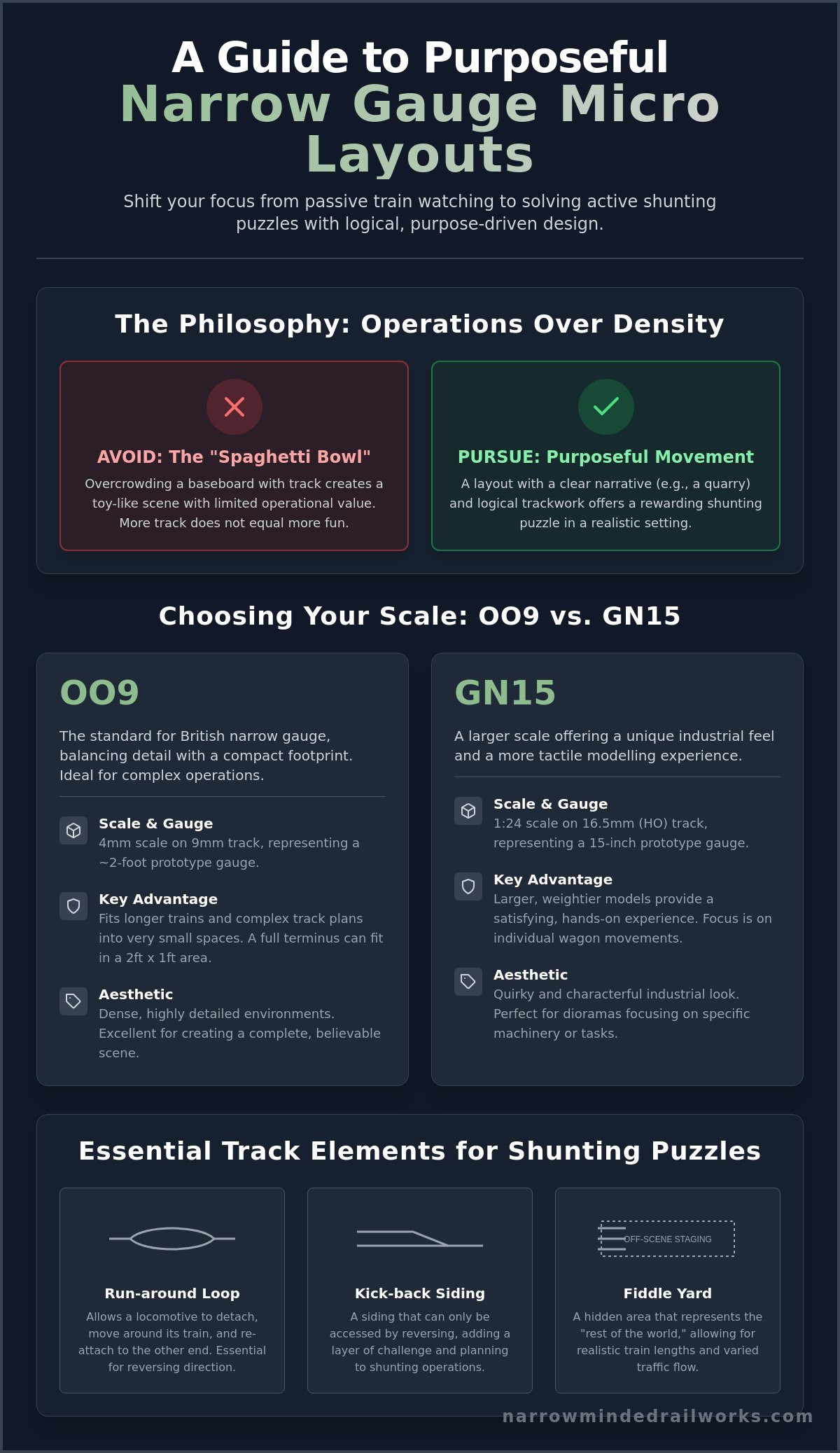
It's tempting to fill every corner with track, but this often leads to a "spaghetti bowl" effect that breaks immersion. You might worry that less track means less fun, but the opposite is usually true. By prioritising negative space, you create room for realistic scenery and industrial buildings. A single siding with a complex shunting requirement is often more satisfying than three sidings that are too short to hold a full wagon. This balance ensures your layout looks like a realistic slice of a working environment rather than a toy.
To maintain a professional aesthetic throughout your hobby room, you can learn more about HiFi Rack for high-quality audio furniture that complements any precision-focused setup.
Choosing Your Scale: OO9 vs GN15 for Operational Micro Layouts
When researching narrow gauge micro layout ideas, the first decision you must make is the scale. This choice dictates the minimum radius of your curves and the overall complexity of your shunting operations. You might feel restricted by a small shelf or a compact diorama case, but selecting the right scale allows you to maximise every millimetre of track. While OO9 offers a dense, detailed environment, GN15 provides a more tactile experience with larger models. Both scales are perfectly suited for micro layouts, yet they offer very different operational rewards.
The physics of your layout change depending on your choice. A smaller scale like OO9 allows for longer trains and more complex track work in a four-foot space. Conversely, a larger scale like GN15 focuses on the weight and movement of individual wagons. Understanding how these scales interact with your space helps you decide which locomotive and wagon kits will best bring your vision to life.
OO9 Scale: The King of the Micro-Layout
OO9 is the standard for British narrow gauge modelling for good reason. It utilises 9mm track to represent a two-foot gauge railway in 4mm scale. While the footprint is similar to N gauge, the larger scale of the rolling stock allows for much higher levels of detail. You can easily fit a full terminus and a small engine shed into a space as small as two feet by one foot. Planning for tight curves is essential here, as narrow gauge prototypes often navigated difficult terrain. For those just starting their fleet, consulting a beginner guide to OO9 kits is a proactive way to ensure your locomotives match your track's technical limits.
GN15 Scale: Industrial Might in Small Spaces
GN15 scale offers a unique "minimum gauge" feel by running G-scale models on standard 16.5mm (OO gauge) track. This combination creates the look of a heavy industrial railway, such as those found in British breweries or estates. You might worry that large-scale models would overwhelm a micro layout. However, GN15 thrives on simplicity and slow, deliberate shunting. The larger size of the stock makes coupling and uncoupling a more engaging, tactile process. If you're interested in this industrial aesthetic, reading a complete guide to GN15 will help you understand the scale context before you start building. Many narrow gauge micro layout ideas in GN15 focus on "critter" locomotives and short, heavy wagons, which are ideal for tight shunting puzzles.
Narrow Gauge Micro Layout Ideas: Industrial Themes and Traffic Flow
Most successful narrow gauge micro layout ideas start with a single, clear commodity. In the UK, narrow gauge lines were rarely built for general transit; they were specific solutions for moving heavy goods across difficult terrain. Whether you choose a North Wales slate quarry, a rural timber mill, or a peat bog, the industry dictates the track layout. You might feel that a tiny baseboard limits your options, but a focused theme provides an immediate purpose for every siding and point. This industrial focus ensures that your railway feels like a working tool rather than a toy.
The "In-Out" flow is the backbone of realistic operations. Raw materials arrive at the facility, and finished goods depart for the wider world. To make this work in a small space, you should utilise a fiddle yard. This off-stage area represents the rest of the national rail network or a distant port. It allows your trains to "arrive" from somewhere and "depart" to a destination, giving your shunting movements a logical beginning and end. If you are fascinated by the real-world logistics that inspire these movements, you can visit Warenous to learn how professional 3PL networks coordinate global supply chains. While a continuous loop is tempting for watching trains run, a point-to-point design usually offers far more operational depth for the serious modeller.
Narrow Gauge Industrial Logic
Narrow gauge lines usually exist to serve one specific industrial purpose. You should design your track to facilitate an "empties in, loads out" cycle. For instance, empty wagons are shunted into a loading bank, while loaded wagons are assembled into a train for the journey down the line. This process often culminates at an interchange point with a standard gauge railway. Including a representation of this exchange, even if it's just a transhipment wharf, adds a layer of historical realism to your project.
Creating a Working Timetable
Simulating a "day in the life" of your railway justifies every locomotive movement. You can define specific train types to keep the operation varied and interesting. A "pick-up goods" might stop at various sidings to collect individual wagons, while a "worker's special" runs at the start and end of the day to move staff to the site. Realistic operations depend on understanding the capacity of your plan. Even if your layout can only handle one locomotive and three wagons at a time, a structured timetable ensures those few pieces of rolling stock remain busy and purposeful.
Essential Track Elements for Realistic Shunting Puzzles
A run-around loop is the most critical component for any operational terminus. Without it, your locomotive becomes trapped at the end of the line, unable to reach the other side of its wagons. When you are developing narrow gauge micro layout ideas, you should prioritise a loop that is long enough to accommodate your standard train length plus the locomotive. This simple addition transforms a static scene into a functional railway where engines can decouple, run around their load, and prepare for the return journey.
Kick-back sidings and headshunts introduce the complexity required for a true shunting puzzle. A kick-back siding requires you to push wagons into a track that branches off another siding, rather than the main line. This forces a specific sequence of movements that tests your logistical planning. Similarly, a headshunt provides a dedicated space for the locomotive to move without fouling the main line or the entrance to the fiddle yard. This hidden area acts as the layout's engine room, providing the necessary "off-stage" space for traffic to originate and terminate. To ensure your track work is as precise as your plan, you can utilise professional diorama tools and scenery to maintain tight tolerances on small baseboards.
The Geometry of Shunting
Precision is vital when space is limited. You should calculate every siding length based on your longest locomotive and wagon combination. If a siding is only 120mm long, it won't comfortably hold a small tank engine and two four-wheel wagons. Planning uncoupling points before you lay the track is a proactive solution to avoid manual handling later. For those using traditional DC power, remember to include isolating sections. These allow you to park one locomotive in a shed or siding while another performs shunting duties elsewhere on the board.
Common Planning Pitfalls to Avoid
The "S-Curve" trap is the most frequent cause of derailments on micro layouts. These tight reverse curves occur when two turnouts are placed back-to-back without a straight section between them. This geometry puts immense stress on couplings and wheelsets. You should also avoid placing critical turnouts in the far corners of your baseboard. If a point fails or a wagon derails in an inaccessible spot, your operational session will end in frustration. Keeping your most active shunting areas within easy reach ensures a smooth and enjoyable experience.
Building Your Fleet: How Kits Inform Your Track Plan
Kit-built locomotives offer a level of operational character that ready-to-run models often struggle to replicate. While mass-produced models are convenient, they are rarely designed for the specific industrial niches found in the best narrow gauge micro layout ideas. You might find that a standard locomotive is too long for your tightest curves or lacks the unique look of a specific Welsh quarry engine. By building from a kit, you can ensure your fleet is perfectly scaled to your track plan's physical limits and industrial narrative.
The locomotive-to-track ratio is a vital consideration for small spaces. You don't need a dozen engines for a four-foot layout; in fact, overcrowding your sidings with idle stock makes shunting more difficult. A proactive approach is to focus on two or three high-quality kits that serve distinct roles. For example, a small "critter" might handle internal factory shunting while a larger tank engine manages the run to the fiddle yard. Customising 3D-printed kits also allows you to include essential operational stock, such as brake vans or maintenance wagons, which are often overlooked in standard ranges.
Selecting the Right Locomotive Kits
Success in micro-modelling depends on slow-speed reliability. You might worry that kit-built engines are temperamental, but utilizing a high-quality, proven N-gauge chassis provides the smooth power needed for intricate shunting. For layouts with exceptionally tight industrial curves, tram locomotives are an excellent choice. Their short wheelbases and covered motion allow them to navigate radii that would stall larger stock. If you are looking for inspiration on specific prototypes, you can refer to our guide to tram loco kits to see how these compact machines fit into a narrow gauge setting.
Wagons and the Waybill System
Building a diverse range of wagon kits enables the use of a "waybill" system, which is the ultimate way to generate operational interest. Each wagon you build can be assigned a specific destination on your layout, such as a coal staithe or a loading dock. There is a unique satisfaction in moving a kit you constructed and painted yourself from a remote mine point to the interchange wharf. This hands-on connection to your rolling stock makes every shunting move feel earned. To begin your journey into purposeful modelling, browse our range of OO9 and GN15 kits to start your fleet today!
Start Building Your Operational Narrow Gauge Railway
Designing a tiny railway requires a shift from track quantity to operational quality. While a four-square-foot board presents physical constraints, it provides a unique opportunity to perfect a specific industrial narrative. By selecting a scale like OO9 or GN15 and integrating essential track elements like run-around loops, you ensure your shunting sessions remain engaging over the long term. You've learned that purposeful movement, driven by a clear industrial theme, is what truly brings a micro layout to life.
Your choice of rolling stock is the final piece of the puzzle. While mass-market models might not fit your specific vision, building bespoke kits allows you to tailor your fleet to your track's unique requirements. We provide high-quality 3D-printed locomotive and wagon bodies designed specifically for narrow gauge enthusiasts. Whether you are modelling a slate quarry or a rural tramway, you can explore our range of 3D-printed narrow gauge kits to bring your track plan to life. With specialist OO9 and GN15 kits and worldwide shipping available, you have everything needed to turn these narrow gauge micro layout ideas into a reality. It's time to clear a space on your workbench and start building.
Frequently Asked Questions
What is the best scale for an operational narrow gauge layout?
OO9 is generally the best scale for UK modellers due to the vast availability of kits and the ability to use 9mm track. If you prefer a more tactile, industrial aesthetic, GN15 is an excellent alternative that runs on 16.5mm track. Your decision should rest on whether you value track density or the physical presence of larger rolling stock in a compact space.
How much space do I need for a realistic OO9 track plan?
You can build a realistic OO9 track plan in a space as small as 2 feet by 1 foot, which is approximately 60cm by 30cm. While larger boards allow for longer train lengths, this compact footprint is sufficient for a terminus with a run-around loop and a single siding. It's a proactive way to enjoy the hobby when your living space is limited.
What is a fiddle yard and why do I need one for a micro layout?
A fiddle yard is an off-stage track area used to store trains and represent the rest of the world. It's essential for micro layouts because it allows you to swap wagons and locomotives without cluttering the visible scene. By including a simple traverser or a sector plate, you provide the necessary in-out logic that makes a small shunting plan feel like a working railway.
Can I use standard gauge track plans for narrow gauge layouts?
You shouldn't directly copy standard gauge plans because narrow gauge prototypes often used much tighter curves and steeper gradients. However, the basic logic of a small goods yard can be adapted. You'll find that narrow gauge trackwork often follows the natural terrain more closely, which allows for more creative and improvised designs that wouldn't be possible with standard gauge models.
Do I need DCC for an operational narrow gauge model railway?
You don't need Digital Command Control (DCC) for a micro layout, as traditional DC wiring is often simpler for single-locomotive operations. Since micro layouts rarely have more than two engines moving at once, isolating sections on a DC board provide a cost-effective way to manage shunting without complex electronics. This approach allows you to focus your budget on high-quality locomotive and wagon kits.
How do I make shunting more interesting on a small layout?
Shunting becomes more engaging when you use a waybill system to assign specific destinations to each wagon on your board. Instead of moving stock randomly, you're fulfilling a work order for a local industry. This approach integrates well with various narrow gauge micro layout ideas by giving every movement a logistical purpose that justifies the time spent at the controls.
What are the most common mistakes in micro track planning?
Overcrowding the baseboard with too many points is the most frequent error. This leaves no room for realistic scenery and makes the railway look cluttered. Another mistake is creating sidings that are too short to hold both a locomotive and a single wagon. You should always measure your longest kit-built engine against your track plan before you start laying any rail.
How do I choose the right industry for my narrow gauge theme?
You should choose an industry that justifies the use of small wagons and frequent, slow-speed shunting. Researching historical UK lines like those in North Wales or the Isle of Man provides a wealth of narrow gauge micro layout ideas. Selecting a single commodity, such as slate or timber, ensures your track plan remains focused and every wagon movement has a clear reason.