

The convenience of a ready-to-run locomotive might actually be the biggest barrier to your perfect narrow gauge layout. It's a common frustration to find that major manufacturers don't produce the specific, quirky prototypes that make British narrow gauge so charming. You might worry about ruining an expensive project or feel that your spare time is too precious to spend on complex assembly. We recognise that the fear of a failed build often keeps enthusiasts tethered to standard models. While time and technical skill are valid concerns, the benefits of building model railway kits often outweigh the initial learning curve.
This article helps you discover whether the convenience of ready-to-run or the creative freedom of kit-building is the right choice for your narrow gauge modelling journey. We will examine how modern 3D-printed designs provide a middle ground for those who want unique models without the difficulty of traditional etched brass. Although you might feel limited by the available ready-to-run range, you can achieve a prototypical layout by using kits designed for reliable commercial chassis. We will show you how to expand your fleet effectively while gaining a genuine sense of accomplishment from building something yourself.
Key Takeaways
- Compare the immediate convenience of factory-finished models against the creative freedom and customisation offered by 3D-printed kits.
- Understand the total cost of ownership and time investment required to ensure your hobby remains both affordable and enjoyable.
- Discover the benefits of building model railway kits to access unique narrow gauge prototypes that are rarely available in the ready-to-run market.
- Learn how modern 3D-printed designs provide a high-detail middle ground, making assembly accessible even if you don't have a professional workshop.
- Identify how to successfully pair specialist locomotive bodies with reliable commercial chassis for a layout that is both unique and dependable.
Defining the Dilemma: Ready-to-Run vs. Kit-Built Models
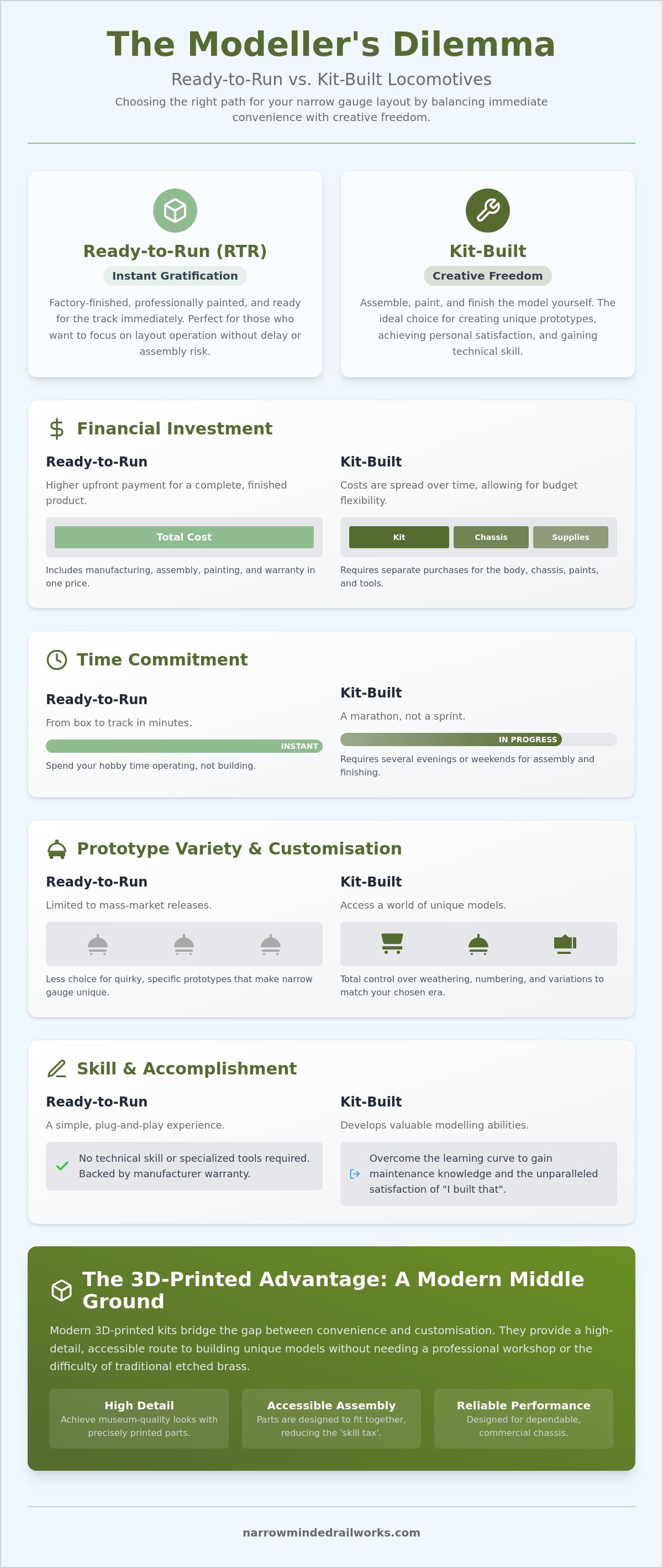
Every enthusiast in the model railway hobby eventually faces a fundamental choice. You must decide whether to purchase factory-finished models or invest your time into assembly. Ready-to-Run (RTR) models arrive fully painted and ready to operate immediately. In contrast, kit-built models consist of separate components, often made from resin or 3D-printed plastic, that require your direct intervention to complete. While the 2020s have seen RTR quality reach museum standards in standard gauge scales, the narrow gauge sector remains a different landscape altogether. Choosing between these paths involves balancing your limited hobby time with your specific creative goals.
To better understand how these two approaches differ in practice, watch this helpful video showing the construction process:
The Appeal of the 'Out of the Box' Experience
Purchasing a finished model provides instant gratification. You can place a locomotive on the track and begin operations without technical delays or the risk of assembly errors. Modern RTR models often feature professional paint finishes and intricate detailing that are difficult to replicate by hand without years of practice. For many, the peace of mind provided by a manufacturer warranty is a significant factor. You receive a product with reliable electrical performance from its very first run, which is ideal if your primary interest lies in layout operation rather than locomotive construction. However, this convenience often comes with a higher price tag and a lack of prototype variety.
The Creative Pull of the Workbench
The primary benefits of building model railway kits centre on personal expression and technical mastery. There is an unparalleled sense of satisfaction in telling visitors "I built that" when they admire your layout. Kit building grants you complete control over weathering, numbering, and specific variations that match your chosen era. While an RTR model is a mass-produced item, a kit-built locomotive is a unique piece of craftsmanship. You also gain a deeper understanding of how your rolling stock functions mechanically. This knowledge is invaluable when it comes to maintaining your fleet or troubleshooting running issues on your own. By choosing kits, you can often expand your fleet in a more cost-effective way, provided you are willing to invest the time at your workbench.
A Head-to-Head Comparison: Cost, Time, and Customisation
Evaluating the financial commitment of this hobby involves looking beyond the initial sticker price. Ready-to-Run (RTR) models typically require a higher upfront payment because you're purchasing a finished product that is ready for the tracks. While kits often appear more affordable at first glance, you must account for the 'Total Cost of Ownership'. This includes essential adhesives, specialist paints, and the specific chassis required to make the model move. Although these additional items require an initial investment, they create a permanent workshop setup that supports all your future projects. One of the practical benefits of building model railway kits is the ability to spread these costs over several months. You can purchase the locomotive body one month and wait until your hobby budget allows for the chassis and detailing parts later.
Time is your most valuable resource, and your choice of model dictates how you spend it. An RTR locomotive is a sprint to the track, but a kit build is a marathon that requires patience. You should expect to spend several evenings or weekends refining, painting, and assembling your model. It's also important to accept the 'skill tax' associated with learning a new craft. While your first attempt might not reach professional standards, this is a necessary step in developing your technical abilities. Modern 3D-printed designs reduce this hurdle by providing high-detail parts that fit together more precisely than traditional white metal or etched brass alternatives, offering a more forgiving experience for those new to the workbench.
The Value of Uniqueness on Your Layout
Mass production often leads to 'cloned layout' syndrome at exhibitions. When every modeller uses the same few RTR locomotives, layouts can begin to look identical regardless of their setting. By choosing to build, you gain access to a vast world of independent designers who focus on obscure industrial and narrow gauge prototypes. These niche subjects are traditionally ignored by big brands because they lack mass-market appeal. Organisations like the National Model Railroad Association celebrate this diversity of craftsmanship, highlighting how individual builds preserve the history of specific railway companies that might otherwise be forgotten. Personalisation allows you to add specific details that match a real-world location or a specific era in your railway's history.
You can avoid the limitations of factory-finished catalogues by taking control of your own rolling stock production. Kits allow you to build exactly what your layout needs rather than what a manufacturer decides to produce this year. If you're ready to move beyond standard models, you can explore our beginner's guide to OO9 kits to find prototypes that ensure your layout remains a unique reflection of your creative vision. This path transforms your collection from a series of purchases into a gallery of your own personal achievements.
Why Narrow Gauge Modelling Often Requires the Kit-Building Route
Standard gauge modellers often have their pick of hundreds of locomotives. If you want a specific Class 66 or a Flying Scotsman, you simply buy it. For those interested in narrow gauge, the market is significantly smaller. This "Narrow Gauge Gap" exists because major manufacturers cannot justify the high tooling costs of mass-producing niche prototypes with limited appeal. Consequently, the benefits of building model railway kits become a practical necessity rather than just a creative choice. If you want a specific locomotive from a Welsh slate quarry or a remote peat bog, a kit is often your only path to prototypical accuracy. These models represent prototypes that were never mass-produced, ensuring your layout features rolling stock that feels authentic to its setting.
The Reality of the Narrow Gauge Market
While standard gauge catalogues offer thousands of factory-finished options, narrow gauge enthusiasts work with a much smaller pool of ready-to-run models. This scarcity is why narrow gauge modelling is widely regarded as a builder's scale. Kits are the lifeblood of niche communities like OO9 and GN15. In fact, industry trends in 2026 show that approximately 65% of GN15 builds rely on 3D-printed components. Small-scale manufacturers play a vital role by using modern 14K resolution printing to produce accurate models of obscure prototypes. This dedication ensures that the unique history of industrial and rural railways is preserved in miniature. Without these kits, many of these fascinating locomotives would simply disappear from the hobby entirely.
The Hybrid Solution: Kit-Bashing RTR
You don't have to sacrifice mechanical reliability to achieve a custom look. The hybrid approach allows you to use a high-quality N gauge chassis as the heart of your build. This provides the smooth electrical performance of a factory-built drive system while allowing you to fit a unique, 3D-printed body on top. 3D printing has made this "chassis-swapping" process remarkably accessible for beginners. These bodies are designed specifically to fit onto existing, reliable commercial chassis from manufacturers like Kato or Peco. You get the character of a bespoke model without needing the heavy engineering skills required for traditional metalwork. It's the most effective way to combine modern reliability with the distinct charm of a custom-built fleet, allowing you to bridge the gap between factory standards and personal creativity.
Overcoming the 'Skills Gap': Modern Techniques and 3D Printed Kits
The perceived barrier to entry for kit-building is often much higher than the reality. You don't need a professional workshop filled with heavy machinery to enjoy the benefits of building model railway kits. In fact, the shift toward 3D-printed designs has removed many of the traditional hurdles like soldering white metal or working with complex etched brass. For the modern modeller in 2026, the "skills gap" is more about patience and finishing than complex mechanical engineering. Your essential beginner toolkit is remarkably simple. A sharp scalpel, high-quality cyanoacrylate glue, and a set of fine-grit sanding sticks are often all you need to achieve professional results.
Some enthusiasts worry about "skill erosion" in the hobby, arguing that ready-to-run models have made traditional craftsmanship unnecessary. We view this differently. While you might not be machining your own wheels, the focus has simply shifted toward new, equally vital skills. Learning to paint, weather, and finish a model is a craft in itself. These techniques allow you to transform a grey resin shell into a living piece of history. By mastering these modern methods, you ensure that your layout remains a personal expression of your creativity rather than a collection of factory-standard products.
Why 3D Printed Kits are the Perfect Starting Point
Traditional resin or white metal casts often require significant cleanup. You might spend hours removing flash or filing down uneven surfaces from a worn-out mould. 3D-printed kits eliminate this frustration through superior dimensional accuracy. Because these parts are designed digitally, they fit together precisely without the need for heavy filing or modification. The incredible surface detail provided by modern 14K printers makes painting 3d printed models a far more rewarding experience for novices. You spend less time correcting manufacturing flaws and more time achieving a high-quality finish that rivals expensive factory models.
Your Five-Step Plan for Your First Kit
Starting your journey doesn't have to be overwhelming. Follow this structured approach to ensure your first build is a success:
- Choose a simple wagon kit: Start with a rolling stock project before attempting a complex locomotive. This builds your confidence without high financial stakes.
- Read and dry-fit: Read the instructions twice. Fit every part together without glue first to ensure you understand the assembly sequence.
- Invest in primer: Use a high-quality primer specifically designed for plastics. This ensures your paint adheres properly and reveals the fine details of the print.
- Embrace the process: Accept that the journey is the reward. Enjoy the mindful, quiet process of creation at your own pace.
- Seek help when needed: The narrow gauge community is famously helpful. Don't hesitate to ask for advice on forums if you get stuck.
By following these steps, you can overcome the fear of ruining an expensive project and begin to build a unique fleet. If you're ready to pick up the scalpel, you can explore our range of OO9 and GN15 kits designed specifically for ease of assembly and high visual detail.
Finding Your Balance: How Narrow Minded Railworks Supports Your Build
Narrow Minded Railworks operates with a transparent philosophy: we aim to bridge the gap between mass-produced models and the high barrier of traditional scratch-building. We understand that your hobby time is often limited and the fear of ruining an expensive project is a valid concern. To address this, we specialise in 3D-printed designs that prioritise ease of assembly without sacrificing the intricate detail you expect. By choosing our kits, you aren't just expanding your layout; you are experiencing the full benefits of building model railway kits through a supportive, modern framework. Every design we produce is a vote for the continued diversity of the narrow gauge hobby, ensuring that unique prototypes remain accessible to everyone.
Designed by Modellers, for Modellers
Taking the Next Step in Your Hobby
Building a prototypical layout involves more than just the locomotives. You can find a wide range of OO9, GN15, and O-16.5 wagon kits in our collection that allow you to expand your rolling stock fleet cost-effectively. To complete your miniature scene, we also offer unique scenery items and diorama tools, ranging from classic telephone boxes to figures scanned from real people for maximum realism. These details help transition your project from a simple track plan into a living, breathing diorama. We invite you to join the growing community of narrow gauge builders today and discover the genuine satisfaction of creating a layout that is truly your own.
Transforming Your Narrow Gauge Vision into Reality
Choosing between ready-to-run and kit-built models is a decision that ultimately shapes the character of your entire layout. While factory models provide immediate operation, the benefits of building model railway kits include access to the specific, industrial prototypes that define the narrow gauge experience. We recognise that the time required for assembly is a significant constraint; however, modern 3D-printed designs offer a proactive solution by reducing assembly complexity. This approach ensures you can achieve a unique, prototypical look while still enjoying the mechanical reliability of a commercial chassis. By moving beyond the limited ready-to-run catalogues, you take full control of your railway's history and aesthetic.
You don't have to navigate this journey alone. We provide specialist OO9 and GN15 designs alongside helpful guides for every stage of your build to ensure a successful finish. With worldwide shipping available for all our products, you can access these unique models regardless of your location. Explore our range of 3D-printed narrow gauge kits and start your build today! We look forward to supporting your transition from a collector to a creator on your narrow gauge modelling journey.
Frequently Asked Questions
Are model railway kits cheaper than ready-to-run models?
Kits typically offer a lower initial purchase price than factory-finished models. While you must account for the additional cost of a chassis and paints, the total investment is often more manageable because you can purchase components over several months. This financial flexibility is one of the practical benefits of building model railway kits for those on a strict hobby budget.
What tools do I need to start building model railway kits?
You only need a basic toolkit to begin your first project. A sharp scalpel, high-quality cyanoacrylate glue, and a set of fine-grit sanding sticks are essential for cleaning and assembling 3D-printed parts. You don't need heavy machinery or a professional workshop; a flat desk with good lighting is sufficient for most narrow gauge projects.
Can I build a kit if I have never soldered before?
Soldering is not required for modern 3D-printed kits. These models use advanced adhesives rather than traditional metal-joining techniques, making them accessible to beginners. While you might eventually learn to solder for electrical wiring, the structural assembly of the locomotive body is entirely solder-free. This removes a significant technical barrier that previously deterred many new modellers.
Do kits come with the motor and wheels included?
Most narrow gauge body kits do not include the motor, wheels, or chassis. They are specifically designed to fit onto reliable, commercially available chassis from manufacturers like Kato or Peco. This approach ensures your model has the smooth electrical performance of a factory-built drive system while allowing you to customise the exterior appearance to your exact requirements.
Which is better for a beginner: OO9 or GN15 scale kits?
OO9 scale is often the best starting point if you have limited space, as it runs on 9mm track and has a wide range of available accessories. However, GN15 kits are physically larger and easier to handle, which is helpful if you are concerned about working with very small parts. Both scales offer excellent 3D-printed options that prioritise ease of assembly for those new to the hobby.
How long does it take to build a typical locomotive kit?
You should expect to spend between 10 and 20 hours on a typical locomotive build, including painting and detailing. The assembly of 3D-printed parts is relatively quick, but achieving a professional finish requires multiple thin coats of paint and adequate drying time. Rushing the process often leads to mistakes, so it's best to view the build as a series of relaxed evening sessions.
Can I paint a 3D-printed kit with regular acrylic paints?
You can use standard hobby acrylics, provided you apply a high-quality plastic primer first. The primer creates a key for the paint to adhere to the resin surface, preventing peeling or uneven coverage. Using a primer also helps reveal the fine details of the print, making it easier to apply weathering and final decorative touches accurately.
What happens if I break a part during the kit assembly?
Most small breaks can be repaired cleanly with a tiny amount of cyanoacrylate glue. Because 3D-printed resin is relatively brittle, you should handle delicate details with care during the cleaning process. If a part is damaged beyond repair, we recommend contacting the manufacturer, as many small-scale producers can provide replacement components to ensure you can finish your project successfully.