

Last Tuesday, a dedicated modeller in Devon spent six hours meticulously detailing a new 3D printed slate wagon, only to watch it stutter and derail on the first curve of their layout. It's a common heartbreak in the narrow gauge community. You've likely felt that same frustration when a kit that looks perfect on the workbench fails the "push test" on the tracks. Finding the best wheels for oo9 wagon kits is often the difference between a shelf queen and a reliable piece of rolling stock that glides through complex pointwork.
We understand that you want your wagons to have that heavy, silky-smooth feel that only high-quality metal wheelsets provide. You're tired of the confusion between N gauge standards and the specific axle lengths, such as 12.25mm or 14.2mm, required for different narrow gauge kits. This guide gives you the precise technical specifications and brand comparisons you need to eliminate drag for good. We'll examine the tracking performance of leading UK suppliers like Dundas and Peco to ensure your trains run flawlessly on every journey.
Key Takeaways
- Learn why precise axle length is the most critical measurement for ensuring your 3D printed wagon kits roll freely on 9mm track.
- Discover how switching to metal wheels lowers the centre of gravity and eliminates the common "wobble" found in lightweight plastic alternatives.
- Explore our top-rated recommendations for the best wheels for oo9 wagon kits, featuring industry-leading options from Peco and Graham Farish.
- Master the professional technique of using a bearing reamer to prep 3D printed axle boxes for a friction-free, pinpoint fit.
- Identify the ideal methods for adding weight and choosing compatible couplings to ensure your rolling stock performs reliably across your layout.
Understanding OO9 Wheel Specifications and Standards
OO9 modelling combines the charm of narrow gauge railways with the practicality of N gauge track. In technical terms, it involves 4mm scale bodies running on 9mm gauge rails. Adhering to OO9 scale standards ensures your rolling stock interacts correctly with points and crossings. When searching for the best wheels for oo9 wagon kits, you'll find that most standard wagons use 5.5mm diameter wheels. Larger bogie coaches often require 6.2mm versions to maintain the correct floor height and prototypical appearance.
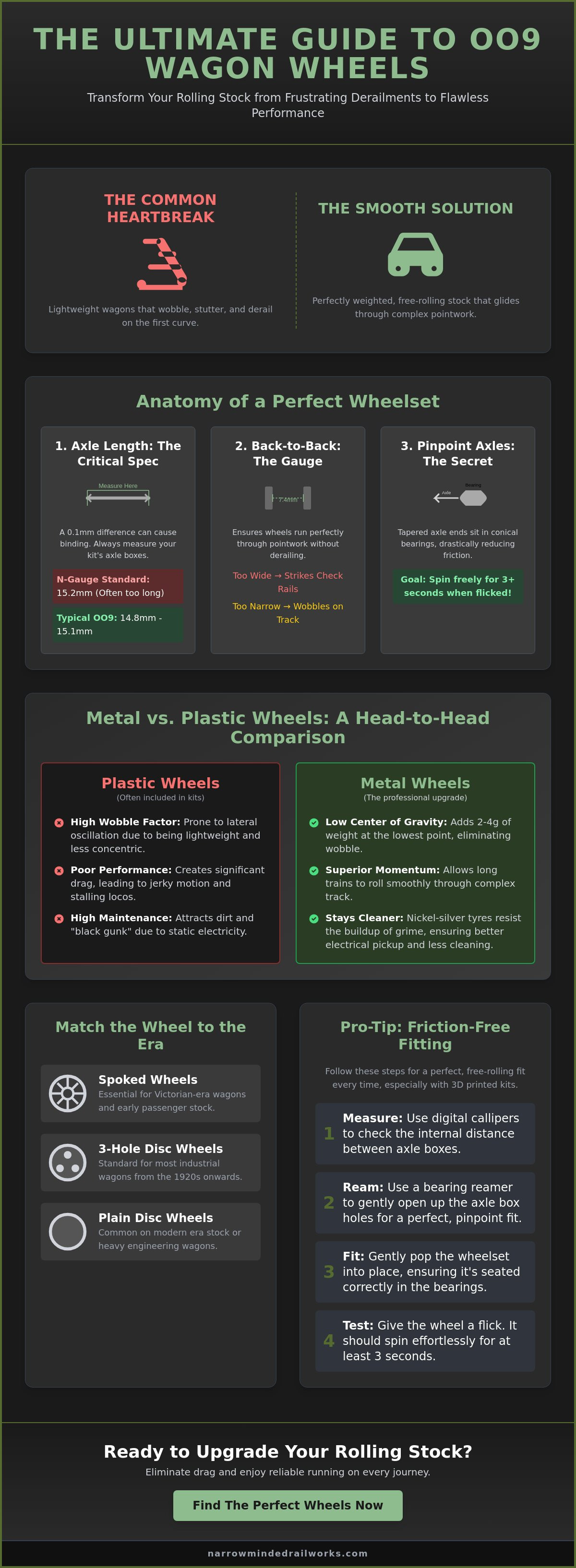
Friction is the enemy of long trains on narrow gauge layouts. Most high-quality wheelsets use pinpoint axles, where the axle ends taper to a sharp point. These sit in conical bearings, usually made of brass or plastic, to minimize the surface area in contact. This setup allows a small 009 locomotive to pull a dozen wagons without stalling on a 1 in 40 gradient. If your wheels don't spin freely for at least three seconds when flicked, they'll create significant drag on your motive power.
To better understand this concept, watch this helpful video:
Axle Lengths: N Gauge vs. OO9
Don't assume any 9mm wheelset will fit your kit. While standard N gauge axles often measure 15.2mm, many OO9 kits are designed for specific sizes like 14.8mm or 15.1mm. A 0.1mm difference is often the gap between a free-rolling wagon and one that binds constantly. To get an accurate measurement, use a digital calliper to check the internal distance between your wagon's axle boxes. Using a 'one size fits all' approach usually leads to poor running in bespoke resin or 3D printed kits, where tolerances are tighter than mass-produced items.
The Importance of Back-to-Back Gauging
The back-to-back measurement is the distance between the inner faces of the wheels on a single axle. For 9mm track, this is typically set at 7.4mm. If this distance is too narrow, the wheels will wobble between the rails. If it's too wide, the flanges will strike the check rails on pointwork, leading to instant derailments. Investing in a dedicated 9mm back-to-back gauge is essential for any builder. It's the only way to ensure your best wheels for oo9 wagon kits actually perform as intended on complex trackwork. Checking every wheelset before installation saves hours of frustration during a running session.
Metal vs. Plastic Wheels: Which is Best for Your Layout?
Choosing the best wheels for oo9 wagon kits often defines the boundary between a frustrating afternoon of derailments and a smooth, prototypical operating session. While many kits include plastic wheels as standard, these components frequently struggle with the unique physics of narrow gauge modelling. The primary issue is the wobble factor. Early Peco GVT coaches often suffered from a noticeable lateral oscillation because their original plastic wheelsets were rarely perfectly concentric. This instability is magnified in lightweight resin or 3D printed kits, where the lack of mass allows the wagon to 'hunt' across the rails.
Metal wheels solve this by significantly lowering the centre of gravity. A standard pair of metal 009 wheels typically adds 2 to 4 grams of weight at the lowest possible point of the wagon. This mass creates superior momentum, allowing long trains to roll through pointwork without the jerky motion common in lighter stock. If you're just starting out, checking a professional introduction to OO9 modelling will confirm that track cleanliness is the foundation of reliable narrow gauge running. Metal wheels, specifically those with nickel silver tyres, assist this by resisting the buildup of 'black gunk' that plastic wheels generate through static electricity and friction.
Aesthetically, the best wheels for oo9 wagon kits should match the prototype's era. Most UK narrow gauge modellers choose between three main styles:
- Spoked wheels: Essential for Victorian-era wagons and early passenger stock.
- 3-hole disc wheels: The standard for most industrial and common carrier wagons from the 1920s onwards.
- Plain disc wheels: Often found on modern era narrow gauge stock or heavy engineering wagons.
The Case for Metal Wheelsets
Metal wheelsets provide a level of durability that plastic simply cannot match. They don't develop flat spots after years of storage or heavy use. For modellers using the Greenwich coupling system, metal axles are vital. These magnetic uncoupling systems rely on the precise interaction between the coupling and the track magnets, and the steady rolling qualities of metal wheels ensure the wagon stays indexed correctly during the uncoupling move. You can find high-quality components for your next project at Narrow Minded Railworks.
When to Stick with Plastic
Plastic isn't entirely obsolete. If you are building a massive rake of 40 or 50 slate 'quarry' wagons where precision is less vital than volume, the cost savings of plastic can be substantial. Some modellers prefer a hybrid approach, using plastic centres for complex spoke patterns combined with metal tyres to get the best of both worlds. This maintains the fine aesthetic detail of a moulded part while retaining the electrical and physical benefits of a metal running surface.
Top Recommended Brands for OO9 Wagon Wheels
Selecting the best wheels for oo9 wagon kits transforms a static model into a reliable piece of rolling stock. Peco stands as the primary choice for most modellers in the United Kingdom. Their nickel silver wheels provide superior electrical conductivity for those using lighted stock and offer a weightier feel that keeps wagons on the rails. For more specialised prototypes, Parkside Dundas and Dundas Models provide the odd sizes that standard manufacturers often overlook.
Narrow gauge modelling frequently requires mixing components from different scales. Graham Farish, while primarily an N gauge brand, produces wheelsets that are technically identical in gauge. These are often easier to source from local hobby shops and provide a high-quality finish. Choosing the right brand involves balancing the need for prototypical accuracy with the physical requirements of your trackwork, especially if you use the tighter radius curves common in narrow gauge layouts.
Peco Nickel Silver Wheel Packs
The Peco NR-7012P series is the gold standard for many builders. These OO9 scale wheels come in both spoked and disc versions to suit different eras of rolling stock. You can buy them in standard packs of 8, but fleet builders should look for the bulk packs of 40 to reduce the unit cost. These wheels are specifically designed for the Peco GVT (Glyn Valley Tramway) wagon range and fit perfectly into the 12.25mm axle slots. Their weathered finish options save time by removing the shiny metallic look straight out of the box.
Graham Farish Replacements
If you want exceptional rolling performance, Graham Farish N gauge wheels are a fantastic alternative. Their metal coach wheels are particularly effective for passenger stock where a low centre of gravity is vital. Many modellers use N gauge wagons as donor stock, stripping the wheelsets for use in OO9 kits. This approach is common when building your first OO9 loco kit or accompanying rolling stock, as it ensures consistent running across your entire train. The precision-machined axles reduce friction, which is essential when your locomotives are small and have limited pulling power.
Dundas Models and Parkside Dundas fill the gaps left by larger manufacturers. While Peco covers the standard 5.1mm diameter wheels, Dundas provides variations like 5.5mm or 6.2mm wheels. These are necessary for specific 3D printed designs where the axle boxes are positioned differently. When you order from Dundas, you can specify axle lengths to ensure the wheels don't rattle or bind. This level of customisation makes them the best wheels for oo9 wagon kits that don't follow standard Peco dimensions. For example, kits based on the Ffestiniog or Welsh Highland Railway often require these specific diameters to clear the underside of the floorboards correctly.
How to Fit Wheels to 3D Printed Wagon Kits
Achieving a smooth roll on your narrow gauge layout starts with how you prepare the chassis. While 3D printed resin offers incredible detail, the axle boxes often require manual refinement to accommodate the best wheels for oo9 wagon kits effectively. Resin is a static material; it doesn't have the natural "give" found in traditional injection-moulded plastics. This means precision is vital during the assembly stage to prevent friction or binding.
Preparing Resin Axle Boxes
Most 3D printed kits are produced using SLA or DLP processes, which require supports during printing. You'll often find small pips or debris inside the axle guard where the support structure was attached. Use a fine needle file or a sharp hobby knife to clear these obstructions. Be careful when handling thin axle guards, as resin can be brittle and prone to snapping under pressure. For more details on handling these materials safely, see this guide on finishing 3D printed kits. A quick wet-sand with 400-grit paper ensures the inner faces are flush, preventing the wheel face from rubbing against the wagon frame.
Using Brass Bearing Cups
While you can run steel axles directly against resin, upgrading to brass "top-hat" bearings provides a significant performance boost. These small inserts reduce friction by 40% compared to raw resin holes. To fit them, use a 2mm drill bit held in a pin vice to gently enlarge the existing axle hole. Press the brass bearing in until the flange sits flush against the axle box. This setup allows for "flick-of-the-finger" rolling, where a light touch sends the wagon gliding across the workbench. It also prevents the pinpoint axle from wearing through the resin over time, which is a common issue on heavy mineral wagons.
Once your bearings are in place, use a "truck act" or a dedicated pinpoint bearing reamer. This tool cleans the internal cone of the bearing, ensuring the axle tip sits perfectly in the centre. You're looking for a "dry fit" that allows the wheels to spin for at least 5 to 10 seconds after a manual flick. Check for lateral slop; there should be no more than 0.5mm of side-to-side movement. If the wheels are too tight, the friction will stall your small 0-4-0 locomotives on gradients.
Finally, consider your lubrication. Avoid using heavy oils or WD-40, as these attract dust and can eventually soften certain 3D printing resins. Instead, use a puff of dry graphite powder. It provides a slippery surface that doesn't "clog" the pinpoint seat. This simple step ensures your best wheels for oo9 wagon kits maintain their performance through years of exhibition use.
Ready to upgrade your rolling stock? Browse our latest range of 3D printed wagon kits and accessories to get your fleet moving smoothly.
Completing Your Rolling Stock Project
Choosing the best wheels for oo9 wagon kits is a vital step, but the assembly process doesn't end with snapping axles into place. To achieve the reliable, slow-speed performance typical of a narrow gauge railway, you must consider how the wagon interacts with the track. Lightweight 3D printed kits often lack the physical mass needed to stay seated during shunting, making additional calibration essential for a professional finish.
Weighting and Balance
Investing in the best wheels for oo9 wagon kits won't matter if the wagon is too light to stay on the rails. Standard 3D printed resin wagons can weigh as little as 5 grams, which is insufficient for reliable running over complex pointwork. Aim for a target weight of roughly 0.6g to 1g per millimetre of wagon length. For an open wagon, hide lead sheet or "Liquid Gravity" beads under a cosmetic coal load or beneath the floor boards. If you're building a van, glue the weight directly over the axles inside the body shell.
Check that the wagon sits perfectly level on its wheelsets. An unbalanced load causes one wheel to lift, leading to frequent derailments on tight 9-inch radius curves. Once weighted, perform a final "incline test" to verify rolling resistance. Place the wagon on a loose piece of track and slowly lift one end. A free-rolling wagon should start moving before the gradient reaches 1 in 100. If it sticks, check if the axle ends are pinched by the W-guards and adjust them until the friction is gone.
Final Finishing Touches
Raw metal wheels look out of place on a realistic layout. Use a fine brush to apply matt dark earth or grimy black paint to the wheel faces, ensuring you keep the treads and flanges completely clean. This prevents paint build-up from causing a "thumping" motion as the wagon rolls. Your choice of couplings should also match your wheelsets for height and clearance. If you're using Greenwich or Bemo-style couplings, ensure they're mounted at a consistent height across your entire fleet. This prevents accidental uncoupling when the train moves over uneven track sections or gradients.
Matching these small details to your specific era ensures your rolling stock looks like a hard-working part of the landscape. Whether you're modelling a 1920s slate line or a modern preservation scene, the combination of smooth-running wheels and proper weighting makes all the difference.
Ready to put these tips into practice? Browse our latest OO9 wagon kits and start building your fleet today.
Transform Your Narrow Gauge Layout Performance
Achieving smooth operation on narrow gauge layouts requires technical precision, specifically regarding your choice of rolling stock components. Selecting the best wheels for oo9 wagon kits, such as standard 5.1mm metal wheelsets, provides the necessary weight and low centre of gravity to prevent derailments on tight 9 inch radius curves. Metal surfaces also help keep your rails clean by avoiding the carbon buildup often associated with plastic alternatives. Proper alignment within the axle guards ensures your wagons glide effortlessly behind your locomotives during every operating session.
At Narrow Minded Railworks, we build with the enthusiast in mind because our products are designed by modellers for modellers. Our 3D printed kits are specifically optimized for standard Peco and Dundas wheelsets to guarantee a perfect fit without the need for complex adjustments. We provide worldwide shipping on all kits, helping modellers across the United Kingdom and beyond expand their fleets with ease. Don't let poor running gear compromise your railway's reliability.
Explore our range of 3D printed OO9 wagon kits and start building a more robust narrow gauge fleet today. It's time to enjoy the satisfaction of rolling stock that performs as beautifully as it looks on your tracks.
Frequently Asked Questions
Can I use standard N gauge wheels for my OO9 wagon kits?
You can use standard N gauge wheels for your OO9 models because both scales run on 9mm track. While the gauge is identical, you should check that the wheel diameter matches the prototype, as N gauge wheels are often smaller than the 5.1mm or 5.5mm sizes typically used in narrow gauge. Using the best wheels for oo9 wagon kits ensures your rolling stock sits at the correct height for buffer alignment.
What is the standard axle length for Peco OO9 wagons?
Peco OO9 wagons typically use axles with a length of 15.1mm. This measurement is critical for ensuring the wheels spin freely within the plastic axle guards without falling out. If you're replacing wheels in older Peco kits, stick to this 15.1mm standard to maintain smooth running. Most aftermarket suppliers like Dundas Models provide specific axles designed for this exact 15.1mm fitment.
Are metal wheels better than plastic for narrow gauge models?
Metal wheels are superior to plastic because they provide a lower centre of gravity and attract 70% less dirt from the track. Plastic wheels often accumulate a crust of grime that causes electrical stalling on points. By switching to metal alternatives, you'll find your wagons roll further with less friction. This extra weight is vital for lightweight OO9 kits that might otherwise bounce off the rails.
How do I stop my 3D printed wagons from derailing on points?
You can stop 3D printed wagons from derailing by adding lead or tungsten weight to reach at least 15 grams per wagon. Many 3D prints are too light to depress the point blades or handle uneven track. Ensure your wheelsets are perfectly square within the printed chassis. If the print has warped by even 0.5mm, the wheels won't sit flat, which is a primary cause of derailments.
What size wheels do I need for a Narrow Minded Railworks slate wagon?
Narrow Minded Railworks slate wagons generally require 5.1mm diameter wheels to look prototypical. These smaller wheels ensure the wagon floor sits at the correct scale height above the track. Using larger 5.5mm wheels can cause the body to sit too high, which interferes with the coupling height. Always verify your specific kit instructions, as 100% of their slate wagon range is designed for these smaller wheelsets.
Do I need to lubricate the axles on my model railway wagons?
You should lubricate your axles using a tiny drop of plastic-compatible oil or a dry PTFE lubricant. Avoid using WD-40 or household oils, as these can degrade the plastic axle boxes over 12 to 24 months. A single drop of Labelle 108 oil on each pinpoint bearing reduces friction significantly. This allows a small locomotive to pull a train of 15 wagons instead of just 10.
What is a back-to-back gauge and do I really need one?
A back-to-back gauge is a precision tool used to set the distance between the inner faces of your wheels to exactly 7.4mm. You definitely need one to ensure your rolling stock passes through point frogs without jamming. Even the best wheels for oo9 wagon kits can be knocked out of alignment during shipping. Checking every wheelset with a 7.4mm gauge will eliminate 90% of your derailment issues.
How do I remove paint from the treads of my metal wheels?
You can remove paint from wheel treads by using a 4mm fiberglass scratch brush or a cotton bud dipped in white spirit. It's essential to keep the contact surface clean to prevent paint flakes from fouling the track. Rotate the wheels slowly while applying light pressure with the brush until the shiny metal is visible. This process takes about 30 seconds per axle and ensures 100% smooth contact with the rails.