

What if your model railway didn't have to occupy an entire spare room or look exactly like every other layout on the circuit? Many enthusiasts find themselves bored by the uniform nature of mass-produced, ready-to-run sets. You might be asking, what is narrow gauge modelling, and why does it attract those who value creativity over convenience? While traditional setups often require vast spaces and standard parts, this branch of the hobby offers a proactive solution through compact footprints and unique prototypes. It's a world where industrial charm and rural quirkiness take center stage.
You probably recognize the frustration of deciphering technical labels like OO9 or On30, especially when you just want to start building. This guide provides a clear path forward. We'll explain the unique appeal of these railways, break down the technical basics, and explore the rewarding culture of kit-building. You'll discover how to navigate popular scales and gain the confidence to begin your first project. From understanding track gauges to mastering 3D-printed kits, this comprehensive introduction sets realistic expectations for your new creative journey.
Key Takeaways
- Gain a clear understanding of what is narrow gauge modelling by exploring how larger scales operate on narrower tracks to replicate specialized industrial environments.
- Decode complex terminology like OO9 and O-16.5 to ensure your locomotive kits are compatible with commercially available donor chassis.
- Acknowledge the scarcity of ready-to-run models and utilize 3D-printed kits as a proactive solution for creating unique, highly detailed rolling stock.
- Overcome space constraints by mastering micro-layout techniques that allow for professional modelling within the footprint of a standard bookshelf.
- Follow a structured three-step plan to select your ideal scale and procure the necessary components to begin your first build with confidence.
Defining the Hobby: What is Narrow Gauge Modelling?
At its heart, narrow gauge modelling focuses on railways that operated on tracks closer together than the 4ft 8.5in "standard" used by most mainline networks. While standard gauge layouts often prioritise speed and massive infrastructure, narrow gauge prototypes were built for economy and utility. They served slate quarries, sugar beet fields, and remote mountain villages where full-sized trains simply couldn't go. Understanding what is narrow gauge modelling starts with appreciating these smaller, more versatile systems that traded raw power for the ability to navigate impossible terrain.
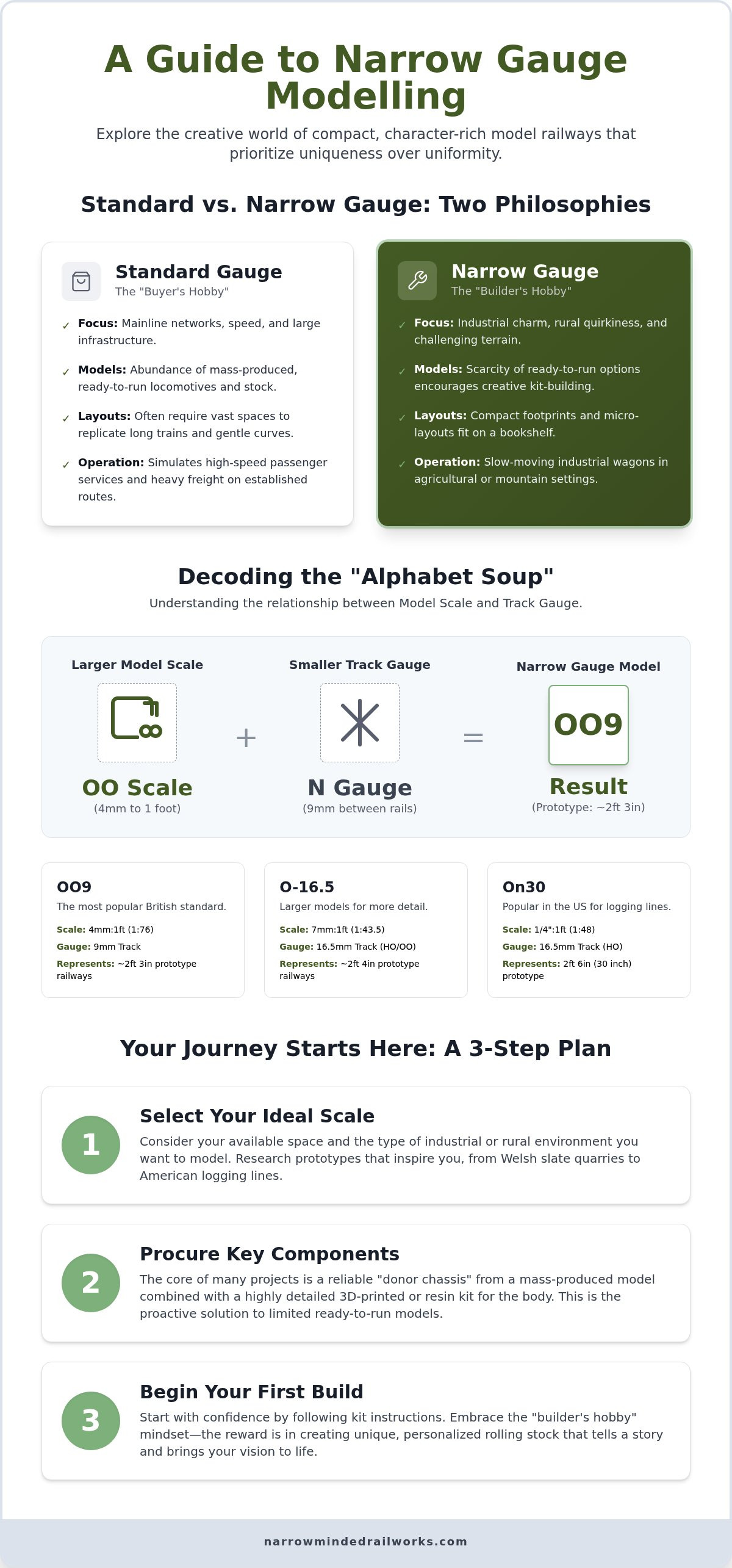
The technical core of the hobby lies in the relationship between scale and gauge. Modellers often use a larger scale, like 7mm or 4mm to the foot, but run these models on track designed for smaller gauges. For instance, a 1:76 scale train running on 9mm track represents a narrow gauge prototype rather than a standard one. This allows for a vast list of narrow-gauge model railway scales that cater to different space requirements and detail levels. Narrow gauge modelling is the practice of running larger-scale models on narrower-gauge tracks to represent industrial or rural lines.
To better understand this concept, watch this helpful video:
Narrow Gauge vs. Standard Gauge
Standard gauge modelling often feels like a "buyer's hobby" because of the abundance of ready-to-run locomotives. Narrow gauge is different. It prioritises quirkiness and character. You'll notice shorter trains, tighter curves, and rolling stock that looks lived-in. While standard railways follow strict engineering rules, narrow gauge lines often adapted to their environment with sharp bends and steep gradients. This shift creates a unique operational atmosphere. Instead of high-speed passenger services, you're often managing slow-moving industrial wagons in agricultural or mountain settings. It's a proactive solution for those who want to move away from the "out-of-the-box" look of standard sets.
The Philosophy of Narrow Gauge
This branch of the hobby is widely considered a "builder's hobby." Because commercial manufacturers don't always offer every niche prototype, enthusiasts often turn to kit-building. It's a creative response to the lack of mass-produced options. This culture encourages deep storytelling and "freelancing," which is the freedom to create your own fictional railway company. You aren't tied to a specific historical timetable. Instead, you can design a line that fits your specific vision, choosing the colours, logos, and history that make your layout feel unique. It's about personal expression and the joy of creating something that didn't exist before.
The Alphabet Soup: Understanding Scales and Gauges
Beginners often find the naming conventions of this hobby confusing, but a simple breakdown solves the mystery. The letters usually refer to the scale, which is the size of the model relative to the real thing, while the numbers refer to the gauge, or the distance between the rails. Understanding what is narrow gauge modelling requires a grasp of how these two elements interact to create a specific look. Modellers frequently use track from one scale to represent narrow gauge track in another. For example, using 9mm N gauge track under a larger 4mm scale locomotive body allows you to represent a 2ft prototype without manufacturing bespoke track components.
This use of a "donor chassis" is a proactive solution to the limited availability of ready-to-run narrow gauge models. By taking the motor and wheels from a mass-produced standard gauge locomotive, you can build a unique narrow gauge character on top of a reliable mechanism. This approach makes the hobby accessible to those who don't want to engineer their own motors from scratch. The NMRA Beginner's Guide provides excellent context on how these themes differ from traditional mainline modelling.
| Scale Label | Model Scale | Track Gauge | Prototype Equivalent |
|---|---|---|---|
| OO9 | 1:76 (4mm) | 9mm | 2ft – 2ft 6in |
| On30 | 1:48 (1/4") | 16.5mm | 2ft 6in |
| HOn3 | 1:87 (3.5mm) | 10.5mm | 3ft |
| GN15 | 1:24 (1/2") | 16.5mm | 15in |
OO9 and H0e: The Small Space Kings
OO9 is arguably the most popular entry point for UK modellers. It uses N gauge track to represent the charming 2ft gauge lines found in Wales and industrial sites. Because the track is narrow, you can fit incredibly tight curves into small spaces. Choosing OO9 locomotive kits is an effective way to start your journey without needing a dedicated railway room. The availability of British-style components makes it a favorite for those recreating rural or slate-quarry scenes.
On30 and O-16.5: Larger Models, Familiar Track
If you prefer larger models but want to use standard OO or HO track, On30 gauge is an ideal choice. It features 1/48 scale models running on 16.5mm track. This scale offers a "comfort zone" for standard gauge modellers because the track and points are widely available. The larger size allows for exceptional detail and easier handling of parts, making it a great option for those with less-than-perfect eyesight or a love for chunky, powerful locomotives.
GN15: The Quirky Giant
GN15 takes the concept of "minimum gauge" to the extreme. These are large 1/24 scale models that also run on 16.5mm track, representing 15-inch gauge estate railways. It's a niche that focuses heavily on character and kit-bashing. You can find more detail in this GN15 scale guide. If you're ready to try your hand at building, exploring OO9 locomotive and wagon kits can provide the perfect first project for your new layout.
The Kit-Building Culture: Why We Build Rather Than Buy
In many branches of model railroading, the hobby begins at the checkout counter with a ready-to-run locomotive. Narrow gauge is different. Because these lines were often unique to specific industries or remote regions, mass-produced models are rare. This lack of "off-the-shelf" availability might seem like a barrier for beginners. However, it serves as a proactive solution for those who want a layout with genuine character. When you ask what is narrow gauge modelling, the answer usually involves a "builder’s culture" where enthusiasts take pride in assembling their own rolling stock. This approach ensures that no two layouts look exactly the same.
Modern technology has dismantled the myth that kit-building is only for experts. While older brass or white-metal kits required advanced soldering skills, today's options focus on ease of assembly. High-quality 3D-printed bodies allow you to skip the complex fabrication and move straight to the rewarding parts of the hobby: assembly, painting, and detailing. Turning a box of parts into a functioning locomotive provides a level of satisfaction that buying a finished model simply cannot match.
The Rise of 3D Printed Model Kits
3D printing has completely changed the landscape of narrow gauge modelling. Traditional injection moulding requires expensive steel tools, which makes niche models financially impossible for large manufacturers. 3D printing provides high detail at a fraction of the cost. This allows for a massive variety of locomotive bodies that represent prototypes found in places like the Narrow Gauge Railway Museum. These kits are designed with the user in mind, featuring smooth surfaces and precise fitments. Once assembled, painting 3D printed models is the final step to achieving a professional, weathered look that brings your industrial scene to life.
Donor Chassis: The Secret Ingredient
One common concern for beginners is the mechanical side of the hobby. You might worry about building a motor from scratch, but the community has a clever solution. We use "donor chassis." These are reliable, mass-produced power units from standard N gauge or HO locomotives. Narrow gauge kits are specifically engineered to fit these commercial chassis perfectly. This bridges the gap between kit-building and ease of use. Narrow gauge ready-to-run models are rare, but kits designed for standard chassis make the entry process straightforward. By utilizing power units from brands like Kato or Bachmann, you ensure your model runs as smoothly as any standard gauge train while maintaining its unique narrow gauge charm. This hybrid approach is a core part of what is narrow gauge modelling in the modern era.
Maximum Character in Minimum Space: Layout Planning
Space is often the primary constraint for new modellers. Standard gauge layouts frequently require dedicated rooms to accommodate realistic curves and long trains, which isn't always practical. Narrow gauge equipment offers a proactive solution because it was designed for cramped, industrial environments in the real world. This inherent flexibility is a core part of what is narrow gauge modelling. Because the original prototypes navigated tight quarry corners and narrow village streets, your models can do the same without looking out of place. This allows you to plan a layout that fits on a single shelf while maintaining a high level of operational interest.
Planning for tight curves is a genuine superpower of this hobby. While a standard locomotive might struggle or look awkward on a 9-inch radius curve, a narrow gauge tram or industrial engine handles it with ease. This means you can design complex track plans in areas where standard gauge simply wouldn't function. It's about maximizing the character of the scene rather than the length of the run.
The Bookshelf Layout Concept
The bookshelf layout is an ideal way to start. In a footprint as small as 4 feet by 1 foot, you can create a fully functional industrial scene. Instead of a simple loop, you might choose a classic shunting puzzle like an Inglenook or a Timesaver. These designs prioritise logic and movement, providing hours of entertainment in a tiny area. Verticality also plays a crucial role in small spaces. By using steep rock faces, elevated tracks, or multi-level industrial buildings, you add depth and visual complexity to a narrow footprint. It transforms a simple plank into a dynamic environment.
Detailing and Scenery
In a micro-layout, every square inch carries weight. You aren't just building a track; you are creating a sense of "place." Whether you're modelling a slate quarry, a rural farm, or a mountain village, the details define the atmosphere. You can use 3D-printed figures, hand tools, and weathered buildings to tell a story without needing vast acreage. Integrating specific scenery and accessories, such as 3D-printed petrol pumps or vintage phone boxes, adds an immediate layer of realism. These small touches bridge the gap between a basic setup and a professional model. If you are ready to start planning your small-space masterpiece, explore our range of diorama tools and scenery kits to bring your micro-layout to life.
Starting Your Narrow Gauge Journey: A 3-Step Plan
Transitioning from standard gauge to narrow gauge can feel like a significant technical leap. You may feel overwhelmed by the variety of scales or the technical requirements of building your own rolling stock. We provide a structured three-step plan to simplify your entry into the hobby. If you're still wondering what is narrow gauge modelling in practice, it’s best understood as a series of manageable creative steps rather than an exhaustive engineering task. By following this path, you can move from curiosity to a finished model with confidence.
- Step 1: Choose your scale. Base this decision on your available space and your eyesight. If you have limited room, OO9 is a proactive solution. If you prefer larger models that are easier to handle, O-16.5 or On30 may be more suitable.
- Step 2: Procure your core components. Identify a reliable commercial chassis from a manufacturer like Kato or Bachmann. Once you have the power unit, select a 3D-printed body kit specifically designed to fit that chassis. This removes the need for complex mechanical engineering.
- Step 3: Build a diorama. Instead of committing to a full layout, start with a small test track or a single-plank diorama. This allows you to practice track laying, scenery application, and kit assembly without the pressure of a large-scale project.
The narrow gauge community is widely regarded as one of the friendliest in the hobby. Because there's a heavy focus on "freelancing" and creativity, there’s less pressure to conform to strict historical rules. Enthusiasts are generally eager to share tips on what is narrow gauge modelling and how to overcome common build challenges. You'll find that most modellers value character and ingenuity over rigid prototype accuracy.
Choosing Your First Kit
Beginners often feel pressured to start with a locomotive, but a wagon kit is a better first project. It allows you to understand the properties of 3D-printed resin and practice your painting techniques without worrying about a motor. Look for "drop-on" bodies that require minimal modification to fit their intended wheelsets. You'll only need a few essential tools to start: a bottle of cyanoacrylate (super glue), a set of fine needle files for cleaning up print supports, and basic acrylic paints. This simple toolkit is enough to turn a raw 3D print into a piece of professional rolling stock.
Where to Find Inspiration
Research is a vital part of the creative process. Visiting preserved railways, such as the Ffestiniog or Talyllyn in Wales, provides a first-hand look at how these tiny trains operate in the real world. Online communities like NGRM-online and the OO9 Society offer a wealth of shared knowledge and galleries of finished layouts. Narrow Minded Railworks helps beginners bridge the gap between curiosity and creation by offering highly detailed kits that eliminate the difficulty of traditional scratch-building. By focusing on kits designed for common chassis, we ensure your first project is a success rather than a source of frustration.
Start Your Narrow Gauge Journey Today
Understanding what is narrow gauge modelling reveals a hobby that prioritizes character over mass-produced uniformity. While traditional layouts often demand significant space, narrow gauge offers a proactive solution through compact micro-layouts and industrial charm. You've learned how to decode the alphabet soup of scales and why the kit-building culture is more accessible than ever. By utilizing reliable commercial chassis and high-detail 3D-printed bodies, you can create a unique railway that reflects your own vision rather than a manufacturer's catalog.
If you're ready to move from planning to building, we offer unique 3D-printed designs you won't find elsewhere. Our kits are specifically designed for easy assembly on standard chassis, bridging the gap for beginners. We provide worldwide shipping for all narrow gauge enthusiasts to ensure you have the tools you need regardless of your location. Explore our range of beginner-friendly OO9 and GN15 kits to find your first project. The narrow gauge community is waiting to welcome your creativity into the fold.
Frequently Asked Questions
What is the difference between N gauge and OO9?
N gauge refers to a specific scale, typically 1:148 in the UK, where models represent standard gauge trains running on 9mm track. OO9 uses that same 9mm track but features larger 4mm scale models. This represents narrow gauge prototypes, such as the 2ft lines found in North Wales. The primary difference is the size of the locomotive and rolling stock bodies relative to the track they sit on.
Do I need special track for narrow gauge modelling?
While you can run OO9 models on standard N gauge track, using dedicated narrow gauge track is a proactive solution for achieving a realistic appearance. Standard track has sleepers spaced for its own scale, which can look incorrect under larger models. Narrow gauge track features wider, irregular sleeper spacing that better represents the rugged nature of industrial lines. This visual detail helps ground your models in a believable, hard-working environment.
Is narrow gauge modelling more expensive than standard gauge?
The cost of the hobby is often comparable to standard gauge. While you may spend more on specialized kits, you typically require fewer locomotives and wagons to complete a satisfying micro-layout. Because ready-to-run options are limited, the focus shifts toward kit-building, which spreads the cost over the duration of the build. This makes it an affordable path for those who enjoy the process of creation over mass accumulation.
Can I run narrow gauge trains on my existing OO or HO layout?
You cannot run most narrow gauge models directly on standard OO or HO tracks because the rail spacing is incompatible. For instance, OO9 trains require 9mm track, while standard OO uses 16.5mm. You can, however, integrate a narrow gauge line alongside your existing layout. This creates a multi-gauge scene where different types of trains interact, providing a proactive way to expand your modelling horizons without replacing your current setup.
What is the best scale for a beginner in narrow gauge?
OO9 is frequently cited as the best scale for beginners due to its compact size and the availability of 9mm track. It allows you to build a complete scene in a very small area. For those who prefer larger parts and easier handling, On30 or O-16.5 are excellent choices. These scales provide a clear entry point for anyone asking what is narrow gauge modelling while utilizing standard 16.5mm track components.
Are narrow gauge kits difficult to assemble?
Modern 3D-printed kits have made assembly much more straightforward than in previous decades. While older white-metal kits required advanced soldering, modern resin bodies are designed to fit directly onto reliable commercial chassis. This proactive design bridges the gap for those who find traditional kit-building intimidating. With basic tools like files and glue, you can successfully assemble a high-detail locomotive or wagon on your very first attempt.
What is a "freelance" narrow gauge railway?
A freelance railway is a fictional company that doesn't strictly follow a real-world prototype. This is a popular approach in what is narrow gauge modelling because it encourages personal creativity. You can invent your own history, liveries, and industrial purposes. It's a proactive solution for modellers who want to build a unique layout without the pressure of following rigid historical rules or replicating specific geographic locations.
Do narrow gauge models use DCC or analogue control?
Narrow gauge models can utilize either system, though the choice often depends on the size of the locomotive. Small engines have limited internal space, which can make fitting a DCC decoder a physical challenge. Many modellers prefer analogue control for its simplicity in micro-layouts. While Narrow Minded Railworks doesn't sell control systems, we recommend checking if your chosen donor chassis is "DCC ready" before you begin your build.