

The most atmospheric railways in the world aren't found on the high-speed mainlines of Europe; they are tucked away in the rugged slate quarries of North Wales. You likely know the specific joy of watching a Double Fairlie or a diminutive Barclay engine tackle a steep grade and wishing you could capture that spirit on your own workbench. It's a common frustration that ready-to-run welsh narrow gauge railway models often sell out within days of a new release, leaving many modellers stuck with empty shelves or expensive collector prices.
We believe that building a miniature slice of Wales should be rewarding, not a source of confusion over whether OO9 or O-16.5 scale fits your space best. This guide promises to show you exactly how to recreate the magic of the Ffestiniog and Talyllyn lines using accessible kits and reliable donor chassis. You'll gain the confidence to assemble your first locomotive body and learn which specific components from manufacturers like Kato or Dundas Models actually fit together. We are going to walk through everything from historical prototypes to the final scenic touches that make a diorama feel like the heart of Snowdonia.
Key Takeaways
- Understand the historical significance of the "Great Little Trains" and why these pioneers remain the most popular subjects for modellers today.
- Compare the best scales for your available space, including why OO9 is the top choice for creating detailed welsh narrow gauge railway models in a compact area.
- Identify the must-have locomotives for an authentic layout, from the rugged "Quarry Hunslet" to the Ffestiniog’s legendary articulated Double Fairlies.
- Learn how to expand your collection beyond standard ready-to-run items by using 3D printed kits and selecting the right donor chassis for motorisation.
- Discover professional tips for recreating the rugged slate landscapes and unique architectural style of Snowdonia to give your layout a true sense of place.
What Makes Welsh Narrow Gauge Railway Models So Iconic?
The appeal of the "Great Little Trains of Wales" goes far beyond simple nostalgia. These lines represent a unique chapter in British engineering where narrow tracks conquered steep mountain passes and rugged terrain. The Ffestiniog and Talyllyn railways weren't just local lines; they were pioneers of the entire narrow gauge movement. When the Talyllyn Railway was saved by volunteers in 1951, it sparked a global preservation trend that continues today. Exploring the North Wales Narrow Gauge Railways history reveals how these lines evolved from horse-drawn slate wagons to sophisticated steam-powered networks.
To see how these prototypes inspire stunning layouts and learn more about the hobby, watch this helpful video:
For many hobbyists, welsh narrow gauge railway models offer a practical solution to space constraints. Standard gauge modelling often requires large rooms for realistic curves. In contrast, Welsh prototypes were designed for tight mountain bends and narrow ledges. This allows modellers to create incredibly detailed scenes on small baseboards or even bookshelves. The shift from industrial workhorses in the 1800s to heritage attractions in the 20th century provides endless inspiration for different eras, whether you prefer a pristine museum look or a grimy industrial setting.
The Charm of the 2-Foot Gauge
Most Welsh narrow gauge lines used a 2-foot gauge, which is approximately 600mm. This specific width defines the visual character of the locomotives. They're often low-slung and powerful; they look like they're gripping the rails. In the modelling world, this translates most commonly to OO9 scale, where 4mm scale locos run on 9mm track. Others prefer the larger O-16.5 scale for extra detail. These models capture the eccentric designs of engines built by manufacturers like Hunslet and Baldwin, which were tailored for the rugged Welsh terrain.
From Slate to Scale: The Industrial Heritage
The massive Penrhyn and Dinorwic quarries were the driving force behind Welsh locomotive design. Engines here didn't need to be pretty; they needed to be indestructible. Modellers are frequently drawn to the rugged, weathered look of these quarry engines. A heavily rusted "Quarry Hunslet" tells a story of decades of hard labour in the Snowdonia rain. If you're just starting your journey into this niche, our guide on narrow gauge railways provides essential context for the hobby. These welsh narrow gauge railway models allow you to recreate a piece of British industrial history in your own home.
Choosing the Right Scale for Your Welsh Layout
Deciding on a scale is the most critical choice for your project. In 2026, the options for welsh narrow gauge railway models have expanded, offering everything from tiny shelf layouts to massive, detail-heavy dioramas. Your choice depends on whether you value a sprawling landscape or the mechanical "presence" of the locomotives. This hobby owes its life to the railway preservation movement, which ensured these historic lines survived for us to replicate today. Without those early volunteers, many of the prototypes we love would have been lost to the scrap heap decades ago.
OO9 Scale: The Industry Standard for Wales
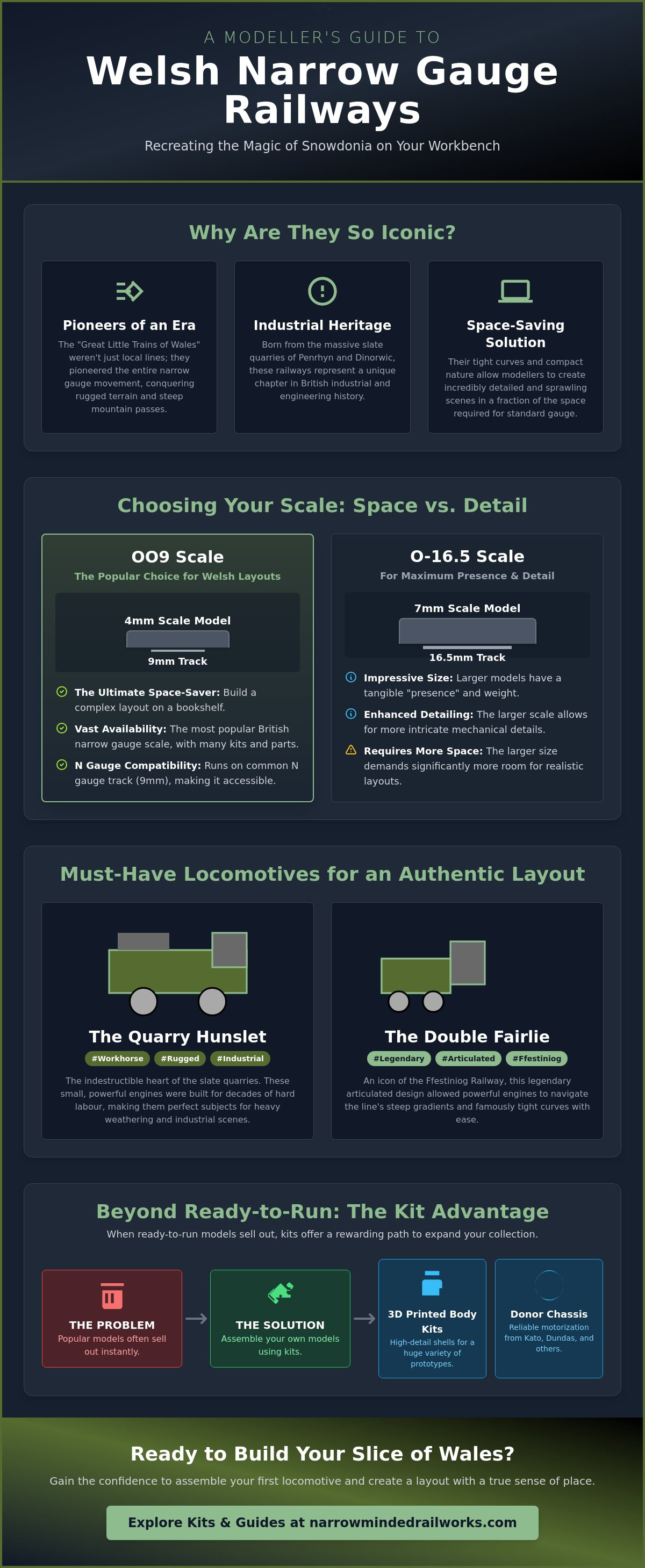
OO9 is currently the most popular choice for British narrow gauge enthusiasts. It uses 4mm scale models running on 9mm track, which accurately represents the 2ft 3in gauge common in the Welsh hills. Its biggest advantage is the "space-saver" factor. You can model a complex station like Tan-y-Bwlch in a fraction of the space required for standard gauge. Since OO9 runs on the same track width as N gauge, you can use N gauge track for hidden staging yards to save money, though Peco’s dedicated narrow gauge track looks far more authentic for scenic areas. Ready-to-run stock from Bachmann has made this scale more accessible than ever. If you're just starting, check out our OO9 beginner guide to help you pick your first locomotive kit.
O-16.5 and 7mm: For the Detail-Oriented Modeller
If you have more room, 7mm scale (O-16.5) offers an incredible level of realism. These models use 16.5mm track, the same width as standard OO gauge, but the locomotives and rolling stock are much larger. This scale is perfect for capturing the intricate valve gear of a Talyllyn "Dolgoch" or the rugged textures of a North Wales slate quarry. The larger size allows for realistic figures and detailed cab interiors that are difficult to achieve in smaller scales. It's the go-to choice for those who want to model the Corris Railway with absolute precision. While kits are more common here than ready-to-run models, the finished welsh narrow gauge railway models have a weight and presence that smaller scales can't match. You'll find that the extra space in 7mm makes installing sound decoders and stay-alive capacitors much easier for smooth running at slow speeds.
Choosing between these scales often comes down to a trade-off between the "big picture" of the Welsh landscape and the fine mechanical details of the engines. Whether you want a compact OO9 layout that fits on a bookshelf or a 7mm masterpiece that fills a spare room, the modern market provides the components you need to succeed. If you're still undecided, starting with a small locomotive kit can help you get a feel for the work involved in your chosen scale.
Key Welsh Prototypes: From Hunslets to Fairlies
The character of a layout featuring welsh narrow gauge railway models is defined by its motive power. Unlike the standard gauge lines of the UK, Welsh narrow gauge prototypes were often bespoke solutions to extreme geographical challenges. From the steep gradients of the Snowdonia foothills to the tight curves of the Ffestiniog, these locomotives were built for grit and endurance. Modellers today benefit from a wide range of ready-to-run models and traditional brass kits that celebrate this unique engineering heritage.
The Versatile Quarry Hunslet
The Quarry Hunslet 0-4-0ST stands as the backbone of Welsh industrial history, serving as the primary workhorse for the world's largest slate quarries for over a century. These diminutive steam engines are often the first choice for hobbyists. Their simple 0-4-0 wheel arrangement makes them reliable runners on small layouts, while their open cabs allow for high levels of interior detailing.
Distinguishing between different fleets is a key part of the hobby. The Dinorwic Quarry fleet featured the famous "Alice" class, while the Penrhyn Quarry favoured the slightly larger "Port" class. Modellers should look for these specific differences:
- Cab configurations: Many quarry locos ran without cabs or with simple "weather boards" to fit through low tunnel portals.
- Livery details: While many were painted in "Midland Red" or "Penrhyn Main Line" black, individual nameplates like Britomart or Holy War add historical accuracy.
- Scale availability: These are now widely available in 009 scale from manufacturers like Bachmann, making them accessible for those with limited space.
Coaches and Slate Wagons
A locomotive is only as good as the load it pulls. For many, the ultimate challenge is modelling the Ffestiniog Railway's "Bowsider" coaches. First introduced in the 1870s, these carriages feature distinctively curved sides designed to maximise internal space while keeping the centre of gravity low. They remain some of the most elegant examples of Victorian narrow gauge design, though their complex curves require patience when building from kits.
If you want to capture a true industrial atmosphere, the focus must shift to slate wagons. You can study the original prototypes at the National Slate Museum, where the history of these rugged vehicles is preserved. An authentic Welsh layout often features "gravity trains," where long strings of slate wagons descended from the quarries to the ports using nothing but momentum and a brave brakesman.
Weathering is vital for these models. Slate dust is a pervasive, light grey powder that settles into every crevice. Don't be afraid to use heavy washes and pigments on your rolling stock. Most wagons spent decades exposed to the harsh Welsh rain and acidic quarry environments, so a pristine finish is rarely realistic for a working line.
Building Your Own Welsh Models: The Kit Advantage
While ready-to-run (RTR) models from major manufacturers provide a solid foundation, they often focus on a narrow selection of famous locomotives. Building your own welsh narrow gauge railway models through 3D printed kits opens up a world of prototypes that will likely never see a mass-produced release. In 2026, the resolution of resin prints has reached a point where detail rivals or exceeds injection-moulded plastic. You can now model obscure quarry Hunslets or specific Ffestiniog variations for a fraction of the cost of a brass kit, often for under £40 per body.
The barrier to entry has dropped significantly. You don't need a workshop full of heavy machinery. A basic toolkit consisting of fine-grade sanding sticks (400 to 1000 grit), high-quality side cutters, and a bottle of cyanoacrylate (superglue) is enough to get started. Modern resin kits are designed with precision alignment features, making assembly straightforward for anyone with a steady hand. If you've been hesitant to try kit building, the current generation of 3D prints offers the perfect entry point.
Preparing and Finishing 3D Printed Bodies
Success starts with preparation. Every resin body should be washed in warm, soapy water to remove any lingering UV resin or processing oils. Once dry, use your side cutters to carefully snip away support structures. Don't pull them off, as this can pit the surface. For a professional look, apply a high-build automotive primer like those found at Halfords. This fills any microscopic layer lines. Follow our guide on painting 3d printed models to master the application of iconic liveries like Penrhyn Red or Ffestiniog Green.
Motorising Your Model
The "magic" happens when you pair a detailed body with a reliable donor chassis. Most Narrow Minded Railworks bodies are designed to fit Kato or Tsugawa chassis, which typically cost between £25 and £35. The Kato 11-103 is a particular favourite for its smooth running at low speeds. To ensure a wobble-free fit, use small amounts of Blu-Tack or dedicated mounting brackets for a secure connection. Because these small welsh narrow gauge railway models are lightweight, adding "liquid lead" or small tungsten weights inside the boiler or water tanks is essential. This 15% to 20% increase in mass significantly improves electrical pickup and pulling power on steep gradients.
Ready to start your first build? Browse our collection of 3D printed Welsh locomotive kits and bring the Great Little Trains to your layout.
Creating an Authentic Welsh Atmosphere
To capture the true essence of welsh narrow gauge railway models, you must look beyond the track and locomotives. The atmosphere of North Wales is defined by its unique geology and unpredictable weather. Modelling the rugged slate landscapes of Snowdonia requires a specific approach to texture and colour. Station buildings in this region, such as those found on the Ffestiniog or Talyllyn, often feature heavy stone masonry and steep slate roofs designed to shed heavy rain. Including specific engine sheds, such as the iconic structures at Boston Lodge, helps ground your layout in a tangible reality. Don't forget the human element; placing figures in period-accurate 1950s attire or slate workers in flat caps adds a vital narrative layer to your miniature platforms.
Slate, Rain, and Moss: The Welsh Colour Palette
Authenticity starts with the ground. Using real slate chippings, crushed to scale, provides a texture that synthetic scatters cannot match. For a damp mountain feel, apply gloss varnishes sparingly to rock faces to simulate the sheen of recent rainfall. Welsh hillsides aren't just a uniform green. They're a complex mix of deep moss, bracken, and grey stone. Use a palette of olive, forest green, and burnt umber to replicate the environment shaped by the 1,200mm of annual rainfall typical of the Snowdonia range. This attention to environmental detail makes your welsh narrow gauge railway models stand out as realistic representations of the landscape.
Bespoke Welsh Scenery and Accessories
Small details define the era of your layout. Adding 3D printed K6 red phone boxes or vintage petrol pumps can instantly transport a scene to the mid 20th century. In quarry scenes, precision is key to telling the story of the industry. You can enhance your scenes by adding 3D printed splitting chisels, hammers, and miniature slate wagons. These small inclusions make a scene feel lived-in rather than staged. Narrow Minded Railworks serves as your dedicated partner in this creative process, providing the specific components needed to bridge the gap between a generic layout and a true Welsh masterpiece. Our kits are designed with the specific proportions and architectural quirks of the Great Little Trains in mind.
Bring Your Welsh Narrow Gauge Vision to Life
Capturing the rugged charm of the Snowdonia foothills requires more than just track and a train. You've explored how selecting the right scale and focusing on iconic prototypes like the Hunslet slate locos or the Double Fairlie can transform a simple layout into a living piece of history. Whether you're modelling in OO9 or 16mm scale, the secret lies in those fine details that define the "Great Little Trains of Wales." High-quality kits bridge the gap between mass-produced models and the unique, often one-off rolling stock found on these historic lines. Building welsh narrow gauge railway models offers a rewarding challenge for any enthusiast looking to recreate the 19th-century industrial spirit or the preserved era of today.
Narrow Minded Railworks provides specialist 3D printed kits for rare Welsh prototypes that you won't find from mainstream manufacturers. These designs are created by modellers, for modellers, ensuring every rivet is accurate to original 19th-century engineering drawings. It's easy to source authentic parts from anywhere with our worldwide shipping for narrow gauge enthusiasts. Browse our collection of Welsh narrow gauge locomotive and wagon kits to find your next workshop project. Your journey into the heart of the Welsh valleys starts with the right kit.
Frequently Asked Questions
What is the best scale for modelling Welsh narrow gauge railways?
OO9 is the most popular scale for welsh narrow gauge railway models because it uses 1:76 scale bodies on 9mm track. This allows you to model iconic lines like the Talyllyn or Ffestiniog in a compact space. 16mm scale is the primary choice for garden layouts, representing 2ft gauge prototypes on 32mm track for a larger, more tactile experience.
Do I need a special track for Welsh narrow gauge models?
You should use dedicated narrow gauge track like Peco Streamline or Crazy Track rather than standard N gauge track. While both use a 9mm gauge, narrow gauge sleepers are spaced further apart to represent 2ft prototypes accurately. Peco's SL-400 series is the industry standard for UK modellers who want an authentic look for their Snowdonia-inspired layouts.
Are Welsh narrow gauge kits suitable for beginners?
White metal or 3D printed kits from brands like Dundas Models are ideal for those starting out in the hobby. These often fit directly onto pre-built chassis, so you don't have to worry about complex motor assembly. It's best to avoid etched brass kits until you've built 3 or 4 simpler models since they require advanced soldering skills and specialised tools.
Where can I find a chassis for my OO9 Welsh locomotive kit?
The Kato 11-103 and 11-109 power units are the most reliable options for small 0-4-0 Welsh locomotive kits. You can also source 0-6-0 chassis from Graham Farish N gauge Class 08 shunters for larger prototypes. These units typically cost between £30 and £50 at UK specialist retailers and provide smooth running at low speeds.
What were the most common locomotives used in Welsh slate quarries?
Hunslet 0-4-0 saddle tanks, such as the "Alice Class" built between 1886 and 1932, were the workhorses of the Dinorwic and Penrhyn quarries. De Winton vertical boiler engines were also prominent during the 1870s because they were easy to maintain in remote locations. These small engines were designed specifically to navigate the incredibly tight curves of Welsh slate workings.
How do I paint a Ffestiniog Railway locomotive accurately?
Use specific livery colours like FR Victorian Maroon or Penrhyn Red from the Phoenix Precision or Railmatch paint ranges. For a 1960s appearance, many modellers choose the darker Colonel Stephens green. Always apply a grey primer first to ensure the top coat adheres to white metal or resin surfaces, then finish with a satin varnish to protect the decals.
Can I run Welsh narrow gauge models on an N gauge layout?
You can physically run these models on N gauge track, but the appearance won't be authentic. N gauge sleepers are too small and packed too tightly for 1:76 scale welsh narrow gauge railway models. It's much better to use Peco OO9 track which scales correctly for the 2ft gauge prototypes found across the Welsh mountains.
Why are Welsh narrow gauge railways called "Great Little Trains"?
The term comes from the Great Little Trains of Wales marketing federation formed in 1970 to promote narrow gauge tourism. It originally included five railways: the Ffestiniog, Talyllyn, Welshpool & Llanfair, Vale of Rheidol, and Snowdon Mountain Railway. Today, the group has expanded to include 12 unique heritage lines that preserve the industrial history of the region.