

A pristine, mass-produced wagon is often the least realistic element on a narrow gauge layout. While ready-to-run models offer convenience, they frequently lack the specific industrial grit required for an authentic 7mm scale scene. You might find it difficult to source accurate quarry or timber prototypes that don't look generic or too clean for a working environment. Choosing high-quality O-16.5 wagon kits provides a direct solution to this problem, allowing you to move beyond standard offerings and create a fleet with genuine character.
It is common to feel overwhelmed by the technical overlap between O-16.5 and On30 standards, or to worry that kit building requires specialized engineering skills. We understand these frustrations and have designed this guide to simplify the process. You will discover how to select the right prototypes, master the assembly of 3D-printed components, and apply weathering techniques that bring your rolling stock to life. This article covers everything from standard definitions to finishing tips, ensuring your next project results in a highly detailed, professional-grade narrow gauge layout.
Key Takeaways
- Understand the specific standards of O-16.5, where 7mm scale meets 16.5mm track to offer superior detail and physical presence compared to smaller scales.
- Learn how to select O-16.5 wagon kits that match your layout’s industrial purpose, whether you are modeling a slate quarry or a general freight line.
- Discover the technical advantages of 3D-printed resin, which captures intricate textures like wood grain and bolt heads more effectively than traditional molding methods.
- Master essential finishing techniques, including how to properly remove support marks and choose the right adhesives for a durable, professional finish.
- Gain clarity on how these kits integrate with commercially available chassis to streamline your build process without sacrificing unique character.
Understanding O-16.5: The Appeal of 7mm Narrow Gauge
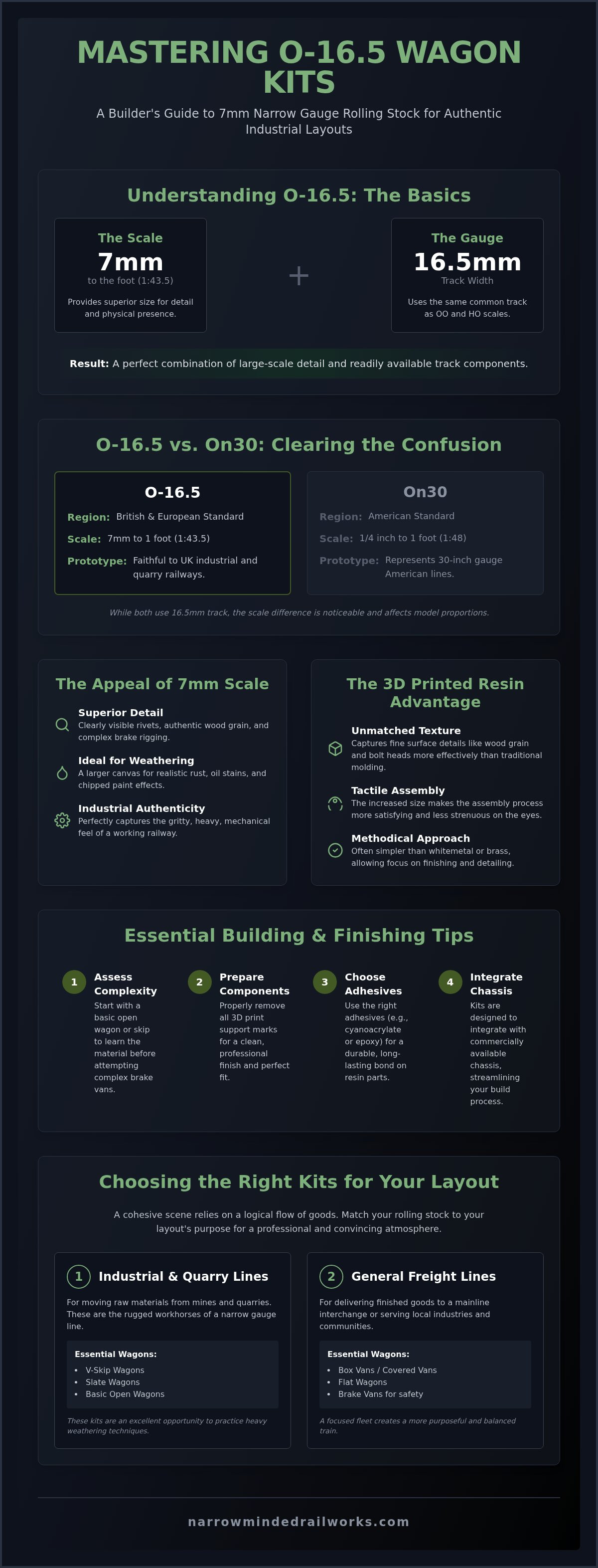
O-16.5 is a unique scale that bridges the gap between small-scale convenience and large-scale detail. Specifically, it uses 7mm to the foot (1:43.5) scale while running on 16.5mm gauge track. This gauge is the same used for standard OO and HO scales, which makes finding track and chassis components straightforward. For many, Understanding O-16.5 begins with recognizing its physical presence. Unlike smaller scales, 7mm models have a distinct 'heft' that allows for intricate details like individual rivets, authentic wood grain, and complex brake rigging to be clearly visible. It's a scale where you don't just see the model; you feel the weight of the machine it represents.
Many modellers begin their journey with OO9 narrow gauge modelling because of its space-saving benefits. However, transitioning to 7mm is a logical progression when you want to focus on the craftsmanship of individual pieces of rolling stock. Building O-16.5 wagon kits provides a larger canvas for weathering and super-detailing. It's a scale where the character of a single wagon can tell a story of years of hard service in a quarry or timber yard. The increased size makes the assembly process more tactile and satisfying, especially for those who find smaller scales a strain on the eyes.
O-16.5 vs. On30: Clearing the Confusion
The terminology in narrow gauge modelling can be confusing because several scales share the same 16.5mm track. On30 is the American standard, which uses 1/4 inch to the foot (1:48) scale to represent 30-inch gauge prototypes. In contrast, O-16.5 is the British and European standard using 7mm scale. While they look similar from a distance, the size difference is noticeable when models are placed side-by-side. We focus on O-16.5 to ensure our kits remain faithful to the proportions of British industrial and quarry railways, providing a consistent look across your layout.
Why 7mm Scale is Perfect for Industrial Scenes
Industrial narrow gauge railways were rarely pristine. They were gritty, improvised, and full of texture. The 7mm scale is ideal for capturing this aesthetic because it's large enough to work with comfortably without requiring a massive room for a layout. When you assemble O-16.5 wagon kits, you aren't just building a model; you're recreating the heavy, mechanical feel of a working railway. The larger surface area makes it easier to apply realistic rust effects, oil stains, and chipped paint that might look cluttered or messy on a smaller 4mm model. This scale rewards the patient modeller who enjoys bringing out the industrial 'soul' of their rolling stock.
Choosing the Right O-16.5 Wagon Kits for Your Layout
Identifying the specific purpose of your layout is the first step in selecting appropriate rolling stock. For decades, model railway enthusiasts have emphasized that a cohesive scene relies on a logical flow of goods. Choosing the right O-16.5 wagon kits involves looking at the 'Job To Be Done' on your line. Are you moving raw materials from a mine or delivering finished goods to a mainline interchange? Matching your rolling stock to your chosen locomotive kits ensures that the train looks balanced and purposeful. While it's tempting to buy every interesting model you see, a focused fleet creates a more professional and convincing atmosphere.
Assess kit complexity before you begin. While 3D-printed resin kits are often simpler to assemble than traditional whitemetal or brass, they still require a methodical approach. We recommend starting with a basic open wagon or skip before moving on to complex brake vans or passenger coaches. This allows you to get a feel for the material and the finishing process before committing to a more involved project.
Industrial and Quarry Classics: Slate and V-Skip Wagons
V-skips and slate wagons are the essential workhorses of any narrow gauge industrial layout. These O-16.5 wagon kits capture the rugged, utilitarian nature of prototypes used in the North Wales quarries and beyond. The V-skip is particularly useful for adding movement to a scene, as its tipping mechanism is a hallmark of narrow gauge operations. Because these wagons were often battered and worn, they provide an excellent opportunity to practice heavy weathering techniques that highlight the grit of a working environment.
General Merchandise: Box Vans and Open Wagons
Even a dedicated industrial line needs to move supplies like coal, tools, or timber. Integrating box vans and open wagons adds necessary visual variety to your trains. These models offer larger flat surfaces, which are ideal for applying custom signage or decals. This variety helps break up the monotony of long trains of identical skips. If you want to expand your freight operations, you can browse our 7mm scale collection for unique industrial designs that stand out from mass-produced models.
The 'End of the Line': Choosing a Characterful Brake Van
Every train needs a tail, and the brake van is frequently the most detailed piece of rolling stock in a consist. In 7mm scale, you can really showcase the interior stove, the intricate handrails, and the heavy underframe detail. A well-chosen brake van provides a focal point for the end of your train and defines the era of your layout. It acts as the final signature on your rolling stock fleet, providing a sense of completion and operational realism to your industrial railway narrative.
The Technical Advantage: Why 3D Printed Resin Kits Excel
Traditional kit building often involves hours of removing flash from whitemetal castings or hiding seam lines on plastic bodies. While these methods have served the hobby for years, modern 3D-printed resin offers a more efficient alternative for those building O-16.5 wagon kits. Resin printing technology allows for the creation of complex, single-piece bodies that would be impossible to produce in a traditional two-part mold. This shift in manufacturing doesn't just save time; it fundamentally changes the level of detail you can expect on your layout.
One common concern regarding resin is its perceived brittleness. While early hobbyist resins were indeed fragile, modern engineering-grade resins used in professional kits are remarkably durable. They provide a sturdy base for your rolling stock that handles the rigors of exhibition use and regular operation. In terms of weight, resin bodies are lighter than whitemetal but possess more presence than thin injection-molded plastic. This balance ensures your wagons sit firmly on the 16.5mm track without requiring heavy-duty locomotives to pull a modest consist.
No More Mold Lines: The Cleanliness of 3D Prints
The most immediate benefit of choosing 3D-printed O-16.5 wagon kits is the absence of traditional mold lines. In injection molding, a seam is created where the two halves of the tool meet. Removing this seam without damaging surrounding detail is a tedious task. 3D prints are built in layers, meaning there is no split line to sand away. While you might find small support marks on the underside of a print, the visible faces of the wagon remain clean and crisp, allowing you to move straight to the painting and weathering stages.
Intricate Rivet Detail: Bringing 7mm Scale to Life
The appeal of 7mm narrow gauge lies in the ability to see the "nuts and bolts" of the machinery. 3D printing excels here by capturing sub-millimeter details like bolt heads, washer plates, and individual wood planks with startling clarity. Unlike whitemetal, which can lose sharpness during the casting process, resin maintains the exact geometry of the digital design. This precision is especially effective for industrial prototypes where the rugged, bolted-together look is a defining characteristic. You'll find that the textures of timber and steel are so well-defined that they practically do the weathering work for you, catching washes and dry-brushing with ease.
Essential Tips for Building and Finishing O-16.5 Kits
Building O-16.5 wagon kits requires a different mindset than working with traditional injection-molded plastic. While the assembly is often simpler, the preparation of 3D-printed resin is vital for a high-quality finish. We acknowledge that the presence of support marks can be off-putting for some modellers; however, these are easily managed with the correct tools and technique. For the best results, use medium-viscosity cyanoacrylate (super glue) for resin-to-resin joins. If you're attaching metal components like brass handrails or additional weight, a high-strength epoxy or specialized metal-bonding CA glue provides a more durable bond.
Preparing 3D Prints: Cleaning and Sanding
Before assembly, examine the body for small nubs left from the printing supports. While we minimize these during the design phase, some light sanding is usually necessary. Use a fine-grit sandpaper, around 400 to 600 grit, to smooth these areas. It's important to sand under a light stream of water or use a wet-sanding technique to prevent resin dust from becoming airborne. Once the surface is smooth, wash the kit in warm, soapy water to remove any residual oils or dust that might interfere with paint adhesion.
Priming and Painting for an Industrial Finish
The surface of resin requires a dedicated primer to ensure the topcoat adheres properly. A high-quality automotive or hobby primer creates a uniform surface that reveals any remaining imperfections before you apply your final colors. For a detailed walkthrough on this process, see our guide on painting 3d printed models. Once primed, focus on creating an industrial look using matte or satin finishes. Industrial wagons were rarely glossy. Use dry-brushing to highlight rivet detail and thin washes to settle grime into the corners of the chassis, emphasizing the hard-working nature of the prototype.
Adding the Final Touches: Couplers and Loads
The final stage of finishing your O-16.5 wagon kits involves adding functional details and weight. Since these kits are designed to fit standard chassis, ensure your couplers are mounted at a consistent height across your fleet. Adding a realistic load, such as crushed slate, real coal, or timber, does more than just look good. It adds necessary weight to the wagon, which improves its tracking and stability on 16.5mm rails. To start your next project, shop our range of 7mm scale kits and begin building a unique, characterful industrial fleet today.
Expanding Your Fleet with Narrow Minded Railworks
At Narrow Minded Railworks, we recognize that the primary challenge for 7mm scale modellers is the limited variety found in mass-produced markets. While ready-to-run items provide a functional starting point, they rarely capture the specific industrial grit of a slate quarry or a remote timber line. We provide a proactive solution by specializing in 3D-printed body kits that prioritize unique character over generic design. Our O-16.5 wagon kits are specifically engineered to bridge the gap between high-end detailing and accessible assembly, ensuring your layout stands out from the crowd.
Building a diverse fleet often requires complex metalwork or soldering that many modellers find intimidating. We address this constraint by utilizing high-detail resin prints that fit directly onto standard, reliable chassis from major manufacturers. While we don't sell the chassis or motors ourselves, our designs are optimized for compatibility with readily available components. This approach allows you to focus on the creative aspects of the hobby, such as painting and weathering, while benefiting from the proven mechanical reliability of established brands.
Our Unique Range of Industrial Wagon Kits
Our philosophy centers on prototypes that other manufacturers often overlook. We focus on the rugged workhorses of industry, including slate wagons, V-skips, and specialized industrial vans. Because we utilize 3D printing technology, we can produce highly detailed models of obscure prototypes that wouldn't be commercially viable for traditional large-scale production runs. This means you can populate your layout with rolling stock that looks like it belongs in a working environment, complete with authentic textures and rivet patterns. Choosing our O-16.5 wagon kits allows you to move beyond the "clean" look of big-box brands and embrace a more realistic, industrial aesthetic.
Worldwide Shipping and Support for Modellers
Sourcing specialist narrow gauge kits can sometimes be difficult for modellers outside the UK. We solve this by offering worldwide shipping from our base in the United Kingdom, with UK shipping starting from £4.50. We understand that starting a new scale can raise technical questions, so we prioritize clear communication and helpful support for our customers. Whether you are transitioning from OO9 or are a seasoned 7mm modeller, our kits are designed to be straightforward to finish. By focusing on industrial and quarry prototypes that fit standard chassis, we make it easier than ever to build a truly characterful 7mm narrow gauge layout. You can explore our full range and start your next project by visiting our online shop today.
Build Your Industrial Narrow Gauge Legacy
Transitioning to 7mm scale allows you to move beyond the limitations of generic, mass-produced models. By choosing detailed 3D-printed prototypes, you gain the ability to recreate the specific industrial grit of a working quarry or timber line. We've explored how resin captures intricate textures that traditional materials often miss, and how simple finishing techniques can bring these models to life. While finding unique prototypes can be difficult, our range provides a proactive solution for modellers who don't want to settle for generic designs. These kits fit standard chassis, ensuring your fleet is as reliable as it is characterful.
Our designs are specifically created for easy industrial weathering and are supported by expert advice from fellow narrow gauge enthusiasts. If you're ready to create a truly unique layout, explore our full range of characterful O-16.5 wagon kits today. We look forward to helping you build a layout that reflects the true spirit of British industrial heritage and craftsmanship.
Frequently Asked Questions
What is the difference between O-16.5 and On30 gauge?
The primary difference lies in the scale ratio used for the models. O-16.5 utilizes 7mm to the foot (1:43.5) to represent British narrow gauge prototypes, while On30 uses 1/4 inch scale (1:48) for American 30-inch gauge lines. While both run on 16.5mm track, mixing them can lead to proportion issues. We focus on 7mm scale to ensure our kits maintain the correct British industrial character.
Do O-16.5 wagon kits come with wheels and axles?
Our body kits don't include wheels or axles as standard. While we provide the high-detail 3D-printed body, modellers need to source their own 16.5mm wheelsets and axles separately. This constraint allows you to choose the specific wheel diameter and bearing type that matches your layout's standards. We design our kits to accept common wheelsets available from major hobby suppliers, ensuring a straightforward assembly process.
Can I run O-16.5 wagons on standard OO or HO gauge track?
You can run O-16.5 wagons on standard OO or HO gauge track because the rail spacing is identical at 16.5mm. However, the sleepers on standard gauge track are often too small and closely spaced for a realistic narrow gauge appearance. We recommend using dedicated narrow gauge track with wider sleeper spacing to complement your O-16.5 wagon kits and maintain the authentic aesthetic of an industrial railway.
What kind of glue should I use for 3D printed resin wagon kits?
Medium-viscosity cyanoacrylate, or super glue, is the most effective adhesive for joining resin components. While traditional plastic cement won't work on 3D-printed resin, super glue creates a strong, near-instant bond. For larger assemblies or load-bearing parts, a two-part epoxy resin provides additional strength. We suggest applying small amounts with a toothpick to avoid excess spill, ensuring a clean finish on your detailed industrial wagon models.
How do I add weight to lightweight 3D printed wagons for better running?
Adding weight is essential for ensuring lightweight resin wagons track reliably through points and curves. While the 3D-printed bodies are light, you can easily secure lead shot or small metal plates to the underside of the chassis. A proactive solution is to incorporate heavy, realistic loads like real slate or coal. This adds necessary mass while simultaneously enhancing the visual realism of your rolling stock consist.
Are these kits suitable for a beginner in 7mm scale modelling?
These kits are highly suitable for beginners because they require less complex assembly than traditional whitemetal or brass alternatives. While some preparation like sanding support marks is necessary, the one-piece body designs simplify the construction process significantly. We provide helpful support to guide you through your first build. Starting with O-16.5 wagon kits is an excellent way to learn the fundamentals of 7mm scale modelling without feeling overwhelmed.
Do these kits require a specific type of paint?
You don't need a specific type of paint, but using a dedicated primer is mandatory for resin surfaces. While the material is non-porous, a high-quality automotive or hobby primer ensures that acrylic or enamel topcoats adhere properly. Once primed, you can use any standard hobby paints to achieve an industrial finish. We recommend matte or satin colors to capture the work-stained look common on industrial and quarry prototypes.
How do I choose the right chassis for a locomotive body kit?
We design our locomotive body kits to fit specific, commercially available chassis from brands like Hornby or Kato. While we don't sell the chassis ourselves, our product descriptions clearly state which donor model is required for a perfect fit. You should verify the wheel diameter and wheelbase of the donor chassis before purchasing. This proactive step ensures that the mechanical components align correctly with the 3D-printed body for smooth running.