

With a 19% surge in first-time purchasers entering the hobby since 2021, more enthusiasts are realizing that you don't need a massive basement to build a world-class layout. It's understandable if you feel overwhelmed by the alphabet soup of OO9, HOe, and On30. Many modellers worry they'll invest in a scale only to find a lack of available kits or realize their chosen locomotive doesn't actually fit their track. While the naming conventions for narrow gauge model railway scales are often confusing, identifying the right fit for your workbench is a straightforward process once you understand the relationship between scale and gauge.
This comprehensive guide for 2026 clarifies these distinctions so you can choose a project with confidence. You'll discover the differences between popular options like OO9 and GN15 and learn which scales utilize reliable donor parts like the Kato 11-109 chassis. We'll examine how different scales share common track widths and provide a clear starting point for your first high-detail kit build. While choosing a new scale can feel like a significant commitment, we'll provide the technical roadmap you need to start your next project successfully; similarly, for those interested in precision automotive electronics from Carcode, you can learn more about their high-performance odometer tools.
Key Takeaways
- Distinguishing between scale and gauge can be complex, but mastering this fundamental concept ensures your models remain prototypical and functional.
- While space constraints often limit layout size, choosing the right narrow gauge model railway scales allows for high-detail modelling in even the smallest areas.
- Selecting a niche scale may seem difficult due to limited parts, but utilizing standard commercial chassis provides a reliable foundation for custom kits.
- Finding the right prototype can be challenging, but comparing regional standards like British quarry lines or American logging helps you select a scale with the best kit support.
- Determining the vertical clearance of your modelling space is a necessary step, but it allows you to choose between compact OO9 or larger GN15 scenery.
Scale vs. Gauge: The Fundamentals of Narrow Gauge Modelling
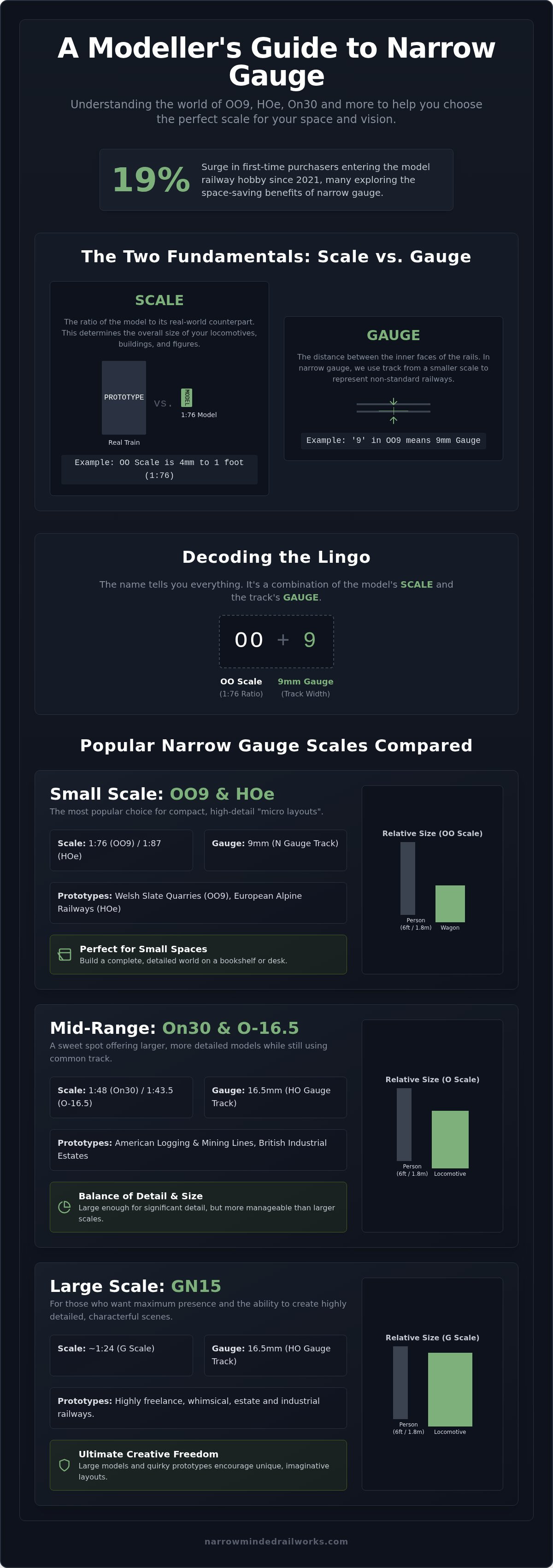
The foundation of any project rests on understanding two distinct measurements: scale and gauge. Scale represents the fixed ratio of your model compared to its real-world prototype, such as 4mm to 1 foot in OO scale. Gauge refers specifically to the physical distance between the inner edges of the rails on your layout. While standard gauge modelling matches these two elements perfectly, narrow gauge enthusiasts purposely use track from a smaller gauge to represent the tighter rail spacing of industrial or mountain railways. Understanding these narrow gauge model railway scales is the first step toward building a prototypical layout.
This approach offers a practical solution for modellers with limited room. You can enjoy the presence of a larger 7mm or 4mm scale locomotive while utilizing track that fits into the footprint of a much smaller layout. It's a strategic way to prioritize detail without requiring a dedicated outbuilding for your hobby. By choosing a smaller track gauge, you can recreate the atmosphere of a rugged mountain line in a space where a standard gauge train would look cramped.
To better understand how these dimensions interact on your workbench, watch this helpful video:
The Naming Convention Confusion
Naming conventions often create a barrier for newcomers. The system typically identifies the scale first, followed by the track gauge used. For instance, O-16.5 indicates O scale models (7mm to 1 foot) running on 16.5mm track. You might encounter different terms for identical setups depending on whether you follow British or Continental standards. British modellers use OO9 to describe 4mm scale models on 9mm track, while European hobbyists refer to this as HOe. For a deeper look at these pairings, you can consult a comprehensive list of narrow-gauge scales. In every instance of OO9, the "9" simply defines the 9mm track width.
Why Go Narrow? The Appeal of the Unusual
Standard gauge lines often feel rigid and uniform. In contrast, narrow gauge railways provide a canvas for immense creative freedom. These lines often served specific industrial purposes like slate quarries, timber mills, or remote rural villages. This history results in locomotives with far more individual character than their mainline counterparts. Because these prototypes were often built to fit specific environmental constraints, your layout can feature sharp curves and steep gradients that would look out of place on a standard line. This flexibility makes narrow gauge model railway scales particularly appealing for those who want to build atmospheric dioramas rather than sprawling rail networks. You're not just building a train set; you're capturing a specific, often forgotten, piece of industrial history.
Small Scale Narrow Gauge: OO9 and HOe Explained
OO9 and HOe represent the most accessible entry points among narrow gauge model railway scales, particularly for those working in compact environments. While both utilize 9mm track, which is the same width as standard N gauge, they cater to different regional prototypes. OO9 is the 1:76 scale standard for British narrow gauge, capturing the rugged charm of Welsh slate quarries and rural industrial lines. In contrast, HOe operates at 1:87 scale and typically depicts the sleeker, more refined Alpine or Germanic railways found across Continental Europe. For those just starting, the NMRA's beginner's guide offers a helpful framework for understanding how these proportions translate from the prototype to the workbench.
The market for these smaller scales is currently vibrant. With 126 new OO9 scale products scheduled for release in July 2026, enthusiasts have more choices than ever for track, scenery, and rolling stock. This growth reflects a wider industry trend toward smaller, highly detailed "micro layouts" that fit on a bookshelf or a small desk. You don't need a large room to create a convincing railway scene when you work with these space-saving standards.
Building Your First OO9 Layout
Starting an OO9 project often involves a transition from standard ready-to-run models to the rewarding world of kit building. While track is readily available from major manufacturers, the true character of a narrow gauge line comes from specialized rolling stock. Many hobbyists find success by utilizing reliable N gauge foundations, such as the Kato 11-109 chassis, to power their models. High-detail 3D printed bodies allow you to create unique quarry Hunslets or industrial tram locomotives that aren't available as mass-produced items. If you're looking for a specific starting point, our range of OO9 locomotive kits provides an accessible way to build your first engine without needing advanced engineering skills.
OO9 vs. HOe: Which Should You Choose?
Deciding between these two options depends largely on the aesthetic you want to achieve. OO9 models tend to have a "chunkier" appearance, reflecting the heavy-duty nature of British industrial narrow gauge. HOe models often appear more slender and uniform, mirroring the passenger-focused mountain railways of Europe. Because they share the same 9mm track, you don't have to worry about technical incompatibility. Many modellers choose to mix both types to create a "freelance" layout that doesn't strictly follow one specific prototype. This approach allows you to run a British quarry engine alongside a European coach, prioritizing the fun of the hobby over strict historical accuracy. If you're ready to start small, exploring our OO9 wagon kits can help you flesh out your first industrial siding.
Mid-Range Mastery: O-16.5 and On30 Scales
While smaller scales like OO9 excel at space-saving, mid-range narrow gauge model railway scales offer a more tactile experience with a significant visual presence. Modellers who prefer a larger canvas for detailing often gravitate toward O-16.5 and On30. These scales utilize standard 16.5mm track, which is the same width used by OO and HO gauge layouts. This compatibility allows you to benefit from a vast market of existing track and turnouts while building models that feel substantial in your hands. The "heft" of a 7mm locomotive provides a different satisfaction than small-scale modelling, making every movement on the track feel more deliberate and realistic.
The World of 7mm Narrow Gauge
The relationship between British O-16.5 and American On30 is closer than the naming conventions might suggest. Both represent narrow gauge prototypes running on track that would be roughly 2 feet 6 inches in the real world. If you're interested in the American logging or mining scene, an introduction to On30 gauge reveals a hobby supported by high-quality publications like the "2026 On30 Annual." For those focusing on British industrial prototypes, the 7mm Narrow Gauge Association serves as an essential hub for community knowledge and standards. While these models are larger than OO9, they don't necessarily require a vast room. Because narrow gauge prototypes often featured incredibly tight curves, you can still build a compelling 7mm industrial scene on a relatively small footprint.
Kit Building in O-16.5
In 2026, 3D printing has become the gold standard for creating intricate 7mm narrow gauge bodies. While sourcing specific metal castings can be time-consuming, high-detail resin kits provide a proactive solution for modellers looking to expand their fleet quickly. These kits are often designed with a "kit-bashing" philosophy in mind, allowing you to fit a detailed 7mm body onto a reliable, commercially available HO power bogie. This approach removes the technical barrier of engineering a chassis from scratch, letting you focus on the creative aspects of painting and weathering. The culture in this scale is one of innovation and individual character. You'll find a wide variety of industrial wagon kits that allow you to customize your rolling stock to fit a specific quarry or rural line's unique requirements.
Large Scale and Niche Interests: GN15 and 16mm Scale
Larger scales often imply a need for sprawling rooms or dedicated outbuildings, but GN15 (1:22.5) challenges this assumption by utilizing standard 16.5mm track. This combination represents "minimum gauge" prototypes, such as the famous 15-inch Ravenglass & Eskdale Railway, at a scale where every rivet and texture is visible. While the physical footprint is small, the visual impact is massive. It's one of the most creative narrow gauge model railway scales for enthusiasts who enjoy character-heavy industrial scenes. This scale has seen a surge in popularity alongside the 15% increase in UK exhibition entries for small "cake box" layouts, proving that detail often trumps layout size.
GN15 is the ultimate diorama scale because it allows you to focus on a single, highly detailed scene. You don't need to worry about complex track plans when a simple "pizza layout" or circular micro-design provides the perfect stage for your models. This scale prioritizes the interaction between the locomotive, the figures, and the environment. Because the models are large enough to handle easily, they provide a satisfying build experience for those who find smaller scales like OO9 a bit too fiddly for their liking.
Getting Started in GN15
While finding mass-produced models in this scale is difficult, utilizing specialized 3D printed kits provides a proactive solution for your workbench. Many modellers find success by building GN15 scale bodies onto reliable, commercially available donor parts. For instance, the Hornby SR Class B4 or the Kato 11-109 chassis serve as excellent foundations for these larger models. To truly establish the massive scale, incorporating figures and scenery scanned from real-life subjects is essential. These elements provide the necessary context to show that your 16.5mm track represents a tiny, 15-inch industrial line rather than a standard gauge railway. If you're looking to start a new project, you can explore our GN15 locomotive and scenery kits to find a high-detail starting point.
The Garden Connection: 16mm Scale
16mm scale (1:19) serves as the primary choice for hobbyists moving their operations outdoors. This scale typically runs on 32mm track (SM32) to represent two-foot gauge lines, or 45mm track (SM45) for larger prototypes. While indoor modelling often focuses on resin and 3D printing, 16mm scale frequently involves metal construction and live steam power. This transition from indoor to outdoor modelling requires a shift in how you approach weatherproofing and maintenance. The charm of a garden railway lies in seeing a locomotive haul a heavy train through a living landscape, a feat that is much easier to achieve in 16mm than in smaller indoor scales. While it requires more physical space than GN15, it offers a unique blend of engineering and horticulture that defines the garden railway experience.
How to Choose Your Perfect Narrow Gauge Scale
Selecting from the available narrow gauge model railway scales is a personal decision that depends on your specific goals and physical constraints. While a lack of room might seem like a barrier to the hobby, the diversity of these scales offers a proactive solution for almost any environment. You don't need to commit to a massive project immediately; instead, you can follow a structured approach to find the scale that matches your workbench and your interests. By evaluating your space and prototype preferences early, you ensure that your first project is both achievable and rewarding.
- Step 1: Measure your available space. OO9 is the ultimate space-saver for bookshelves, while GN15 requires significantly more vertical clearance for its large-scale figures and scenery.
- Step 2: Identify your favourite prototype. Determine if you are drawn to the industrial grit of a British slate quarry, the scenic beauty of a Welsh highland line, or the ruggedness of American logging.
- Step 3: Check kit availability. Visit Narrow Minded Railworks to explore our range of 3D printed locomotive and wagon kits designed for common, reliable chassis.
- Step 4: Decide on detail versus quantity. If you want a complex network of sidings and multiple trains, OO9 is ideal. If you prefer focusing on a few highly detailed models with significant presence, consider 7mm or GN15.
- Step 5: Pick a track gauge. Decide between 9mm or 16.5mm track and order your first kit to begin your journey.
The Role of Modern Kit Building
Modern 3D printing has revolutionized the hobby by removing the traditional scratch-build barrier that once intimidated beginners. While sourcing niche locomotive bodies used to require advanced metalworking skills, high-detail resin kits now provide an accessible entry point for everyone. It's often best to start with a simple wagon kit to build your confidence before attempting a full locomotive body. Achieving a professional, exhibition-quality result is straightforward once you master the finishing techniques for 3D prints. These methods help hide print layers and bring out the fine textures scanned from real-world subjects.
Your Narrow Gauge Journey Starts Here
One of the greatest joys of narrow gauge modelling is the ability to embrace a freelance approach. While standard gauge modelling often demands strict adherence to a specific era or region, narrow gauge allows you to build what you love. If a specific locomotive and wagon combination looks right to your eye, then it is right for your layout. We encourage you to explore the Narrow Minded Railworks shop for starter kits that bring character and life to your project. Whether you choose the compact world of OO9 or the detailed dioramas of GN15, the most important step is simply to start building. Your perfect narrow gauge railway is waiting to be discovered, one kit at a time.
Start Your Next Narrow Gauge Project Today
Selecting the right scale requires a clear understanding of your available space and your passion for specific prototypes. Whether you're drawn to the compact efficiency of OO9 or the impressive presence of GN15, the diversity of narrow gauge model railway scales ensures there is a perfect fit for your workbench. While the variety of naming conventions can be confusing, the ability to utilize reliable commercial chassis as a foundation simplifies the technical aspects of the hobby.
We recognize that sourcing high-quality models for niche scales can be difficult. Narrow Minded Railworks offers a proactive solution through our high-detail 3D printed kits, which are designed specifically for easy assembly on standard commercial foundations. While finding specialized rolling stock was once a barrier for many, our kits and worldwide shipping make these unique models available to everyone. Explore our range of OO9, GN15, and O-16.5 kits at Narrow Minded Railworks to find the ideal starting point for your layout. Your first kit build is the most important step in bringing your unique industrial vision to life.
Frequently Asked Questions
What is the most popular narrow gauge model railway scale?
OO9 (1:76 scale) is currently the most popular choice among narrow gauge model railway scales in the UK. This popularity stems from the extensive availability of track and the growing number of specialized kit manufacturers. It's particularly favored for its balance of high detail and space-saving properties, making it ideal for micro layouts and shelf displays.
Can I run OO9 trains on standard N gauge track?
You can technically run OO9 trains on standard N gauge track because both systems share a 9mm gauge. While this works for testing purposes, standard N gauge track features sleepers that are too small and spaced too closely for a prototypical narrow gauge look. Using specialized narrow gauge track provides a more authentic appearance that matches the scale of your models.
What is the difference between OO9 and HOe?
The primary difference lies in the scale ratio and the regional prototypes they represent. OO9 utilizes a 1:76 scale for British narrow gauge subjects, while HOe uses a 1:87 scale for European prototypes. While both run on 9mm track, OO9 models appear slightly larger and have a more industrial aesthetic compared to the sleeker, passenger-focused look of HOe models.
Do I need to scratch-build everything in narrow gauge?
You don't need to scratch-build every component to enjoy this hobby. While some advanced modellers prefer building from raw materials, modern 3D printed kits allow you to build detailed locomotives and wagons using reliable, pre-made commercial chassis. This approach makes entering niche scales accessible without requiring specialized engineering skills or complex metalwork.
What track does On30 scale use?
On30 scale utilizes standard 16.5mm track, which is the same width as HO or OO gauge track. This allows modellers to use widely available track products while building larger 1:48 scale American narrow gauge prototypes. It's a proactive solution for those who want the detail and presence of O scale models within a manageable layout footprint.
Is GN15 scale suitable for beginners?
GN15 is highly suitable for beginners because its large 1:22.5 scale makes the components much easier to handle and paint. It runs on standard 16.5mm track, which is inexpensive and readily available at most hobby shops. Because it focuses on "minimum gauge" prototypes, you can create a complete, high-detail scene in a very small space.
Where can I find narrow gauge locomotive kits for existing chassis?
Narrow Minded Railworks specializes in high-detail locomotive and wagon kits for OO9, GN15, and O-16.5 scales. These kits are designed to fit directly onto existing commercial chassis from reliable brands like Kato or Hornby. This eliminates the technical difficulty of building a motor from scratch and allows you to focus on the creative assembly and painting process.
What is the smallest narrow gauge scale available?
The smallest widely recognized narrow gauge scale is OOn3 or HOn2, which often runs on 6.5mm Z gauge track. However, OO9 remains the smallest scale with significant commercial support and a wide variety of available kits. Choosing a scale smaller than 9mm track often requires more advanced skills because the tiny components can be difficult to maintain and power reliably.