

Joining a model railway club isn't a test of your current skills. It's actually the most efficient way to acquire the advanced techniques you admire in seasoned modellers. While you might feel hesitant to step into a room full of experts, most groups are eager to share their knowledge with newcomers. If you're wondering how to join a model railway club without feeling like an amateur, you aren't alone. Many enthusiasts find the initial search for a local group or the uncertainty of membership costs a bit daunting.
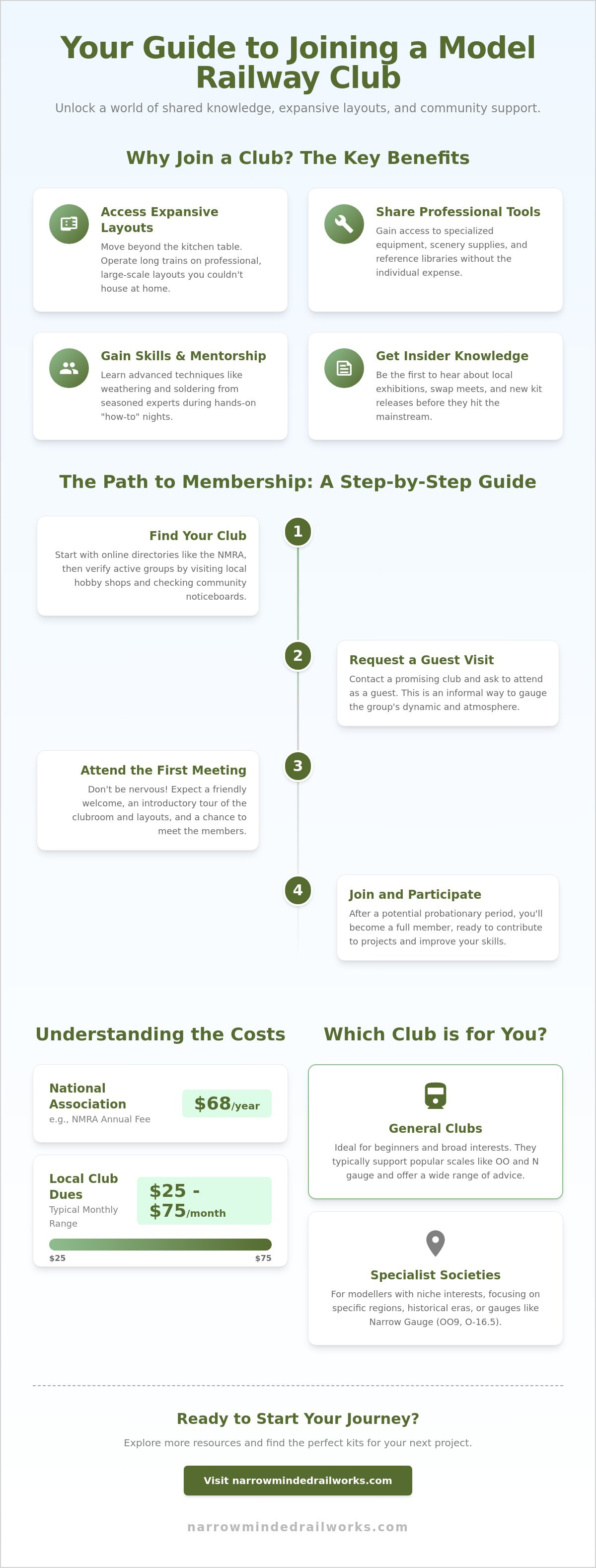
Finding the right group can be difficult when you don't know where to start. However, resources like the National Model Railroad Association (NMRA) provide clear directories to help you locate active communities nearby. This article explains how to find, visit, and join a club that matches your interests and your budget. You'll learn about different membership tiers, such as the NMRA's basic $68.00 annual fee or local club dues that often range from $25 to $75 per month. We'll also cover what to expect during probationary periods so you can confidently start improving your modelling skills alongside a supportive community.
Key Takeaways
- Gain access to professional-grade layouts and decades of collective modelling experience to accelerate your own skill development.
- Locate nearby groups by combining digital directory searches with visits to local hobby shops and community noticeboards.
- Master the protocol for how to join a model railway club by requesting an informal guest visit to observe the group's dynamic first.
- Arrive at your first meeting with confidence, knowing exactly what to bring and what to expect during a standard introductory tour.
- Explore specialized societies if your interests lean toward niche categories like narrow gauge modelling or specific historical eras.
The Benefits of Joining a Model Railway Club
Many hobbyists begin their journey at a small kitchen table or a modest workbench. While solo modelling offers a peaceful escape, limited space often restricts the scope of your projects. Joining a local group provides a proactive solution by offering access to expansive clubrooms and professional-grade layouts that would be impossible to house individually. If you're researching how to join a model railway club, you're likely looking for more than just a place to run trains; you're looking for a community that can help you master the finer points of the craft.
Individual modellers often face budget constraints when purchasing specialized workshop equipment. Membership offers a proactive solution through shared access to expensive tools, scenery supplies, and reference libraries. Beyond physical resources, clubs serve as early warning systems for the hobby. Members often receive the first word on local exhibitions, upcoming swap meets, and new kit releases before they hit the mainstream market. This insider knowledge ensures you're always informed about the best opportunities to expand your collection.
To better understand this concept, watch this helpful video:
Skill Sharing and Mentorship
Mastering advanced techniques like weathering or complex scenery building can be a steep learning curve when working in isolation. Club mentorship offers a proactive solution through "how-to" nights where seasoned pros demonstrate their methods. This is particularly valuable when you're moving away from ready-to-run models and toward building specialized kits, such as OO9 or GN15 locomotives. You can receive direct help with technical tasks like soldering or finishing 3D printed kits to ensure your models look professional from the start.
Access to Large Scale Layouts
A primary draw for many people learning how to join a model railway club is the opportunity to operate on massive layouts. While a spare bedroom might only fit a small diorama, a clubroom allows you to run long trains on prototypical schedules. Engaging with rail transport modelling at this scale gives you a deeper appreciation for different gauges and eras. You might find yourself contributing to a large-scale group build for a national exhibition, allowing you to see your own work, such as a hand-built O-16.5 wagon or a custom-scened diorama, featured on a professional stage.
How to Find the Right Club for Your Interests
Finding a local group often starts with a digital search, but static directories can be unreliable. While many websites list hundreds of organizations, some entries haven't been updated for years. A proactive solution is to use these lists as a foundation and then verify their status through recent community posts or local hobby shop noticeboards. Shop owners across the UK are usually the best-informed members of the community. They know which groups are active and which ones might be looking for new members to help as enthusiasts struggle to keep model railway industry on track in an evolving hobby landscape.
Exhibitions offer another excellent opportunity to gauge a club's atmosphere. When you attend a show, observe how members interact with the public and each other. Are they focused strictly on the technical operation of the layout, or are they enjoying a social chat? If you want to know how to join a model railway club that fits your personality, these brief interactions are more telling than any website description. It's better to spend time researching the "vibe" of a club now than to join one that doesn't align with your social preferences later.
General Clubs vs. Specialist Societies
Most local clubs are generalist by nature, typically supporting popular scales like OO and N gauge. This is ideal if you're looking for a broad range of advice, but it can be limiting if you prefer niche interests. A proactive solution for those with specific tastes is to look for specialist societies. These groups focus on particular regions, historical eras, or the unique charm of a narrow gauge railway. Deciding between a local general club and a national specialist network depends on whether you value physical meeting space or deep technical expertise more.
Using Social Media and Forums
Digital communities provide a fast track to understanding how to join a model railway club in your area. Search online community platforms using your town or county name alongside "model railway" to find active local circles. Forums like RMweb are also indispensable for modellers in Great Britain. They feature regional sub-sections where members announce upcoming open nights or project updates. Clubs that maintain an active online presence are often more receptive to new technologies, such as 3D printing or laser-cut components. If you're planning to start a new project for a club layout, browsing our selection of locomotive and scenery kits can give you a great head start on your next build.
The Step-by-Step Process: How to Join a Model Railway Club
While the prospect of entering an established group can feel intimidating, the formal process for how to join a model railway club is designed to ensure a mutual fit. Most UK-based organizations follow a structured path from initial inquiry to full membership to protect the interests of current members and newcomers alike. If you're concerned about the social dynamic or technical requirements, a proactive solution is to treat your first few visits as a trial period before committing to any long-term subscriptions.
Making the First Contact
Initiating contact through a club's website or community page is the most effective way to start. When you reach out, mentioning your specific interests, such as building OO9 locomotive kits, helps the secretary direct you to the right sub-group or layout team. If you're unsure about your technical proficiency, a proactive solution is to ask if the club hosts dedicated "beginner nights" or workshops. Before your visit, always confirm the meeting location and any specific entry requirements, as many British clubs operate out of community centres, church halls, or secure industrial units with specific access protocols.
Once you've made contact, the standard procedure involves an invitation to a "guest night." This allows you to observe the club's workflow and social atmosphere without any financial obligation. Most clubs encourage prospective members to attend two or three meetings for free. This period is vital for determining if the group's focus aligns with your personal goals, whether you're looking for prototypical operation sessions or casual diorama building.
Understanding Membership Fees
Membership costs vary significantly depending on the club's facilities and location. For international oversight and resources, the National Model Railroad Association (NMRA) offers a basic membership for $68.00 per year, which provides access to a wide network of digital resources and insurance. On a local level in the UK, monthly dues are common and typically cover the cost of rent and layout maintenance. A proactive solution for those on a budget is to check for junior, student, or senior discounts, which are standard in most community-focused clubs.
It's also standard practice for clubs to implement a probationary period, often lasting between three and six months. During this time, you can participate in club activities but may not have voting rights or keys to the premises. A proactive solution to integrating quickly is to volunteer for a small maintenance task or join a specific layout project. Taking an active role in construction or wiring is the fastest way to turn a probationary status into a full membership while gaining the mentorship you need to improve your modelling techniques.
Preparing for Your First Visit: What to Expect
Walking into a clubroom for the first time often feels like entering a private workshop where everyone already knows the unwritten rules. While you might worry about proving your worth or demonstrating advanced skills immediately, a proactive solution is to remember that these groups are usually just as eager to meet you as you are to see their layouts. When you are learning how to join a model railway club, your first visit is primarily about observation and introduction rather than technical performance. You won't be expected to have a finished masterpiece or a fleet of locomotives ready for operation on night one.
Most clubs start a guest visit with a tour of the facilities. You'll likely see several layouts in various stages of construction, ranging from bare timber frames to fully detailed landscapes. Use this time to ask questions about the eras and scales they focus on. While you might feel shy about your own progress, a proactive solution is to talk openly about your specific interests. Members appreciate enthusiasts who are curious about the hobby's history and willing to learn the club's specific standards for trackwork and scenery.
What to Bring (and What to Leave at Home)
Space in many clubrooms is often limited, which can make bringing large items difficult for a newcomer. A proactive solution is to pack light for your introductory night. A small notebook and pen are essential for jotting down tips on wiring or specific paint codes used on club layouts. If you are currently working on a project, such as a GN15 scale kit, bringing a single wagon or locomotive for a brief "show and tell" is a great way to break the ice. However, you should leave larger diorama bases or fragile scenery at home until you understand the club's storage and workbench policies.
Etiquette and "Unwritten Rules"
Every group has its own internal culture, and navigating these social norms can be tricky for a guest. A proactive solution is to adhere to the "look but don't touch" rule that applies to almost every layout. Never handle another member's rolling stock or adjust trackwork without explicit permission. While you may want to dive into complex modelling right away, a proactive solution is to offer help with essential maintenance tasks like track cleaning or scenery dusting. These tasks are the backbone of any functional club. Showing a willingness to contribute to the basic upkeep will quickly earn you the respect of senior members.
Listening more than you talk during your first few visits allows you to absorb the group dynamic. You'll learn who the electronics experts are and who specializes in realistic weathering. If you're looking to start a new project to show at your next meeting, you can browse our range of narrow gauge kits and diorama tools to find a build that fits your new community's interests.
Specialist Societies and Narrow Gauge Modelling Groups
Local generalist clubs provide excellent social opportunities, but they often focus on standard gauge layouts like OO or N gauge. If your passion lies in niche prototypes or specific regional lines, a standard club might feel somewhat limiting. Specialist societies provide a proactive solution by catering specifically to your area of interest. Niche modelling is rewarding. When researching how to join a model railway club, you should consider whether a local physical meeting space or a national network of experts will better serve your goals. Specialist societies bridge this gap by providing deep technical knowledge that general groups might lack.
The Appeal of Narrow Gauge Societies
Narrow gauge modelling requires a different mindset than standard gauge projects. Societies dedicated to scales like OO9, O-16.5, and GN15 provide focused expertise that is invaluable for building realistic layouts. These organizations often maintain extensive historical archives and prototype drawings. Engaging with these societies offers a proactive solution for those facing technical challenges in small-scale kit building. This specialized mentorship is a key reason why many modellers look beyond their local town when deciding how to join a model railway club.
How We Support Club Modellers
At Narrow Minded Railworks, we understand that club layouts require unique rolling stock to stand out. We provide the kits that become the talking point of club nights, including:
- OO9 Locomotive & Wagon Kits
- GN15 Locomotive & Scenery Kits
- O-16.5 / 7mm Scale Kits
- Diorama Tools & Scenery
Our 3D printed bodies and diorama tools are perfect for club layout projects. They simplify complex builds. Limited local availability can make it hard to source specialized narrow gauge components. Our worldwide shipping provides a proactive solution for members who struggle to find niche parts locally. We ship kits worldwide. Whether you are working on a solo diorama or a massive group layout, our products help you share your passion for the hobby with your new community.
Start Your Modelling Journey with Confidence
Joining a model railway club provides a proactive solution for enthusiasts who feel limited by space or isolated in their work. By utilizing online directories and visiting local exhibitions, you can find a community that aligns with your specific interests and skill level. Understanding how to join a model railway club is the first step toward transforming your solo hobby into a collaborative passion. Whether you choose a local generalist group or a specialist society, the mentorship and shared resources will significantly enhance your modelling skills.
If you're ready to impress your new club members with a high-quality build, we can help. We are specialists in 3D printed OO9 and GN15 kits, offering worldwide shipping for global enthusiasts. We also provide direct, helpful support to ensure beginners find success with their first projects. Browse our range of narrow gauge kits to start your next club project and arrive at your first meeting with a model you're proud to showcase. Your perfect community is out there; it's time to find them.
Frequently Asked Questions
Do I need to be an expert to join a model railway club?
No, you don't need to be an expert to join. Most groups exist to foster the hobby and welcome beginners who are eager to learn. While you might feel intimidated by complex layouts, a proactive solution is to view membership as an apprenticeship where you gain access to mentorship that helps you progress much faster than working alone.
How much does it typically cost to join a club?
Costs vary depending on whether you join a national organization or a local group. For example, international membership with the NMRA is $68.00 annually, while local UK clubs typically charge monthly subscriptions ranging from £10 to £30 to cover clubhouse rent. A proactive solution for those on a budget is to ask about associate or junior tiers that offer reduced rates for the same access.
Can children or teenagers join model railway clubs?
Most clubs welcome younger members, though those under 18 usually require a parent or guardian to accompany them during meetings. National organizations offer specific student rates, and many local UK groups provide discounted junior memberships. A proactive solution for young enthusiasts is to join a group that has a dedicated youth section or focuses on teaching basic modelling skills.
What happens if I don’t have my own layout at home?
You don't need a home layout to be an active member. In fact, many hobbyists learn how to join a model railway club specifically because they lack the space for a permanent setup at home. A proactive solution is to use the club's extensive layouts to run your own stock, allowing you to enjoy the hobby without the constraints of limited square footage.
Will I have to help build the club layouts?
Active participation is usually encouraged, but you won't be expected to lead complex projects immediately. Most clubs have an expectation that members help with maintenance or public exhibitions. A proactive solution for newcomers is to volunteer for simpler tasks like track cleaning or basic scenery work, which provides a natural way to learn technical skills from more experienced members.
What if there isn’t a model railway club near me?
If a local physical group is unavailable, virtual clubs and specialist societies offer a proactive solution. Many enthusiasts find that digital forums or online interest groups provide the community they need without the commute. You can also look into modular groups that meet occasionally at UK exhibitions rather than maintaining a permanent clubhouse, ensuring you still benefit from collective knowledge.
Can I join more than one club at a time?
You can certainly join multiple clubs if your schedule and budget allow. Many modellers belong to a local generalist group for social interaction while also maintaining membership in a specialist society for niche technical advice. A proactive solution is to balance a local club's physical layout access with a specialist society's deep historical archives and prototype research.
Do I need to bring my own trains to every meeting?
You aren't required to bring your own trains to every meeting. Many nights are dedicated to construction or layout maintenance rather than running sessions. If you're still researching how to join a model railway club, your first few visits should focus on meeting the members and understanding the club's specific operating standards before you bring your own rolling stock to run.