

Stepping into the fascinating world of gauge model trains can feel like learning a new language. You hear terms like 'scale' and 'gauge' used almost interchangeably, and a sea of acronyms like OO9, On30, and HOn3 only adds to the confusion. If you've ever felt overwhelmed, wondering which path to take for your layout-especially when space is at a premium-you're certainly not alone. Many aspiring modellers find this initial hurdle the most daunting, but it doesn't have to be.
This beginner's guide is your friendly ticket into the captivating niche of narrow gauge railways. We're here to demystify the jargon once and for all. We'll clearly explain the crucial difference between scale (the size of your model) and gauge (the distance between the rails). More importantly, we’ll explore the most popular narrow gauge options available to UK modellers, comparing OO9, On30, and HOn3, so you can confidently choose the perfect scale to bring your miniature world to life, no matter the size of your room.
Key Takeaways
- Grasp the crucial difference between a model's 'scale' (its size) and its 'gauge' (the track width) to confidently start your narrow gauge journey.
- Decode the naming conventions for popular scales like British OO9 and American On30 to understand exactly what you're buying.
- Discover the diverse world of narrow gauge model trains and learn which scales are most popular in the UK and beyond.
- Determine the best scale for your project by evaluating three key factors: available space, personal interest, and product availability.
The Golden Rule: Understanding the Difference Between Scale and Gauge
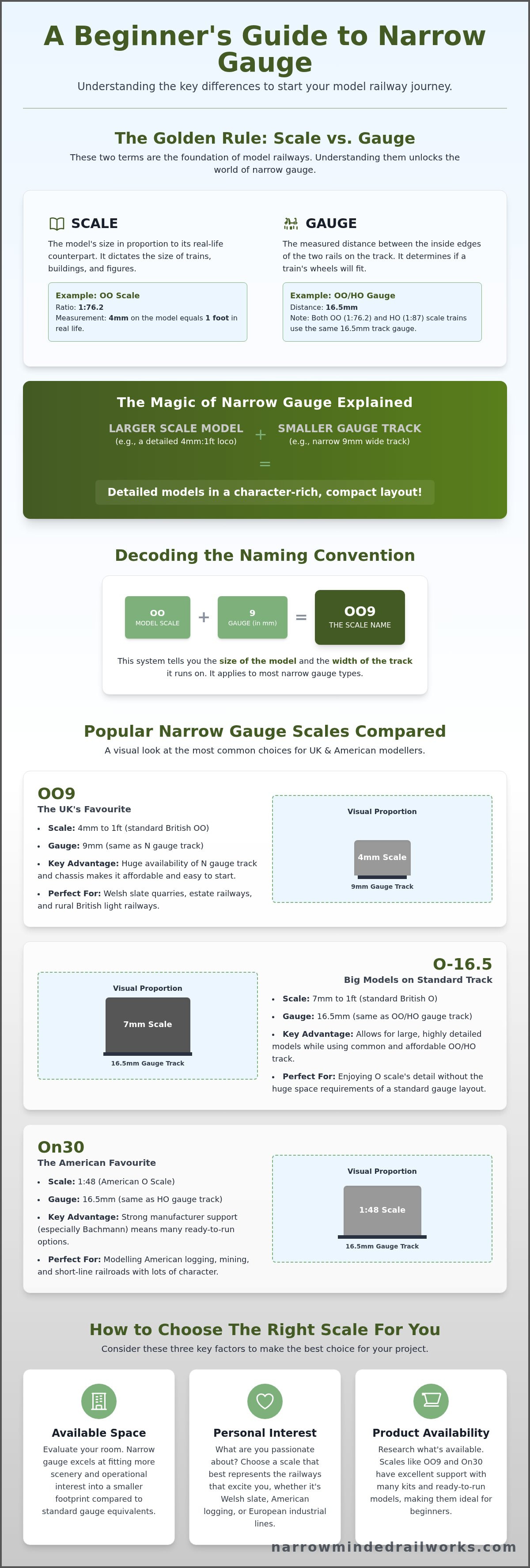
Before diving into the fascinating world of narrow gauge model trains, we must grasp one fundamental concept: the difference between scale and gauge. Think of it like this: scale is the size of a model car, while gauge is the width of the road it drives on. Understanding this distinction is the key to unlocking the unique appeal and creative potential of narrow gauge modelling.
For a visual breakdown of how different scales and gauges look, this video offers some great insights:
In essence, narrow gauge modelling uses larger scale models that run on smaller gauge tracks, allowing for wonderfully detailed locomotives and rolling stock in a compact layout space. Let's break it down further.
What is Model Railway Scale?
Scale refers to the model's size in proportion to its real-life counterpart. In the UK, this is often expressed in millimetres per foot. For example, the most popular scale, OO, is 4mm-to-the-foot (a ratio of 1:76.2). O scale is larger at 7mm-to-the-foot (1:43.5). The scale you choose dictates the size of everything on your layout, from the trains themselves to the buildings, figures, and scenery. There are dozens of model railway scales available, each offering a different perspective.
What is Model Railway Gauge?
Gauge, on the other hand, is much simpler. It is purely the measured distance between the inside edges of the two rails on the track. It has nothing to do with the size of the train sitting on it. For example, standard OO and HO gauge track both have a gauge of 16.5mm. N gauge track, which is much smaller, has a gauge of 9mm. The gauge determines what track your locomotive's wheels will fit on.
Why This Matters for Narrow Gauge
This is where the magic happens. Narrow gauge modelling combines a larger scale with a smaller gauge to replicate real-world narrow gauge railways, which used smaller tracks to navigate tight spaces like quarries, forests, and industrial sites. A perfect example is OO9. The "OO" tells you it's a 4mm scale model, but the "9" signifies it runs on 9mm gauge track (the same as N gauge). This creates the convincing appearance of a large, detailed engine running on a distinctly narrow track, just as it would in real life.
Exploring Popular British & European Narrow Gauge Scales
In the UK and Europe, narrow gauge modelling thrives by cleverly combining popular scales with smaller track gauges. The naming convention is straightforward: the first part denotes the model's scale (like OO or O), and the number represents the track gauge in millimetres. This approach allows modellers to create intricate, character-rich layouts in limited space, often by repurposing readily available track and mechanisms from other scales. Understanding these combinations is a key first step, and resources like the NMRA Beginner's Guide to Model Railroading provide a fantastic foundation for anyone new to the hobby. These unique gauge model trains offer a distinct charm separate from their standard gauge counterparts.
OO9: The UK's Favourite Narrow Gauge
OO9 is the most popular narrow gauge scale in Britain, representing a perfect marriage of convenience and character. It places 4mm:1ft scale models (the same as standard OO) onto 9mm wide track. This is hugely advantageous because 9mm is the standard gauge for N scale, meaning a vast array of affordable track, points, and even complete running chassis are readily available. This scale is ideal for modelling the iconic Welsh slate quarries, charming estate railways, or rural light railways that once crisscrossed the British countryside. See our extensive range of OO9 locomotive and wagon kits.
O-16.5: Bigger Models on Standard Track
For those who appreciate larger, more detailed models, O-16.5 offers an excellent solution. This scale uses 7mm:1ft models (British O scale) running on 16.5mm gauge track. Modellers will immediately recognise 16.5mm as the standard gauge for OO and HO scale trains. This compatibility means you can build a detailed, large-scale narrow gauge layout using common and widely available track products. It’s the perfect way to enjoy the heft and detail of O scale without requiring the enormous space a standard gauge O scale layout would demand.
GN15: Quirky Industrial Modelling in G Scale
GN15 is perhaps one of the most distinctive and whimsical scales. It involves running large G scale models (a scale of 1:22.5) on the very same 16.5mm OO/HO gauge track. The extreme difference between the large model size and the tiny track gauge creates a unique, almost cartoonish appearance that is perfect for modelling quirky industrial tramways, mining operations, or factory lines. These layouts often feature small, freelance "critter" locomotives and tipper wagons, making for a fun and highly creative modelling project.
A Look at Popular American Narrow Gauge Scales
While British narrow gauge often evokes images of slate quarries and quaint passenger lines, the American scene is dominated by the rugged spirit of the frontier. Think sprawling logging operations in the Pacific Northwest, tenacious mining railways clinging to Rocky Mountain cliffsides, and agricultural lines serving vast farmlands. This difference in prototype gives American gauge model trains a distinctly heavier, more industrial feel. The naming convention also differs, typically indicating the scale, the fact it's narrow gauge ('n'), and the prototype's track gauge in feet or inches (e.g., On30 means 'O' scale, 'narrow' gauge, '30' inch prototype track).
On30: O Scale on HO Track
On30 is arguably the most popular American narrow gauge scale, largely thanks to its incredible convenience. The name signifies O scale (1:48) models of prototypes that ran on 30-inch gauge track. By a happy coincidence, this scales down perfectly to run on standard 16.5mm HO gauge track. This accessibility, combined with extensive ready-to-run support from manufacturers like Bachmann, has made it a gateway for many modellers into the world of American narrow gauge.
HOn3: True-to-Scale HO Narrow Gauge
For those seeking greater prototypical accuracy, HOn3 is a leading choice. It represents the common 3-foot gauge lines, like the famous Denver & Rio Grande Western, in standard HO scale (1:87.1). Unlike On30, HOn3 is a 'purist's scale' that requires specific 10.5mm gauge track to be accurate. This commitment to precision makes it a favourite among serious modellers dedicated to faithfully recreating specific historic American railways.
Sn3: The 'Perfect' In-Between Scale
Often called the 'Goldilocks' scale, Sn3 offers a superb compromise between the larger presence of O scale and the space-saving nature of HO. It uses S scale (1:64) to model 3-foot gauge prototypes. This results in models that are noticeably larger and more detailed than their HO counterparts but require less layout space than O scale. While less common, Sn3 has a dedicated following and a growing selection of kits and components available for those seeking a unique modelling experience.
Exploring these scales opens up a fascinating chapter in railway history, far removed from the UK scene. For those looking to start their journey into American narrow gauge, you can find a curated selection of kits and accessories at Narrow Minded Railworks.
How to Choose the Right Narrow Gauge Scale for You
Now that you understand the key differences, how do you pick the right scale? The truth is, there’s no single ‘best’ option. The perfect scale depends on your personal circumstances. To make the decision easier, consider three key factors: the space you have available, the type of railway that inspires you, and the availability of models and community support.
Factor 1: How Much Space Do You Have?
Your available space is often the biggest constraint. If you're working with a bookshelf or a small corner, OO9 and HOn3 are fantastic choices, allowing for complex operations in a tiny footprint. For those with a bit more room, On30 or O-16.5 offer the satisfaction of larger, more detailed models without demanding the vast space of standard gauge O scale. For the ultimate micro layout, GN15 is perfect for creating charming, self-contained dioramas.
Factor 2: What Kind of Railway Inspires You?
What stories do you want your layout to tell? If you're captivated by the charm of Welsh slate quarries, the Ffestiniog Railway, or quaint English estate lines, OO9 is your ideal scale. Conversely, if the rugged, pioneering spirit of American logging and mining railways calls to you, then HOn3 and On30 are the dominant choices. For whimsical, freelance industrial scenes, GN15 provides a wonderful canvas for creativity.
Factor 3: Availability of Kits and Support
Getting started with narrow gauge model trains has never been easier. While major manufacturers offer some ready-to-run items, the hobby thrives on kits from specialist suppliers. The rise of high-quality 3D printing has revolutionised the scene, with businesses like Narrow Minded Railworks offering incredibly detailed and accessible kits. Don't forget the power of community; forums and societies like the OO9 Society provide invaluable advice and support for newcomers.
Quick Comparison Table
| Scale | Gauge | Common Prototype | Space Required | Track Compatibility |
|---|---|---|---|---|
| OO9 | 9mm | UK & European | Very Small | N Gauge |
| O-16.5 | 16.5mm | UK Industrial | Small to Medium | OO / HO Gauge |
| On30 | 16.5mm | US Logging & Mining | Small to Medium | OO / HO Gauge |
| HOn3 | 10.5mm | US Logging & Mining | Small | Specific to HOn3 |
Ultimately, the best scale is the one that excites you most and fits your life. Weigh these factors, explore the options, and start your narrow gauge journey with confidence.
Embark on Your Narrow Gauge Adventure
Now that you grasp the crucial difference between scale and gauge, and have explored the popular options from British OO9 to American HOn3, you're well-equipped to make an informed choice. The world of narrow gauge model trains is rich with character and charm, and selecting the right scale for your available space and creative vision is the first exciting step. The perfect scale is simply the one that inspires you to start building.
When you’re ready to bring that vision to life, Narrow Minded Railworks is here to help. As a specialist in high-quality 3D printed kits, we offer unique models you won't find elsewhere, focusing on beloved scales like OO9, GN15, and O-16.5. With worldwide shipping available for modellers, your next project is just a click away.
Explore Our Full Range of Narrow Gauge Model Kits and discover the perfect foundation for your layout. Happy modelling!
Frequently Asked Questions
What is the difference between OO9 and N gauge?
The main difference is the scale of the models versus the track they run on. OO9 models are built to 4mm:1ft scale (the same as OO gauge), but they run on 9mm wide track to represent narrow gauge prototypes. N gauge models are smaller, built to 2mm:1ft scale, and also use 9mm track, but in this case, it represents standard gauge track. So, while they share a track gauge, the models themselves are very different sizes.
Can I use my existing OO or HO gauge track for narrow gauge modelling?
Generally, no. Standard OO and HO gauge track is 16.5mm wide. Most popular UK narrow gauge scales, like OO9, require 9mm track. While the US-outline scale On30 does use 16.5mm track, it represents a wider 30-inch prototype gauge, not British narrow gauge. For authentic UK modelling in scales like OO9 or 0-16.5, you will need to purchase the correct, narrower track to match your chosen scale and prototype for your gauge model trains.
Is narrow gauge modelling more difficult or expensive than standard gauge?
It can be different, but not necessarily more difficult or expensive. While the ready-to-run market is smaller than for OO gauge, it is growing rapidly. Many modellers enjoy the challenge of kit building, which can be more affordable, with wagon kits starting from around £15. The smaller size of layouts can also save money on baseboards and scenery. The perceived difficulty often comes from working with smaller parts, which simply requires a bit more patience.
What is the most popular narrow gauge scale in the world?
Popularity varies significantly by country. In North America, HOn3 and On30, which model American prototypes, are extremely popular. However, here in the United Kingdom, OO9 is unquestionably the most popular narrow gauge scale. This is due to its perfect combination of 4mm scale scenic compatibility, the wide availability of N gauge track and mechanisms, and a vast range of UK-specific kits and ready-to-run models from major brands.
Where can I find unique narrow gauge model train kits?
Beyond major retailers, the heart of narrow gauge modelling lies with specialist suppliers. In the UK, companies like Dundas Models, Narrow Planet, and Peco offer extensive ranges. It's also highly recommended to check the sales stands at model railway exhibitions or browse the 009 Society's members' sales. These are fantastic places to find unique resin, white metal, and 3D-printed kits from small, cottage-industry producers for all kinds of gauge model trains.
Do I need special tools to build narrow gauge kits?
You don't need highly specialised tools, but a quality set of basic modelling tools is essential. Key items include a sharp craft knife with spare blades, fine-pointed tweezers for handling small parts, a set of needle files, and a pin vice with small drill bits. For etched brass or white metal kits, a temperature-controlled soldering iron is invaluable. While these are standard for many modelling hobbies, their importance is amplified when working with smaller narrow gauge components.