

So, you’ve heard the term ‘GN15’ whispered in model railway clubs or seen it pop up online, but you're left scratching your head. It sounds intriguing, but what does it actually mean? Many modellers are captivated by the unique charm of this scale but feel confused about where to start, worried that finding the right track, chassis, or kits will be a daunting task. If you're wondering whether the quirky and characterful world of gn15 scale is too complex for a beginner, you've come to the right place.
Forget the confusion and put those worries aside. This guide is your friendly introduction to one of the most creative and accessible corners of the hobby. We will demystify the scale, explaining exactly how G scale models run on track meant for 15-inch gauge prototypes. You’ll discover the surprising availability of components right here in the UK and gain the confidence to start your first project. By the end, you’ll not only understand GN15 but feel inspired and equipped to build your own charming layout.
What is GN15? The Basics of a Unique Modelling Scale
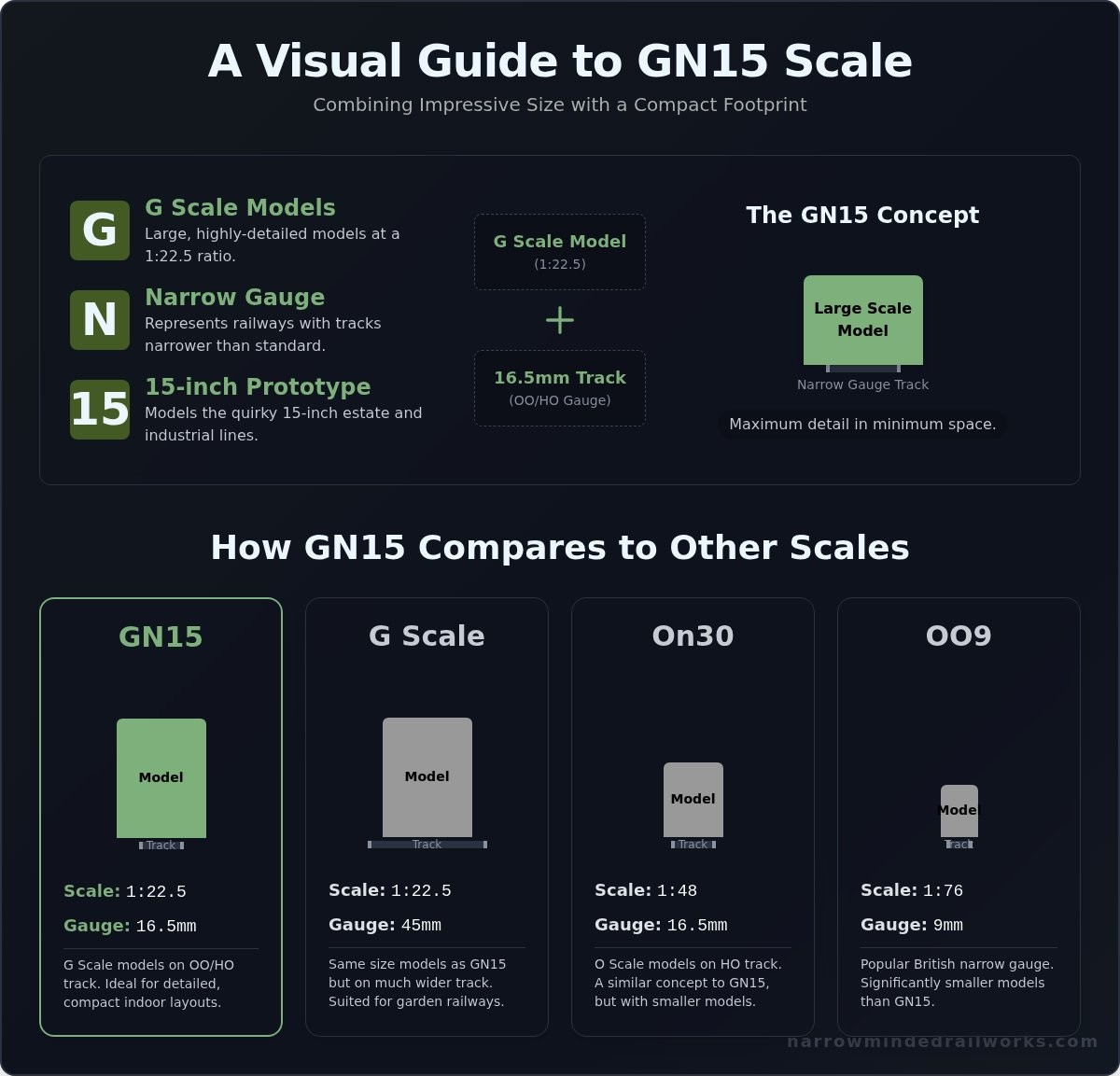
Welcome to the charming and characterful world of GN15! At its core, GN15 is a model railway scale that combines large, highly-detailed G scale models (a ratio of 1:22.5) with readily available 16.5mm gauge track, the same track used for OO and HO scale layouts. This clever combination allows you to enjoy the impressive size of garden railway models within a much smaller, indoor-friendly space.
The name itself tells you everything you need to know. The 'G' stands for G scale, the 'N' signifies Narrow Gauge, and the '15' represents the 15-inch prototype railways it aims to model, such as the estate and industrial lines that once dotted the British countryside. It's the perfect choice for modellers who love detail but are short on space.
To see this charming scale in action, take a look at this fantastic layout which showcases the creative potential of GN15:
Understanding Scale vs. Gauge
For newcomers to the hobby, the terms 'scale' and 'gauge' can be confusing. Scale refers to the size of the model in proportion to its real-world counterpart (1:22.5 in this case). Gauge, on the other hand, is simply the measurement between the two rails of the track (16.5mm). The unique appeal of the gn15 scale comes from using a very large scale on a very narrow gauge. This mismatch perfectly replicates the look of a tiny, quirky locomotive running on a small industrial or agricultural railway line. If you're looking for a detailed technical breakdown, Wikipedia's page on What is GN15 scale? is a great resource.
How GN15 Compares to Other Scales
To better place GN15 in the wider world of model railways, here’s how it stacks up against some other popular scales:
- Versus G Scale: GN15 uses the exact same size models as standard G scale. The key difference is the track; standard G scale runs on much wider 45mm gauge track, making it suitable for gardens, while GN15's use of 16.5mm track makes it ideal for compact indoor layouts.
- Versus OO9: Both are popular British narrow-gauge scales. However, OO9 models are built to a much smaller 1:76 scale, meaning the locomotives and rolling stock are significantly smaller than their GN15 counterparts, even though they can run on similar track.
- Versus On30: This American scale shares a similar concept of putting larger-than-standard models on HO track. The main difference is the scale; On30 uses O scale (1:48) models, which are noticeably smaller than the G scale (1:22.5) models used in GN15.
The Unique Appeal of GN15: Why Choose This Scale?
While many railway modellers strive for perfect historical accuracy, the gn15 scale offers a delightful departure into a world of creativity, character, and charm. It combines large, detailed G scale models (running at a ratio of 1:22.5) with narrow 15-inch gauge track, represented by standard 16.5mm OO/HO gauge track. This unique combination is the source of its distinct appeal, attracting modellers who value imagination as much as engineering.
Maximum Detail in Minimum Space
One of the most compelling advantages of GN15 is its ability to deliver a rich, detailed modelling experience in a remarkably small footprint. You don't need a spare room or a garage; a complete, captivating scene can be built on a bookshelf, a small coffee table, or as a self-contained diorama. The large size of the locomotives and rolling stock makes them a joy to work on, allowing for super-detailing, intricate painting, and realistic weathering that would be challenging on smaller scales.
Creative Freedom and 'Gnineering'
GN15 is the spiritual home of the freelance modeller. The focus is less on replicating a specific prototype and more on what the community affectionately calls 'Gnineering'-the art of building whimsical, imaginative, and story-driven models. While many scales adhere to strict model railroading standards to ensure accuracy, GN15 encourages you to bend the rules. Kit-bashing parts from various sources and scratch-building your own unique creations are not just common; they are celebrated. This is your chance to build the quirky industrial tramway or magical garden railway you've always imagined.
A Welcoming and Niche Community
Choosing the gn15 scale means joining a friendly, supportive, and passionate community. Because it's a niche interest, you'll find active online forums and groups where members eagerly share tips, celebrate each other's work, and offer encouragement. The scene is supported by a variety of small, specialist manufacturers in the UK and beyond, offering unique kits and parts that you won't find in mainstream catalogues. It’s a refreshing alternative to mass-produced model railways, built on a shared love for creativity and craftsmanship.
Core Components: What You Need for a GN15 Layout
One of the greatest appeals of the gn15 scale is that you don't need to start entirely from scratch. The core of any layout consists of three essential elements: track, power, and the models themselves. By making smart choices and leveraging components you may already own from OO or HO gauge modelling, you can keep your initial investment manageable. The key is to start small, focusing on compatibility and building a charming scene that works for you. For a deeper dive into the scale's origins and principles, the discussions on the Model Railroader forum on Gn15 provide excellent background from seasoned modellers.
Track and Turnouts
Getting your trains running is surprisingly straightforward because GN15 uses standard 16.5mm gauge track-the very same used for OO and HO scales. This means you can repurpose existing track or easily purchase new supplies. Brands like Peco offer an extensive range of track and turnouts perfect for the job. We particularly recommend flexible track, as it allows you to create the tight, winding curves that give narrow gauge railways their unique character. For ultimate realism, some enthusiasts also choose to hand-build their own track.
Power and Control: The Chassis
Most GN15 kits, including ours, are supplied as unpowered bodies. This creative approach allows you to choose the performance and price point that suits you. The body is designed to fit onto a separate, ready-to-run motorised chassis. This is the heart of your locomotive, providing power and control. Common donor chassis in the UK include:
- Hornby 0-4-0 'Pug' or 'Smokey Joe' chassis
- Bachmann 0-4-0 GWR Pannier or Class 08 shunter chassis
- Tenshodo 'Spud' motor bogies
Each of our kits clearly specifies which chassis it is designed for, taking the guesswork out of your build.
Couplings and Details
To connect your wagons and locomotives, you can begin with the standard tension lock couplers common in OO/HO modelling. However, many modellers in the gn15 scale eventually upgrade to more realistic options like chopper or link-and-pin couplers for an authentic narrow gauge look. The final, magical step is bringing your layout to life with details. Figures, tools, crates, and scenic elements transform a simple track into a believable world in miniature.
Explore our range of GN15 figures and scenery!
Finding and Building Your First GN15 Model Kit
One of the most engaging aspects of the gn15 scale is its hands-on nature. Unlike mainstream scales, you'll find very few 'ready-to-run' models. Instead, the vast majority of locomotives and rolling stock are sold as kits. This isn't a barrier; it's a core part of the charm! Building your own models provides an immense sense of satisfaction and allows you to add unique character to your layout. From a simple wagon to a detailed locomotive, the process is a rewarding journey for modellers of any skill level.
Types of Kits Available
The world of GN15 kits is wonderfully diverse. Most newcomers start with the main attraction, a locomotive, but there's a whole miniature world to build. Your options generally fall into three categories:
- Locomotive Body Kits: These kits provide the shell and details to transform a standard N-gauge or H0e chassis into a characterful narrow gauge engine.
- Wagons and Rolling Stock: Essential for giving your railway a purpose. You can build everything from simple skip wagons and flatbeds to quirky box vans and tippers.
- Buildings and Scenery Kits: These kits help you create the environment, from small industrial sheds and water towers to trackside details that bring your layout to life.
Common Kit Materials
GN15 kits are produced by specialist manufacturers and are typically made from high-quality materials designed to capture fine detail. The most common materials you'll encounter are resin and 3D prints. Resin kits are known for their sharp, crisp details and smooth surfaces, making them excellent for painting. Modern 3D printed kits, often in UV-cured resin, allow for incredibly complex and unique designs that would be difficult to produce otherwise. Many kits also include white metal castings or brass etchings for smaller, more delicate parts like handrails and couplings.
Essential Tools for Kit Building
You don't need an expensive workshop to start building. A small, dedicated space with good lighting and a cutting mat is the perfect foundation. Most kits can be assembled with a basic set of tools:
- A sharp craft knife for removing parts from sprues.
- A set of small files or sanding sticks for cleaning up parts.
- Superglue (cyanoacrylate) for assembly.
- A good pair of tweezers for handling small components.
For finishing, acrylic paints are highly recommended for beginners as they are easy to use and clean up with water. With these simple tools, you have everything you need to begin your modelling adventure. Ready to start building? Check out our GN15 loco kits!
Inspiration: Popular Themes for GN15 Layouts
One of the greatest joys of working in G scale on narrow gauge track is the immense creative freedom it offers. The charming, often chunky nature of the locomotives and rolling stock is perfect for modelling everything from gritty industrial operations to whimsical fantasy worlds. The key is to remember that even a small layout can tell a big, compelling story. It’s time to think beyond the mainline and explore the unique narrative potential of the gn15 scale.
Industrial and Estate Railways
The roots of narrow gauge are firmly planted in industry, making it a popular and rewarding theme. These railways were built for a purpose, often in challenging terrain, which creates instant operational interest. You can focus on a single, detailed scene that captures the essence of these hard-working lines. Popular industrial themes include:
- Mines and Quarries: Imagine a small locomotive hauling slate wagons from a quarry face or tubs of coal from a pithead.
- Estate Lines: Model a private railway serving a large country estate, transporting goods, staff, and supplies around the grounds.
- Factory Tramways: Create a compact shunting puzzle within the walls of a factory, brewery, or munitions works, with tight curves and limited space.
Whimsical and Freelance Designs
If realism isn't your primary goal, GN15 truly shines. The scale lends itself perfectly to freelance designs inspired by the imaginative cartoons of Rowland Emett or the quirky charm of small, independent railways. There are no rules here. You could create a fantastical line serving a gnome-run mushroom farm, a garden railway that navigates between real flowerpots on a shelf (drawing inspiration from the work of professional landscapers like Chrisam Gardens Ltd), or a rickety tramway delivering biscuits from an eccentric factory. If you can dream it, you can build it.
The Power of the Micro-Layout
You don't need a sprawling space to create a masterpiece. The micro-layout concept is incredibly popular in GN15, allowing you to build a complete, operating railway in just a few square feet-sometimes as small as a box file or an A3-sized baseboard. This approach encourages you to focus your efforts on a single, highly detailed scene. Micro-layouts are not only manageable and more affordable to build, but their small size and detailed finish make them perfect for entering in local model railway exhibitions and competitions.
Whatever story you choose to tell, the unique character of the gn15 scale provides the perfect canvas. For more inspiration and bespoke parts to bring your vision to life, explore the creative possibilities at Narrow Minded Railworks.
Your GN15 Adventure Awaits
As we've explored, the charm of GN15 lies in its unique combination of large-scale G scale modelling on compact O gauge track. It’s a world where you can craft incredibly detailed scenes without needing a massive space, making it one of the most accessible and rewarding niches in the hobby. You now have the foundational knowledge to dive into the wonderfully quirky world of the gn15 scale and begin creating your own miniature railway.
The next step is the most exciting: choosing your first model. At Narrow Minded Railworks, we're as passionate about narrow gauge as you are. That’s why we offer unique 3D printed designs you won't find anywhere else, all created by dedicated modellers. With worldwide shipping, we're proud to support the global GN15 community.
Explore our full range of GN15 locomotive and wagon kits!
Your miniature railway is waiting to be built. Start your journey today and bring your unique vision to life.
Frequently Asked Questions About GN15
Is GN15 the same as G scale?
No, they are not the same, although they are related. G scale typically refers to models of standard gauge railways built to a scale of around 1:22.5, running on 45mm gauge track. The gn15 scale uses the same large-scale models (often G scale or similar) but runs them on much narrower 16.5mm track. This clever combination represents a 15-inch gauge industrial or estate railway, offering large, detailed models in a compact space.
What does the '15' in GN15 stand for?
The '15' in GN15 stands for the 15-inch gauge of the real-world railway being modelled. The name breaks down like this: 'G' for G Scale (the scale of the models, approximately 1:22.5), and 'N' for Narrow Gauge. So, GN15 literally means G scale models representing a 15-inch narrow gauge prototype. This was a common gauge for industrial, agricultural, and estate railways across the United Kingdom and beyond.
Can I use my existing OO or HO gauge track for a GN15 layout?
Yes, you absolutely can. This is one of the biggest advantages of modelling in GN15. Both OO gauge (the UK standard) and HO gauge track have a rail spacing of 16.5mm. This is the exact gauge used for GN15 to represent the 15-inch prototype track. This means you can repurpose any existing 16.5mm track, points, and controllers you may have, making it a very cost-effective way to start a new project.
Are there any ready-to-run GN15 locomotives available?
True ready-to-run (RTR) models are extremely rare in GN15. It is primarily a scale for builders and kit-bashers. However, the path to a running locomotive is very accessible. Many UK specialist suppliers offer resin or 3D-printed body kits designed to fit directly onto affordable and reliable OO gauge chassis, such as the Hornby 0-4-0 "Smokey Joe" or a Bachmann Percy chassis. This provides a great entry point without requiring advanced engineering skills.
How much space do I need for a typical GN15 layout?
GN15 is perfect for modellers with limited space. Because the prototype railways used very sharp curves, you can build a fascinating and operationally interesting layout in a very small area. Many award-winning GN15 layouts are "micro-layouts" built on baseboards of 4ft by 1ft (approx. 120cm x 30cm) or even smaller. It is an ideal choice for a shelf layout, a diorama, or a project that can be easily stored in a cupboard; for those seeking a more permanent display, furniture specialists like Womacks Of Bawtry can offer inspiration for the perfect showcase cabinet or shelf.
Is GN15 a good scale for a beginner to start with?
For a beginner who enjoys creativity and building things, GN15 is an excellent choice. The larger model size makes handling, detailing, and painting much easier than in smaller scales. The re-use of affordable OO gauge track and mechanisms keeps initial costs down. While it requires more hands-on modelling than an RTR scale, the gn15 scale offers a uniquely rewarding and fun introduction to the creative side of the railway modelling hobby.