

Ever admired those beautifully detailed, weathered wooden structures on exhibition layouts but felt they were beyond your skill level? Or perhaps you've wondered if those classic American-style buildings could ever find a home on your British-themed railway? If so, you're not alone. The world of craftsman kits can seem intimidating, but that's precisely where Banta Modelworks shines, offering a rewarding entry point into the art of laser-cut wood modelling for enthusiasts of all abilities.
In this complete review, we'll demystify these popular kits. We will guide you through their unique materials, the essential tools and glues you'll need, and how they compare to traditional plastic or modern 3D printed alternatives. We'll explore some of their most popular models and help you decide if adding a touch of American charm is the perfect next step for your layout. Get ready to discover if a Banta kit is the right project to elevate your modelling skills.
What is Banta Modelworks? The Craftsman Kit Philosophy
For modellers seeking a build experience that goes beyond the snap-together simplicity of mainstream plastic kits, Banta Modelworks offers a rewarding alternative. The company has carved out a distinguished reputation in the world of model railways by producing 'craftsman' style kits. This philosophy prioritises the modeller's journey, skill development, and the creation of a truly unique, character-rich structure over mass-produced uniformity. Building a Banta kit is as much about the process as it is the final, stunning result on your layout.
Unlike the injection-moulded polystyrene that dominates the market, these kits embrace traditional, authentic-feeling materials that bring a distinct realism to any scene. They represent a challenge that rewards patience with an unparalleled sense of accomplishment and a model that stands out from the crowd.
Signature Materials: Laser-Cut Wood and Plaster
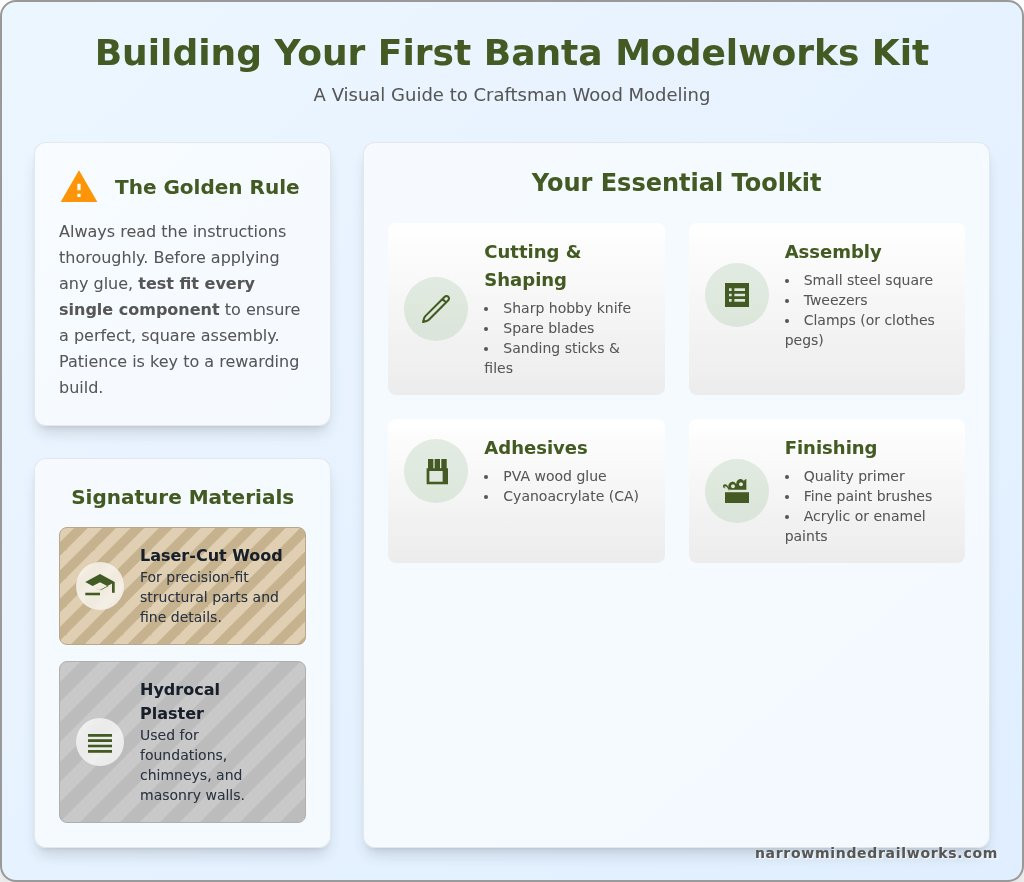
The heart of the Banta Modelworks appeal lies in its choice of materials. The primary components are precision-cut wood parts, created using advanced laser-cutting technology that ensures an exceptionally clean and accurate fit. This method allows for intricate details like window mullions and decorative trim that are sharp and true to scale. Complementing the wood are hydrocal plaster castings, used to represent stone foundations, brick chimneys, or entire masonry walls. The inherent texture of these materials provides a superb canvas for painting and weathering, capturing the rough-hewn feel of aged wood and stone far more convincingly than moulded plastic.
Focus on American Narrow Gauge Prototypes
Banta Modelworks has a strong focus on a beloved niche: the rustic structures of American narrow gauge railways. Their catalogue is a treasure trove for anyone modelling iconic lines such as the Denver & Rio Grande Western (D&RGW) or the Rio Grande Southern (RGS). Modellers can find accurate kits for a wide range of essential trackside buildings, including:
- Classic timber depots and stations
- Essential water towers and coaling stages
- Lineside structures like section houses and sheds
- Iconic town buildings like mills, saloons, and general stores
While this specialisation serves a dedicated segment of the hobby, Banta also offers a range of freelance designs. These kits capture the same rustic, North American aesthetic but can be easily adapted to fit a wider variety of layouts, making their craftsman quality accessible to a broader audience of modellers.
Exploring the Banta Modelworks Range: Scales and Subjects
One of the defining features of the banta modelworks catalogue is its impressive breadth, catering to modellers across multiple scales and interests. Whether you're seeking a small, characterful lineside hut or a sprawling industrial complex to act as a layout's centrepiece, there's likely a kit to match your vision. Navigating their collection is straightforward, typically organised by scale, making it easy to find a project that perfectly fits your layout's specific needs.
O/On30 Scale: The Heart of the Collection
O scale, and its narrow-gauge cousin On30, represent the core of the Banta collection. These larger scales are a perfect canvas for the craftsman kit philosophy, allowing for a level of intricate detail that truly brings a model to life. This focus on high-fidelity modelling is a principle shared by hobby organisations like the National Model Railroad Association. A prime example is the iconic Silver Bull Saloon, a kit celebrated for its detailed facade and classic Western character. Beyond complete structures, Banta also offers an extensive array of O scale detail parts and conversion kits, enabling modellers to customise and enhance their projects further.
HO Scale: Classic Structures for Popular Layouts
For the many modellers working in the UK's most popular scale, Banta provides a superb selection of HO scale structures. These kits strike an excellent balance between intricate detail and a manageable footprint, making them ideal for adding a signature scene to an existing layout without overwhelming it. The magnificent Port Costa Roundhouse kit is a standout, offering a truly impressive focal point for any locomotive depot scene. These structures are designed to inject personality and operational interest, transforming a simple track plan into a believable, living world.
Other Scales: From S Scale to G Scale
While O and HO dominate the catalogue, the Banta Modelworks range demonstrates a commitment to the wider hobby by offering select kits in other scales, including S and G. Their G scale buildings, for instance, are perfect for garden railway enthusiasts looking to add durable and characterful structures to their outdoor layouts. This willingness to serve niche segments of the modelling community highlights their deep-rooted expertise and passion for the craft, ensuring more people can enjoy the satisfaction of building a high-quality kit.
Building a Banta Kit: What to Expect from Your First Project
Diving into your first wooden model kit is a uniquely rewarding experience. Unlike plastic kits, building with wood requires a different pace and skillset, but the result is a model with unmatched character and realism. The journey from a box of laser-cut wood sheets to a finished structure is immensely satisfying. Before you start, set realistic expectations: take your time, embrace the learning process, and always read the instructions thoroughly before applying any glue. The golden rule of wooden kits is to measure twice and cut once-or in this case, test fit every single component before fixing it permanently.
Essential Tools for Wood Kit Construction
Having the right tools is crucial for a smooth build. You don't need an expensive workshop, just a few key items. A clean, flat work surface is non-negotiable to ensure your model is square and true. Most projects will require:
- Cutting & Shaping: A sharp hobby knife with spare blades and various sanding sticks or files.
- Assembly: A small steel square, tweezers, and a selection of clamps (clothes pegs work well for small parts).
- Adhesives: A quality PVA wood glue for structural joints and a cyanoacrylate (CA) or 'superglue' for attaching metal or resin castings.
- Finishing: A set of fine brushes, a good quality primer, and your choice of acrylic or enamel paints.
Key Techniques for a Great Finish
The quality of a banta modelworks kit provides a fantastic canvas for your skills. To prevent walls from bowing, always glue interior bracing in place as instructed; this is vital for structural integrity. When handling delicate window and door castings, be gentle and use a minimal amount of CA glue applied with a toothpick for precision. For painting, enhance the wood's natural texture by using thin washes of colour rather than thick coats. Finally, bring your model to life by adding details like roofing materials and signage, which are often the final touches that make the structure truly stand out on your layout.
This focus on structural integrity is a principle that's just as crucial in real-world properties. For those interested in how professionals assess the condition and construction of actual buildings, you can [learn more about South Surveyors].
Mastering these fundamentals will ensure your first project is a success and will give you the confidence to tackle more complex structures. You can find a great selection of kits to hone your skills at Narrow Minded Rail Works.
Banta Laser-Cut vs. 3D Printed Kits: A Modeller's Comparison
In modern model making, we're fortunate to have two outstanding technologies at our fingertips: precision laser-cutting and high-resolution 3D printing. The choice isn't about which is "better," but which is better suited to your project and modelling style. Both Banta's laser-cut wood kits and modern resin prints offer a path to a stunning final model, but the journey to get there is quite different.
Material Properties and Preparation
Laser-cut wood, the hallmark of a classic banta modelworks kit, offers an authentic feel with its natural grain texture. This requires some preparation; wood parts should be sealed or stained before assembly to prevent warping and to bring out the beautiful texture. While individual parts can be delicate, a well-built wooden structure is remarkably sturdy.
3D printed resin, by contrast, excels at capturing incredibly fine details, from bolt heads to delicate brickwork. Preparation involves carefully removing support structures and washing the parts to remove any residual resin. Resin is typically more brittle than wood, so care must be taken during handling, but it offers a smooth, non-porous surface ideal for painting.
Assembly and Finishing Differences
The building experience is where these two styles truly diverge. A wooden kit often involves a traditional "craftsman" approach, assembling structures piece by piece, layering walls, and adding individual trim. It's a hands-on, rewarding process that many modellers cherish.
3D printed kits frequently streamline this initial stage. Walls or even entire building bodies can be printed as a single, highly detailed piece, significantly reducing assembly time. This allows you to move more quickly to the painting and weathering stages, which is where a resin kit truly shines. The crisp detail responds beautifully to washes and dry-brushing techniques. See the detail of 3D printed kits for yourself.
Which Kit Style is Right for You?
Making the right choice comes down to your personal modelling goals. To help you decide, consider the following:
- Choose a Banta kit if: You relish the process of construction, enjoy the feel and challenge of working with wood, and want a traditional, hands-on building experience. These kits are especially perfect for authentic American prototypes.
- Choose a 3D printed kit if: Your priority is maximum detail with a potentially faster assembly. If you love the painting and weathering stages and want to get to them sooner, resin is an excellent choice.
Ultimately, whether you're building a classic laser-cut kit or a modern resin print, both technologies empower you to create a high-quality, show-stopping model for your layout. The best choice is the one that excites you the most.
Banta Modelworks: A Craftsman's Choice for Your Layout
As we've explored, banta modelworks kits represent a fantastic tradition in railway modelling. They offer a rewarding, hands-on building experience with high-quality, laser-cut wood components that bring a classic American feel to any layout. Whether you're drawn to the craftsman philosophy or comparing traditional techniques against modern innovations like 3D printing, it's clear these kits hold a special place in the hobby for their character and engaging construction process.
While Banta excels in classic materials, the world of railway modelling is constantly evolving. If our look at 3D printing has sparked your curiosity for what's possible with modern technology, particularly within the UK's vibrant narrow gauge scene, then your next project is waiting.
Ready to see the future of the hobby? Explore the world of modern 3D printed narrow gauge kits from Narrow Minded Railworks. Discover unique OO9, GN15, and O-16.5 kits designed by fellow enthusiasts and enjoy worldwide shipping. Whatever you choose to build next, the goal is always the same: to create, enjoy, and bring your miniature world to life. Happy modelling!
Frequently Asked Questions about Banta Modelworks
Are Banta Modelworks kits suitable for beginners?
Yes, many Banta Modelworks kits are excellent for beginners, provided you start with a smaller, simpler structure like a shed or a small lineside hut. These kits have fewer parts and allow you to learn the basic techniques of wood laser-cut kit construction. The instructions are generally clear and well-illustrated, guiding you through the process. More complex kits like multi-storey buildings are better suited for modellers with some prior experience under their belt.
What kind of glue should I use for a Banta laser-cut wood kit?
For the main wood-to-wood construction, a good quality PVA wood glue like Evo-Stik Wood Adhesive or Gorilla Wood Glue is ideal. It provides a strong bond and allows for some repositioning time. For attaching smaller detail parts, especially metal or plastic castings to the wood structure, a cyanoacrylate (super glue) is highly effective. A canopy glue that dries clear is also perfect for installing window glazing without fogging the clear plastic material.
Do Banta kits come with paint, glue, or figures?
No, Banta kits typically do not include paint, glue, scenery materials, or figures. The box contains the core structural components, such as the laser-cut wood sheets, plaster castings, plastic windows, roofing material, and detailed assembly instructions. You will need to purchase all adhesives, paints, and any scenic details or figures separately, allowing you to customise the model to fit perfectly into your layout's specific theme and colour scheme.
How do I prevent the thin wood parts from warping during assembly?
The best way to prevent warping is to seal the wood before assembly. Before removing parts from the fret, apply a light coat of sanding sealer or a thinned-down primer to both sides and all edges. This stabilises the wood and minimises moisture absorption from glue and paint. When gluing large, flat pieces like walls or roofs, it can also be helpful to weigh them down with a flat, heavy object while the glue cures completely.
What are some popular alternatives to Banta Modelworks for scenery kits?
In the UK, modellers have several excellent alternatives. For card kits, Metcalfe Models and Superquick are incredibly popular, offering a huge range of British-outline buildings. If you prefer working with plastic, Wills Kits and Peco provide detailed kits that are easy to assemble and modify. Each material offers a different building experience, with card being quick to build and plastic offering robust construction, while wood provides exceptional texture and realism.
Can I use acrylic paints on Banta's wood and plaster parts?
Absolutely. Acrylic paints are perfect for finishing your Banta Modelworks kit. Brands like Vallejo, Humbrol, and even craft acrylics work very well on both the wood and plaster components. For the best results, it is highly recommended to apply a primer first. A light grey or white primer will help the paint adhere better, provide a uniform base for your colours, and make the fine details on the model truly stand out.