

Why should your narrow gauge layout be limited by the rigid catalogs of mass-market manufacturers who prioritize standard scales over niche realism? Finding high-quality 3d printed accessories for model railways has become the essential solution for modellers working in OO9, GN15, or O-16.5 scales. While traditional white metal or cast resin parts often feel heavy and lack fine detail, they remain the standard for many large-scale producers. We recognize that these mass-produced options frequently ignore the specific needs of narrow gauge enthusiasts, so we focus on the precision that modern technology now allows.
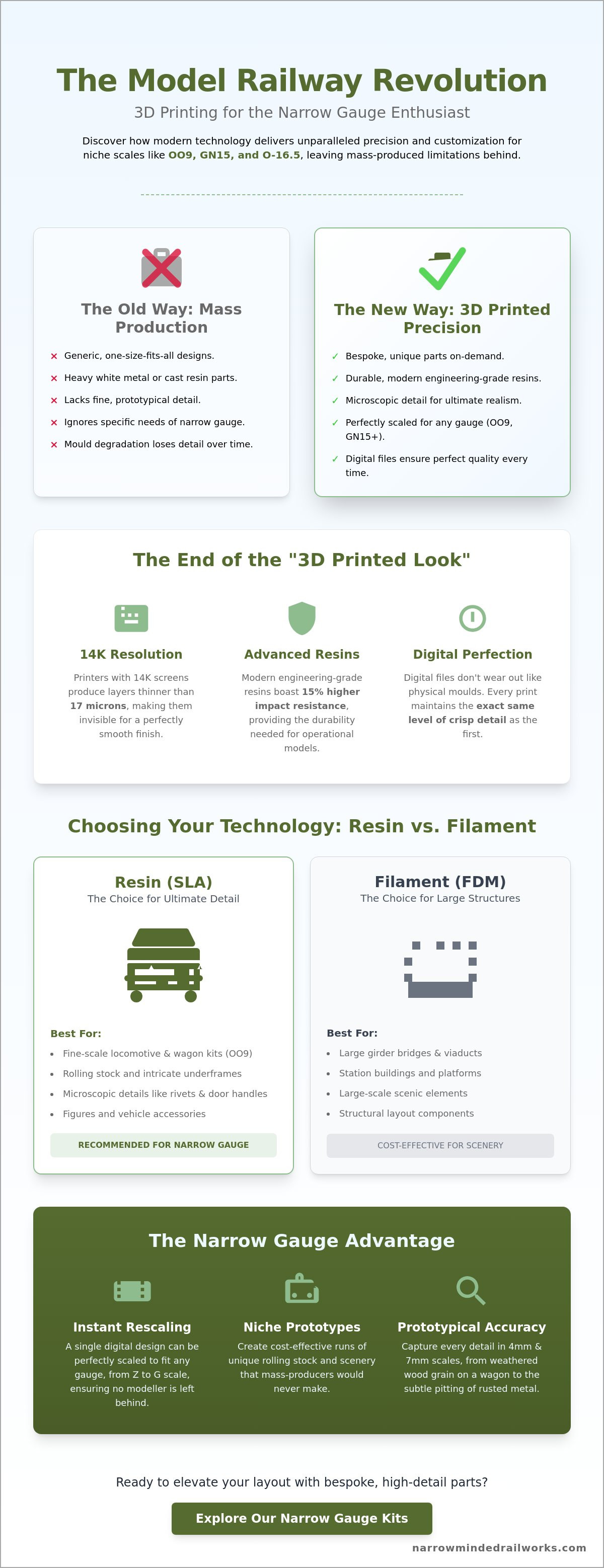
You likely want a layout with unique, realistic character but worry that visible layer lines might ruin the immersion. It's a valid concern, yet 2026 technology has changed the hobby. With 14K resolution screens producing layers thinner than 17 microns, the "3D printed look" is a thing of the past. This guide will show you how to leverage these advancements to get perfectly scaled, professional results. You'll discover how the latest engineering-grade resins, which offer 15% higher impact resistance than materials from just a few years ago, provide the durability and bespoke detail that industrial injection moulding simply cannot match.
Key Takeaways
- Understand why 3d printed accessories for model railways offer a level of bespoke precision that mass-produced plastic cannot achieve.
- Identify the critical differences between resin and filament printing to ensure you choose the right technology for fine-scale locomotive and wagon kits.
- Learn how to use professional finishing techniques to remove support marks and prepare resin surfaces for a realistic, high-quality paint finish.
- Explore how 3D printing supports the specific needs of narrow gauge scales like OO9 and GN15 with unique, industrial scenery and rolling stock details.
How 3D Printed Accessories are Revolutionising Model Railways in 2026
3d printed accessories for model railways represent a fundamental shift in how we approach layout building. These high-precision resin and filament components have moved beyond the "experimental" phase to become essential tools for the serious modeller. Historically, the industry relied on mass-produced plastic, which forced enthusiasts to accept generic designs or expensive, hand-crafted alternatives. We understand that this lack of variety can be frustrating, so we embrace the move toward "on-demand" bespoke modelling. This technology makes low-volume production of niche prototypes cost-effective, as it removes the need for expensive industrial tooling.
Modern 3D printing technology enables the creation of complex geometries that are physically impossible to replicate using traditional two-part moulds. Features like internal cab details, hollowed-out boilers, and intricate underframes can now be produced as single, unified pieces. This reduces assembly time while increasing the structural integrity of the model. Because digital designs don't suffer from the physical wear associated with traditional casting, every print maintains the same level of crispness and accuracy.
To better understand how these digital models translate into physical reality, watch this helpful video:
The End of the "One Scale Fits All" Era
For years, the hobby was dominated by standard 00 gauge, leaving those interested in a narrow gauge railway with limited options. 3D printing bridges this gap by allowing digital files to be rescaled instantly. Whether you work in Z scale or G scale, the ability to adapt a design to your specific gauge ensures that no modeller is left behind. This flexibility is essential for the narrow gauge community, where prototype variety is high but commercial support has historically been low. It allows for the rapid creation of rolling stock and scenery that perfectly matches the unique character of your chosen scale.
Prototypical Accuracy in 4mm and 7mm Scales
Precision is the primary driver for modellers moving toward SLA (Stereolithography) resin printing. In 4mm and 7mm scales, the detail level is staggering. You can now clearly see textures like weathered wood grain on a wagon plank or the subtle pitting of rusted metal. 3D scanning has also played a significant role, allowing designers to capture the exact proportions of real-world figures and vintage vehicles. While a silicone mould for cast resin typically loses detail after 25 to 30 pulls, a digital file remains perfect every time it's printed. This consistency ensures that 3d printed accessories for model railways meet the highest standards of prototypical accuracy.
Resin vs. Filament: Choosing the Right Printing Technology
Selecting the right technology for 3d printed accessories for model railways often feels like a choice between speed and detail. Fused Deposition Modelling (FDM) uses spools of plastic filament to build models layer by layer. While this method is excellent for large, structural components like girder bridges or station buildings, it often leaves visible ridges on smaller items. We understand that these texture issues can detract from a realistic layout, so we recommend Stereolithography (SLA) resin printing for any high-detail work. Resin has become the industry standard for producing oo9 wagon kits and other fine-scale rolling stock because it captures microscopic details such as individual rivets and door handles.
Some modellers worry that resin is too brittle for functional use. However, modern engineering-grade resins in 2026 have a 15% higher impact resistance compared to those from 2022. This makes them durable enough for regular handling during operation. If you're looking for the highest level of precision, exploring our range of narrow gauge kits is a great place to start. For items that won't be seen up close, filament remains a cost-effective choice, but for anything that defines the character of your scene, resin is the superior option.
Understanding Layer Heights and Resolution
Visible "steps" on a model's surface are the result of high layer heights. In 2026, 14K resolution screens on resin printers produce layers thinner than 17 microns, making these lines virtually invisible to the naked eye. Layer height is the thickness of each individual slice of a model, and choosing a smaller height significantly reduces the time you'll spend sanding. While 8K and 12K printers are common, the latest 14K technology provides the smoothest finish for curved surfaces like locomotive boilers or water tanks.
Material Properties: UV Stability and Strength
Modellers often face the constraint of resin parts becoming brittle or yellowing under layout lighting. We address this by using UV-stable resins that maintain their structural properties over time. For functional parts that require extra durability, such as quarry hunslet couplers, "tough" or ABS-like resins are the proactive solution. These materials offer a balance of detail and flexibility, ensuring they won't snap during shunting. High-end resins also achieve a shrinkage rate of less than 0.7%, which prevents parts from warping even in warmer environments like a converted loft.
The Narrow Gauge Advantage: Bespoke Parts for OO9 and GN15
Narrow gauge modelling has always been a hobby for the kit-builder, as the unique prototypes of industrial and rural lines rarely attract the attention of mass-market manufacturers. While standard gauge modellers can often rely on ready-to-run stock, those working in OO9 or GN15 face a significant constraint in availability. We recognize this gap and provide a proactive solution through 3d printed accessories for model railways that are specifically designed for niche scales. This technology allows for the creation of unique industrial details that are essential for the gn15 scale community, where every layout tells a distinct story.
The synergy between modern 3D printing and established mechanical components has changed the landscape of the hobby. Instead of struggling with complex metalwork, modellers can now pair a highly detailed 3D printed body with a commercially available chassis. This approach is currently the primary source for on30 gauge accessories, where the demand for characterful, American-style narrow gauge equipment is met by digital designers rather than industrial factories. It's a shift that prioritizes the modeller's vision over the manufacturer's production schedule.
Detailed Figures and Diorama Tools
Locomotive Bodies and Wagon Kits
3D printed shells allow enthusiasts to model rare prototypes that would otherwise require expensive, one-off scratch building. Traditional etched brass or white metal kits can be intimidating for beginners and time-consuming for experts. The "drop-on" body kit revolution offers a proactive solution, providing a high level of detail with significantly easier assembly. By designing shells to fit specific, reliable chassis, we ensure that your 3d printed accessories for model railways aren't just beautiful display pieces but functional parts of a working railway. This accessibility has opened the door for many to explore narrow gauge without the steep learning curve of traditional kit-building.
Professional Finishing Techniques for 3D Printed Accessories
The transition from a raw print to a realistic model requires a specific set of post-processing steps. While 3d printed accessories for model railways offer unparalleled detail, they often retain a microscopic film of uncured resin or cleaning agents that can hinder paint adhesion. Research indicates that acrylic paint has a 50% higher chance of peeling off a smooth, unprimed 3D printed resin surface. We recognize that this can be frustrating for modellers, so we recommend a thorough degreasing in warm, soapy water as the proactive solution before any assembly begins.
Choosing the right primer is equally critical for a professional finish. While standard hobby primers are excellent for plastic, many modellers find that automotive plastic primers provide a more robust "bite" into the resin surface. We suggest using a fine-surface primer to ensure the 17-micron details mentioned earlier aren't filled in by heavy paint. Once primed, you can safely use your preferred acrylics or enamels to bring the model to life. If you're ready to apply these techniques, you can browse our latest narrow gauge kits to find your next project.
Removing Support Structures Safely
Removing the delicate lattice of supports is the most common point where parts might snap. We address this constraint by utilizing the "hot water" method: soaking the model in water heated to approximately 60°C for thirty seconds. This softens the resin, allowing you to peel the supports away with minimal force. For the remaining stubs, use sharp flush cutters and high-grit sandpaper to achieve a smooth surface. You can find more detailed advice on finishing 3d printed kits to ensure your rolling stock looks its best. Support pips are typically found on the underside or hidden faces of a model and appear as small, raised circular bumps that don't match the symmetrical layout of rivets or prototypical hardware.
Painting and Weathering for Realism
Airbrushing is the preferred method for applying base coats to 3d printed accessories for model railways because it maintains the crispness of the print. Hand-painting is still useful for small details like handles or dials, but a thin, airbrushed layer prevents the "clumping" often seen with heavy brushwork. Following established painting 3d printed models principles will help you achieve a factory-standard finish. To truly blend the print into your layout, use enamel washes and weathering powders to highlight textures like wood grain or stone. These products settle into the fine recesses of the print, accentuating the depth that 3D technology provides.
Narrow Minded Railworks: Your Partner in Detailed Modelling
Narrow Minded Railworks was founded on a simple philosophy: we are modellers designing for modellers. We understand that enthusiasts in OO9, GN15, and O-16.5 scales often face the constraint of limited commercial support from large-scale manufacturers. While the industry frequently prioritizes standard gauge, we provide a proactive solution by specializing in the unique needs of the narrow gauge community. Our commitment to high-resolution resin printing ensures that every item in our range of 3d printed accessories for model railways meets the exacting standards of modern hobbyists. We support the global narrow gauge community with worldwide shipping, ensuring that modellers can access bespoke detail regardless of their location.
We recognize that achieving a realistic finish requires more than just a good print. It requires a design that understands how a model is actually built and operated. By focusing on the 7mm and 4mm narrow gauge markets, we bridge the gap between industrial production and the bespoke needs of a private layout. Our goal is to provide the parts that allow your creative vision to become a physical reality, without the frustration of searching for parts that don't exist in traditional catalogs.
Our Unique Product Range
Our catalog is built around the specific character of narrow gauge lines. We recognize that scratch-building every structure or vehicle is a significant time constraint for many. To address this, we offer bespoke scenery items such as vintage petrol pumps and unique lineside huts that add instant narrative to a scene. One of our most distinct offerings is our range of figures. These are scanned from real people, providing unmatched prototypical realism that generic, mass-produced figures cannot replicate. By focusing on these human-centric details, we help you create a layout that feels lived-in and authentic.
Getting Started with Your First Kit
If you're new to working with resin, our 3d printed locomotive bodies are the perfect entry point. We understand that sourcing a reliable mechanism can be difficult, so we design our kits to fit popular, commercially available chassis. This removes the technical barrier of complex metalwork while delivering a professional result. Our service style is built on transparency. We acknowledge the inherent constraints of 3D printing, such as the need for careful support removal, and provide clear, proactive solutions through our guides and support. When you choose our 3d printed accessories for model railways, you're partnering with a team that values precision as much as you do. You can browse our latest 3D printed narrow gauge kits and accessories to find the right project for your next layout session.
Building Your Perfect Narrow Gauge Scene
The evolution of 3D printing has transformed the hobby from a search for "close enough" parts into a pursuit of prototypical perfection. We recognize that finding specialized items for niche scales can be a significant constraint for many modellers. By utilizing high-resolution resin printing, we provide a proactive solution that delivers the fine detail and character your layout deserves. Investing in high-quality 3d printed accessories for model railways allows you to bypass the limitations of mass production and focus on the unique narrative of your industrial or rural line.
Whether you are finishing your first locomotive body kit or detailing a complex diorama, the right technology makes the difference. Our products are expertly designed for OO9 and GN15 scales, ensuring every part fits your specific gauge perfectly. We offer figures scanned from real people for unmatched realism and provide worldwide shipping for all kits to support the global modelling community. It's time to elevate your layout with the precision that modern technology allows. Explore our range of 3D printed narrow gauge accessories and start your next project today. Your vision for a realistic, detailed railway is now more achievable than ever.
Frequently Asked Questions
Are 3D printed model railway accessories more fragile than plastic ones?
Modern 3D printed components are generally comparable to traditional plastic, though they can be more brittle if dropped. We address this constraint by utilizing engineering-grade resins that offer 15% higher impact resistance than materials available in 2022. While they require careful handling during support removal, they provide the durability needed for regular operation on a working layout without the weight of traditional white metal.
Do I need special glue to assemble 3D printed resin kits?
You cannot use standard plastic solvent glue because it will not melt or bond the resin surface. The proactive solution is to use Cyanoacrylate (super glue) or a two-part epoxy for structural joints. These adhesives create a strong mechanical bond that is essential for assembling locomotive bodies and wagon kits reliably, ensuring your 3d printed accessories for model railways remain securely attached.
Can I paint 3D printed accessories with standard acrylic hobby paints?
You can use standard acrylic hobby paints provided you apply a dedicated primer first. Because unprimed resin has a 50% higher chance of paint peeling, we recommend using an automotive plastic primer to create a stable "bite" on the surface. Once the primer is dry, standard acrylics will adhere perfectly to the model, allowing you to achieve a professional, prototypical finish.
How do I remove the visible layer lines on a 3D printed model?
Visible layer lines are best addressed during the printing stage by using 14K resolution screens that produce layers thinner than 17 microns. If lines are still visible on older prints, a light sanding with 1000-grit sandpaper followed by a filler primer is the most effective solution. This process ensures a smooth finish without losing the fine details that define the character of bespoke narrow gauge models.
Are these accessories compatible with standard 00 gauge and N gauge layouts?
While our physical kits focus on narrow gauge scales like OO9 and GN15, many 3d printed accessories for model railways can be adapted for standard 00 or N gauge layouts. We acknowledge that scale compatibility is vital, so we provide precise dimensions for our scenery items. This allows you to determine if an industrial hut or petrol pump fits the proportions of your specific scene.
Why should I choose 3D printed resin over white metal or cast resin parts?
3D printed resin offers a level of precision and consistency that traditional white metal or cast resin cannot match. A silicone mould typically loses detail after 25 to 30 pulls, whereas a digital print remains perfect every time it's produced. Additionally, 3D printing allows for complex, hollow geometries that reduce weight and increase the space available for internal detailing or lead weighting.
What is the best way to clean 3D printed parts before painting?
The most effective cleaning method involves washing the parts in warm, soapy water to remove any residual processing chemicals or oils. We understand that paint adhesion is a common concern, so we recommend this proactive step to ensure the surface is chemically neutral. Always allow the components to air dry completely for at least 24 hours before applying your first layer of primer.
Do 3D printed models warp or degrade over time?
High-quality 3D printed models are designed to be stable, but they can warp if exposed to extreme heat or prolonged direct sunlight. We address this by using resins with a shrinkage rate of less than 0.7% to ensure dimensional accuracy remains consistent. Applying a coat of UV-resistant paint or varnish is a proactive way to protect the material from layout lighting over many years of operation.