

Your layout doesn't need more track; it needs a reason for the train to stop. In narrow gauge modeling, a central structure isn't just a building. It's the narrative anchor that justifies your railway's existence. If you are searching for the latest updates on the project tagged (inurl:news) thebighouse, you already know that creating a focal point this large presents unique challenges for even the most seasoned builders. Finding a kit that looks architectural rather than generic is a constant struggle for hobbyists in May 2026.
We understand the intimidation factor that comes with managing massive 3D-printed components and trying to squeeze a stately manor into a tight narrow gauge footprint. This article delivers the latest specifications for the project alongside expert tips for finishing large-scale structures. You'll learn how to prepare resin surfaces for realistic weathering and see how to position this centerpiece to transform your layout from a simple loop into a historical snapshot. Whether you're building a private estate line or an industrial hub, these insights will help you master the assembly of your most ambitious model yet.
Key Takeaways
- Understand the historical role of estate railways and how this 2026 flagship kit serves as the essential narrative anchor for your modeling project.
- Discover the technical benefits of combining high-grade resin for fine architectural details with PLA for the structural integrity of large-volume 3D prints.
- Master the art of placing massive buildings in small footprints by utilizing low-relief techniques and following the latest (inurl:news) thebighouse project updates.
- Identify the most effective adhesives and surface preparation steps required to securely bond and finish large-scale 3D-printed components.
- Learn how to customize your kit to create a unique centerpiece that reflects your specific layout's story and historical era.
What is 'The Big House' Project in Narrow Gauge Modelling?
'The Big House' Project stands as our flagship architectural kit for 2026. It isn't just another building for your collection; it's a statement piece designed to anchor your entire railway narrative. Many modelers struggle to find a focal point that justifies the existence of their lines. This kit solves that problem by providing a massive, detailed structure that serves as the logical destination for every train on your track. Whether you are searching for (inurl:news) thebighouse updates or looking for a way to elevate your scenery, this project represents a new standard in high-fidelity modeling.
Historically, the narrow-gauge railway was the preferred choice for grand estates and private parklands. These lines were often built to transport coal for heating, timber for maintenance, or even guests arriving for a gala. By placing a 'Big House' at the end of your line, you instantly create a 'sense of place' that feels grounded in reality. The kit's design bridges the gap between a stately manor and a functional industrial 'Big House', making it versatile enough for diverse layout themes from the Victorian era through the mid-20th century.
The Link Between Narrow Gauge and Grand Estates
Private estate railways were more than just hobbies for the wealthy. They were essential infrastructure. These lines handled the heavy lifting that kept a grand house running, from moving wood to transporting domestic staff. Our kit draws inspiration from prototypes like the Eaton Hall Railway, capturing the architectural weight of a 19th-century manor. It's a crucial addition for modelers who want to move beyond generic industrial scenes. You'll find that having a grand destination makes every shunting operation feel purposeful and historically accurate.
Project Timeline and 2026 News Updates
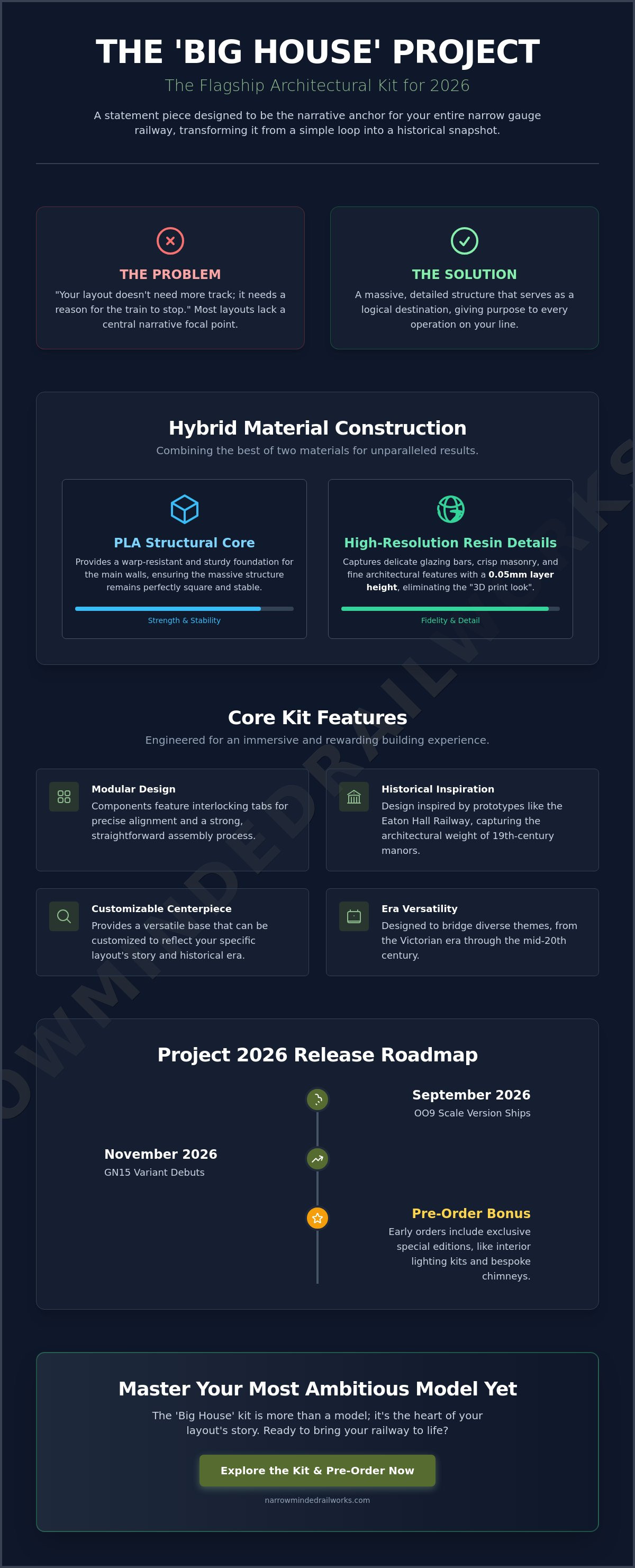
The development cycle for 2026 has focused on solving the '3D print look' that plagues many large-scale kits. We've implemented new high-resolution resin techniques to ensure the brickwork and cornices are crisp. According to the (inurl:news) thebighouse project roadmap, the OO9 scale version will ship in September 2026. The larger GN15 variant is slated for a November 2026 debut. Early pre-orders will include exclusive special edition features like interior lighting kits and bespoke chimneys, ensuring your model stands out from the standard retail versions.
Designing a Masterpiece: The 3D Printing Behind the Kit
Designing a flagship kit like 'The Big House' involves balancing immense physical scale with microscopic detail. Most large 3D-printed buildings suffer from visible print lines that ruin the illusion of stone or brick. To combat this, we've transitioned to a multi-material approach for the 2026 release. You'll notice in our (inurl:news) thebighouse project logs that we've separated the structure into modular components. This makes assembly easier and allows us to use the best material for each specific part. The modularity also means we can ship these massive kits safely without the risk of a single large piece snapping in transit. Each wall section is designed with interlocking tabs, ensuring your manor stays perfectly aligned during the gluing process.
The architectural character of the manor comes from its sash windows and heavy masonry. These aren't just flat surfaces; they feature recessed frames and textured roof tiles that catch the light. By printing these as separate resin inserts, we achieve a level of crispness that traditional one-piece PLA prints simply can't match. If you're curious about how these individual pieces fit together, you can see the exploded view diagrams at narrowmindedrailworks.com. This level of detail ensures that your centerpiece looks as good in a macro photograph as it does from a distance.
Resin vs. PLA: Choosing the Right Surface
High-resolution resin is the only way to capture the delicate glazing bars of a Victorian sash window. However, resin can be brittle and prone to warping over large flat areas. That's why we use PLA for the main structural walls. This hybrid method ensures the building remains square and sturdy on your baseboard while retaining fine-scale fidelity. Modern 3D printing for architectural models relies on these material distinctions to create professional-grade results. We've optimized our print settings to a 0.05mm layer height for resin parts, virtually eliminating the need for aggressive sanding before you prime the surface.
Scaling 'The Big House' for OO9 and GN15
Scaling a building isn't a simple math problem. If you just shrink a door, it might look too narrow for a scale figure to pass through. For the OO9 version, we've adjusted the masonry courses so they look correct for 4mm scale. The GN15 version requires more robust detailing because the larger scale reveals every flaw. The footprint of the OO9 model occupies a space approximately 280mm wide by 160mm deep. This ensures it fits comfortably on most standard 4-foot modules without crowding the track. We've also varied the window heights between the scales to maintain the imposing stately look that defines the (inurl:news) thebighouse project aesthetic.
Why Your Layout Needs an Architectural Centerpiece
Many modelers think their space is too cramped for a massive structure. They're wrong. A large building actually anchors the scene and provides a sense of gravity that a collection of small sheds simply cannot achieve. If you've been following the (inurl:news) thebighouse updates for 2026, you'll see how a single focal point justifies the railway's presence. Without a major destination, your layout is just a loop of track. With it, you have a reason for every train movement, from the morning mail delivery to the evening coal run.
You don't need a full-depth footprint to make this work. Using 'The Big House' as a low-relief backdrop is a smart move for narrow gauge layouts, which are often built on narrow shelves. By modeling only the front facade or a single wing, you can place the grand architecture against the backscene using only 40mm to 60mm of board depth. This trick effectively hides ugly baseboard joints or disguises the track exit where the line disappears into the fiddle yard. It's a functional tool as much as a decorative one, serving as the ultimate visual shield.
Creating Scale Contrast
Narrow gauge locomotives are inherently small. When you place a tiny 0-4-0 tank engine next to an imposing manor house, it highlights that diminutive scale in a way that empty fields never could. It creates a visual tension that makes the railway feel more realistic and grounded. You can also use the building to force perspective. By placing the kit in the mid-ground and using smaller trees behind it, you create the illusion of a vast 50-acre estate on a modest 4-foot board. The building acts as a perfect view blocker, preventing the eye from taking in the entire scene at once. This forces viewers to move around the layout to discover new angles.
Narrative Modelling: Who Lives in the Big House?
Every building should tell a story through its details. Is the house well-maintained with a butler waiting at the door, or is it a decaying industrial "Big House" with overgrown ivy? Adding figures and accessories like a horse-drawn delivery cart or luggage trolleys integrates the railway into the building’s daily operations. If you're new to this niche and want to understand the logic behind these lines, you should learn more about what is a narrow gauge railway to see how estate lines functioned. By the time you finish the (inurl:news) thebighouse project, your layout won't just be a track; it'll be a living history of the people and the property it serves.
Building and Finishing 'The Big House' Kit
Assembling a massive structure like this requires more than just a tube of plastic cement. Because we've used a hybrid of PLA and resin for the 2026 (inurl:news) thebighouse project, you'll need the right adhesives to ensure a permanent bond. For the main structural walls, a high-viscosity cyanoacrylate (CA) glue works best, while two-part epoxies are ideal for larger resin sections that might require a few minutes of adjustment time. Always dry-fit your components before applying glue. Even with 0.05mm precision, minor tolerances in 3D printing can occur. A quick pass with a 400-grit sanding stick ensures every corner meets at a perfect 90-degree angle.
The final 10% of the build is where the magic happens. Adding clear acetate for glazing and fine-scale guttering from our accessory range completes the look. If you want your layout to shine during night-time exhibitions, install warm-white LEDs inside the structure. You can order your detailing accessories here to finish the project to a professional standard. These small touches transform a 3D-printed shell into a convincing architectural masterpiece that serves as the heart of your railway.
Surface Preparation and Priming
Before you reach for the paint, you must prepare the surface. Support marks are inevitable on 3D-printed parts, especially on the underside of window lintels and cornices. Use a sharp hobby knife to flick off the nibs, then follow up with a fine sanding sponge. To hide any microscopic layer lines, follow our guide to painting 3D printed models. A high-build automotive primer is particularly effective for the large PLA wall sections. It fills minor imperfections while providing a 'tooth' for your architectural colors to grab onto.
Weathering for Realism
Realism is found in the imperfections. As you track the latest (inurl:news) thebighouse developments, remember that the finishing stage is what separates a model from a miniature. Start with a dark wash over the brickwork to define the mortar lines. For stone sections, vary the shades of individual blocks to avoid a flat, toy-like appearance. You can simulate 'rising damp' at the base of the walls using a mixture of dark green and brown washes applied with a soft brush. Don't forget the roof. Applying soot-colored weathering powders near the chimneys and light grey streaks on the tiles will mimic years of exposure to rain and coal smoke.
Conclusion: Joining 'The Big House' Community
'The Big House' Project represents the peak of narrow gauge architectural modeling for 2026. By selecting this kit, you're creating a focal point that ties your entire railway together. As we approach the September 2026 launch for OO9 and the November 2026 release for GN15, the project has evolved into a full ecosystem of models. If you've been monitoring the (inurl:news) thebighouse news feed, you've seen how this structure serves as the heart of a wider estate, necessitating specialized rolling stock and figures to bring the scene to life.
We're excited to see these buildings populated. Our upcoming range of estate wagons and domestic staff figures will provide the final layer of realism. These aren't generic additions; they're designed to interact specifically with the loading bays and grand entrances of the house. Sharing your progress with other builders is a huge part of the hobby. We encourage you to post your assembly photos and weathering techniques to help others master the challenges of large-scale 3D-printed structures.
Customization Options
Every grand estate has its own architectural quirks. To help you match your prototype, we provide three distinct window styles: Victorian sash, Edwardian arched, and mid-century industrial frames. You can also choose between weathered slate or traditional clay tile roof sections. For modelers with unique space constraints, we offer bespoke 3D printing services to adjust the wing lengths or modify the footprint. If your project requires even more specialized industrial fabrication, learn more about CNC Cut to Size to explore their professional printing and cutting services. This ensures that your centerpiece integrates seamlessly with your existing scenery and track plan without requiring major baseboard modifications.
Next Steps for Your Layout
Don't wait for the box to arrive to start your project. Begin preparing the site by leveling the terrain and planning the access roads. A building of this volume requires a well-thought-out landscape to look its best. If you're building in the 1:24 scale, check out our other GN15 scale guides for tips on scenic integration. When you're ready to secure your place in the 2026 build cycle, you can Pre-order 'The Big House' Kit now. Join the community of builders sharing their progress under the (inurl:news) thebighouse tag and let's build something extraordinary together.
Transform Your Layout with a Narrative Anchor
Integrating a structure of this magnitude transforms your scenery from a simple loop into a purposeful estate. You've seen how the hybrid use of resin and PLA ensures both crisp architectural detail and long-term structural stability. By following the 2026 project roadmap, you can prepare your baseboard for the September 2026 OO9 release or the November 2026 GN15 debut. This project isn't just about adding a building; it's about justifying every train movement on your line.
Stay updated with the latest (inurl:news) thebighouse developments as we move toward the final production phase. Our kits feature expertly designed 3D prints created specifically for narrow gauge enthusiasts. We offer worldwide shipping to ensure your project arrives safely, no matter where your workshop is located. Secure your 'The Big House' kit and browse our latest news to start your most ambitious build yet. It's time to create the destination your locomotives deserve.
Frequently Asked Questions
What scales is 'The Big House' kit available in?
'The Big House' kit is available in OO9 (1:76) and GN15 (1:24) scales. The OO9 version is scheduled for release in September 2026, followed by the larger GN15 variant in November 2026. These scales cater to the most popular narrow gauge modeling standards, ensuring the building fits perfectly with existing rolling stock and figures from major manufacturers.
Is 'The Big House' a 3D-printed kit or a ready-built model?
This is a multi-part 3D-printed kit rather than a ready-built model. We use a hybrid manufacturing process that combines high-resolution resin for fine details and PLA for structural walls. This approach allows you to follow the latest (inurl:news) thebighouse project updates and customize the finish to match your specific layout's era and condition.
How long does it take to assemble 'The Big House'?
Most modelers spend approximately 15 to 20 hours on the basic assembly and initial painting of the kit. This timeline accounts for the preparation of modular sections and the bonding of large wall components. If you choose to add complex weathering or bespoke interior lighting, you should expect to invest an additional 10 hours to reach a professional exhibition standard.
Do I need special tools to build large 3D-printed kits?
You don't need specialized machinery, but standard hobby tools are essential. We recommend 400-grit and 600-grit sanding sticks, a sharp hobby knife for removing support nibs, and high-viscosity CA glue. A set of right-angle clamps is also helpful for ensuring the 90-degree corners of the main structural walls remain perfectly square during the curing process.
Can I customize the architectural details of the kit?
Yes, the kit offers significant customization through three different window styles and two roof textures. You can choose between Victorian sash, Edwardian arched, or industrial frames to change the building's character. If you need unique modifications for a specific footprint, we provide bespoke printing services to adjust wing lengths by up to 25% to fit your baseboard.
Will 'The Big House' fit on a standard 4-foot layout?
The OO9 version fits easily on a standard 4-foot layout with its 280mm by 160mm footprint. It's designed to occupy about 15% of a typical module's surface area, leaving plenty of room for track and scenery. For even tighter spaces, many builders use the kit as a low-relief structure, which reduces the required depth to just 60mm.
What is the best paint to use for large resin buildings?
High-quality acrylic paints applied over a high-build automotive primer provide the best results. The primer fills microscopic print lines on the PLA sections, while acrylics allow for the subtle blending needed for realistic brickwork. You should avoid heavy enamel paints that might obscure the 0.05mm layer details on the resin window frames and cornices.
Does the kit include interior details or lighting?
Early pre-order versions of the kit include a dedicated LED lighting package and bespoke chimney details. While the standard kit focus is on the exterior facade, the modular design makes it easy to add your own floors and partitions. You can find more information on these special edition features by searching for the (inurl:news) thebighouse tag in our community forums.