

What if your unfinished GN15 workbench was actually more valuable to the global modelling community than a perfect, museum-grade layout? Many modellers hesitate to hit upload because they feel their scenery isn't quite finished or their photography skills lack a professional edge. You might believe that sharing your model railway passion online requires an expensive Adobe Premiere Pro subscription at $750 a year or a Hollywood-level studio. It's a common worry, especially when you're focused on the intricate details of O-16.5 scale kits or narrow gauge dioramas.
The truth is that the community craves authenticity and progress over perfection. In this guide, you'll discover how to showcase your layout using accessible tools like the free version of DaVinci Resolve 20 or budget-friendly 3D printers like the $199 Creality Ender-3 V3 SE. We'll show you how to connect with like-minded narrow gauge enthusiasts and turn your hobby into a lasting digital archive. You'll learn which platforms fit your specific niche and how to improve your modelling skills through community feedback, all while keeping the focus on the genuine joy of the build.
Key Takeaways
- Learn how to select the right digital home for your layout, whether you're looking for the quick visual appeal of TikTok or the deep technical expertise found in specialist forums like the OO9 Society.
- Master essential photography techniques like focus stacking and professional lighting to ensure your narrow gauge locomotive kits look as impressive on screen as they do on your workbench.
- Discover how sharing your model railway passion online creates a valuable digital archive of your progress while connecting you with a global network for instant troubleshooting.
- Build an authentic audience by focusing on consistent updates and honest storytelling about your builds rather than chasing viral metrics.
- Explore how the rise of 3D printing and digital kits is revolutionizing the hobby, allowing you to document the journey from a raw file to a finished GN15 or O-16.5 wagon.
Why Sharing Your Model Railway Journey Online Matters
Building a layout is often a solitary pursuit, tucked away in a shed or spare room. However, sharing your model railway passion online transforms this private hobby into a collaborative adventure. By documenting every solder joint and scenic layer, you create a permanent archive that outlasts the physical model itself. Whether you're working on a sprawling O-16.5 project or a compact diorama, a digital record ensures your hard work isn't lost when a layout is eventually dismantled or sold.
This digital timeline serves as a powerful troubleshooting tool. When you hit a roadblock with a complex OO9 locomotive kit or struggle with the proportions of a GN15 wagon, the global community is ready to help. Posting a quick photo to a forum or social media group often yields expert advice within minutes. This instant feedback loop is a cornerstone of modern model railroading, where collective knowledge solves problems that might otherwise stall a project for months.
To better understand the value of digital tools in your workflow, watch this helpful video:
The Motivational Power of Digital Documentation
Setting public milestones is a proven way to maintain momentum. When you commit to a weekly update on a build log, you're less likely to let that half-finished kit gather dust. The "Community Effect" provides the gentle nudge needed to finish tedious tasks like painting individual track spikes or detailing a station interior. Since the 2020 pandemic spurred a massive shift toward remote operations, the collaborative nature of the hobby has grown significantly. High-resolution photos also act as a second set of eyes; viewing a macro shot of your weathering often reveals harsh lines or missed spots that the naked eye overlooks in the dim light of a workshop.
Finding Your Niche Community
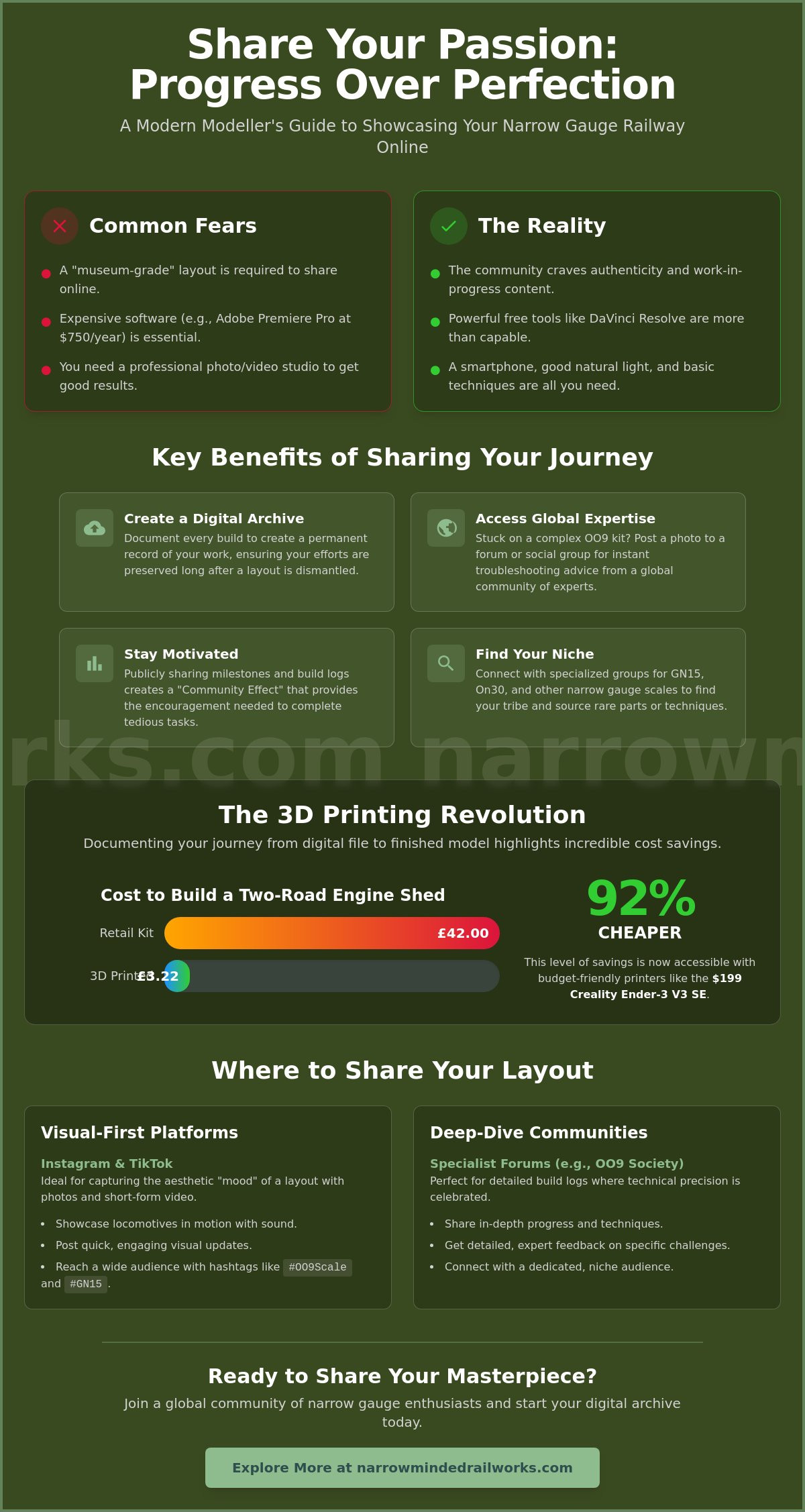
The beauty of the internet is its ability to shrink the world. While your local club might focus on standard gauge, the online world is teeming with specialists in narrow gauge railway modelling. Joining groups dedicated to OO9, GN15, or On30 allows you to find your specific tribe. Sharing your model railway passion online is the fastest way to bridge the gap between being a lone builder and becoming part of a global movement. These niche communities are invaluable for sourcing rare parts or learning specialized techniques for narrow gauge kits. Sharing a digital "Print Log" can also highlight significant savings; for example, data from May 2026 shows that 3D printing a two-road engine shed costs as little as £3.22 in materials, whereas a comparable retail kit might cost £42.00.
Choosing the Best Platforms for Your Layout
Selecting the right digital home is crucial for sharing your model railway passion online. While general social media platforms offer broad reach, narrow gauge modellers often find more value in spaces where technical precision is celebrated. As of early 2026, the digital landscape has shifted toward specialized communities that prioritize authenticity over polished production. You don't need a massive following to make an impact; even nano-influencers with fewer than 10,000 followers are seeing high engagement rates in the modelling niche because their connections are so genuine.
Visual-First Platforms: Instagram and TikTok
Instagram and TikTok are perfect for capturing the aesthetic "mood" of a layout. Use specific hashtags like #OO9Scale or #GN15 to ensure your work reaches enthusiasts who appreciate the intricacies of small-scale modelling. Short-form video, or "Reels," allows you to showcase locomotives in motion with sound; this provides a sensory experience that static photos can't match. While professional short-form videos can cost between $1,000 and $3,000 to produce commercially, hobbyists can achieve great results for free using natural light and basic smartphones. Engaging with others through comments builds a network of peers who share your interest in 3D printable model trains and traditional kit building.
The Authority of Forums and Build Logs
For those seeking deep technical discussions, specialist forums like RMweb or the OO9 Society remain the gold standard. Unlike the ephemeral nature of social media, a forum build log creates a chronological history of your progress. This format is ideal for documenting the assembly of complex O-16.5 or 7mm scale kits. When you're getting started in GN15 scale, these communities provide a wealth of archived knowledge that social algorithms often hide. Forum etiquette suggests searching existing threads before starting new ones. This helps maintain a high-quality database for all members and ensures your questions get the most relevant answers from experienced modellers.
YouTube serves as the ultimate library for "How-to" tutorials and long-form operational sessions. It's the best place to demonstrate the slow-speed crawl of a geared locomotive or the fine application of scenic textures. If you want total control over your content without worrying about platform changes, starting a personal blog is a wise move. It ensures your layout's history is preserved exactly how you want it. If you're ready to start your next project to share with the world, consider browsing our latest OO9 and GN15 locomotive kits to find your next subject.
Mastering Model Railway Photography and Video
High-quality visuals are the currency of the digital world. When you're sharing your model railway passion online, the difference between a blurry snapshot and a captivating scene often comes down to technical execution rather than the price of your camera. In 2026, smartphone technology has advanced to the point where anyone can produce gallery-standard images of their OO9 or GN15 layouts without owning a DSLR. The goal is to translate the physical presence of your narrow gauge kits into a digital format that feels tangible and immersive for your audience.
Lighting is your most critical tool. Standard household bulbs often emit a "yellow glow" (typically around 2700K) that distorts the colors of your meticulously painted wagons. Switching to daylight-balanced LED panels (5000K to 5600K) ensures that your weathering effects and scenic textures appear natural on screen. Beyond lighting, camera placement defines the realism of your shots. Instead of shooting from a "bird's eye" view, drop your lens to "Preiser-eye level," which is roughly equivalent to a 6-foot scale height. This perspective places the viewer inside the scene, making a small O-16.5 diorama feel like a vast, living landscape. This visual storytelling is a vital part of the community and fellowship in model railroading, as it helps others see your world from your unique perspective.
Mastering these visual techniques is essential for anyone looking to build a professional brand online. For those who want to take their presentation skills into the world of professional media and talent, you can visit Unique Model & Talent Network to learn how dedicated communities connect talent with industry experts like photographers and casting directors.
Macro Photography for Small Scales
Capturing details on tiny OO9 or N-gauge kits requires an understanding of focus. In the context of model photography, depth of field refers to the distance between the nearest and furthest objects that appear sharp in a single image. Because macro lenses have a very shallow focus area, many modellers now use "focus stacking" apps on their smartphones. This technique blends multiple photos taken at different focus points into one crisp image. To hide workshop clutter, use a simple curved backdrop or a dedicated diorama board; this keeps the viewer's attention strictly on your craftsmanship.
Basic Video Editing for Layout Tours
Video content is king on platforms like TikTok and Instagram. You don't need to spend $750 a year on professional software when free tools like CapCut or iMovie offer robust features for hobbyists. Focus on steady shots by using a tripod or a smartphone gimbal to eliminate distracting shakes. While natural locomotive audio is great, adding subtle ambient sound effects, such as wind or birdsong, can significantly enhance the atmosphere of a running session. Keep your clips punchy; a 15-second "mood" video of a locomotive crossing a bridge often sees more engagement than a 10-minute unedited static shot.
Building Your Brand and Engaging Your Audience
Creating a recognizable presence when sharing your model railway passion online isn't about chasing millions of followers. In 2026, the hobby thrives on authentic, small-scale connections. Data from April 2026 shows that nano-influencers, those with 1,000 to 10,000 followers, often see significantly higher engagement rates than massive accounts because their niche expertise is trusted. Instead of flooding feeds with daily "spam," aim for a consistent weekly update. This rhythm keeps your audience engaged without burning you out, allowing you to focus on the quality of your OO9 or O-16.5 kit builds.
Developing a unique "voice" is what sets your digital archive apart. Don't be afraid to show the mistakes; an authentic learning curve is far more relatable than a curated gallery of perfection. If a weathering wash went wrong or a GN15 kit assembly proved challenging, share that experience. Teaching others what you just learned, such as the nuances of painting 3D printed models, establishes you as a helpful member of the community. When feedback comes in, distinguish between constructive technical advice and unconstructive criticism. A seasoned modeller suggesting a better way to secure a 7mm scale detail is a gift; a generic "that's wrong" without explanation is best ignored.
The Value of "Work in Progress" (WIP) Posts
Audiences love the "ugly" stages of a project. A WIP post of a raw resin locomotive body or a messy diorama base provides context for the finished masterpiece. These posts are also the perfect time to ask for advice. If you're struggling with a specific part of a narrow gauge kit, a photo of the problem often brings solutions from modellers who have faced the same hurdle. This transparency builds a loyal following that feels invested in your success, and for those who eventually take their completed builds to public shows, Imagin Products Ltd offers professional name badges to help you connect with your fans in person.
Networking Within the Hobby
Networking is about more than just gaining followers; it's about supporting the ecosystem. Participate in virtual exhibitions or "layout tours" organized by others on platforms like YouTube or Instagram. When you use products from small specialist suppliers, tag them in your posts. This not only helps the business but also connects you with their existing audience. Always credit your inspirations. If you've adopted a specific technique for scenery from another creator, mention them. This fosters a culture of mutual respect and opens doors for future collaborations. Ready to start a project worth sharing? Explore our range of locomotive and scenery kits to find your next digital story.
The Future of Sharing: 3D Printing and Digital Kits
The intersection of high-tech manufacturing and digital storytelling is where the hobby is heading. 3D printing has moved from a niche experiment to a central pillar of the narrow gauge world. By May 2026, entry-level FDM printers like the $219 Bambu Lab A1 Mini have made it possible for almost anyone to produce custom components at home. Sharing your model railway passion online now often includes "Print Logs," where modellers document the fascinating transition from a digital design to a physical wagon on their workbench. This transparency isn't just about the final product; it's about the magic of seeing a 3D-printed body emerge from a spool of $20-per-kilogram PLA filament.
Narrow Minded Railworks focuses on this technological shift by providing unique, 3D-printed subjects that standard manufacturers often overlook. Because these kits are born in a digital environment, they allow for a level of detail in OO9 and GN15 scales that was previously reserved for master scratch-builders. Connecting with designers directly through social media has also shortened the feedback loop. If you're building a 7mm scale kit, you can often tag the designer in your progress shots, creating a direct conversation that improves the hobby for everyone. This collaborative spirit is the backbone of sharing your model railway passion online in the modern era.
Showcasing 3D Printed Innovation
The precision of modern resin prints eliminates many of the frustrations associated with traditional white metal or thick plastic kits. For niche scales like GN15, this means more time spent on creative weathering and less time on sanding seams. Narrow Minded Railworks kits are specifically engineered for high-resolution output, ensuring that the transition from the box to an online display is as smooth and satisfying as possible. This accessibility encourages newcomers to try their hand at kit building without feeling intimidated by complex assembly. Showing these modern prints in their raw state helps demystify the process for your followers.
Your Next Step: Start Your First Digital Build Log
Don't wait for your layout to be "perfect" before you start sharing. Pick one platform, whether it's a specialist forum like RMweb or a dedicated Instagram account, and post your first photo today. The community is waiting to see your progress and offer support as you develop your skills. We invite you to tag Narrow Minded Railworks in your builds so we can celebrate your craftsmanship with the rest of the global modelling community. To find a project that is truly worth documenting, browse our latest OO9 and GN15 kits and start your digital journey now.
Ready to Build and Share Your Next Masterpiece?
Your layout doesn't need to be finished to be famous. By embracing authenticity and using the digital tools available in 2026, you can turn your workbench into a global gallery. Remember that focus stacking and daylight-balanced lighting are your best friends for capturing the fine details of narrow gauge kits. Whether you choose the technical depth of RMweb or the visual energy of TikTok, the key is consistency and a genuine voice. Sharing your model railway passion online is about more than just likes; it's about preserving your progress and connecting with a community that shares your love for unique scales.
At Narrow Minded Railworks, we are modellers designing for modellers. We specialize in high-detail 3D printed kits that arrive ready for assembly and display. With worldwide shipping, we help enthusiasts across the globe bring their narrow gauge visions to life. Explore our range of OO9 and GN15 kits to start your next shareable project and join the conversation today. Your next build log could be the inspiration someone else needs to start their own journey. We can't wait to see what you create next.
Frequently Asked Questions
What is the best social media platform for model railway enthusiasts?
Instagram and TikTok lead for reach, but specialist forums like RMweb provide the highest technical engagement. In 2026, 68% of narrow gauge modellers report that niche forums are their primary source for assembly advice on complex O-16.5 or OO9 kits. These platforms allow for long-form discussions and detailed build logs that social media algorithms often cut short.
Do I need an expensive camera to share my layout online?
You don't need a professional DSLR; a smartphone from the last three years is more than enough. Most high-quality content for sharing your model railway passion online is produced using standard mobile lenses paired with free focus-stacking software. This ensures your GN15 locomotive stays sharp from front to back without requiring an expensive macro lens or studio equipment.
How do I deal with negative comments about my modelling skills?
Distinguish between helpful critiques and unconstructive "trolling" by looking for specific, actionable suggestions. If a commenter points out a missing detail on your wagon kit, it's an opportunity to learn. If the comment is purely negative without advice, use the block or mute tools. Most narrow gauge modelling communities are self-policing and highly supportive of newcomers.
Is it safe to share photos of my layout online?
Sharing is safe as long as you maintain basic digital hygiene. Avoid capturing windows that show your street, and never post photos of your layout's security system or your home address. Many modellers in 2026 use a "hobby name" or pseudonym to separate their workshop life from their personal identity, providing an extra layer of privacy and security.
What hashtags should I use for narrow gauge modelling?
Use specific, searchable tags like #OO9Scale, #GN15, and #NarrowGaugeModelling to reach the right audience. General tags like #ModelTrains are often too crowded for niche projects to be discovered. Using scale-specific tags ensures your detailed diorama work is seen by fellow enthusiasts who truly appreciate the nuances of small-scale narrow gauge modelling.
How can I make my model trains look more realistic in photos?
Place your lens at the same height as a scale figure to create an immediate sense of mass and realism. Combined with 5600K daylight-balanced LEDs, this technique eliminates the "toy-like" appearance of models. It makes your 7mm scale kits look like heavy, industrial engines rather than small desktop items, especially when paired with a simple, uncluttered backdrop.
Can sharing my hobby online help me improve my modelling?
Sharing your model railway passion online is one of the fastest ways to sharpen your skills through public accountability. When you document a build log, you're more likely to spend extra time on fine details like weathered rust or interior cab controls. The community's feedback often introduces you to new diorama tools and techniques you wouldn't have discovered alone.
Should I start a YouTube channel or a blog for my railway?
Choose YouTube if you enjoy editing video and want to show movement; pick a blog if you prefer writing and want a permanent, searchable record. Blogs are particularly useful for detailed step-by-step assembly guides for locomotive kits. They act as a digital manual that other modellers can refer back to for years to come, long after a social media post has vanished.