

Have you ever admired a unique, characterful narrow gauge locomotive, only to discover it’s a kit? The thought of tackling a box of mysterious parts can be daunting. What if you use the wrong glue? What if you snap a delicate 3D-printed detail? How do you even begin to achieve that professional-looking paint finish? It’s enough to make many modellers stick to ready-to-run, but you'd be missing out on one of the most rewarding aspects of the hobby. Building your own model from one of the many fantastic gn15 locomotive kits on the market is far more achievable than you think, and this guide is here to prove it.
We'll walk you through every essential stage of the process, from the initial unboxing and parts preparation to the final touches of paint and weathering. You will learn the core techniques, discover the right tools for the job, and gain the confidence to turn that collection of parts into a smooth-running, eye-catching model for your layout. Get ready to create a locomotive that is truly your own and unlock a new level of satisfaction in your model railway journey.
Preparation is Key: Tools and Workspace for Your GN15 Kit
There's a special kind of excitement that comes with opening a new model kit. The promise of a beautifully finished locomotive sits right there in the box, waiting to be realised. The secret to a successful and enjoyable build lies not in rushing to glue parts together, but in methodical preparation. Embarking on your first project in the charming Gn15 modeling scale is an incredibly rewarding journey, and setting up your tools and workspace correctly is the essential first step.
To get a great visual overview of what's involved in starting a kit, this introductory video is an excellent resource:
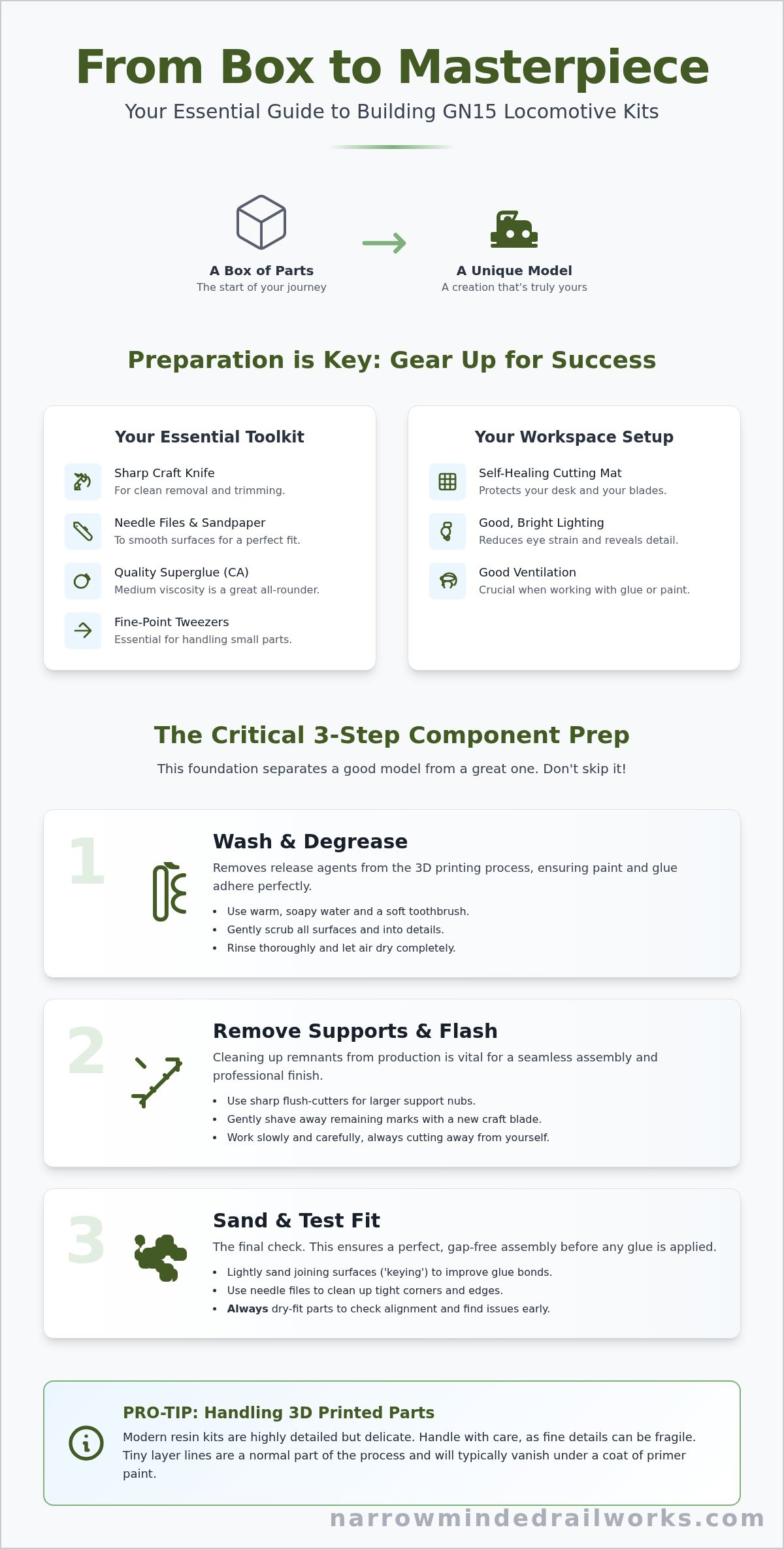
Your Essential Kit-Building Toolkit
You don't need a workshop full of expensive equipment. A small, curated set of quality tools will see you through most gn15 locomotive kits. Gathering these items before you begin will make the entire process smoother.
- A sharp craft knife or scalpel: Essential for cleanly removing parts from their supports and trimming any excess material.
- Needle files and sandpaper: A small set of files and some fine-grit (600-1200) sandpaper are perfect for smoothing surfaces and ensuring a snug fit.
- Quality superglue (CA glue): A medium-viscosity superglue is a great all-rounder. Look for one with a fine applicator tip for precise control.
- Fine-point tweezers: Absolutely vital for handling and placing the many small, delicate detail parts without fumbling.
Setting Up Your Modelling Bench
Your environment is just as important as your tools. A dedicated, organised space allows you to focus on the model without distraction or frustration. A good setup protects both you and your furniture.
- Self-healing cutting mat: This protects your table or desk from stray knife cuts and provides a non-slip surface to work on.
- Good, bright lighting: A desk lamp with a daylight bulb is ideal. It reduces eye strain and helps you see tiny details clearly.
- Good ventilation: Always work in a well-ventilated room, especially when using superglue or preparing to paint, to avoid inhaling fumes.
Understanding Your 3D Printed Kit Parts
Many modern kits are produced using high-resolution 3D resin printing. These parts are incredibly detailed but have unique characteristics. You may notice very fine layer lines, which are a normal part of the process and will often disappear under a coat of primer. Look for tiny "pips" or marks where supports were attached; these will need to be carefully trimmed and sanded smooth. Above all, handle the parts with care, as some fine details can be delicate until they are securely fixed to the main body.
Step 1: Cleaning and Preparing the Resin Components
Welcome to the most critical stage of your project. Before you even think about reaching for the superglue, proper preparation of the resin parts is essential. This foundational step is what separates a good model from a great one, ensuring your finished engine looks professional and runs reliably. Taking your time here guarantees strong adhesive bonds, a flawless paint finish, and that all the intricate parts of your gn15 locomotive kits fit together as the designer intended. Patience now will be rewarded tenfold later.
Washing and Degreasing
Resin components often have a faint, greasy residue left over from the casting or 3D printing process. This mould release agent will prevent glue and paint from adhering properly. To remove it, gently wash all parts in a bowl of warm water with a few drops of standard washing-up liquid. Use a soft, old toothbrush to carefully scrub into all the nooks and crannies, dislodging any stubborn residue. Once clean, rinse every component thoroughly under cool running water and set them aside on a paper towel to air dry completely. Do not proceed until the parts are bone dry.
Removing Support Nubs and Flash
Your kit parts will have small remnants from their production, either fine 'flash' (a thin web of excess resin) or small 'nubs' where support structures were attached. Removing these is vital for a clean assembly.
- Use Sharp Clippers: Snip away the larger support structures with a pair of sharp flush-cutters or sprue clippers. Get as close to the model's surface as you can without cutting into it.
- Pare with a Craft Knife: For the remaining marks, use a new, sharp blade in a craft knife. Gently shave or pare away the excess resin in thin slivers. Avoid trying to cut the entire nub off in one go, as this can gouge the surface.
- Work Carefully: Always cut away from your body and fingers. A gentle touch is all that's needed to achieve a smooth, clean surface ready for the next stage.
Sanding and Test Fitting
With the parts clean and free of excess resin, the final preparation step is to ensure a perfect fit. Lightly sand any surfaces that will be glued together using a fine-grit sandpaper (400-600 grit is ideal). This process, known as 'keying', creates a slightly rougher texture that gives the adhesive much more surface area to grip. Use a set of needle files to clean up any tight corners or edges. Most importantly, always 'dry fit' the components. Assemble the parts without any glue to check for gaps and ensure perfect alignment. This allows you to make minor adjustments now, preventing major headaches during final assembly.
Step 2: Assembling the Main Locomotive Body
This is the most rewarding stage of the build, where a collection of parts truly begins to resemble a locomotive. The key to a professional finish on all gn15 locomotive kits is patience and precision. Work systematically, starting with the largest components and moving to the smaller details. Remember, constant test fitting is your best friend-it prevents mistakes that are difficult to correct once the glue has set. Use adhesives sparingly to avoid messy joints that can spoil the final look.
Choosing the Right Adhesive
The right glue is crucial for a sturdy model. For most joints in resin or plastic kits, a medium viscosity superglue (cyanoacrylate or CA) is ideal as it provides a strong, quick bond. To speed up the curing time, especially on tricky parts, a CA glue 'kicker' or accelerator spray is invaluable. For major structural components that need maximum strength, such as joining the chassis to the footplate, a 5-minute epoxy offers a more robust and slightly flexible bond.
Building the Core Structure
Begin by joining the main, largest parts of the body. This typically involves attaching the cab, boiler, and/or bonnet to the footplate. Always dry-fit these parts first to check for a perfect fit. Once you are satisfied, apply your chosen adhesive and ensure everything is perfectly square and aligned. Small modelling clamps or even simple rubber bands are excellent for holding the structure together securely while the adhesive cures, guaranteeing a solid foundation for the details to come.
Getting the model's boiler right is key to a convincing locomotive. Of course, a miniature boiler is one thing, but if your home's boiler is the one causing trouble, that's a different kind of project entirely. For those in the London area needing professional help with their heating system, you can check out Plumbing & Boilers London.
Attaching the Finer Details
With the core body assembled, it's time for the character-defining details. Parts like handrails, whistles, pipes, and smokebox doors require a delicate touch. A good pair of fine-point tweezers is essential for placing these components accurately. Instead of applying glue directly from the bottle, put a tiny drop onto a piece of scrap plastic and apply it to the model with the tip of a toothpick or a pin. Always refer to the kit's instructions or product photos for correct placement.
Taking your time with these details will transform your model from a simple kit into a convincing miniature. Ready to take on the challenge and start your own build? Explore our GN15 Loco Kits and find your next project today.
Step 3: Priming, Painting, and Bringing Your Loco to Life
With the assembly complete, you have a solid structure. Now it’s time for the most transformative stage: painting. This is where your collection of resin and metal parts truly becomes a characterful locomotive, ready for the whimsical world of your garden railway. A thoughtful paint job, finished with weathering and fine details, will elevate your model from a kit to a masterpiece.
The Importance of a Good Primer
Before you even think about your main colours, applying a good quality primer is non-negotiable. It's the foundation for a professional finish. A light grey primer is an excellent choice for most projects as it helps you spot any tiny imperfections that need sanding before the topcoat is applied. Its key benefits include:
- Superior Adhesion: Primer creates a surface that your topcoats of paint can grip onto, preventing chipping and peeling later on.
- Uniform Base: It provides a consistent, neutral base colour, ensuring your chosen livery looks vibrant and true.
- Flaw Detection: It highlights any small gaps, scratches, or print lines that you may have missed during the assembly phase.
Basic Painting Techniques
The golden rule of model painting is to apply several thin coats rather than one thick one. This preserves the fine surface detail on your model. Whether you choose acrylics or enamels from trusted brands like Humbrol or Tamiya, use quality brushes for the best control. For an exceptionally smooth and even finish, especially on larger flat surfaces like cab sides, an airbrush is an invaluable tool. Taking your time here is key to achieving a stunning result with your gn15 locomotive kits.
Adding Glazing, Decals, and Final Touches
Small details make a big impact. To create realistic windows, use a product like Micro Kristal Klear, which dries crystal clear and can be applied with a toothpick to fill the window apertures. When adding decals for names, numbers, or emblems, always apply them to a gloss varnish surface to avoid "silvering" (visible air trapped under the decal). Once they are dry, a final coat of matt or satin varnish will seal everything in, protect your paintwork, and provide a realistic, non-plastic finish.
Finally, consider weathering. A light touch with powders or washes can simulate soot, rust, and grime, giving your locomotive a history and a sense of place on your layout. For inspiration and a full range of finishing supplies, browse the gallery at Narrow Minded Railworks.
Step 4: Mounting on a Chassis and Final Checks
This is the final and most rewarding stage of the build, where your beautifully detailed model body is united with a motorised chassis. This crucial step transforms your static creation into a living, working locomotive, ready for the rails. Achieving a secure and level fit is paramount, as this directly impacts the running quality and reliability of your finished model on your layout.
Selecting the Correct Chassis
Most gn15 locomotive kits are designed around a specific, commercially available chassis to ensure a perfect fit. Always check the kit’s instructions or online description for the recommended power unit. Popular choices often include the reliable Tenshodo spud or chassis from small OO9 locomotives. It is vital that the wheelbase and overall dimensions match the kit's requirements to avoid issues with wheel clearance and appearance. We have a separate, detailed guide for choosing the right chassis for your project.
Securing the Body to the Chassis
The method for attaching the body can vary. Some kits are cleverly designed for a simple, snug push-fit over the chassis block, which is ideal for easy maintenance. For a less permanent but firm hold, a small ball of Blu-Tack can work wonders, securing the body while still allowing for removal. For a truly permanent and robust bond, you can use small screws if mounting points are provided, or a strong adhesive like two-part epoxy glue.
Final Testing and Adjustments
With the body mounted, it's time for the moment of truth. Place your completed locomotive on a section of test track to perform these final checks:
- Clearance: Gently push the loco through curves and points. Check that no part of the body, steps, or detailing fouls on the track or any lineside scenery.
- Wheel Rotation: Ensure the wheels can rotate freely through their full range of motion without rubbing against the inside of the body, splashers, or brake gear.
- Smooth Running: Power up the track and run the locomotive at various speeds, both forwards and in reverse. Watch for any wobbling, binding, or jerky movements, which may indicate the body is not sitting level or is interfering with the mechanism.
Make any small adjustments needed to ensure your new locomotive runs smoothly and reliably. Congratulations on completing your model! Now it's time to think about the next addition to your fleet. Find your next project in our full range of narrow gauge kits.
Bringing Your GN15 Locomotive to the Finish Line
You've now walked through the entire process, from preparing your workspace to the final checks on your completed model. The key takeaways are clear: meticulous preparation of the resin components and a patient approach to painting are what truly elevate your build from a simple kit to a masterpiece. Building these detailed gn15 locomotive kits is a deeply rewarding experience that adds unparalleled character and personality to any narrow gauge layout.
Ready to begin your own project? Our kits are designed and produced by passionate narrow gauge modellers, featuring unique prototypes with crisp, fine details thanks to high-resolution 3D printing. Find the perfect starting point for your next build in our collection.
Browse Our Full Collection of GN15 Locomotive Kits
Your journey into the characterful world of 15mm scale is just beginning. We can't wait to see what you create. Happy modelling!
Frequently Asked Questions
What is the best glue to use for 3D printed resin kits?
For 3D printed resin parts, cyanoacrylate (CA) glue, commonly known as super glue, is your best choice. A medium or gel viscosity glue provides more control and prevents the adhesive from running everywhere. Brands like Zap-A-Gap or Gorilla Super Glue Gel are excellent options readily available in the UK. For an instant bond, especially on tricky parts, consider using a CA accelerator or 'kicker' spray. This helps to set the glue immediately, securing the part exactly where you want it.
Do I absolutely need an airbrush to paint my GN15 locomotive kit?
An airbrush is not an absolute necessity, but it does produce a superior, smoother finish. You can achieve fantastic results with hand-brushing, especially using high-quality acrylic paints like those from Vallejo or Citadel, which are designed to level out well. For a first build, don't let the lack of an airbrush stop you. You can always apply a final coat of matt varnish from a spray can, such as those from Humbrol, to even out the finish.
How can I fix a part that I've glued in the wrong place?
If you've used cyanoacrylate (super glue), your best solution is a CA debonder. These are widely available from model shops. Apply a small amount of the debonder to the join and allow it a few moments to penetrate and soften the glue. You should then be able to gently wiggle the part free. Be patient and work carefully to avoid snapping the delicate resin part. Clean any residue from both surfaces before attempting to re-glue the component.
What chassis should I use for my locomotive kit?
The specific chassis required will almost always be recommended in the kit's instructions, as the body is designed to fit it precisely. Many popular gn15 locomotive kits are designed to fit onto readily available OO9 or N gauge chassis. Common donor chassis in the UK include the Bachmann 'Percy' 0-4-0 or the Hornby 'Smokey Joe' 0-4-0. Always check the kit manufacturer's recommendation before purchasing a chassis to ensure compatibility and avoid frustration.
How long does it typically take to build a GN15 kit?
Build time can vary significantly based on your experience and the complexity of the kit. For a beginner, a straightforward kit might take between 10 to 15 hours, spread over several evenings or a weekend. This includes time for cleaning parts, assembly, painting, and waiting for glue and paint to dry. An experienced modeller might complete the same kit in 6 to 8 hours. Don't rush the process; enjoying the build is the most important part of the hobby.
Is it difficult to remove the support marks from the 3D print?
Removing support marks is generally straightforward but requires patience. First, carefully snip the supports close to the model using a sharp pair of flush cutters or a scalpel. Then, use a fresh hobby knife blade to pare away the remaining nubs. Finally, smooth the area with fine-grit sanding sticks (400-800 grit is a good start) or a needle file. Work slowly and carefully, especially around fine surface detail, to achieve a clean and seamless finish on your model.