

What if you could enjoy the heavy presence of 7mm scale modelling without needing a spare warehouse to house your layout? While traditional O scale often demands vast spaces and significant investment, O-16.5 model railway kits offer a practical, space-saving alternative for the British modeller. You might feel confused by the technical jargon surrounding O-16.5, On30, and O-14, or perhaps you've found it difficult to source affordable kits that don't require master-level soldering. We understand that these hurdles can make narrow gauge feel inaccessible, but the solution is simpler than it appears.
This guide demonstrates how O-16.5 kits allow you to build highly detailed models that run on standard 16.5mm track, effectively giving you O scale detail within OO gauge space requirements. You'll learn how to identify the best 3D-printed body kits and how to fit them to readily available commercial chassis. We will also clarify the differences between common narrow gauge scales to help you choose the right path for your project. By the end of this article, you'll have a clear roadmap for creating a professional narrow gauge railway that fits your budget and your home.
Key Takeaways
- Learn how O-16.5 modelling combines the impressive presence of 7mm scale with the compact footprint of OO gauge layouts.
- Discover how to utilise standard 16.5mm track to build an authentic narrow gauge railway without the need for bespoke trackwork.
- Identify the critical scale and origin differences between O-16.5 and On30 to maintain a consistent British industrial aesthetic.
- Find out how to simplify your build process by fitting 3D-printed O-16.5 model railway kits onto reliable, commercially available donor chassis.
- Master the basic techniques for preparing and finishing modern resin kits to achieve a professional, highly detailed result.
What is O-16.5? Understanding the 7mm Narrow Gauge Scale
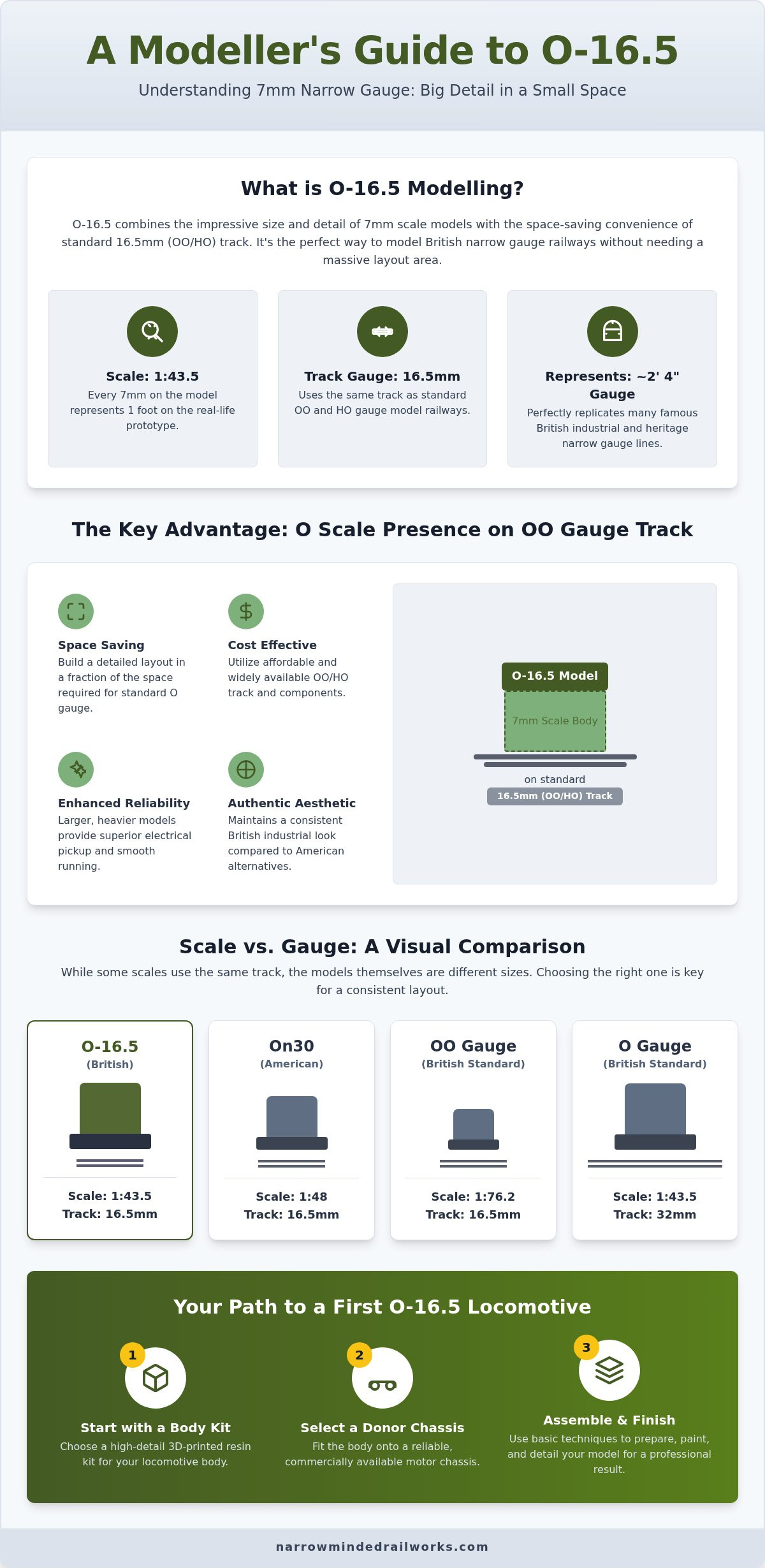
O-16.5 is a modelling scale that represents narrow gauge railways using a ratio of 7mm to the foot. In this scale, the models are built to 1:43.5 proportions, which is the standard for British O gauge. While standard O gauge models represent trains running on 4ft 8.5in tracks, O-16.5 focuses on smaller, industrial, or heritage lines. The "16.5" in the name refers to the track gauge in millimetres. This is the exact same width as standard OO or HO gauge track. By using this combination, you can build substantial, highly detailed locomotives and rolling stock that run on affordable and readily available track systems.
Historically, O-16.5 gained popularity in the UK because it allowed modellers to replicate the charm of industrial tramways and rural lines without the engineering hurdles of building bespoke track. It's an ideal entry point if you want the tactile feel of larger models but don't want to sacrifice an entire room to the hobby. Using O-16.5 model railway kits, you can create a convincing 2ft 3in to 2ft 6in gauge railway that feels heavy and authentic, even on a modest budget.
Scale vs Gauge: Clearing the Confusion
It's easy to get lost in the terminology, especially when different countries use different standards. In the UK, we use the 1:43.5 scale. This means every foot on a real locomotive is represented by 7mm on the model. When you place a 7mm scale body on 16.5mm track, that track scales out to approximately 2ft 4in. This is a perfect match for many famous British narrow gauge lines.
You may also encounter the term On30. While On30 also uses 16.5mm track, it's an American standard based on a 1:48 scale. If you mix the two, the size difference becomes noticeable quickly. British O-16.5 models are slightly larger than their American counterparts. Choosing O-16.5 ensures your layout maintains a consistent British industrial look, which is why many modellers prefer 7mm scale for local prototypes.
Why O-16.5 is Perfect for Small Layouts
Standard gauge O scale often requires massive curves that simply don't fit in a typical spare bedroom. Narrow gauge prototypes are different. Because real narrow gauge trains were designed to navigate tight mountain passes and cramped factory yards, they can handle much sharper curves. This allows you to build a functional layout in a fraction of the space required for standard O gauge.
If you're wondering what is a narrow gauge railway in a broader sense, it's essentially any line with rails set closer together than the standard 4ft 8.5in. In the modelling world, this translates to compact dioramas and intricate shunting puzzles. O-16.5 model railway kits allow you to pack an incredible amount of detail into these small spaces, making them a proactive solution for modellers with limited room but high standards for realism.
The Secret Advantage: Using Standard 16.5mm Track
Starting a new modelling project often involves significant upfront costs for specific infrastructure. You can bypass this hurdle by using standard 16.5mm track, which is the same gauge found in common OO and HO layouts. This compatibility is a major draw for those transitioning from standard gauge. It allows you to test prototypes or even build entire layouts using existing materials you might already have in your workshop. While some specialist scales require expensive, imported track, O-16.5 leverages mass-produced components to keep your entry costs manageable.
Reliability is a frequent pain point for narrow gauge modellers, especially when dealing with smaller scales. Locomotives in O-16.5 are physically larger and heavier than their OO9 counterparts. This extra weight results in superior electrical pickup and smoother slow-speed running. You'll find that stalling on points becomes much less of a concern, which is essential for the slow, methodical shunting typical of industrial narrow gauge lines. Using standard rails provides a stable foundation for O-16.5 model railway kits, ensuring your hard work on the workbench translates to reliable performance on the layout.
Choosing Between OO/HO and Dedicated O-16.5 Track
Standard OO track is perfectly functional, but it can look slightly out of proportion under 7mm stock. The sleepers are typically too small and spaced too closely for a 7mm narrow gauge prototype. To solve this aesthetic issue, you can use dedicated O-16.5 track. This specialist track features larger, wider-spaced sleepers that better reflect the "heavy narrow gauge" look of British industrial lines. If you're working on a tight budget, you can modify standard flexi-track by cutting the webbing and repositioning the sleepers. This simple adjustment creates a more authentic, "shabby" look perfect for a rural or factory setting.
Wiring and Power for 7mm Narrow Gauge
You aren't restricted to basic DC operation when building with O-16.5 model railway kits. The generous internal dimensions of 7mm locomotives provide ample space for DCC decoders and large sound speakers. This makes the scale particularly attractive if you enjoy the immersive experience of realistic engine sounds. While smaller scales often require tiny, expensive micro-decoders, O-16.5 bodies can usually accommodate standard-sized chips. Wiring a small layout remains straightforward. A simple two-wire bus is often enough to provide reliable power across a compact industrial diorama, allowing you to focus more on scenery and less on complex electrical engineering.
O-16.5 vs On30: Which Scale is Right for You?
While both O-16.5 and On30 share the same 16.5mm track gauge, they represent fundamentally different modelling worlds. O-16.5 is the British standard, built to a scale of 7mm to the foot (1:43.5). On30 follows the American proportion of 1/4 inch to the foot (1:48). This distinction might seem minor on paper, but it creates a visible difference in the physical size of your locomotives and rolling stock. If you're building a layout based on British prototypes, choosing O-16.5 model railway kits ensures your trains look correct alongside local scenery and architecture.
The prototypical origins of these scales also differ. O-16.5 typically replicates the narrow gauge railways found in British industrial settings, such as Welsh slate quarries, coastal tramways, or English brickworks. On30 is rooted in the heavy-duty logging and mining operations of the United States. While you can technically run an American On30 locomotive on an O-16.5 layout, the difference in design philosophy and physical bulk can feel disjointed. Choosing the right scale from the start prevents the frustration of owning a collection that doesn't quite fit together visually.
The 7mm Advantage for UK Modellers
Using the 7mm scale offers a significant advantage for those based in the UK. Because O-16.5 is built to 1:43.5, it's perfectly compatible with the vast range of British O gauge accessories, figures, and buildings. This scale feels more substantial and heavy than the 1:48 American alternative. For a deeper look at the US equivalent and its specific features, you can read our introduction to On30 gauge. By sticking to 7mm, you ensure that your station masters, trackside huts, and road vehicles all look proportionally correct next to your rolling stock. It's a proactive way to maintain a consistent and realistic atmosphere across your entire layout.
Mixing Scales: What to Avoid
How to Build Your First O-16.5 Locomotive Kit
Building your first locomotive doesn't have to involve complex soldering or expensive brass work. While traditional metal kits often require specialised skills and heavy tools, modern 3D-printed O-16.5 model railway kits offer a far more accessible entry point for the average modeller. These kits arrive as high-detail resin bodies designed to fit directly onto proven, mass-produced mechanisms. This approach allows you to focus on the creative aspects of modelling, such as detailing and painting, rather than difficult mechanical engineering.
Before assembly, you must prepare the resin surface. Most 3D-printed parts have small support pips that require careful removal with a sharp hobby knife or fine-grit sandpaper. It's also vital to wash the parts in warm, soapy water to remove any residual resin dust. Once the parts are dry, you can use Cyanoacrylate (super glue) to attach any additional details like handrails or chimneys. Using these modern materials provides a lightweight yet sturdy alternative to older kit-building methods.
Fitting Body Kits to Commercial Chassis
The most cost-effective way to power your models is by using a "donor" chassis. Many 7mm narrow gauge bodies are designed to sit on standard OO gauge 0-4-0 or 0-6-0 mechanisms from major UK manufacturers. You'll usually need to remove the original plastic body shell from the donor locomotive before securing the new 7mm resin body. Because resin is naturally lighter than white metal, you should add lead or tungsten weights inside the tanks or boiler. This proactive step ensures your locomotive has enough traction to pull a realistic train of wagons without slipping on gradients.
Finishing Your 3D-Printed Model
A professional finish starts with a high-quality primer. Resin can be non-porous, so a dedicated plastic primer is essential to give the topcoat something to grip. When painting, you can simulate weathered wood for cab floors or rusted steel for boiler plates using layered acrylic washes. For detailed instructions on achieving a realistic look, see our guide on painting 3D printed models. Once you've mastered these basic techniques, you can explore our full range of O-16.5 model railway kits to begin expanding your industrial fleet.
Narrow Minded Railworks: Modern O-16.5 / 7mm Scale Kits
Traditional narrow gauge modelling often feels restricted by the availability of affordable, high-quality components. Many enthusiasts find that white metal or brass kits are either too heavy for small donor chassis or require advanced soldering skills that take years to master. Narrow Minded Railworks provides a proactive solution to these challenges by specialising in 3D-printed O-16.5 model railway kits. Our use of high-resolution resin allows us to capture the intricate rivets, bolt heads, and textures found on industrial prototypes without the excessive weight associated with traditional metal casting. This modern approach ensures that even those new to the 7mm scale can achieve a professional, highly detailed finish on their first attempt.
Our design philosophy focuses on the unique charm of British industrial and heritage lines. We understand that finding prototypical narrow gauge stock can be a difficult task, so we concentrate on producing models that are often overlooked by larger manufacturers. By prioritising compatibility and ease of assembly, we help you overcome the technical hurdles of kit building. This allows you to spend more time on the creative aspects of the hobby, such as weathering and scene-setting, rather than struggling with complex mechanical fits.
Locomotive Body Kits and Wagon Options
The core of our range consists of locomotive body kits specifically designed to fit standard commercial chassis. While scratch-building a reliable mechanism is a significant constraint for many modellers, our kits allow you to use proven donor units from major UK brands. This ensures your locomotive runs smoothly from the moment you complete the build. Our wagon kits follow the same principle, offering a lightweight resin construction that is far easier to handle than heavy metal alternatives. This reduced weight is a practical benefit for small layouts, as it allows your locomotives to pull longer, more realistic trains without the risk of motor strain or wheel slip on tight industrial curves.
Bringing Your Layout to Life
A convincing narrow gauge railway requires more than just rolling stock; it needs a sense of place and purpose. Sourcing consistent 7mm scale accessories can be a frustrating process, but we offer a range of 3D-printed details to help you complete your diorama. Our collection includes everything from petrol pumps and phone boxes to 7mm scale figures that add a human element to your industrial scenes. We also provide specialized diorama tools designed to assist with the precise assembly of these smaller components. If you are ready to expand your fleet or start a new project, you can browse our full range of O-16.5 model railway kits and accessories to find the perfect addition to your 7mm narrow gauge world. We ship worldwide, ensuring that modellers everywhere can access these modern, high-detail kits.
Start Your 7mm Narrow Gauge Journey Today
While the transition to O scale often feels daunting due to space constraints and high costs, O-16.5 offers a practical path forward. You've seen how this scale combines the impressive presence of 7mm modelling with the convenience of standard 16.5mm track. By choosing 3D-printed O-16.5 model railway kits, you bypass the difficulties of traditional metalwork while benefiting from modern, lightweight materials. These kits are specifically designed to fit commercially available chassis, providing a reliable mechanical foundation for your creative work.
Whether you're building a tiny industrial shunting plank or a sprawling heritage line, these models bring a level of detail that is difficult to achieve in smaller scales. Our expertly designed kits are available for worldwide shipping, ensuring you have access to high-quality narrow gauge prototypes regardless of your location. It's time to stop worrying about space requirements and start building the detailed railway you've always wanted.
Browse our full range of O-16.5 and 7mm scale kits today!
Frequently Asked Questions
What track does O-16.5 use?
O-16.5 uses standard 16.5mm track, which is the same width as conventional OO and HO gauge rails. While you can use standard OO track for initial testing, dedicated O-16.5 track is preferred for its wider sleeper spacing and more prototypical appearance. This specialist track better represents the look of a heavy narrow gauge railway in 7mm scale. Using standard gauge rails as a foundation makes the transition to larger scales much more affordable for modellers on a budget.
Is O-16.5 the same as On30?
No, O-16.5 and On30 are different modelling standards despite sharing the same 16.5mm track gauge. O-16.5 is the British standard at 1:43.5 scale, while On30 follows the American proportion of 1:48. This means British 7mm models are physically larger and more substantial than their American counterparts. Mixing the two can lead to visual inconsistencies, especially when placing figures or buildings from different traditions side by side on a layout.
Can I use OO gauge wagons on an O-16.5 layout?
You can physically run OO gauge wagons on O-16.5 track, but they will look significantly out of scale and undersized. Because OO is 4mm scale and O-16.5 is 7mm scale, the standard gauge wagons will appear tiny next to your locomotives and scenery. It's much better to use dedicated O-16.5 model railway kits for your rolling stock. This ensures every wagon has the correct bulk and height to match your 7mm engines, maintaining a realistic industrial atmosphere.
Do I need to solder O-16.5 kits?
You don't need to solder when building our 3D-printed resin kits. Traditional white metal or brass kits often require complex soldering skills, but modern resin bodies are assembled using Cyanoacrylate, commonly known as super glue. This makes the build process much cleaner and more accessible for beginners. You only need basic tools like a hobby knife and fine files to prepare the parts, allowing you to focus on the creative aspects of painting and finishing.
What is the best chassis for an O-16.5 loco kit?
While scratch-building a mechanism is difficult, most kits are designed to fit standard OO gauge 0-4-0 or 0-6-0 mechanisms from major UK manufacturers. These donor units provide a reliable, pre-built motor that saves you from complex mechanical engineering. Always check the kit description to verify which commercial chassis is required for a specific body. Using these proven mechanisms ensures your locomotive runs smoothly and has sufficient power for slow-speed industrial shunting.
How much space do I need for an O-16.5 layout?
You can build a functional O-16.5 layout in a space as small as 4 feet by 1 foot. Because narrow gauge prototypes were designed to navigate tight factory yards and quarries, you don't need the massive radii required for standard O gauge. A simple shunting plank or a small industrial diorama fits easily on a bookshelf. This compact footprint makes O-16.5 model railway kits an ideal choice for modellers who want high detail without sacrificing an entire room.
Are 3D-printed kits as durable as metal ones?
Modern 3D-printed resin kits are highly durable and offer a lightweight alternative to heavy metal castings. While they don't have the same impact resistance as brass, they are sturdy enough for regular use and handling on a layout. The resin captures finer surface details that are often lost in traditional metal moulds. Once properly primed and painted, these models are resilient and maintain their finish well over time, providing a proactive solution for building a modern fleet.