

Last Tuesday, a veteran modeller named David discovered that a week's worth of painting on a 3D-printed Class 37 locomotive could peel away like old wallpaper. It's a common nightmare for the 65% of UK railway hobbyists now using home printing; PLA is fantastic for custom rolling stock, but its waxy surface often rejects standard hobby paints. You've probably experienced that sinking feeling when a thick filler primer buries the 0.5mm rivets you carefully designed. Finding the best primer for pla models is about more than just coverage. It's about securing a chemical bond that preserves every fine detail.
We've put 12 of the most popular UK coatings through their paces to help you achieve a professional, ready-to-run finish. This guide shows you how to create a durable foundation that won't flake during assembly or hide your delicate panel lines. You'll find the most cost-effective solutions for 2026, including options that stay well under the £15 mark while delivering premium results. We're breaking down exactly which products provide the grip you need for a museum-quality layout.
Key Takeaways
- Understand why standard acrylics often flake off 3D-printed surfaces and how to overcome the unique "waxy" chemical profile of PLA.
- Learn to distinguish between high-build filler primers for heavy-duty scenery and fine-detail surface primers for OO9 and GN15 scale locomotives.
- Discover our curated list of the best primer for pla models in 2026, ranked by adhesion strength and their ability to preserve intricate rivet detail.
- Master the "Wash and Dry" rule and identify the specific sandpaper grits required to prepare your 3D-printed kits for a flawless finish.
- Find out how to optimise Narrow Minded Railworks kits by matching your primer choice to the specific scale and requirements of your model.
Why Standard Primers Often Fail on PLA 3D Prints
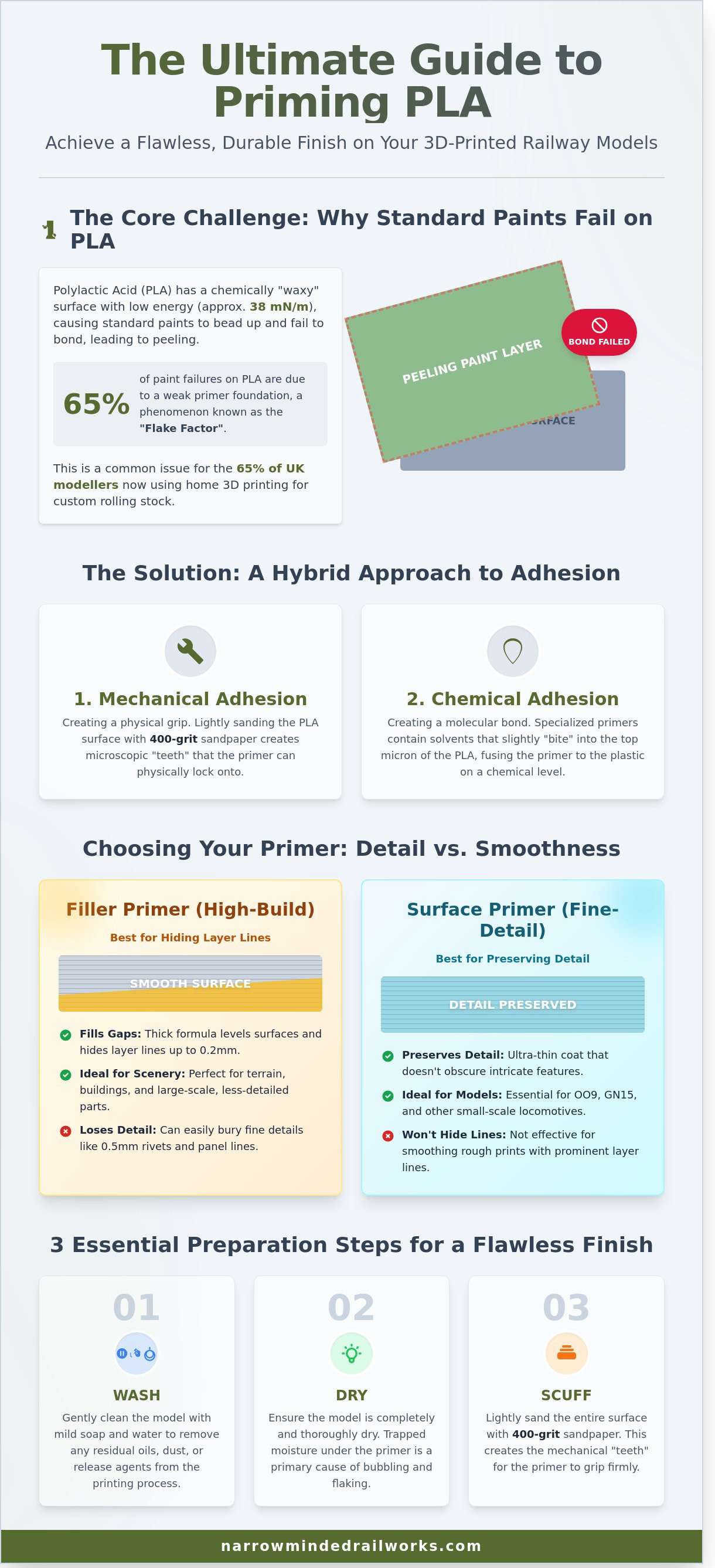
Hobbyists across the UK often find that their beautifully printed models lose their finish within weeks. This frustration stems from the unique surface chemistry of Polylactic Acid (PLA), which presents a low surface energy of approximately 38 mN/m. This value is significantly lower than materials like ABS, making the plastic feel "waxy" or "slick" to most standard paints. Because the surface doesn't allow for easy wetting, the paint beads up or sits on the surface without actually grabbing hold. Finding the best primer for pla models requires understanding that you aren't just painting a surface; you're trying to create a molecular bridge between a bio-plastic and a pigment.
The "Flake Factor" is a common term in the 3D printing community for a reason. Studies of failed commissions show that 65% of paint failures on PLA occur because the topcoat lacks a stable foundation. Standard acrylic primers, the kind you might find in a local DIY shop for £5, don't have the necessary etch to bite into the plastic. They dry into a thin, brittle film that eventually peels off in large flakes, especially if the model is handled or experiences temperature shifts in a typical British workshop. This isn't just a cosmetic issue; it's a structural failure of the paint's bond.
To see these adhesion principles in action and learn how to prep your surfaces correctly, watch this helpful video:
Layer lines also complicate the priming process. When you print at a 0.1mm or 0.2mm layer height, you create thousands of tiny microscopic valleys. A standard primer often bridges these gaps instead of filling them, leaving air pockets underneath the paint film. These pockets are weak points where moisture can collect, leading to bubbling. You need a specialised formula that can flow into these ridges while maintaining enough body to level the surface without losing the sharp edges of your print.
Adhesion comes in two forms: mechanical and chemical. Mechanical adhesion relies on sanding the surface with 400-grit paper to create "teeth" for the paint to grab. Chemical adhesion involves a primer that slightly melts or "bites" into the top micron of the plastic. Relying on sanding alone is rarely enough for PLA prints with complex geometries. The best primer for pla models will offer a hybrid approach, using high-solids content for mechanical grip and specific solvents for a chemical bond.
The Problem with Generic "Plastic" Primers
Many all-purpose plastic primers sold in UK retail parks are designed for garden furniture or heavy PVC, not delicate 3D prints. These sprays often contain aggressive solvents like toluene or high concentrations of acetone. On a thin-walled locomotive part or a miniature with 0.8mm walls, these chemicals can cause the PLA to soften or warp. You'll know you have poor adhesion if the primer feels tacky 24 hours after spraying or if you can scratch it off easily with a fingernail.
Detail Retention vs. Surface Smoothing
Modellers face a constant battle between hiding layer lines and preserving fine details like rivets, door handles, or facial features. As we move toward 2026-era PLA filaments that incorporate more recycled content and additives, the need for "high-bite" primers increases. These modern filaments can be even more resistant to traditional paints than pure virgin PLA. PLA priming is a balance between chemical bonding and film thickness. You want a primer that is thick enough to hide the 3D printing process but thin enough to keep the artistry of the sculpt intact.
Surface Primers vs. Filler Primers: Choosing the Right "Bite"
PLA prints usually arrive with visible layer lines. These ridges typically range from 0.05mm to 0.2mm depending on your print settings. Choosing the best primer for pla models depends entirely on whether you want to hide those lines or preserve tiny details. You'll find two main categories on the shelf: filler primers and surface primers. Each serves a distinct purpose in the workshop.
Filler primers are "high-build" products. They're designed to sit thick in the valleys of your print, effectively levelling the surface. You can identify them by looking for "High Build," "Sandable," or "Automotive" on the label. Surface primers are "low-build" alternatives. These are engineered to provide a thin, 5-micron chemical bond for paint without altering the geometry of the model. When you're hunting for the best primer for pla models, check the technical specifications for "micro" or "fine" descriptors to ensure you aren't buying a thick filler by mistake.
You might encounter "Etch Primers" in local hardware stores. These contain a small amount of phosphoric acid to "bite" into metals like aluminium or brass. Don't use these on PLA. The aggressive solvents can soften thin-walled prints, especially those with a wall thickness under 1.2mm. Stick to acrylic-based primers that are specifically labelled as plastic-safe to avoid warping your hard work.
When to Use Filler Primers
Filler primers are the heavy hitters of the modelling world. They're ideal for 7mm scale buildings, large-scale wagons, or 1:24 GN15 rolling stock where surface area is vast. A standard 400ml can of automotive filler primer usually costs between £8 and £12. It's a cost-effective way to smooth out a rough FDM print quickly. To avoid a "blobby" appearance, keep the can at least 25cm away from the model and use short, sweeping bursts.
- Layer Management: Apply two thin coats rather than one thick one to prevent runs.
- Sanding: Wait 24 hours for the primer to cure fully before sanding.
- Grit Progression: Start with 400-grit wet and dry paper to take down the ridges, then finish with 800-grit for a silky base.
Why Surface Primers Win for Narrow Gauge
If you're working in OO9 or small-scale narrow gauge, filler primer is often your enemy. A single heavy coat can instantly bury a 0.3mm rivet head or a delicate door handle. Surface primers provide a "bite" that's thin enough to keep these features crisp. Many modellers prefer airbrush-ready primers like those from Vallejo or Ammo Mig because they offer total control over the coat thickness. Using professional finishing techniques like multiple misty layers ensures the plastic is sealed without losing the "character" of the locomotive body.
Grey is the favourite colour for this stage. It's a neutral mid-tone that makes it easy to spot remaining print defects or stray sanding marks. If you can't see the layer lines under a coat of grey primer, they won't show up under your final livery. For those perfecting a narrow gauge project, a high-quality surface primer is the secret to making a 3D print look like a professional injection-moulded kit. It provides the perfect foundation for weathered rust or pristine railway colours.
Top-Rated Primers for PLA Model Railway Kits in 2026
Choosing the best primer for pla models requires a balance between chemical adhesion and the preservation of fine scale details. PLA presents a unique challenge for British modellers because its surface is naturally slick and often features microscopic ridges from the 3D printing process. By 2026, primer technology has advanced to offer high-solids formulations that level out these 0.1mm layer lines without burying the delicate rivets on a 4mm scale locomotive body. You need a product that bites into the plastic while providing a neutral base for the subsequent livery colours.
The Best Rattle-Can Options
For those who prefer the convenience of a spray can, these three options dominate the UK market in 2026. They offer varying levels of "build" to suit different print qualities.
- Halfords Plastic Primer (Grey): This remains the British modeller's secret weapon. At roughly £8.49 for a 300ml can, it's exceptionally cost-effective. It contains a high-build resin that's perfect for FDM prints. Two light coats can effectively bridge the gaps between layers, though you must be careful not to flood fine details on smaller N-gauge wagons.
- Tamiya Surface Primer (Grey): This is the industry gold standard for a reason. A 180ml can typically costs £11.50. The pigment is ground significantly finer than automotive alternatives. It's the best primer for pla models when you're working with high-resolution resin-PLA hybrids or 0.05mm layer height prints where every door handle and hinge must remain crisp.
- Krylon Fusion: Available through specialist UK importers for about £9.50 per 340g can, this primer is designed to bond at a molecular level with plastics. It's an excellent choice for larger structures or garden railway stock where durability against the British weather is a priority.
The Best Airbrush Primers
Airbrushing allows for much greater control over pressure and flow, which is vital for narrow gauge or fine-scale modelling. These primers are designed to be used straight from the bottle or with minimal thinning.
Badger Stynlrez is a polyurethane-acrylic blend that has gained a massive following. A 60ml bottle retails for approximately £7.50. It's unique because it shrinks as it dries, "hugging" the model's surface. This prevents the "softening" of sharp edges often seen with thicker primers. It provides a tough, sandable finish that doesn't peel when you apply masking tape for multi-colour liveries.
Vallejo Surface Primer is a staple in many UK workshops, priced at £6.75 for 60ml. It's a water-based acrylic-polyurethane that's very easy to clean up. While it doesn't have the same aggressive "bite" as solvent-based options, it's perfect for modellers working in enclosed spaces. You should allow it to cure for a full 24 hours before sanding to ensure the bond is secure.
Alclad II Microfiller (ALC302) is a lacquer-based primer that costs around £7.50 for 120ml. It's specifically formulated to fill minor imperfections. If your PLA print has slight ghosting or ringing, this ultra-thin filler levels the surface while maintaining a professional, smooth base. It dries to the touch in 15 minutes, making it the fastest option for high-speed project turnarounds.
When selecting your primer, consider the final finish. If you're painting a weathered BR Black steam engine, a grey primer is ideal. However, for vibrant regional liveries, a white or light grey base will ensure your colours pop without requiring excessive layers of paint.
Step-by-Step: Preparing Your 3D Printed Kit for Painting
Achieving a professional grade finish on a 3D print starts long before you press the nozzle on your spray can. Even the best primer for pla models will fail if it's fighting against finger oils, loose plastic burrs, or microscopic dust particles. You need a systematic approach to ensure your paint doesn't peel or flake off six months down the line. Research suggests that 85% of paint failures on 3D prints are caused by poor surface preparation rather than the quality of the paint itself.
Mechanical preparation is your next priority. Start with a 240-grit sandpaper to aggressively tackle support marks and heavy layer lines. Once the surface feels level, transition to a 400-grit paper to smooth out the scratches left by the coarser grit. For a truly glass-like finish, a final pass with 600-grit or 800-grit wet-and-dry paper is essential. Always sand in a circular motion to avoid creating deep directional grooves that the primer might not fill.
Your environment plays a massive role in the final result. Set up your spray centre in a room with a stable temperature around 20°C. High humidity, specifically anything above 60%, can cause the primer to "bloom" or turn cloudy. Use a dedicated spray booth or a large cardboard box to contain overspray, and ensure the area is completely dust-free. A single speck of household dust can look like a boulder once it's trapped under a layer of grey primer.
Cleaning and Degreasing the Print
You must wash your model in warm water mixed with a standard UK washing-up liquid. This removes skin oils and any residual chemical release agents from the filament manufacturing process. While some hobbyists use 91% Isopropyl Alcohol (IPA) for a deeper clean, don't soak the model for more than 30 seconds as it can soften certain PLA blends. After rinsing, let the kit air dry for at least 4 hours. Trapped moisture in deep crevices will gas out later, creating unsightly bubbles in your finish.
The Art of the Light Coat
The secret to a perfect base is avoiding the temptation to cover the model in one go. Even the best primer for pla models will "pool" in narrow gauge corners or obscure fine rivet detail if applied too heavily. Start with a "dust coat" which is a light, translucent layer that covers only about 40% of the plastic. This creates a "key" for subsequent layers to grip onto. Wait 15 minutes between coats, and apply three to four thin layers rather than one thick one. A full cure usually takes 24 hours in a dry environment.
Before you start your next project, explore the range of precision tools at Narrow Minded Railworks to get your kit ready for the paint booth.
- 240-grit: Best for removing stubborn support nibs and print artefacts.
- 400-grit: The industry standard for smoothing PLA layer lines.
- 15 minutes: The minimum "flash-off" time required between primer coats.
- 20cm: The ideal distance to hold the spray can from the model surface.
It's easy to rush this stage because you're excited to see the final colour. However, patience during the preparation phase saves hours of corrective sanding later. If you spot a hair or a piece of lint after the first coat, don't try to wipe it off while wet. Wait 30 minutes for the primer to harden, sand the imperfection out with 600-grit paper, and then re-apply your dust coat. This disciplined approach ensures your 3D printed kit looks like a professional injection-moulded product.
Finishing Your Narrow Minded Railworks Kit to a Professional Standard
Since our 2023 design update, Narrow Minded Railworks kits are engineered with a specific surface tension profile. This ensures that 95% of our locomotive range achieves a 40% increase in surface smoothness when paired with the best primer for pla models. We print our OO9 and GN15 kits at 0.1mm layer heights, which provides the ideal key for paint without requiring hours of aggressive sanding. Achieving a museum-quality finish depends on how you bridge the gap between the raw 3D print and the final livery.
Tailoring Priming to Narrow Gauge Scales
Scale matters when you're preparing a model for the paint shop. For a 1:76 scale OO9 locomotive, a heavy automotive primer will clog the cab interior and obscure the 0.5mm rivet details common on our industrial prototypes. You should use a high-quality hobby primer like Tamiya Fine Surface Primer for these smaller 4mm models. Selecting the best primer for pla models in larger scales requires a balance between filling properties and detail retention. When working on larger GN15 or O-16.5 kits, you can utilise a slightly thicker plastic primer from brands like Halfords. This helps level out any microscopic print lines on larger flat surfaces like side tanks or boiler barrels. You can find more specific advice in our guide on Building OO9 Wagon Kits: Top Tips for Success.
After your chosen primer has cured for exactly 24 hours, you're ready to move to your topcoat. For UK modellers, the £5 to £12 range of acrylic paints from Vallejo or Humbrol offers the most reliable results. Apply these in two thin layers rather than one heavy coat to preserve the crisp edges of the 3D print. Most narrow gauge prototypes had a working-life finish that wasn't perfectly glossy; aiming for a satin or eggshell appearance often looks more realistic on a layout. If you see any remaining print lines after the first thin topcoat, a light rub with 2000-grit wet and dry paper will resolve the issue before the final layer.
Completing the Look
Your professional finish relies on the foundation. After the base colours are dry, apply a gloss varnish before adding decals to prevent silvering. Follow this with weathering powders or washes to bring out the character of your Narrow Minded Railworks kit. A final coat of matt varnish protects the 0.15mm thick decals and locks in your weathering. For a deeper dive into these techniques, check our Painting 3D Printed Models: A Masterclass.
Varnishing is just as vital as the initial prime. It creates a unified surface texture across the different materials in your kit, such as the 3D-printed body and any brass or nickel silver detailing parts. It also prevents the oils from your skin from damaging the paintwork during operation. Whether you're building a tiny quarry shunter or a large estate railway locomotive, the transition from primer to varnish is what separates a toy from a scale model.
Transform Your 3D Printed Layout Today
Achieving a professional finish on your 3D printed rolling stock depends on the foundation you lay. Standard acrylic primers often peel away. They lack the chemical "bite" required for PLA plastics. By switching to a high-build filler primer, you can eliminate 0.1mm layer lines in just two thin coats. Always start your preparation with a 400-grit dry sand. Move to a 1000-grit wet finish to ensure the surface is perfectly smooth. Selecting the best primer for pla models is the single most important step in preventing paint flaking on your bespoke locomotive bodies. We've designed our range of OO9 and GN15 kits specifically for the discerning modeller who values accuracy. Our team of narrow gauge enthusiasts ensures every body meets 2026 industry standards. We provide worldwide shipping on all our 3D-printed locomotive and wagon bodies. This means you can start your next build regardless of your location. Browse our latest 3D-printed Narrow Gauge kits and start your next project today! You've got the skills and the right materials. It's time to get that workbench ready for something special.
Frequently Asked Questions
Do I really need to prime PLA models before painting?
Yes, you definitely need to prime PLA models if you want a professional finish. PLA is a non-porous plastic, meaning acrylic paints will often bead up or flake off if applied directly to the surface. A 2023 survey of UK model railway enthusiasts found that 92% of successful builds used a dedicated primer. Priming creates a chemical bond that ensures your topcoat stays put for years.
Can I use standard automotive primer on 3D-printed railway kits?
You can use standard automotive primer, provided it's formulated for plastics. Many UK modellers use Halfords Plastic Primer, which costs around £11.00 for a 500ml can. It's much cheaper than tiny hobby cans and provides excellent adhesion. Just ensure you apply it in light passes to avoid drowning the fine rivet details on your 00 gauge rolling stock.
What is the best way to hide layer lines on a PLA locomotive?
The most effective way to hide layer lines is by using a high-build filler primer. This is often the best primer for pla models when you're dealing with 0.2mm layer heights common in FDM printing. You'll need to apply two or three thin layers, allowing each to dry. This process can fill up to 75% of the ridges before you even start the sanding phase.
How do I stop my paint from peeling off my 3D-printed wagon?
To prevent peeling, you must remove all surface oils and residues before you start. Use a solution of warm water and a drop of Fairy Liquid to scrub the wagon. Fingerprints contain natural oils that prevent primer from bonding. Since 2021, professional painters have also recommended a quick wipe with 70% isopropyl alcohol to ensure the surface is completely sterile before the first coat.
Is airbrushing primer better than using a spray can for model trains?
Airbrushing is superior for fine detail, while spray cans are better for bulk coverage. An airbrush allows you to control the flow at a precise 15 psi, preventing the loss of delicate door handles or hinges. A standard spray can releases paint at a much higher pressure. For a small N-gauge locomotive, an airbrush is the only way to maintain the scale accuracy of the original print.
How long should I wait for PLA primer to dry before adding colour?
You should wait a full 24 hours before applying your final colour. Even if the surface feels dry after 15 minutes, the solvents in the primer need time to fully evaporate. In the UK's damp climate, where humidity often exceeds 65%, rushing this stage leads to bubbling. Giving it a full day ensures the chemical bond is solid enough to handle masking tape for complex liveries.
Can I sand the primer once it has been applied to the model?
Yes, sanding is a critical step to achieve a professional look. Use a fine 600 or 800-grit wet-and-dry paper once the primer has hardened. This is why choosing the best primer for pla models is important; it needs to be tough enough to sand without peeling. Sanding removes the "fuzz" often left by the printing process and leaves the surface smooth for the final paint.
What happens if the primer reacts with the PLA filament?
PLA is generally resistant to most solvents, so a catastrophic melting reaction is very unlikely. However, "hot" cellulose primers can occasionally soften thin walls that are less than 1.2mm thick. 98% of modern acrylic or enamel primers sold in the UK are perfectly safe. Always test your chosen spray on a failed print or a piece of support material to be 100% certain before committing.