

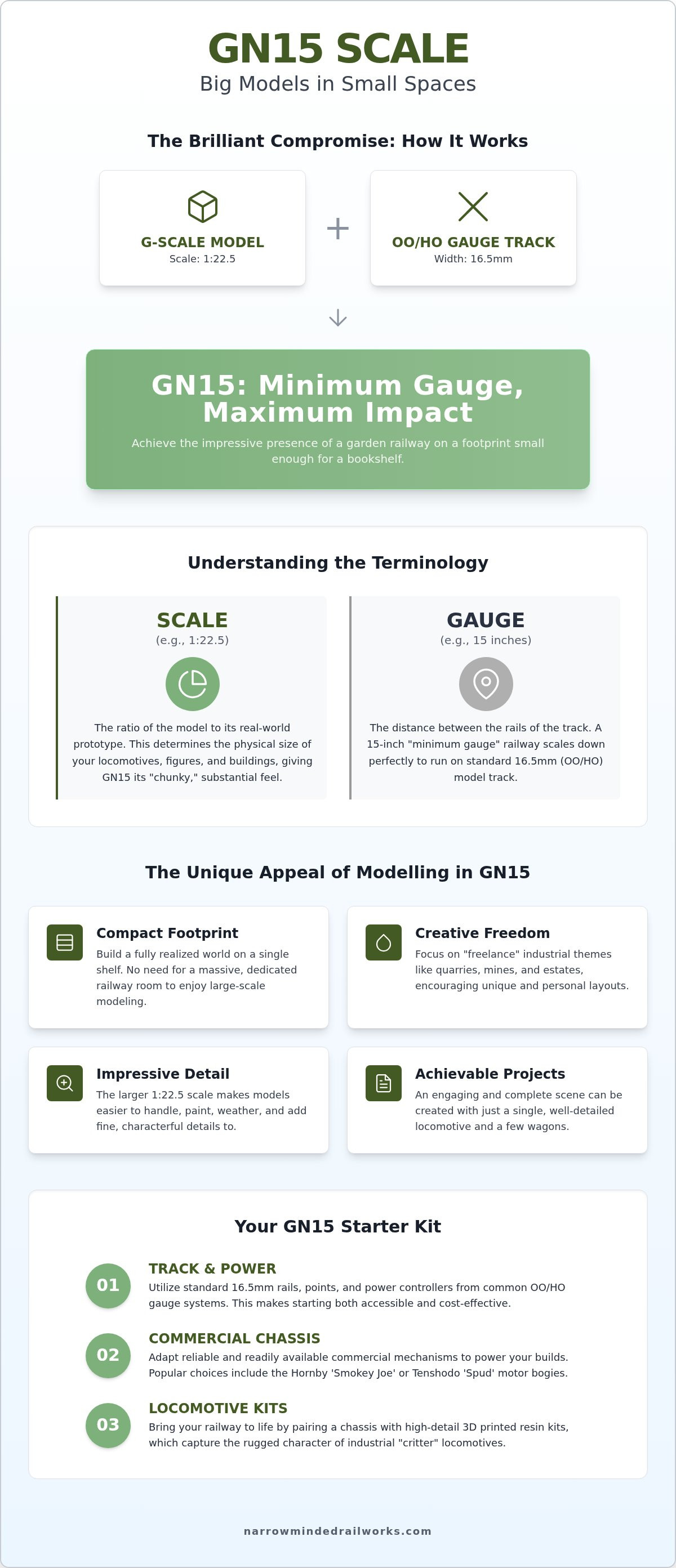
What if you could enjoy the massive presence of G-scale modeling without sacrificing an entire room to a sprawling layout? Many enthusiasts feel restricted by limited space, yet they still crave the chunky, industrial character of large-scale narrow gauge. This is where the gn15 scale offers a brilliant solution. It allows you to build 1:22.5 scale models that run on standard OO or HO gauge track. By utilizing a 16.5mm gauge to represent a 15-inch "minimum gauge" prototype, you gain the visual impact of a garden railway on a footprint small enough for a bookshelf.
Transitioning to a new scale often brings confusion regarding chassis compatibility and technical standards. While sourcing specific parts can be challenging, you can successfully adapt reliable commercial chassis like the Hornby 'Smokey Joe' or Tenshodo 'Spud' to power your builds. This guide provides a clear roadmap for your journey. You'll learn the essential technical specifications of the scale, discover how to repurpose standard OO components, and explore the high-detail 3D printed kits that make starting this hobby straightforward. It's time to discover how big models can thrive in small spaces.
Key Takeaways
- While large-scale modeling often requires significant space, the gn15 scale allows you to build 1:22.5 models on a compact OO/HO track footprint.
- Although technical compatibility can be confusing, you can achieve reliable performance by pairing 3D-printed bodies with common commercial chassis.
- Since resin kits have specific assembly requirements, mastering support-removal techniques will ensure a smooth and professional finish for your locomotives.
- If you want to avoid specialized equipment, you can use standard 16.5mm rails to create highly detailed, characterful industrial scenes.
- Because GN15 focuses on creative minimum-gauge prototypes, it offers a unique opportunity to build a personalized railway with immense visual impact.
What is GN15 Scale? Defining the Minimum Gauge Model
The gn15 scale represents a unique intersection in the model railroading world. While traditional G scale often requires significant outdoor space or a large basement, this niche allows you to enjoy the same physical presence on a standard bookshelf. At its core, What is GN15 Scale? defines a system where 1:22.5 or 1:24 scale models run on 16.5mm track. This specific track width is identical to the rails used for OO and HO gauge layouts. By combining these elements, you can build a "minimum gauge" railway that captures the charm of small, industrial locomotives without the logistical burden of larger track systems.
Modelling in this scale focuses on the "chunky" aesthetic of narrow gauge prototypes. You get the benefit of large, highly detailed figures and locomotive bodies that are easy to handle and paint. Because the layouts utilize standard 16.5mm track, the footprint remains remarkably small. This makes it a proactive choice for modellers who want to prioritize character and detail over long, complex mainline runs. The result is a layout that feels substantial and detailed while fitting into a spare corner of a room.
Scale vs. Gauge: Clearing the Confusion
Understanding the difference between scale and gauge is often the first hurdle for newcomers. Although the terms are sometimes used interchangeably, they refer to two distinct measurements. The "G" in gn15 scale signifies the scale, which is the ratio of the model to the real world, typically 1:22.5. This determines the size of your locomotive bodies, figures, and trackside accessories. The "15" refers to the gauge, which is the distance between the rails on the real-life prototype.
Since a 15-inch prototype gauge is extremely narrow, it scales down perfectly to 16.5mm in the modelling world. While finding specialized narrow gauge track can be difficult, using standard OO/HO track provides a reliable and cost-effective solution. This allows you to repurpose existing track and points while maintaining prototypical accuracy for a 15-inch line. It is a practical compromise that simplifies construction without sacrificing the visual identity of the model.
A Brief History of 15-Inch Railways
The concept of the 15-inch gauge railway was pioneered by Sir Arthur Heywood in the late 19th century. He believed that this was the "minimum gauge" required for a practical working railway. His work at Duffield Bank demonstrated that these small lines could effectively serve large estates and industrial sites. If you are curious about how these fit into the broader hobby, you can explore our guide on What is a Narrow Gauge Railway? to see how these systems compare to standard lines.
As the 20th century progressed, these railways transitioned from aristocratic estate transport to rugged industrial tools. Mines, quarries, and factories adopted small diesel "critters" to move heavy loads through tight spaces. These industrial applications provide the perfect inspiration for modern GN15 layouts. Because these prototypes were often built for utility rather than aesthetics, the scale encourages a high degree of creativity and "freelance" modeling that focuses on grit and functionality.
The Unique Appeal of Modelling in GN15
While many modellers believe they must choose between large-scale detail and a compact layout, the gn15 scale eliminates this compromise. This niche is celebrated for its creative freedom and whimsical character. Unlike mainline modelling, which often demands strict prototypical adherence, GN15 encourages a more lighthearted approach. You can build a fully realized industrial world on a single shelf. The larger 1:22.5 scale provides a significant physical presence, yet the 16.5mm track ensures the layout remains manageable in a standard room.
The appeal is not just about size; it is about the story you can tell in a small space. Because the prototypes were often "minimum gauge" lines, the layouts feel complete even with just a few feet of track. This focus on small-scale operations makes the hobby more achievable for those without a dedicated railway room. You don't need a massive fleet to create an engaging scene. A single, well-detailed locomotive moving a few wagons through a quarry or estate is enough to capture the imagination of any viewer. To add further realism to these scenes, you might discover Romford Fencing Ltd to see the types of professional fencing used to secure industrial and estate boundaries.
Industrial 'Critters' and Estate Locos
A central part of the appeal lies in the "critter." These are small, often improvised industrial locomotives designed for specific tasks in mines, quarries, or on large estates. These engines prioritize utility over elegance, which results in a rugged and charming aesthetic. Designs like the Lister or Clayton Electric are iconic examples of this style. Their simple, often open-cab structures allow you to see internal components and the driver, adding a layer of life to the model.
Because these locomotives were often modified by their real-world owners, the scale is a haven for kit-bashers and creative builders. If you are looking for more inspiration or connections within the broader community, the narrow gauge modelling resources provided by the Association of 16mm Narrow Gauge Modellers can help you find like-minded enthusiasts. This community-driven aspect ensures that help is always available for those tackling their first build.
Detailing and Characterful Scenery
The shift to 1:22.5 scale opens up a world of detailing possibilities that are simply impossible in smaller scales like OO9. Figures in this scale have distinct personalities and facial expressions you can actually see. This makes the painting process far more rewarding. You aren't just painting a blob of plastic; you are bringing a character to life. The larger size allows for more realistic textures on clothing and tools, making your scene feel authentic.
Scenery items also benefit from this larger size. Small details like vintage petrol pumps, weathered crates, or old-fashioned tools become focal points rather than background noise. The larger surface areas make techniques like rust effects and wood graining much easier to execute effectively. For those ready to start their own project, exploring a collection of GN15 Locomotive & Scenery Kits is a proactive way to find unique, industrial subjects that stand out from standard commercial offerings. This scale turns every small corner of a layout into an opportunity for deep, immersive storytelling.
Technical Requirements: Track, Chassis, and Power
One of the most proactive reasons to choose the gn15 scale is its inherent accessibility. You don't need to invest in specialized or expensive rail systems to get started. Because the scale uses 16.5mm gauge track, any standard OO or HO gauge rail is technically compatible. This allows you to repurpose existing track or purchase affordable bulk packs from major manufacturers. While specialized narrow gauge track with wider sleeper spacing is available for a more prototypical look, standard track remains a perfectly functional starting point for any industrial scene.
Power requirements are equally straightforward. Most locomotives in this scale operate on standard 12V DC power. This compatibility means you can use your existing controllers and wiring techniques without modification. Space constraints are often a barrier in large-scale modelling, but GN15 solves this by thriving on a "micro-layout" footprint. You can build a complete, characterful railway on a single bookshelf or a small diorama board. Since industrial prototypes were designed for tight spaces, a layout measuring just 120cm by 30cm can provide a fully realized operational environment.
Choosing the Right Chassis for Your Kit
While the scale offers great freedom, the choice of chassis is the most critical factor for reliable performance. Many small diesel "critters" are designed to fit the Tenshodo 'Spud' or Hanazono power bogies. These units are compact and self-contained; however, they can be difficult to source at times. A reliable alternative for small steam locomotives is the Hornby 'Smokey Joe' 0-4-0 chassis. It is affordable and widely available, though it requires a body kit designed specifically for its dimensions. To avoid the frustration of heavy cutting or filing, you should always verify that your resin kit is intended for your specific chassis model.
Trackwork and Minimum Radii
Narrow gauge prototypes are famous for their ability to navigate incredibly tight environments. This allows you to use much sharper curves than would be possible on a standard gauge layout. When planning your trackwork, you can choose between fixed-radius 'Setrack' or flexible 'Streamline' components. According to the G-Scale Society GN15 standards, maintaining clean rails is vital for small, short-wheelbase locomotives to ensure consistent power pickup. Tight industrial turns are a hallmark of the scale, but you must ensure your rolling stock can handle the radius you choose.
If you use flexible track, you can create organic, flowing curves that mimic the look of a temporary industrial line. For those who are new to the technical side of the hobby, our guide on Getting Started in GN15 Scale: Your Complete Guide offers detailed advice on planning your first circuit. By focusing on simple, reliable trackwork from the beginning, you ensure that your focus remains on the creative detailing and character that makes this scale so rewarding.
Building and Finishing GN15 Locomotive Kits
Traditional white metal kits often require significant cleanup and soldering skills, which can be a barrier for many hobbyists. In contrast, 3D printed resin kits in the gn15 scale offer superior surface detail and a significantly easier assembly process. Because these models are often printed as single-piece bodies, you can skip the complex alignment of multiple panels. However, you must first address the support marks left behind by the printing process. Carefully snipping these away with sharp side cutters and sanding the remaining nibs ensures a smooth, professional finish before you move on to painting.
Once you've cleaned the body, degreasing becomes the next vital step. Resin can sometimes retain a slight residue from the manufacturing process that prevents paint from adhering correctly. A quick soak in warm, soapy water followed by a thorough rinse will prepare the surface for a high-quality primer. Because the 1:22.5 scale provides a larger surface area than smaller gauges, it's the perfect canvas for advanced weathering. You can apply realistic rust streaks, oil spills, and grime with greater precision, making your industrial "critter" look like a hard-working piece of machinery.
Working with 3D Printed Resin
Safety is a priority when you modify resin parts. While the cured material is stable, you should always wear a dust mask when sanding to avoid inhaling fine particles. When it comes to assembly, traditional plastic cements won't work on resin. You'll need to use cyanoacrylate, commonly known as super glue, to create a permanent bond between the body and any additional details. For a deeper look at the finishing process, our guide on Painting 3D Printed Models: A Beginner's Guide provides a step-by-step breakdown of achieving a professional look.
Detailing Your GN15 Rolling Stock
Lightweight 3D printed wagons can sometimes struggle with tracking on uneven industrial rails. A simple solution is to add hidden weights, such as lead shot or adhesive weights, to the underside of the chassis. This improves the "feel" of the rolling stock and ensures more reliable operation during shunting. You should also consider using simple link-and-pin couplers to maintain an authentic industrial aesthetic. Finally, adding detailed figures to your locomotive cabs brings the scene to life. If you're ready to start your next project, you can browse our GN15 Locomotive & Scenery Kits to find the perfect industrial subject for your layout.
Starting Your GN15 Journey with Narrow Minded Railworks
While the creative freedom of the gn15 scale is a major draw, many modellers find the initial search for compatible components to be a significant hurdle. Narrow Minded Railworks addresses this constraint by providing a specialized range of 3D-printed locomotive bodies designed for a "plug and play" experience. Our kits are engineered to fit directly onto common commercial chassis, which eliminates the need for complex scratch-building or heavy modification. Whether you're drawn to the rugged utility of industrial "critters" like our Lister and Clayton Electric designs or prefer a more traditional estate aesthetic, our collection provides a reliable starting point for your project.
Building a successful layout requires more than just a locomotive; it requires a cohesive environment. Although finding high-quality, large-scale accessories can be difficult, we offer a unique selection of 3D scanned figures and detailed scenery to help you complete your diorama. These items are scaled specifically to complement our locomotive kits, ensuring a consistent visual style across your entire railway. Since we provide worldwide shipping, modellers everywhere can access these specialized kits and start building their own minimum gauge world without being limited by local hobby shop stock.
Our Recommended GN15 Starter Kits
If you're unsure which project to tackle first, we recommend starting with a kit designed for a chassis you already own or can easily source. The Lister Diesel Loco Kit is a proactive choice for those using the Tenshodo 'Spud' or Hanazono power bogies, as it offers a straightforward assembly process with excellent results. For modellers who have a spare Hornby 'Smokey Joe' 0-4-0, our 'Pixie' or 'Huntsy' steam locomotive kits provide a characterful way to repurpose that reliable mechanism. To complete your first train, our GN15 wagon kits offer easy-to-build rolling stock that matches the industrial theme of our locomotives perfectly.
Expert Support for Your Build
Modellers sometimes struggle with the finer points of chassis fitment or achieving a realistic weathered finish. We believe that transparency is essential for a successful build, so we offer direct advice to help you overcome any technical challenges you might encounter. If you find yourself stuck during the assembly process, you can reach out for guidance on how to best align your kit with your chosen motor. Additionally, our blog serves as an ongoing resource for tips on painting and detailing, ensuring you have the information needed to produce a professional-looking model. By combining high-quality kits with expert support, we help you focus on the joy of creating a unique narrow gauge railway.
Browse our full GN15 collection and start your layout today.
Bring Your Large-Scale Vision to Life
While many modellers feel limited by their available space, the gn15 scale provides a proactive way to build characterful railways on a compact footprint. You can successfully utilize standard OO or HO gauge track to represent a 15-inch prototype, allowing for immense detail without a massive layout area. By pairing reliable commercial chassis with high-detail 3D printed bodies, you simplify the construction process and focus on the creative aspects of weathering and scenery. It's a rewarding niche that prioritizes personality and industrial grit over complex mainline operations.
Although sourcing specialized narrow gauge parts can be difficult, our specialist 3D printed designs are engineered to fit standard commercial mechanisms perfectly. We provide worldwide shipping from the UK to ensure every modeller can access high-quality industrial kits. If you're ready to start your journey into this unique scale, Explore our GN15 Locomotive and Wagon Kits and discover your next project. Your spare shelf is the perfect place for a big story to begin.
Frequently Asked Questions
What is the difference between GN15 and OO9 scale?
The primary difference lies in the scale ratio and the physical size of the models. While OO9 uses 1:76 scale on 9mm track to represent 2-foot gauge lines, the gn15 scale utilizes 1:22.5 scale on 16.5mm track to represent 15-inch gauge railways. This results in GN15 models being significantly larger and more detailed than their OO9 counterparts despite representing a narrower prototype.
Can I use standard Hornby track for GN15?
You can use standard Hornby or Peco 16.5mm track for your layout without any technical issues. Although the track gauge is correct, the sleeper spacing on standard OO/HO track is technically too close for a narrow gauge prototype. To improve the visual authenticity, you can choose to remove every other sleeper or use specialized narrow gauge track designed for the 1:22.5 scale.
Which chassis is best for a GN15 diesel critter?
The Tenshodo 'Spud' and Hanazono power bogies are the most common choices for small diesel critters. These self-contained units are ideal for the short wheelbases found on industrial prototypes. If these units are difficult to source, you can adapt a Hornby 0-4-0 chassis, provided your chosen body kit is specifically designed to accommodate its larger motor and wheelbase dimensions.
Do I need to paint 3D printed GN15 kits?
You must paint 3D printed kits to protect the material and achieve a realistic finish. Raw resin is often translucent and can become brittle if exposed to prolonged sunlight without a protective coating. A high-quality primer is essential to ensure that your topcoats adhere properly to the smooth resin surface. This process also allows you to hide any minor support marks left over from the printing process.
Are GN15 models suitable for outdoor use?
What scale are the figures used in GN15?
Figures for this scale should be 1:22.5 or 1:24, which are the standard sizes for G scale. Because these figures are relatively large, they allow for a high level of personality and detail that smaller scales can't match. Using 3D scanned figures specifically designed for industrial scenes will ensure that your drivers and trackside workers look proptotypically correct alongside your locomotives.
Is GN15 compatible with DCC (Digital Command Control)?
Compatibility with Digital Command Control depends entirely on the chassis you choose rather than the gn15 scale itself. While most commercial chassis are sold as DC models, you can often hard-wire a micro-decoder if there's sufficient space inside the locomotive body. You should check the specifications of your chosen motor unit to see if it's DCC-ready or if it requires manual modification for digital operation.
How much space do I need for a GN15 micro-layout?
You can build a functional micro-layout in a space as small as 60cm by 30cm. Since industrial railways often featured very tight curves and short trains, you don't need the long runs required for standard gauge modeling. A bookshelf or a small diorama board provides ample room for a shunting puzzle or a simple point-to-point operation that captures the full character of a working minimum gauge line.