

Does that brand-new locomotive on your layout look a little too perfect? Straight from the box, our models often gleam with a plastic sheen that feels more toy-like than true-to-life. You see stunningly realistic, grimy models online, but the fear of ruining a locomotive you've spent hours on-or a small fortune for-is very real. The world of weathering model trains can feel overwhelming, with complex techniques and expensive airbrush kits seeming like the only way forward. It’s enough to make you leave your rolling stock in its pristine, unrealistic state.
Forget that fear. This guide is designed specifically for you. We’re going to break down the process into simple, repeatable steps that don't require an airbrush or a big budget. You will learn how to use basic powders, washes, and a few simple tools to add authentic layers of dust, rust, and operational grime. By the end, you'll not only have the skills to transform your models into weathered masterpieces but also the confidence to tackle any project and bring a whole new level of realism to your railway.
Why Weather Your Models? The Art of Realism
Step into any model railway exhibition, and you'll notice the most captivating layouts share one common trait: realism. The secret often lies in moving beyond the pristine, 'fresh out of the box' appearance of new rolling stock. This is the art of weathering, a crucial step in the model railroading hobby that transforms a plastic toy into a miniature replica with a story. Weathering replicates the real-world effects of a hard life on the rails-the subtle layers of brake dust, the creeping rust on metalwork, the general grime from industrial environments, and the fading paint from years under the sun.
To see how a simple effect like rust can dramatically enhance a model, take a look at this short video:
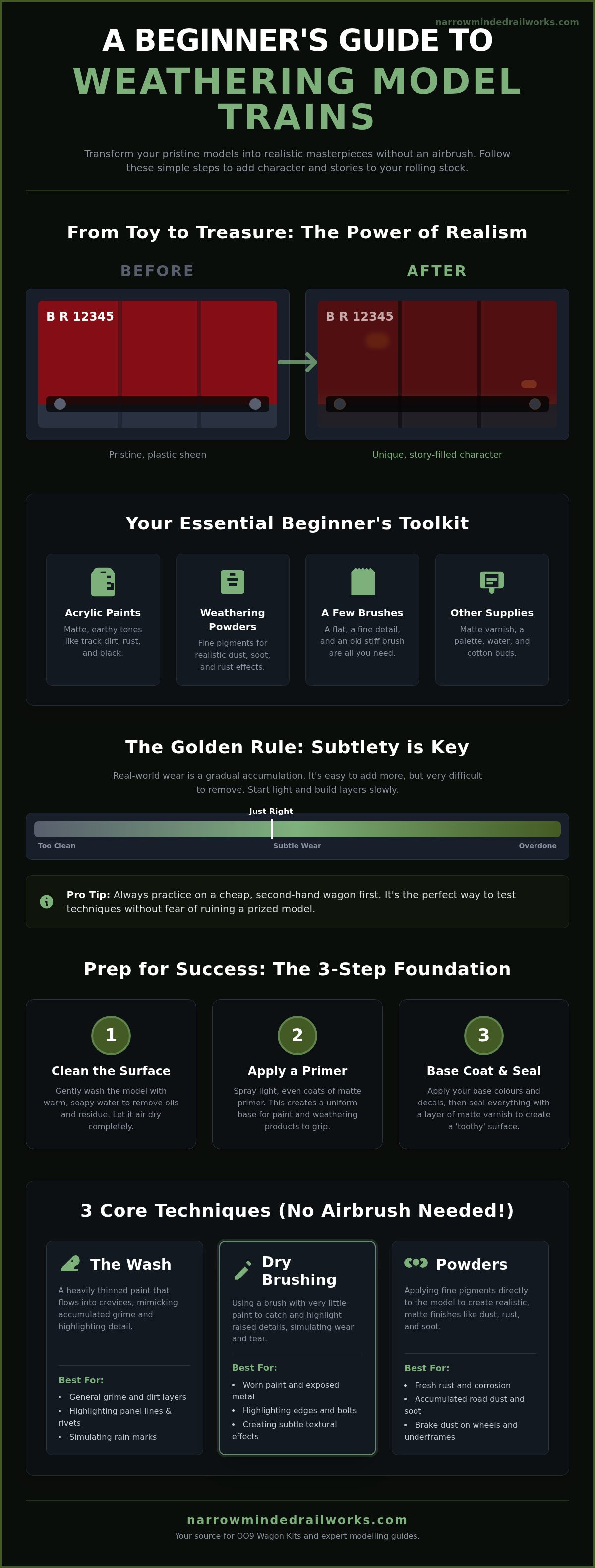
The difference between a weathered and unweathered wagon is truly night and day. A factory-fresh model looks identical to every other one produced, but a weathered wagon is unique. It tells a story of its 'life'-has it been hauling coal from a Welsh colliery, carrying china clay in Cornwall, or simply sitting neglected in a siding? This process gives your rolling stock character and individuality.
Your Essential Beginner's Weathering Toolkit
You don’t need an expensive airbrush setup to get started. A fantastic finish can be achieved with just a few basic supplies, most of which cost only a few pounds each.
- Acrylic Paints: Start with a small selection of earthy, matte tones. Think track dirt, sleeper grime, rust, and black. Brands like Humbrol or Vallejo offer excellent options.
- Weathering Powders: These are fine pigments perfect for creating realistic dust, rust, and soot effects. Key starter colours include rust orange, dark earth, and black.
- Brushes: You'll need three main types: a small flat brush for washes, a fine-pointed detail brush for specific rust spots, and an old, stiff-bristled brush for 'dry brushing' techniques.
- Other Supplies: A can of matte varnish is essential for sealing your work. You’ll also need a small palette (an old plastic lid works well), cotton buds for blending and removing excess, and a pot of water for thinning paints.
Understanding the 'Less is More' Philosophy
The single most important rule in weathering model trains is that subtlety is key. It's very easy to overdo it, but much harder to remove. Real-life wear is often a gradual accumulation of grime, so start with very thin, light layers and build them up slowly. Before touching your prized models, grab a cheap, second-hand wagon from a model fair or online for under a tenner. Use this as your testbed to practice techniques without fear. Most importantly, look at photographs of real-life rolling stock for inspiration-it’s the best way to understand how wagons weather in the real world.
Preparation is Key: Setting Your Model Up for Success
Before you even think about picking up a weathering powder or wash, the most crucial work has already begun. Just like a painter needs a properly prepared canvas, your weathering effects require a perfect surface to adhere to. Rushing this stage is the number one reason beginners get frustrating results. A little time spent here will pay huge dividends, ensuring your grime, rust, and dust effects look realistic and stay put.
Cleaning and Priming Your Model
Every model, whether it's a ready-to-run wagon or a 3D printed kit, will have residue on its surface. This can be anything from mould release agents to the natural oils from your fingers. To ensure your paint and weathering products stick, give your model a gentle bath in warm water with a drop of washing-up liquid. Use a soft brush to get into the crevices, then rinse thoroughly and let it air dry completely.
Next, apply a primer. This is non-negotiable for resin or metal kits but is highly recommended for all models. A good quality grey or black aerosol primer provides a uniform, neutral base and gives the subsequent paint layers a surface to grip. For a flawless finish without losing fine detail:
- Shake the can for at least two minutes.
- Spray in short, light bursts from 20-30cm away.
- Keep the can moving to avoid thick build-up.
- Let it dry completely before proceeding.
Applying the Base Colours and Decals
With your model primed, you can now apply its base livery. Whether you're using an airbrush or spray cans, the most important goal is to finish with a non-glossy surface. Weathering products simply slide off a high-gloss finish. A matte or satin varnish is essential as your final coat before the real fun of weathering model trains begins. This creates a slightly rough surface, or 'tooth', that powders and washes can cling to.
Decals, such as running numbers and logos, should be applied after the base colours but before any weathering. This ensures they look like part of the original paintwork. For a truly 'painted on' look, use a decal setting solution like Micro Sol to help them conform to rivets and panel lines. Once they are dry, sealing them with another thin layer of matte varnish protects them and unifies the surface. Mastering these foundational techniques is central to what The Model Railway Club aptly calls The Art of Weathering. Our OO9 Wagon Kits are the perfect canvas for your first project, providing a detailed base ready for your personal touch.
Core Weathering Techniques for Beginners (No Airbrush Needed!)
Forget expensive airbrushes for now. The art of weathering model trains is built upon three fundamental, brush-based methods: the wash, dry brushing, and using powders. These are the pillars of creating realistic grime, wear, and texture. Many guides on beginner weathering techniques start with these core skills for a reason: they are simple, effective, and require minimal investment. By mastering them, you will have the ability to produce a huge variety of convincing effects on any piece of rolling stock.
Technique 1: The Acrylic Wash
A wash is simply heavily thinned paint that uses capillary action to flow into recessed details like panel lines, rivets, and wood grain, creating depth and shadow. To make a basic grime wash, mix one part black or dark brown acrylic paint with about 8-10 parts water. You can add a tiny drop of washing-up liquid to break the surface tension.
- Apply: Using a soft brush, generously apply the wash over a section of your wagon's side panel.
- Settle: Let it sit for a minute, allowing the pigment to settle into the crevices.
- Remove Excess: With a clean, slightly damp brush or a cotton bud, gently wipe the wash off the raised, flat surfaces, leaving the pigment only in the details.
Technique 2: Dry Brushing
Dry brushing is the opposite of a wash; it's used to highlight raised details and simulate wear. This technique is perfect for creating the look of faded paint, worn metal edges, or scuffs. Using a light grey or earthy tone, you can make details pop. The key is to use an almost completely dry brush.
- Load: Dip the tip of a flat brush into a small amount of acrylic paint.
- Wipe: Vigorously wipe the brush on a paper towel until almost no paint seems to be coming off.
- Brush: Gently and quickly flick the brush back and forth across the raised details of the wagon, such as plank edges, hinges, and rivets. The tiny amount of remaining pigment will catch on these high points.
Technique 3: Using Weathering Powders
Weathering powders are finely ground pigments that create incredibly realistic dust, rust, soot, and mud effects. They can be applied in several ways for different results. For a general layer of track dust on the lower half of a wagon, simply dip a soft, wide brush into a light earth-coloured powder and gently dab and streak it onto the model. For more concentrated effects like rust streaks, mix a rust-coloured powder with a drop of water or matt varnish to create a paste, then paint it on with a fine-tipped brush.
Creating Specific Effects: Rust, Dust, and Grime
With a base layer of grime established, you can now build up specific, believable effects. This is where the art of weathering model trains truly comes alive. The secret is to observe reality-look at photographs of real industrial wagons and locomotives. Where does rust form? How does dust settle? By layering different effects, you can transform a plastic model into a convincing miniature replica that tells a story of hard work on the rails.
Simulating Realistic Rust
Rust is more than just one colour; it's a texture and a process. For widespread surface corrosion on steel panels or frames, gently stipple a mix of orange and brown weathering powders with a stiff brush. To simulate rust that has collected in crevices, apply a dark brown enamel or acrylic wash directly into panel lines and around bolts, letting capillary action do the work. For distinctive rust streaks, create a thin paste with your powders and a little thinner, then use a fine-point brush to paint thin vertical lines running down from rivets and seams.
Achieving the Perfect Dusty Finish
Dust and dirt kicked up from the track bed naturally accumulate on the lower parts of a wagon. Use light earth-toned powders-tans, greys, and light browns-and brush them onto the underframe, bogies, and the lower third of the body. You can create realistic rain marks by dragging a clean, slightly damp brush downwards through the fresh powder, creating subtle streaks. A very light, uniform wash over the entire model can also be an effective first step to tone down the 'brand new' look.
Adding Coal, Soot, and Cargo Spills
Industrial settings leave unique marks. Replicate soot stains on locomotive roofs or the ends of wagons closest to the engine using black and dark grey powders. For open mineral wagons, simulate cargo spillage by applying fine coal dust or dark powders around the top edges and ledges, fixing them with a matte varnish. Finally, add a touch of realism to the running gear by dabbing a tiny amount of gloss black paint around axle boxes to represent fresh grease and oil stains.
By combining these techniques, you build a rich, layered history on your model. Don't be afraid to experiment with different products and applications. For more detailed guides and inspiration, browse the project galleries at Narrow Minded Railworks.
Putting It All Together: Weathering a Wagon Step-by-Step
You've learned the individual techniques, from washes to powders. Now, let's combine them into a logical workflow to take a simple open wagon from a plastic toy to a realistic, hard-working piece of rolling stock. This layered approach is the key to achieving convincing results when weathering model trains.
A Layered Weathering Workflow
Follow these steps in order to build up layers of grime, wear, and tear. We'll use a standard grey open wagon as our example.
- Step 1: Apply a General Wash. Mix a dark wash using thinned black or dark brown acrylic paint. Apply it generously over the entire model, allowing the wash to pool in recesses, panel lines, and around rivets. This instantly adds depth and picks out the fine details.
- Step 2: Dry Brush the Details. Once the wash is completely dry, take a light grey paint (a lighter version of the wagon's base colour). Put a tiny amount on a flat brush, wipe most of it off on a paper towel, and then gently brush it over the raised details like planks, hinges, and framework. This simulates sun-bleaching and wear on the high points.
- Step 3: Add Rust Patches and Streaks. Using a small, soft brush, apply rust-coloured weathering powders to areas prone to corrosion, such as axle boxes, couplings, and any metal strapping. Create vertical streaks running down from these details to mimic the effect of rain washing rust down the wagon sides.
- Step 4: Build Up Dust and Grime. Finally, use earthy-toned powders (like dark earth or light dust) to represent accumulated dirt. Focus your application on the underframe, wheels, and the lower third of the wagon body, where grime from the trackbed would naturally collect.
The Final Seal: Protecting Your Masterpiece
After all your hard work, the final and most crucial step is to protect it. Applying a matte varnish is essential. It seals the delicate weathering powders, preventing them from being smudged or rubbed off during handling. Furthermore, it creates a uniform, flat finish that eliminates any unrealistic plastic sheen, tying all the weathering effects together.
When using a spray can varnish:
- Shake the can for at least two minutes before use.
- Spray in light, sweeping passes from about 20-30cm away.
- Apply several thin coats rather than one heavy one to avoid runs or a cloudy "frosting" effect.
- Allow the model to dry completely in a dust-free area.
With this workflow, your journey into weathering model trains is well underway. Ready to try these techniques on a new project? Check out our fantastic range of model railway kits and find the perfect canvas.
Bringing Your Rolling Stock to Life
You've now seen that transforming a factory-fresh model into a realistic, hard-working piece of rolling stock is well within your reach. The key takeaways are simple: proper preparation is the foundation for a great finish, and you don't need complex tools to achieve incredible results. With basic washes and powders, you can create authentic stories of wear, tear, and service on your layout.
The true art of weathering model trains is about adding character, and the best way to develop your skills is to get hands-on. Ready to start your first project? Find the perfect wagon kit to practice your new weathering skills. Our high-resolution 3D printed kits are packed with the sharp details that make weathering a joy. Designed by modelers, for modelers, and with worldwide shipping available, your next masterpiece is just a click away.
Don't be afraid to experiment. Every model is a new canvas. Grab your brushes, embrace the imperfections, and start building a layout that truly feels alive.
Frequently Asked Questions
How much weathering is too much?
This is subjective, but the golden rule is "less is more," especially when starting out. The goal is realism, not to completely obscure the model's original livery and details. A great tip is to work from reference photos of real UK wagons. A wagon used for coal in the Pennines will look very different from a container flat on the West Coast Main Line. You can always add more weathering, but it's much harder to take it away.
Can I remove weathering effects if I make a mistake?
Yes, in most cases. For water-based acrylics and weathering powders, a damp cotton bud can often lift the effect if you act quickly. For more stubborn acrylics, a small amount of isopropyl alcohol can remove them without usually harming the factory paint, but always test on an inconspicuous area first. Enamel or oil-based weathering is more permanent and requires specific thinners, so it's best to build these up in very light layers to avoid mistakes.
Do I really need an airbrush to get good results?
Absolutely not. While an airbrush is a fantastic tool for creating subtle gradients and fine mists, it is not essential for achieving brilliant results. Many professional modellers achieve incredible realism using only brushes, weathering powders, and washes. These techniques offer excellent control and are far more affordable for a beginner, with a good set of powders and washes often costing less than £30. They are the foundation of great weathering model trains.
How do you weather wheels and couplings on a model train?
For wheels, focus on creating a grimy, dusty look. Apply a dark wash like 'track dirt' or a thin 'dark rust' colour to the wheel faces. After it has dried slightly, use a cotton bud dipped in thinner to carefully wipe the wheel tread clean, realistically showing where it makes contact with the rail. For couplings, a light dry-brush with a rust or grimy black colour is very effective. Avoid applying thick paint that could clog the mechanism.
What's the best way to weather 3D printed models specifically?
The crucial first step for 3D printed models is applying a quality primer. Whether the model is resin or filament printed, a matte primer (grey is a good all-rounder) creates a uniform surface that weathering products can grip onto. Without it, washes can become patchy and powders won't adhere properly. Once primed, you can treat it just like a standard plastic kit, building up layers of washes, dry brushing, and powders to bring out the printed details.
How do I choose the right colours for weathering?
Your best guide is the real world. Look at photos of the type of rolling stock you are modelling and observe the colours of the grime and rust. For general UK railway dirt, start with earthy browns, dark greys, and sooty blacks. Rust isn't just one colour; use a mix of dark browns and brighter oranges. Consider the wagon's cargo - a china clay wagon will have light grey or white streaks, whereas a steel carrier will show more prominent rust patches.