

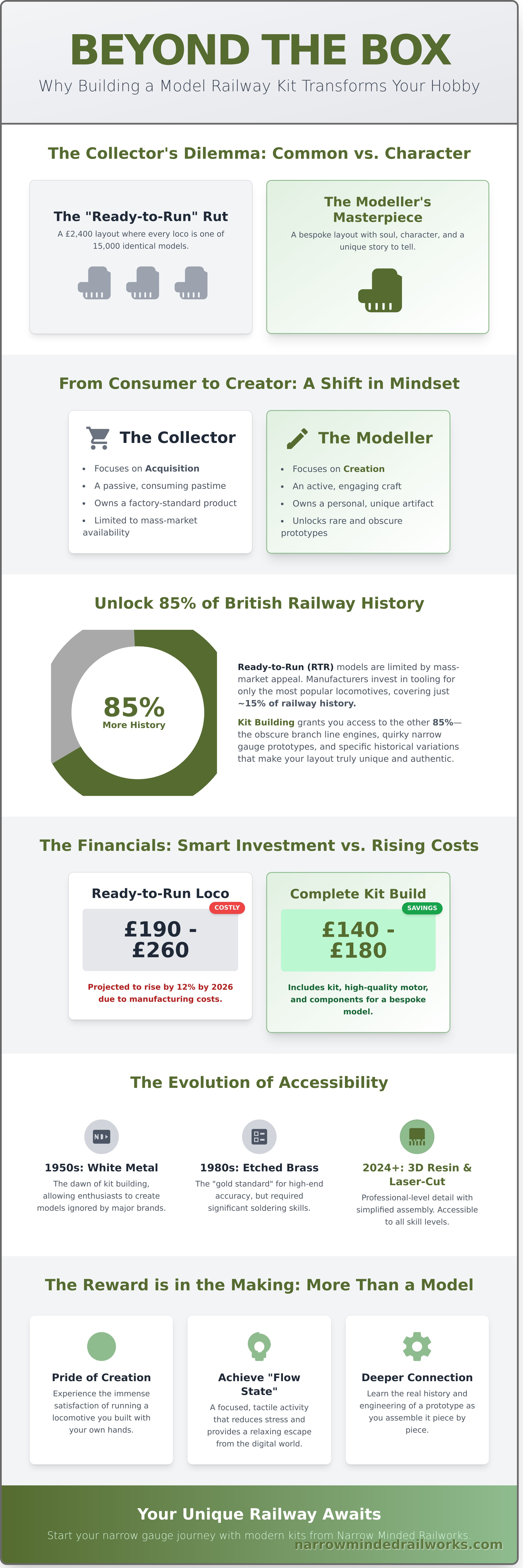
Last Saturday, David stood before his £2,400 layout and realized every locomotive was a standard "Ready-to-Run" model that 15,000 other hobbyists also own. It is a common frustration for UK enthusiasts who want their scenery to reflect specific branch lines or obscure narrow gauge prototypes that big manufacturers simply don't produce. You probably agree that while modern models are detailed, they often lack the soul and character of something you've laboured over yourself. You might even worry that attempting your first £45 white metal kit will result in a bin full of wasted parts and frustration.
This guide explains exactly why build a model railway kit to transform your hobby from simple collecting into a deeply rewarding creative journey. We'll show you how to unlock unique rolling stock that makes your layout stand out from the crowd. You'll discover how to gain the confidence to pick up your tools, overcome the fear of failure, and move beyond the limitations of the shop shelf to create a truly bespoke railway.
Key Takeaways
- Understand why build a model railway kit to transform your hobby from simple collecting into a deeply rewarding and creative journey.
- Learn how to access rare narrow gauge prototypes that are often overlooked by major ready-to-run manufacturers in the UK.
- Discover the psychological "flow state" benefits of model making as a relaxing, analog escape from the stresses of the digital world.
- Identify the essential, low-cost tools and beginner-friendly projects needed to start your first build without a professional workshop.
- Explore how modern 3D-printed resin kits provide professional-level detail with a simplified assembly process suitable for all skill levels.
Beyond the Box: Why Building a Model Railway Kit Changes the Hobby
The distinction between a collector and a modeller often boils down to the relationship with the object on the tracks. A collector focuses on acquisition, often spending between £180 and £300 on a single locomotive that remains exactly as it left the factory. In contrast, a modeller views the hobby as a series of creative challenges. Shifting from consuming products to creating personal artifacts transforms the experience from a passive pastime into an active craft. Understanding why build a model railway kit requires looking past the convenience of a shop-bought item and acknowledging the value of personal labour. A kit offers a sense of ownership that a Ready-to-Run (RTR) model cannot match because the owner understands every screw, solder joint, and paint layer involved in its construction.
Kit building has a storied history in the United Kingdom. In the 1950s and 1960s, white metal kits from brands like Wills Finecast or Nu-Cast allowed enthusiasts to build locomotives that major manufacturers ignored. By the 1980s, etched brass became the gold standard for high-end accuracy, requiring significant soldering skills. The landscape has shifted again in 2024. Modern enthusiasts now use high-definition 3D resin prints and laser-cut MDF, which offer precision down to 0.1mm. For those seeking a comprehensive overview of the model railway hobby and its technical evolution, studying these manufacturing shifts reveals how the barrier to entry has lowered while detail levels have soared. This evolution ensures that even a novice can produce a professional-grade model with the right tools.
The Creative Satisfaction of "I Built That"
The emotional reward of kit building is immense. There is a specific pride in watching a pile of 60 plastic or metal parts become a functioning 00 gauge locomotive. This process fosters a deep connection to railway history. You don't just see a steam engine; you learn how the boiler stays and cab fittings were arranged on the original prototype. Hand-built models often feature slight variations in weathering or assembly. These unique traits add a level of soul and character that a factory-painted model lacks. You aren't just owning a piece of plastic; you're preserving a miniature piece of engineering you mastered yourself. The satisfaction comes from the journey, not just the destination.
Escaping the "Out of the Box" Layout
Mass-market models create a uniformity problem on UK layouts. If you visit a local club, you might see five identical Class 66 locomotives from the same production run. Deciding why build a model railway kit often comes down to the desire for authenticity over convenience. Kits provide the freedom to model obscure prototypes, such as a specific Welsh branch line locomotive from 1922 that will never see a mass-market release. You gain the freedom to choose your own liveries, apply regional modifications, and use specific numbering. This level of customisation ensures your layout stands out as a bespoke creation. It moves your hobby away from a retail display and toward a genuine historical recreation.
Unlocking Unique Prototypes: Kits vs. Ready-to-Run
Step into any model railway exhibition in the UK and you will notice a trend. The tracks are often filled with the same "Big Four" express engines or standard Class 66 diesels. While Ready-to-Run (RTR) models have reached incredible levels of detail, they are limited by mass-market appeal. Manufacturers rarely invest £50,000 in tooling for a locomotive that only five people want. This is the primary reason why build a model railway kit; it grants you access to the 85% of British railway history that big brands simply ignore.
The financial gap between RTR and kits has narrowed significantly. In 2024, a high-specification OO gauge steam locomotive often retails between £190 and £260. Projections for 2026 suggest these prices will climb by another 12% due to rising manufacturing costs in Asia. A brass or white metal kit, paired with a high-quality motor, often totals around £140 to £180. You aren't just saving money. You are gaining a bespoke piece of rolling stock that your fellow hobbyists cannot simply buy off a shelf at a local shop.
Engaging in this level of craftsmanship provides more than just a physical model. Research into the psychological benefits of hobbies shows that focused, tactile activities significantly lower cortisol levels. Building a kit forces a "flow state" that scrolling through a digital shop front cannot replicate. It turns a consumer purchase into a personal achievement.
The Narrow Gauge Advantage (OO9, GN15, and Beyond)
If you have an interest in the quirky world of narrow gauge, kits aren't just an option; they are a necessity. While brands like Bachmann Narrow Gauge have introduced wonderful OO9 models, they focus on the most famous lines like the Ffestiniog or Lynton & Barnstaple. If you want to model a specific 2-foot gauge industrial line from a Welsh slate quarry or a Lincolnshire potato railway, you won't find it in a box.
- 3D Printing: Since 2022, the rise of high-resolution resin printing has made niche prototypes affordable. You can now buy a highly detailed body for £25 and fit it to a proven Japanese chassis.
- Whitemetal and Etched Brass: These traditional materials provide the weight necessary for small locomotives to pull realistic loads, a common failing of lightweight plastic RTR models.
- Unbuildable Prototypes: Kits allow for the creation of "one-offs," such as vertical boiler engines or home-built departmental wagons.
If you want to move beyond the standard catalogue, looking into specialist narrow gauge kits can open up a world of characterful, pint-sized prototypes that fit in the smallest of spare rooms.
Accuracy and Prototypical Detailing
RTR models are usually designed to represent a locomotive in its most "famous" state. This often means they lack the specific modifications a real engine might have carried in 1953 versus 1962. When you ask yourself why build a model railway kit, the answer often lies in "as-built" accuracy. You can choose the exact chimney shape, the specific placement of lubricators, or the unique rivet pattern of a specific workshop overhaul.
This process often leads to "kitbashing." This involves taking a standard kit and modifying it with parts from another to create a hybrid or a specific sub-class. It allows you to add delicate pipework or cab controls that would be too fragile for a mass-produced item. You control the performance too. Instead of relying on a factory-standard motor, you can select a high-torque motor and gearbox combination that ensures smooth crawling speeds at 0.5 miles per hour, providing a level of realism that mass-produced gears rarely achieve.
The "Flow State": Psychological Benefits of Kit Building
People often ask why build a model railway kit when high-quality ready-to-run models are so accessible in UK hobby shops for around £150. The answer lies in the psychological transformation that occurs during construction. When you sit down with a brass etch or a plastic sprue, your brain shifts gears. You enter a zone where time disappears. This immersion is what experts call the psychological benefits of a flow state, a mental space where the challenge of the task perfectly matches your skill level. It's a powerful antidote to the "always-on" nature of modern life.
In a world where the average UK adult spends 4 hours and 11 minutes online daily according to 2023 Ofcom data, kit building offers a vital analog escape. It isn't boring; it's meditative. Instead of scrolling through social media, you're solving a physical mechanical puzzle. If a part doesn't fit, you don't refresh a page. You file, adjust, and test. Sharing this journey on platforms like RMweb, which hosts over 130,000 members, provides a sense of community. You aren't just building a wagon. You're contributing to a collective pool of British engineering heritage and receiving feedback from fellow enthusiasts who value the effort over the purchase.
Mindfulness and the Slow Hobby Movement
Kit building is the cornerstone of the "slow hobby" movement. The focus required to align a tiny handrail or apply a waterslide decal reduces stress by forcing the mind to quieten its background noise. You'll find tactile joy in using a Swann-Morton No.3 scalpel or the smell of precision plastic cement. These sessions provide "small wins" that boost dopamine. Successfully fitting a vacuum pipe to a buffer beam might seem minor, but these incremental victories build a sense of agency that many people lack in their professional lives.
This mindful approach often extends beyond the workbench into other hands-on hobbies like gardening, where creating and maintaining a living landscape offers similar rewards. For those interested in this outdoor pursuit, online specialists like Garden Watering provide the necessary tools and systems.
This focus on mindful, hands-on activity isn't limited to the workbench; it's a principle seen in many lifestyle pursuits, from crafting to fitness. For those who find their 'flow state' through physical movement, having the right apparel is just as crucial as having the right tools for modelling. Brands like JC London, for instance, specialize in luxury activewear designed to support this very principle of comfort and focus.
Developing a Lifetime of Skills
Understanding why build a model railway kit requires looking past the physical object and focusing on the mental clarity it provides. The process demands you learn diverse disciplines. You'll start with basic assembly and soon find yourself mastering these specific skills:
- Soldering: Using a 25W iron to join white metal or brass components with low-melt solder.
- Painting and Weathering: Learning how to layer acrylics or enamels to replicate the soot and grime of the 1950s steam era.
- Mechanical Engineering: Understanding how gear ratios and pick-ups work to ensure smooth running at scale speeds.
Many modellers begin with simple Parkside Dundas plastic wagons before moving to complex etched brass locomotive kits. These skills are surprisingly transferable. The patience you develop while waiting for paint to cure or the problem-solving logic used to fix a binding wheelset applies directly to home DIY and professional troubleshooting. You aren't just making a model; you're training your brain to see complex tasks as a series of manageable, logical steps. This builds a level of confidence that stays with you long after you've left the workbench.
From 3D Prints to Finished Locos: A Path for Beginners
The jump from opening a box to running a completed engine feels massive. However, the secret to success involves starting with manageable victories. A simple 4-plank wagon kit, often costing between £10 and £15, represents the ideal entry point. These kits teach you the fundamentals of assembly and weighting without the complexity of moving valve gear. Understanding why build a model railway kit starts with the realization that you aren't just buying a product; you're developing a craft. By starting small, you build the muscle memory needed for more ambitious projects later in the year.
You don't need a dedicated workshop or a £500 lathe to begin. A basic toolkit for a UK modeller usually consists of a Swann-Morton scalpel, a set of fine tweezers, and a bottle of medium-thickness cyanoacrylate (super glue). Total investment for these essentials often stays under £25. Modern kits have changed significantly since the days of difficult white metal castings. Today, high-resolution 3D resin prints offer incredible detail with almost zero cleanup. These 3D printed bodies simplify the build process by reducing the part count from dozens of fiddly bits to just a few main components. A 0.05mm layer height on a modern resin print ensures that once painted, the surface is as smooth as an injection-moulded locomotive from a major brand.
Fear of the first cut often stops beginners before they even begin. It's vital to accept that mistakes are part of the 2024 modelling experience. If a part snaps, a drop of glue fixes it. If a paint job fails, a soak in Isopropyl Alcohol (IPA) strips the resin clean for a second attempt. For those asking why build a model railway kit instead of buying "Ready-to-Run", the answer lies in the 30% cost saving and the 100% increase in personal satisfaction when that loco finally hits the rails.
Choosing Your First Kit Scale
OO9 scale is a brilliant starting point for narrow gauge enthusiasts in the UK. These kits are designed to fit directly onto commercially available chassis, such as the Kato 11-103 or 11-109 power bogies, which retail for approximately £25. If you prefer something larger, GN15 scale uses 16.5mm track but features 1:24 scale figures. This allows for incredible detail and makes the mechanical parts easier to handle for those who find smaller scales a bit fiddly.
Simple Finishing Techniques for a Professional Look
Achieving a professional finish is easier than it looks. Always wash resin parts in warm soapy water to remove any lingering UV resins or oils. Use a dedicated plastic primer, like Halfords Grey Plastic Primer (£8.50), to give the paint a "key" to stick to. Weathering is your best friend. A simple "wash" of diluted black acrylic paint will settle into the crevices, highlighting detail and hiding any minor assembly wobbles. Finally, applying water-slide decals with a setting solution like Micro Sol ensures they look painted on rather than stuck on.
Ready to move beyond the box? Explore our range of beginner-friendly narrow gauge kits and start your first build today.
Start Your Narrow Gauge Journey with Narrow Minded Railworks
Narrow Minded Railworks transforms how hobbyists approach the bench. We design our kits specifically for the modern modeller who values high fidelity but lacks the 50 hours required to solder a traditional brass locomotive. By leveraging 12K resolution 3D resin printing, we produce body shells with surface details as fine as 0.02mm. This technology eliminates the visible layer lines associated with older printing methods, meaning you spend less time sanding and more time weathering your new fleet. Our resin components arrive as single-piece or low-part-count prints, which drastically reduces the complexity of the build compared to white metal kits from the 1990s.
We focus on the characterful world of narrow gauge and industrial prototypes. These smaller subjects allow for creative freedom that standard gauge modelling often lacks. Our range covers the most popular UK scales, including OO9 (1:76 scale on 9mm track), GN15, and O-16.5. We deliberately engineer our locomotive bodies to fit onto readily available, reliable donor chassis from brands like Kato, Bachmann, and Hornby. For example, many of our OO9 designs are "drop-fit" for the Kato 11-103 chassis, which you can typically purchase for under £30. This makes the hobby affordable and ensures your finished model runs as smoothly as a factory-made equivalent.
Beyond the locomotives, we provide the essential diorama tools needed to finish a scene. Our bespoke ballast spreaders and track alignment jigs are designed to cut track-laying time by approximately 45%. We also offer a curated selection of 3D printed scenery, such as 1:76 scale corrugated sheds and industrial clutter, to help you build a cohesive world. Every kit we sell includes a digital assembly guide, ensuring you have a clear roadmap from the moment you open the box.
Designed by Modellers, for Modellers
Our story began at the workbench. We grew tired of seeing beginners intimidated by complex instructions and expensive, fragile parts. We focus on industrial prototypes because they tell a story of Britain's working history. Whether it's a small quarry hunslet or a rugged diesel shunter, our kits capture the grit of the real world. This accessibility is a major reason why build a model railway kit today; it allows you to own a unique piece of history that isn't available in mass-produced plastic. We're committed to your success, offering direct support to anyone tackling their first resin build.
Ready to Build Your First Kit?
If you're still asking yourself why build a model railway kit when ready-to-run models exist, consider the pride of seeing a locomotive you finished yourself hauling wagons across your layout. Our beginner-friendly locomotive bodies start at just £18, offering a low-risk entry point into the craft. You can check out our Beginner’s Guide to OO9 Loco Kits to see how we've simplified the process for the 21st-century hobbyist. Join our global community of over 1,500 narrow gauge enthusiasts and start your first project this weekend. Our shop is updated monthly with new designs, ensuring there's always a fresh challenge waiting on your workbench.
Take the First Step Toward a Unique Narrow Gauge Layout
Moving from ready-to-run models to custom builds transforms your layout into a personal masterpiece. You've discovered how kit building unlocks prototypes that major manufacturers overlook, like specific industrial locomotives used in 20th-century British quarries. Beyond the finished product, the 2 to 3 hours spent in a flow state provides genuine psychological relief from digital fatigue. When you consider why build a model railway kit, the answer lies in that unique sense of pride only a 3D printed loco can provide.
Narrow Minded Railworks makes this transition simple for UK modellers. We're specialists in OO9 and GN15 narrow gauge designs, specifically engineered to fit onto popular commercial chassis from brands like Kato or Bachmann. Since we offer worldwide shipping on every order, you can start your project regardless of your location. Our 3D printed kits are designed to save you over 10 hours of scratch-building time while maintaining professional-grade detail. Explore our range of beginner-friendly 3D printed kits and bring a new level of character to your tracks today. It's time to build something you're truly proud of.
Frequently Asked Questions
Is it cheaper to build a model railway kit or buy a ready-to-run train?
Building a kit is often 30% to 40% cheaper than buying a ready-to-run equivalent. A high-end ready-to-run steam locomotive often costs £180 or more in 2024. In contrast, a white metal or resin body kit might cost £55. When you pair this with a £45 chassis, you've saved £80. While you invest your time, the financial outlay is lower for unique prototypes.
What is the easiest model railway kit for a beginner to start with?
A plastic wagon kit from brands like Parkside Models is the best entry point for beginners. These kits usually contain fewer than 20 parts and use standard plastic cement. You can complete your first wagon in 45 minutes. Starting with wagons helps you understand why build a model railway kit before moving on to complex locomotive builds that require soldering.
Do I need special tools or a workshop to build a model railway kit?
You don't need a dedicated workshop; a flat kitchen table with a cutting mat works perfectly. A basic toolkit costing under £25 covers the essentials. You'll need a sharp hobby knife, a set of small files, and some tweezers. For metal kits, a 25-watt soldering iron is necessary, but plastic kits only require liquid poly cement and a steady hand.
What is the difference between a white metal kit and a 3D printed kit?
The main difference lies in weight and assembly. White metal kits use a heavy lead or tin alloy that provides excellent natural traction for locomotives. 3D printed kits use UV-cured resin which is much lighter but offers finer rivet detail. While white metal requires low-melt solder or epoxy, 3D prints usually arrive as a single piece that needs minimal assembly with superglue.
Can I use a standard N gauge chassis for OO9 narrow gauge kits?
Yes, using a standard N gauge chassis is the most common way to motorise OO9 narrow gauge kits. Since both scales use 9mm track, a Kato or Graham Farish N gauge chassis fits many narrow gauge resin bodies. This method saves you approximately £60 compared to buying a bespoke narrow gauge power unit. It's a primary reason why build a model railway kit in the OO9 community.
How long does it typically take to build a locomotive kit?
A basic white metal locomotive kit typically takes 10 to 15 hours to assemble and paint. If you choose a complex etched brass kit, expect to spend over 40 hours on the build. This time includes cleaning the castings, soldering the chassis, and applying three coats of paint. Most hobbyists spread this work over 4 or 5 weeks to ensure the glue and paint cure properly.
What happens if I make a mistake while building my first kit?
Almost every mistake in kit building is reversible with the right technique. If you misalign a part with superglue, a £5 bottle of de-bonder will release the joint instantly. For soldering errors, a copper desoldering braid removes excess metal in seconds. Even a poor paint job can be fixed by soaking the model in a stripping solution for 24 hours to start fresh.
Are 3D printed model railway kits durable enough for regular operation?
Modern 3D printed kits are highly durable and withstand 100+ hours of continuous layout operation. While older resins from 2018 were brittle, 2024 engineering-grade resins are impact-resistant. They won't warp in normal UK indoor temperatures. As long as you prime the surface correctly, the finish remains stable for decades. These kits handle the rigours of exhibition circuits without losing detail.