

Tired of the familiar sight of mainline express trains? Do you dream of building a characterful railway layout but find yourself short on space? If the world of standard gauge modelling feels a little too... standard, then you've come to the right place. It’s time to explore a corner of the hobby brimming with personality and quirky engineering. This is where we answer the fundamental question: what is narrow gauge modelling? It’s a captivating niche that trades sprawling mainlines for the winding tracks of industrial, rural, and mountain railways, where unique locomotives and rolling stock are the stars of the show.
In this beginner's guide, we'll demystify the often-confusing terminology of scale versus gauge, explore the unique appeal of these smaller prototypes, and show you exactly how to get started. You'll discover how you can pack more operational interest and scenic character into a smaller footprint, proving that you don’t need a huge budget or a dedicated room to create something truly special. Get ready to leave the beaten track and enter a world where every layout tells a unique story.
Key Takeaways
- Understand what is narrow gauge modelling by learning how it represents real-world railways that used track narrower than the standard size.
- Grasp the crucial difference between scale (the model's size) and gauge (the track's width) to see how OO scale models run on N gauge track.
- Discover why OO9 is the most popular narrow gauge scale in the UK, making it an ideal choice for beginners seeking kits and community support.
- Embrace total creative freedom by 'freelancing' a fictional railway line, where your imagination is the only limit to what you can build.
What is Narrow Gauge Modelling? Defining the Niche
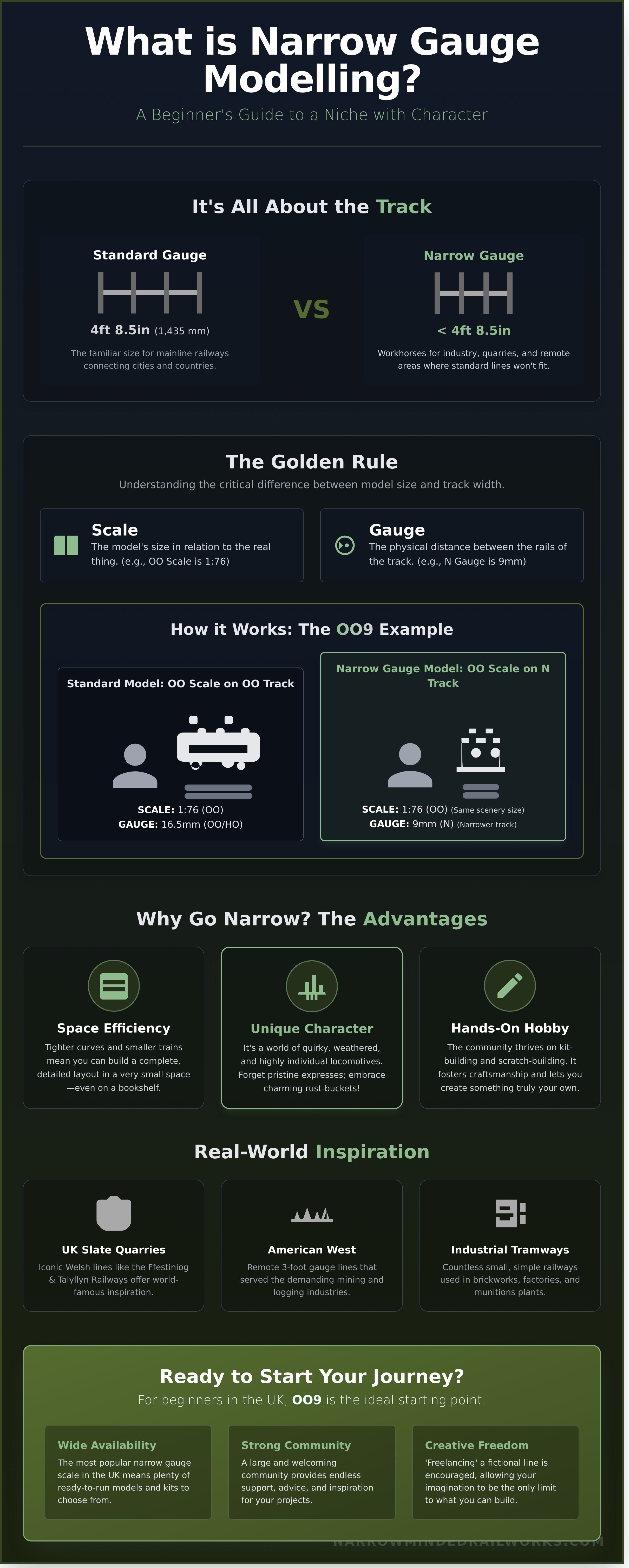
At its core, narrow gauge modelling is the craft of creating miniature replicas of railways that use a track gauge narrower than the standard 4ft 8.5in (1,435 mm). While mainline railways connect cities and span countries, narrow gauge lines were often the workhorses of industry and remote communities. They were built for specific purposes-hauling slate from Welsh quarries, timber from dense forests, or sugar cane from vast plantations-often in terrain where a standard gauge line would be impossible or too expensive to build.
To see these differences in action, this video from the National Railway Museum offers a great visual explanation of track gauges:
The real-world constraints of tight curves, steep gradients, and low budgets gave these railways a unique and often ramshackle character that modellers find irresistible. Answering what is narrow gauge modelling is also about understanding this 'atmosphere' factor. It’s about capturing the charm of a small, plucky locomotive struggling up a hill, rather than the thunder of a mainline express. Modellers achieve this by using track that is narrower than the standard for their chosen scale; for example, using N gauge track (9mm) to represent a 3-foot gauge line in OO scale (a combination known as OO9). The variety of potential combinations across different model railway scales is part of the niche's appeal.
The History of Small Lines
Inspiration for narrow gauge layouts is drawn from a rich global history. In the UK, the slate quarries of North Wales gave rise to iconic lines like the Ffestiniog and Talyllyn Railways, which are now world-famous heritage attractions. Across the Atlantic, the American West was crisscrossed by 3-foot gauge lines serving remote mining and logging communities. Closer to home, countless industrial sites, from brickworks to munitions factories, relied on small, simple 'tramways' for internal transport, providing endless inspiration for compact and characterful model railways.
Why Choose Narrow Gauge Over Standard Gauge?
For many beginners and seasoned modellers alike, the decision to go narrow gauge comes down to a few key advantages:
- Space Efficiency: Because the trains and track are smaller and can handle tighter curves, you can build a complete, scenically rich layout in a very small space-even on a bookshelf. This makes it perfect for those with limited room.
- Unique Character: Narrow gauge is less about pristine, uniform express trains and more about quirky, weathered, and highly individual locomotives and rolling stock. It’s a world of charming rust-buckets and hard-working engines with real personality.
- A Hands-On Community: While ready-to-run models are available, the narrow gauge community thrives on kit-building and scratch-building. It fosters a culture of creativity and craftsmanship, moving away from 'out-of-the-box' perfection to something uniquely yours.
This focus on craftsmanship and skill is common across many niche hobbies. If you enjoy the meticulous nature of model building and are curious about other hands-on challenges, you can check out Lockpick Pros, which caters to another community of dedicated enthusiasts.
Scale vs. Gauge: Clearing the Confusion
One of the first hurdles for newcomers is understanding the difference between scale and gauge. In essence, these terms define what is narrow gauge modelling. While standard gauge models have a fixed relationship between their size and the track they run on, narrow gauge plays by a different set of rules. This mirrors the real-world railways, many of which are beautifully preserved and can be explored at places like the Narrow Gauge Railway Museum, which used track of varying widths to navigate tight spaces or reduce construction costs.
The golden rule to remember is simple:
- Scale is the size of the model itself in relation to the real thing (e.g., 4mm to 1 foot for OO).
- Gauge is simply the physical distance between the rails of the track.
In narrow gauge modelling, we cleverly combine a larger scale model with a smaller scale's track. The most popular example in the UK is OO9. Here, you use OO scale (1:76) models-the same scale as standard British railway models-but run them on N gauge track (9mm wide). This creates the perfect illusion of a full-sized train on a narrow track. It's why a 1:76 scale person looks perfectly at home next to a standard OO locomotive on 16.5mm track, but makes an OO9 locomotive on 9mm track look like a small, industrial engine from a quarry or estate railway.
The Scale and Gauge Comparison Table
This table breaks down some popular narrow gauge combinations. Notice how larger scale models are paired with track from smaller standard gauge layouts.
| Scale Name | Model Scale | Track Gauge | Borrows Track From |
|---|---|---|---|
| OO9 | 4mm/ft (1:76.2) | 9mm | N Gauge |
| H0e / HOn30 | 3.5mm/ft (1:87.1) | 9mm | N Gauge |
| On30 | 7mm/ft (1:43.5) | 16.5mm | OO / HO Gauge |
| GN15 | G Scale (~1:24) | 16.5mm | OO / HO Gauge |
Understanding the Naming Conventions
The names can seem cryptic, but they often follow a simple logic. The letters denote the scale, and the numbers refer to either the track width or the prototype's gauge.
- OO9: This simply means OO Scale models running on 9mm gauge track.
- On30: This means O Scale, narrow gauge, modelling a prototype that used 30-inch gauge track. The fact it runs on 16.5mm (OO/HO) track is a convenient coincidence that makes it accessible.
This mix of metric (9mm) and imperial (30-inch) references reflects the origins of the scale and the real-world railways they aim to replicate, adding another layer of rich history to the hobby.
Popular Narrow Gauge Scales for Beginners
One of the most exciting aspects of narrow gauge is the sheer variety of scales available. Unlike standard gauge modelling, where choices are often limited to N, OO, or O, narrow gauge offers a creative blend of model size and track width. A key part of understanding what is narrow gauge modelling is choosing a scale that fits your space, budget, and creative vision. Here are the most popular choices for beginners in the UK.
OO9: The British Narrow Gauge Standard
By far the most popular choice in the UK, OO9 combines 4mm:1ft scale models (the same as standard OO gauge) with 9mm wide track (the same as N gauge). This clever combination perfectly represents two-foot gauge railways, like the famous Ffestiniog or Talyllyn Railways in Wales. Its popularity means there is a fantastic selection of Ready-to-Run (RTR) locomotives and rolling stock from brands like Bachmann and Peco, making it incredibly easy to get started. For many OO gauge modellers, OO9 is the perfect 'entry drug' into the narrow gauge world as it uses the same scale for scenery and buildings. Once you're comfortable, a thriving kit-building scene awaits, which we cover in our guide: Your First OO9 Loco Kit.
On30: The American Favourite
While less common in the UK, it's important to know about On30, especially if you admire American prototypes. This scale uses larger 1:48 scale models (US O scale) running on 16.5mm track (HO gauge). It’s primarily supported by Bachmann USA and is perfect for modelling the quirky, backwoods railroads of North America, offering a distinctively different character.
GN15 and O-16.5: Stepping Up in Size
For those who love detail or want to create something with real presence, a larger scale might be the answer. These scales use standard 16.5mm OO/HO track, which keeps costs down.
- O-16.5 (7mm Narrow Gauge): This uses 7mm:1ft scale models (the same as O gauge) to represent railways of around 2ft 4in gauge. The larger models are robust, highly detailed, and a joy to work on. The dedication to these unique prototypes is a global passion, with organisations like the Australian Narrow Gauge Railway Museum Society preserving the real thing and providing endless inspiration.
- GN15: This quirky scale uses large G Scale models (1:22.5) to represent tiny 15-inch gauge industrial lines. The result is a layout with massive visual impact in a minimal space. A key appeal of GN15 is the ability to use cheap, second-hand OO/HO chassis to power your large-scale creations, making it a surprisingly affordable niche in what is narrow gauge modelling.
The Creative Freedom of 'Freelancing'
One of the most appealing aspects of the hobby is the concept of 'freelancing'-the art of building a model railway that never actually existed. This approach is governed by the hobby’s most liberating principle: 'Rule 1' - It’s your railway, you make the rules. This freedom to create is a core part of the answer to what is narrow gauge modelling for countless enthusiasts, allowing you to design a world entirely of your own making, free from the constraints of historical accuracy.
Prototypical vs. Freelance Modelling
While some modellers gain immense satisfaction from meticulously recreating a real railway, like the Ffestiniog or Lynton & Barnstaple, freelancing offers a different kind of joy. This doesn't mean abandoning realism. A believable backstory-a small slate quarry in Wales or a forgotten timber line in the Forest of Dean-provides a framework for your decisions. Your fictional line feels authentic through:
- Consistent Weathering: Applying grime, rust, and wear to locos and wagons to match their fictional working environment.
- Plausible Scenery: Choosing terrain, buildings, and vegetation that suit your railway's imagined location and purpose.
- Kit-Bashing: Creatively combining parts from different kits to build unique rolling stock that perfectly fits your world.
Industrial and Quarry Themes
Narrow gauge railways were the unsung workhorses of British industry, and this is where freelancing truly shines. There's an undeniable charm in modelling 'dirty' railways, complete with rust-streaked wagons, grimy locomotives, and cluttered workshops. Your scenery can tell a story: a disused siding being reclaimed by nature, a leaky water tower, or an old petrol pump serving the line's first diesel loco. Adding small details and period-correct figures brings the entire scene to life.
This creative freedom is why the question "what is narrow gauge modelling" is so often linked to the 'micro-layout' movement. Because the real trains were small and served compact locations, you can build a detailed and operationally fascinating layout in a tiny space. A freelance concept gives you the perfect excuse to design a railway that fits your space, budget, and imagination. For kits and accessories to bring your freelance vision to life, visit Narrow Minded Railworks.
How to Start: From Kits to Track
Diving into the world of narrow gauge modelling is an incredibly rewarding journey. While the sheer variety can seem daunting, getting started is more accessible than ever before. By breaking it down into a few key steps, you can move from curious beginner to confident builder. This guide will walk you through choosing your first project, from the scale right through to the essential tools you'll need on your workbench.
Your first decision is choosing a scale. For those with limited space, OO9 (running on 9mm gauge track) is the most popular choice in the UK, offering a huge range of support. If your eyesight isn't what it used to be, a larger scale like Gn15 might be more comfortable. Crucially, the secret to reliable running is selecting a good "donor chassis". Many kits are designed as simple bodies that fit directly onto excellent, mass-produced chassis from brands like Kato or Bachmann, giving you smooth performance from day one.
The 3D Printing Revolution
Understanding what is narrow gauge modelling today means appreciating the impact of 3D printing. This technology has replaced expensive brass and tricky white metal kits with highly detailed, affordable and lightweight resin alternatives. For a beginner, a 3D printed locomotive body is the easiest entry point. Top tip: Always gently wash resin prints in isopropyl alcohol and rinse with water before priming to ensure perfect paint adhesion.
Finding Your First Kit
We recommend starting with a simple wagon kit before tackling a locomotive. This allows you to practise basic assembly, painting, and weathering skills on a low-cost project. Look for 'body-only' kits that clearly state which donor chassis they are designed to fit; this removes all the guesswork. Ready to take the plunge? Browse our range of 3D printed OO9 and GN15 kits to find your perfect first project.
Finally, you only need a few essential tools to assemble your first kit. You likely have some of these already:
- A sharp craft knife (with spare blades)
- A self-healing cutting mat
- Good quality superglue (a medium viscosity type is very versatile)
- A set of small needle files for cleaning up parts
- A can of spray primer (grey is a great all-rounder)
Your Narrow Gauge Adventure Awaits
We’ve journeyed through the fundamentals, from understanding the crucial difference between scale and gauge to embracing the creative freedom that ‘freelancing’ offers. You now have a comprehensive answer to the question, what is narrow gauge modelling: it’s a captivating and rewarding niche focused on characterful railways that allows you to build incredibly detailed layouts, often in a surprisingly small space. It’s a chance to tell unique stories in miniature, inspired by the industrial and rural lines that once crisscrossed the British countryside.
When you’re ready to bring those stories to life, the right kit makes all the difference. At Narrow Minded Railworks, we offer specialist 3D printed designs for popular scales like OO9, GN15, and O-16.5. Our locomotive and wagon kits are engineered to fit reliable, commercially available chassis, ensuring a smooth build for every modeller. With worldwide shipping for enthusiasts across the globe, your first project is closer than you think.
Explore our collection of Narrow Gauge Locomotive & Wagon Kits today and start building the miniature world you’ve been dreaming of. Happy modelling!
Frequently Asked Questions About Narrow Gauge Modelling
Is narrow gauge modelling more expensive than standard gauge?
Not necessarily. While some specialist kits can be pricey, the cost is often comparable. Ready-to-run (RTR) locomotives from brands like Bachmann in OO9 can cost a similar amount to their OO gauge counterparts, typically from £100 to £180. The real difference can be in kit building, where a body kit might cost £30-£50, but you will also need to source a separate chassis, which can add another £40-£90 to the total cost before paint and transfers.
Do I have to build my own track for narrow gauge?
No, you don't. While hand-laying track is a rewarding skill for many modellers, it is not a requirement. Peco is the leading manufacturer of ready-to-lay narrow gauge track in the UK, offering widely available and easy-to-use options for popular scales like OO9 and O-16.5. You can purchase flexible track sections and pre-made points directly from most model shops, allowing you to build a layout just as you would with standard gauge track systems.
What is the difference between OO9 and N gauge?
The key difference is the scale of the models, even though they use the same track. OO9 models are built to 4mm:1ft scale (the same as OO gauge) but run on 9mm wide track. This combination represents a 2ft to 2ft 6in prototype railway. In contrast, N gauge models are built to a smaller 2mm:1ft scale and run on that same 9mm track to represent a standard gauge (4ft 8.5in) railway. So, an OO9 loco is much larger than an N gauge one.
Can I run narrow gauge trains on my existing HO or OO layout?
You cannot run them on the same physical track, as the gauge (the distance between the rails) is different-16.5mm for OO/HO versus 9mm for OO9, for example. However, you can absolutely incorporate a separate narrow gauge line into your existing standard gauge layout. This is a very popular way to add operational interest, such as an industrial siding, a quarry line, or a mountain railway that interacts with your main line station.
What is the best scale for a small bookshelf layout?
For a small bookshelf layout in the UK, OO9 is an excellent and hugely popular choice. Because the models are built to the familiar 4mm scale but run on compact N gauge track, you can fit a complete, interesting scene into a space as small as three or four feet long. The wide availability of Peco track, kits, and a growing range of ready-to-run stock from major brands makes it one of the most accessible scales for modellers with limited space.
Do I need special DCC equipment for narrow gauge locomotives?
No, the DCC systems, controllers, and protocols are exactly the same as for standard gauge. You can use your existing DCC command station from brands like Hornby, Bachmann, or NCE. The only practical difference is the physical size of the decoders. Due to the small size of many narrow gauge locomotives, you will often need to fit a "micro" or "sub-miniature" 6-pin decoder, and finding space for a sound speaker can be a significant challenge.
Are 3D printed kits durable enough for regular use?
Yes, modern 3D printed resin kits are more than durable enough for regular handling and operation on a layout. The quality of photopolymer resins used by reputable UK kit designers has improved dramatically, resulting in strong, resilient models that capture incredible detail. While they may not withstand a fall from a great height as well as a die-cast metal model, with normal care during building and running, they will last for many years of enjoyment.
Where can I find chassis for narrow gauge kits?
Finding a suitable chassis is a core part of learning what is narrow gauge modelling. For OO9 scale, the most common solution is to use a ready-to-run chassis from an N gauge locomotive, with popular donors coming from Graham Farish and Kato. Kit designers will often recommend a specific chassis for the best fit. For larger scales like O-16.5, a chassis from an HO scale model is often used. Specialist suppliers also offer dedicated chassis kits and components.