

Ever felt intrigued by the quirky charm of a tiny model train chugging through a scenic landscape, only to be put off by confusing jargon like 'OO9' and the fear that you'd need a massive loft to build anything worthwhile? If that sounds familiar, then the captivating world of the narrow gauge railway might just be the perfect starting point for you. These smaller, more characterful railways offer a unique modelling experience that often requires less space than you think, without sacrificing any of the detail or enjoyment.
This beginner's guide is designed to cut through the confusion and get you on the right track. We'll explore exactly what makes a railway 'narrow gauge', introduce you to the most popular scales here in the UK, and show you how easy it can be to get started on your first layout, even if you've never built a kit before. By the end, you'll not only understand the terminology but will feel inspired and equipped with the essential first steps to begin creating your own charming miniature world.
Understanding the Basics: What Makes a Railway 'Narrow Gauge'?
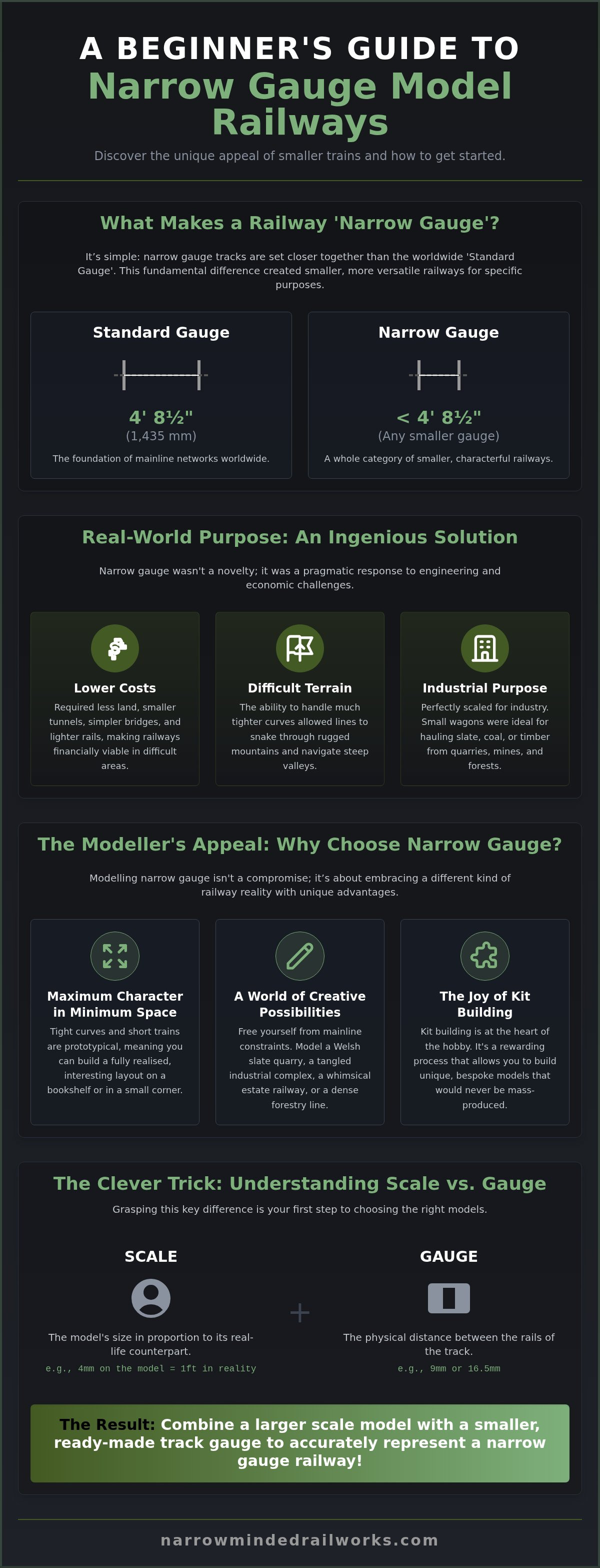
To understand what a narrow gauge railway is, we first need a benchmark: standard gauge. In the United Kingdom and across much of the world, the standard distance between the rails is 4 feet 8½ inches (1,435 mm). This measurement, championed by pioneers like George Stephenson, became the foundation for our mainline network, from the age of steam to the high-speed trains of today.
So, what makes a railway 'narrow gauge'? Simply put, it’s any railway with tracks set closer together than the 4 ft 8½ inch standard. It isn’t one single size but a whole category of smaller railways, each built to a gauge that suited its specific environment and purpose. These were often the unsung workhorses of industry and remote communities.
To see this difference in action and understand its historical context, take a look at this excellent video:
Why Did Narrow Gauge Exist?
Narrow gauge railways were not a novelty; they were a pragmatic and ingenious solution to specific engineering and economic challenges. Their existence was driven by three key factors:
- Lower Costs: Building a railway was incredibly expensive. Narrow gauge lines required less land, smaller and cheaper tunnels, simpler bridges, and lighter rails. This dramatically reduced the construction bill, making projects financially viable in areas where a standard gauge line would be unthinkable.
- Difficult Terrain: The ability to handle much tighter curves allowed these railways to snake through rugged landscapes. They could cling to mountainsides and navigate steep valleys, making them perfect for the industrial heartlands of Wales, Cornwall, and the Pennines.
- Industrial Purpose: They were perfectly scaled for industry. Small wagons were ideal for hauling slate from quarries, coal from mines, or timber from forests. The entire system, from the locomotives to the track, was designed to fit within the tight confines of a factory, quarry, or farm.
From Real World to Model Form
This rich history is precisely why narrow gauge modelling is so captivating. The real-world lines provide a deep well of inspiration, from the slate quarries of North Wales served by the famous Ffestiniog Railway to the tiny estate railways that once dotted the British countryside. Each line has a unique story and character born from its purpose.
The appeal lies in this quirky, industrial charm. It’s a departure from the express passenger trains of the mainline. Instead, it’s about modelling small, hardworking locomotives, distinctive rolling stock, and layouts that tell a story of a specific place and industry. This focus on character and atmosphere is what translates into a uniquely rewarding and creative modelling experience.
The Unique Appeal: Why Choose to Model Narrow Gauge?
While the glamour of mainline expresses has its place, many modellers are drawn to the distinct character and charm of the narrow gauge world. It’s a branch of the hobby that trades high-speed passenger services for intimate, character-rich scenes full of operational interest. Choosing to model a narrow gauge railway isn't about compromise; it’s about embracing a different kind of railway reality, one with its own unique set of advantages and rewards.
Maximum Character in Minimum Space
Perhaps the most significant advantage is the efficient use of space. In the real world, narrow gauge lines were built with tight curves and steep gradients to navigate difficult terrain. This means short, quirky trains winding through compact scenes are completely prototypical. You can build a fully realised, interesting layout on a bookshelf or in a small corner-a feat almost impossible with a standard gauge layout, which demands generous curves and long sidings to look realistic.
A World of Creative Possibilities
Narrow gauge frees you from the constraints of the national network. Instead of replicating a mainline, you can create a unique world serving a specific purpose. Imagine modelling:
- A Welsh slate quarry with gravity-fed inclines.
- A tangled industrial complex serving a factory or mine.
- A whimsical estate railway on a country manor's grounds.
- A forestry line hauling timber through dense woodland.
This creative freedom extends to the locomotives and rolling stock, which were often bespoke, modified, and full of personality. Organisations like The 7mm Narrow Gauge Association provide excellent resources for getting started in narrow gauge modelling and exploring these diverse prototypes.
The Joy of Kit Building
While the ready-to-run market is growing, kit building remains at the heart of the narrow gauge railway scene. This isn't a chore; it's a deeply rewarding part of the hobby that allows you to build truly unique models. Kits open the door to a vast range of prototypes that would never be commercially viable as mass-produced items. With the rise of 3D printing, even the most obscure and fascinating models are becoming accessible, giving you the satisfaction of creating something truly your own. Explore our range of unique loco kits to start your journey.
A First Look at Popular Narrow Gauge Scales & Gauges
Diving into the world of narrow gauge modelling can feel confusing at first, largely due to the terminology. The most crucial concept to grasp is the difference between scale and gauge.
- Scale refers to the size of the model in proportion to its real-life counterpart (e.g., 4mm on the model equals 1ft in reality).
- Gauge refers to the physical distance between the rails of the track.
The genius of narrow gauge modelling is combining a larger, more detailed scale with a smaller, ready-made track gauge. This clever trick allows modellers to accurately represent the smaller, more intimate nature of a real narrow gauge railway without needing to build everything from scratch.
OO9: The British Favourite
Arguably the most popular choice in the UK, OO9 is the perfect entry point into the hobby. It uses the familiar British OO scale for locomotives and rolling stock but runs them on N gauge track.
- The Formula: 4mm:1ft scale models on 9mm gauge track.
This combination perfectly replicates the two-foot gauge railways that served British slate quarries, industrial sites, and charming passenger lines like the Ffestiniog Railway. Thanks to its popularity, there is a vast range of ready-to-run models, kits, and accessories available from major brands, making it incredibly accessible for beginners.
On30: The American Standard
Across the Atlantic, On30 reigns supreme for modelling the rustic charm of American short lines. This scale uses the larger O scale for impressive detail, but conveniently runs on the widely available HO gauge track.
- The Formula: 1/4" scale models on 16.5mm gauge track.
It's ideal for capturing the character of logging, mining, and agricultural lines that crisscrossed the American landscape. The rich heritage, detailed in resources like the Maine Narrow Gauge Railroad History museum, provides endless inspiration for layouts. The availability of ready-to-run chassis also makes it a favourite for kit-builders.
Other Interesting Scales: GN15 and More
The creativity of the hobby doesn't stop there. For those wanting something truly unique, GN15 offers a whimsical experience by running large G scale (garden railway size) models on tiny 15mm track. It’s perfect for characterful micro layouts depicting quirky estate railways or industrial tramways. Other established scales like HOn3 (HO scale on 10.5mm track) provide even more options, showing the incredible breadth and flexibility of the hobby.
This is just a glimpse into the most popular options. Exploring the available kits and locomotives is often the best way to find what truly inspires your modelling journey.
How to Get Started in Narrow Gauge Modelling: Your First Project
Diving into the world of narrow gauge modelling is an incredibly rewarding journey, and it's more accessible than you might think. The key is to start small. Forget sprawling layouts for now; your first project should be a compact diorama or a "micro-layout" on a small baseboard, perhaps no larger than a shoebox lid. This approach allows you to learn the essential skills without feeling overwhelmed, ensuring your first experience with a narrow gauge railway is a successful one.
Planning Your Micro-Layout
Before you buy a single item, grab a pencil and paper. A simple plan is your most valuable tool. Choose a focused theme that captures the essence of narrow gauge, such as a slate quarry siding, a small engine shed scene, or a rural halt. Sketch a basic track plan-often just a single siding is enough to create interest. Consider the essential scenic elements needed to bring your vision to life, like ground cover, a small structure, and some rockwork; for inspiration on authentic fencing styles, you can even visit Romford Fencing Ltd to see classic designs.
The DIY mindset often extends beyond the layout to the hobby space itself. If you're planning a setup in a garage, for example, it's wise to budget for potential upgrades. Australian readers can find helpful cost guides for major improvements at doorsupply.com.au.
Gathering Your Essential Supplies
To build your first scene, you only need a handful of core components. This focused shopping list keeps initial costs down and allows you to concentrate on the build itself. You will need:
- A locomotive body kit and a compatible, ready-to-run (RTR) chassis. This is the simplest way to get a unique engine running quickly.
- One or two wagon kits to assemble and paint.
- A short length of flexible track. For OO9 scale, standard N gauge track is the perfect choice.
- A basic DC (analogue) train controller and power pack to bring your model to life.
Building Your First Kit
The thought of building a kit can be daunting, but modern 3D printed and resin kits are designed with the newcomer in mind. They often feature simple, slot-together assembly. With a few basic tools-a craft knife, plastic cement, small files, and tweezers-you have everything you need. The satisfaction of watching a collection of parts transform into your very own, unique locomotive is the true magic of the hobby. Ready to take the first step? Find the perfect beginner-friendly kit in our store and start your adventure.
Embark on Your Narrow Gauge Adventure
You've now discovered that narrow gauge isn't just about smaller tracks; it's a gateway to a world of character, charm, and creative modelling freedom. From the quirky prototypes to the ability to build a captivating layout in a compact space, the appeal is undeniable. Getting started is more accessible than you might think, with popular scales like OO9 offering a fantastic entry point for your first project.
Building your own narrow gauge railway is a deeply rewarding journey, allowing you to craft a miniature world that is uniquely yours. When you're ready to lay the first piece of track, we're here to help. As specialists in 3D printed OO9, GN15, and O-16.5 kits, we offer unique models you won't find anywhere else, with worldwide shipping for modellers everywhere.
Browse our full range of narrow gauge model kits and start your adventure! Your miniature masterpiece is waiting to be built.
Frequently Asked Questions
What is the difference between narrow gauge and N gauge?
N gauge is a specific modelling scale (1:148 in the UK) that represents standard gauge trains on 9mm wide track. In contrast, narrow gauge is a prototype term for any railway with tracks narrower than the standard 4ft 8½in. In modelling, we replicate this by using a track gauge that is smaller than the model's scale would normally require. For example, OO9 models use OO scale (1:76) models on N gauge track to represent a real-world narrow gauge railway.
Is narrow gauge modelling more expensive than standard OO or HO gauge?
The cost can be quite comparable, though it varies. Ready-to-run models from major brands are often priced similarly to their OO gauge equivalents. However, the hobby also features many specialist kits from smaller UK producers, which can sometimes be more expensive initially. Building your own rolling stock from plastic or 3D printed kits can be very budget-friendly, often costing under £40 for a unique wagon, offering excellent value and a rewarding experience.
Do I need special tools to build 3D printed narrow gauge kits?
For the most part, a standard model-making toolkit will suffice. This includes a sharp craft knife, fine files or sanding sticks, tweezers, and a good quality superglue. A pin vice drill is also highly recommended for clearing out pre-formed holes. For resin 3D prints specifically, it is wise to wear a dust mask when sanding and to have some isopropyl alcohol on hand for cleaning parts before painting. No major specialist equipment is required to get started.
Can I run narrow gauge models with DCC (Digital Command Control)?
Yes, absolutely. Most new ready-to-run locomotives are "DCC-ready," featuring a socket for a decoder to be plugged in easily. Even smaller kit-built locomotives can be converted to DCC by hard-wiring a micro-decoder, although this may require some soldering skill. Due to the compact size of many models, you will often need the smallest decoders available on the market, but they are fully compatible with standard DCC systems from brands like Hornby or Bachmann.
Where can I find inspiration and track plans for a narrow gauge layout?
UK magazines like Railway Modeller and the specialist Narrow Gauge and Industrial Railway Modelling Review are excellent sources. Books by renowned layout designers like Iain Rice are filled with practical track plans and ideas. Online, forums such as RMweb and the NGRM Online forum host fantastic communities for sharing plans and advice. Visiting a real preserved narrow gauge railway, like the Ffestiniog & Welsh Highland Railways in Wales, is also one of the best ways to get inspired.
Are narrow gauge model railway kits suitable for beginners?
Yes, they can be a brilliant starting point! While a complex multi-material locomotive kit can be challenging, many simpler options are perfect for beginners. Look for basic plastic wagon kits from UK brands like Peco or Parkside Dundas, which are designed for straightforward assembly. These kits are a fantastic way to develop core modelling skills like gluing and painting before moving on to more intricate projects, providing a very rewarding introduction to the hobby.