

The most characterful American narrow gauge layouts aren't found in a ready-to-run box; they're built on the workbench. Many modellers feel overwhelmed by the technical jargon of On30 versus HOn3 or struggle to find american narrow gauge kits that meet modern 3D-printed standards. You might find it difficult to identify which specific chassis fits a locomotive body, leading to stalled projects and frustration. While we don't sell ready-to-run models or the internal motors themselves, we believe that transparency regarding these components is the key to a successful build.
This guide provides a clear roadmap for choosing, building, and detailing your models to create a realistic railway. You'll discover how to navigate scale terminology and select the right locomotive or wagon kits for your specific era. We'll also explain how to source compatible commercial chassis for our O-16.5 and OO9 offerings. By the end of this article, you'll have the knowledge to transform a collection of parts into a detailed, functional piece of narrow gauge history.
Key Takeaways
- Master the distinctions between scales like On30 and HOn3 to select the best format for your space and modelling goals.
- Learn how to choose american narrow gauge kits that utilise 3D-printed resin for a level of detail that traditional materials often struggle to match.
- Understand the body kit assembly process, which involves sourcing your own chassis to ensure your locomotive has the exact performance characteristics you require.
- Discover practical methods for preparing 3D-printed parts and adding specific American details like cowcatchers and bells for a characterful finish.
- Gain a clear roadmap for building your first locomotive or wagon kit, from initial part cleaning to the final assembly of your rolling stock.
Understanding the Appeal of American Narrow Gauge
American narrow gauge refers to railroads with rails spaced closer than the standard 4 feet 8.5 inches. While 3-foot gauge lines dominated the rugged terrain of the West, 2-foot gauge tracks were essential for the timber industries of the Northeast. Modellers are drawn to this niche because it prioritises personality over clinical perfection. The "shortline" aesthetic focuses on logging camps, remote mining outposts, and steep mountain passes where standard equipment simply could not operate. You won't find mile-long, uniform freight trains here. Instead, you'll find weathered locomotives and mismatched rolling stock navigating tight curves and precarious trestles.
In a modelling context, standard gauge often feels predictable. Narrow gauge is idiosyncratic. Because these lines were often built on tight budgets, their equipment was frequently modified, repaired, or custom-built in local shops. This unique history makes american narrow gauge kits the traditional heart of the hobby. While ready-to-run models are common in standard gauge, the diverse nature of narrow gauge prototypes means that building from a kit is often the only way to capture a specific locomotive's character. We recognise that the technical terminology can be a barrier for newcomers, so we focus on providing clear scale information to help you choose the right project.
The Golden Age of US Narrow Gauge
The era between the late 19th century and the mid-20th century represents the peak of American narrow-gauge history. Iconic lines like the Denver & Rio Grande Western defined the image of Colorado railroading, while industrial operations relied on geared locomotives like Shays and Climaxes. These machines used vertical cylinders and drive shafts to navigate uneven tracks that would derail a standard engine. For the enthusiast, these prototypes offer mechanical visual interest that is unmatched. Our O-16.5 and OO9 kits allow you to recreate these hardworking machines, bringing a sense of industrial history to your layout.
Why Model American Narrow Gauge in 2026?
Many modellers previously avoided this niche due to the high cost of brass models or the complexity of white metal construction. We acknowledge that traditional metal kits can be intimidating for beginners; therefore, we provide 3D-printed resin bodies that offer crisp detail without the need for complex soldering. Modern american narrow gauge kits allow you to achieve a professional finish on a realistic budget.
Narrow gauge is also a masterclass in space management. You can model an entire mountain branch line in the same footprint as a small standard gauge terminal. This makes it an ideal choice for modellers with limited room who still want the presence of larger scales like O or GN15. The community in 2026 is more connected than ever, making it easier to find the advice and inspiration needed to start your first build.
Choosing Your Scale: On30 vs HOn3 and Beyond
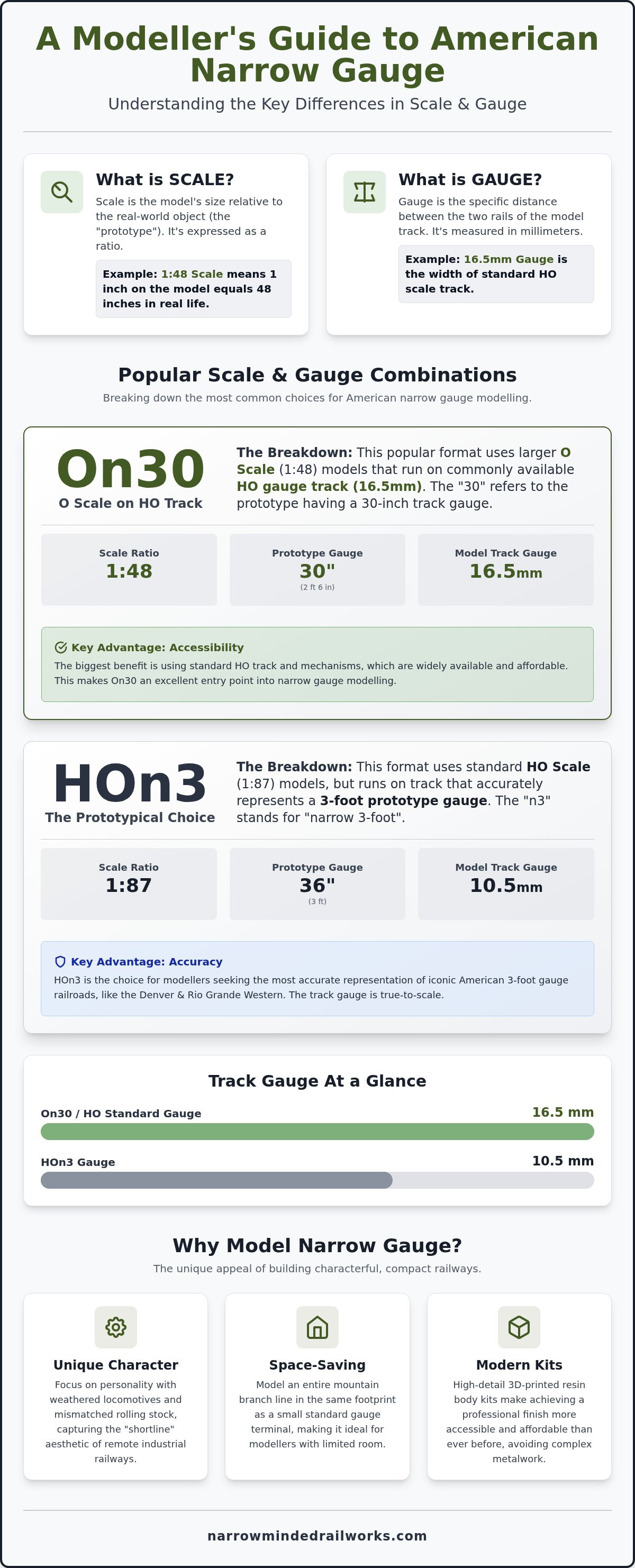
When selecting american narrow gauge kits, the first hurdle is often understanding the nomenclature. Scale refers to the size of the model relative to the prototype, while gauge refers specifically to the width between the rails. In the United States, the most common prototype was 3-foot gauge. This history has led to the popularity of On30 and HOn3 in the modelling community. While On30 uses O scale (1:48) models running on 16.5mm track, HOn3 uses HO scale (1:87) models running on 10.5mm track. Selecting the right combination depends on your available space and your preference for detail versus ease of assembly.
To understand why these specific gauges were chosen, one can look at Colorado's narrow gauge legacy, where mountainous terrain made standard gauge impractical. For the industrial modeller, GN15 offers another alternative. This involves using 16.5mm track (the same as HO standard gauge) to represent 15-inch gauge lines in a larger scale. It's a popular choice for those who enjoy the "critter" aesthetic of small industrial locomotives. We acknowledge that choosing between these can be difficult; therefore, we focus our kits on the O-16.5 and GN15 scales to provide the best balance of size and detail.
The Versatility of On30 and O-16.5
On30 is often considered the perfect entry point for those building their first american narrow gauge kits. The primary advantage is track compatibility. Because it runs on 16.5mm track, you can use standard HO gauge points and rails, which are widely available and affordable. This eliminates the need for expensive, specialised track systems. While we don't sell the track or chassis ourselves, the abundance of HO components makes sourcing the "guts" of your locomotive much simpler. For a deeper dive into this specific scale, An Introduction to On30 Gauge: Your Complete Guide offers a comprehensive breakdown of the benefits for new builders.
HOn3: For the Space-Conscious Modeller
HOn3 is the precision choice for modellers who want to recreate vast landscapes in a smaller footprint. It allows you to fit significant scenes, such as a multi-level mining operation or a sprawling timber mill, into a spare room or a small shed. However, there's a trade-off. The 1:87 scale means parts are smaller and more delicate, which can increase the complexity of the assembly process. You'll also need to source specialised 10.5mm track, which is less common than standard HO rail. If you prefer a larger, more robust model that's easier to handle during construction, you might find our O-16.5 locomotive kits provide a more accessible building experience.
The Anatomy of American Narrow Gauge Kits
Understanding the components of modern american narrow gauge kits is essential before you start your first build. Many modellers expect a single box containing every part needed for a running engine. We acknowledge that most high-quality kits today follow a "body kit" philosophy; however, this approach provides the highest level of detail while allowing you to choose a motor that fits your specific performance needs. A locomotive kit typically consists of the main shell and detailed accessories, whereas a wagon kit includes the body and requires you to add appropriate bogies and couplings.
The transition in materials has been significant. Traditional kits used white metal or resin castings which often required extensive sanding and drilling to achieve a professional finish. In 2026, high-quality 3D-printed resin has become the industry standard. This material captures the intricate rivets and pipework common on US prototypes with far greater precision than older casting methods. It allows for thinner cab walls and more realistic proportions that were previously impossible to manufacture at an accessible price point.
3D Printed Kits: The Modern Standard
3D printing allows for complex, one-piece boiler and cab assemblies. This significantly reduces assembly time because you don't have to struggle with aligning multiple heavy metal castings. When evaluating a kit, you should look for a smooth surface finish and minimal support marks. A well-designed print will have support structures placed in inconspicuous areas, such as the underside of the footplate, to ensure the visible details remain crisp. We focus on these modern techniques to ensure our O-16.5 and OO9 kits are as user-friendly as possible for the enthusiast.
Sourcing Your Chassis and Guts
The most common hurdle for new builders is identifying the right "guts" for their model. While we specialise in the bodywork, we design our kits to fit specific, readily available commercial chassis. Manufacturers like Bachmann and Kato produce reliable power units that are perfect for this purpose. You should always verify the recommended donor chassis before starting your build to ensure a seamless fit. We don't sell these motors directly, but we provide clear guidance on which units provide the best wheelbase for our various locomotive bodies.
For those looking to understand how these components fit into a wider layout theme, NMRA's introduction to narrow gauge modeling offers excellent context on the technical standards used across the hobby. By separating the body from the chassis, we ensure you get a highly detailed American prototype without the mechanical compromises often found in generic models. This transparency helps you build a more reliable and characterful railway. Our GN15 kits also follow this modular logic, ensuring that your industrial "critters" have the robust performance required for heavy shunting work.
Essential Techniques for Building and Detailing
Building american narrow gauge kits requires a shift in mindset from simple assembly to creative artistry. While 3D-printed resin provides an exceptional base for your model, the first step is always thorough preparation. You might notice tiny support marks on the underside of the boiler or footplate; however, these are easily removed with a fine-grit sanding stick or a sharp hobby knife. Once the surface is smooth, you can begin adding the iconic details that define the US shortline aesthetic. Components like pilot cowcatchers, large brass bells, and spark-arresting chimneys transform a generic engine into a characterful prototype. We don't include these specific brass detail parts in our standard kits to keep them affordable, but they're easily sourced from specialist suppliers to suit your chosen era.
Finishing Your 3D Printed Model
Achieving a professional finish on 3D-printed resin requires the correct chemical bonds. You should avoid standard plastic cements, as they won't fuse with resin surfaces. Instead, utilise cyanoacrylate (super glue) for resin-to-metal or resin-to-plastic joins. A high-build primer is your most effective tool for identifying any remaining layer lines before you apply the final topcoat. For a comprehensive walkthrough on this process, see our guide on Painting 3D Printed Models: A Beginner’s Guide. This stage sets the foundation for a realistic "working railroad" appearance that reflects the rugged nature of American shortlines.
American Weathering Secrets
Weathering is the stage where your model truly comes to life. American narrow gauge lines were often gritty, industrial operations where cosmetic maintenance was a low priority. To simulate sun-bleached wood on your wagon kits, start with a grey base and use a dry-brushing technique with lighter tan tones. For locomotives, focus on the areas prone to grease, heat, and heavy use.
- Apply a dark pin-wash around the smoke box and cylinders to highlight the intricate 3D-printed bolt heads and textures.
- Use rust-coloured weathering powders on the lower frames and cowcatchers where track grime naturally accumulates.
- Add a dusting of matte black coal soot around the top of the tender or the cab roof to simulate years of hard work.
We acknowledge that weathering can be intimidating for beginners; therefore, we suggest starting with very light layers and building up the effect gradually. This conservative approach prevents over-saturating the fine details of your american narrow gauge kits. If you're ready to put these techniques into practice, you can find your next project in our collection of O-16.5 and GN15 kits.
Finding Your Next Project at Narrow Minded Railworks
Choosing your next project involves balancing historical accuracy with the practicalities of the workbench. At Narrow Minded Railworks, we specialise in 3D-printed locomotive bodies and wagons that simplify the construction of american narrow gauge kits. We acknowledge that many modellers find traditional kit building daunting; therefore, we utilise high-resolution 3D printing to provide one-piece bodies that eliminate the need for complex soldering or heavy metal casting. This modern approach allows you to focus on the creative aspects of detailing and painting rather than the frustrations of part alignment.
Our range focuses on OO9, GN15, and O-16.5 scales, providing options for layouts of all sizes. The O-16.5 and GN15 kits are particularly well-suited for American industrial themes, such as logging camps or mining operations. While we don't sell ready-to-run models or the internal motors, we provide the shell that gives your railway its unique character. This modular approach means you can select the exact donor chassis that fits your budget and technical requirements. For a deeper understanding of the hobby's foundations, read our beginner's guide: What is a Narrow Gauge Railway?
Our Locomotive and Wagon Kit Range
The advantage of 3D printing for American prototypes lies in the ability to capture complex textures. Traditional kits often struggle with the fine wood grain or the intricate rivet patterns found on US rolling stock. Our 3D-printed resin captures these details with a precision that makes weathering far more rewarding. We recognise that sourcing parts from different suppliers can be a constraint; however, we provide clear documentation on which chassis are most recommended for each kit. This ensures that your project moves from the box to the track without unnecessary technical delays. Our wagon kits are designed for easy assembly, allowing you to build a characterful train of shortline stock in a single weekend.
Scenery and Diorama Tools
Setting the scene is the final step in creating a realistic model railway. American narrow gauge modelling thrives on the "shortline" aesthetic, which relies heavily on the surrounding landscape. Our diorama tools and scenery items are designed to complement our wagon and locomotive kits, allowing you to build a cohesive scene. We understand that American modelling is as much about the environment as it is about the trains. Whether you're building a dusty Colorado canyon or a damp pine forest in Maine, our scanned figures and accessories help bring your scene to life. We offer worldwide shipping to ensure that every enthusiast has access to high-quality components, regardless of their location.
Browse the Narrow Minded Railworks shop for your next American kit and start building your characterful shortline today.
Build Your American Shortline Legacy
Building a characterful model railway requires a balance of historical research and practical construction. We acknowledge that the technical requirements of scale selection and chassis sourcing can be intimidating for those new to the hobby. However, selecting american narrow gauge kits designed for modern 3D-printed standards provides a clear path to success. By focusing on high-quality resin bodies and transparent chassis integration, you can create a realistic representation of a rugged industrial shortline without the complexity of traditional metal kits.
Our expertly designed kits ensure a professional finish with intricate details that bring your layout to life. We offer worldwide shipping on all our 3D-printed locomotive and wagon bodies, making these unique prototypes accessible to enthusiasts everywhere. While we don't provide the mechanical chassis, our designs are optimised for easy integration with common commercial power units to ensure reliable performance. Explore our range of Narrow Gauge Kits and start your American Shortline project today! Your journey into the fascinating world of narrow gauge railroading is just beginning.
Frequently Asked Questions
What is the difference between On30 and On3?
On30 and On3 both utilise O scale (1:48) but differ in track width. On30 models run on 16.5mm track, which represents a 30-inch prototype gauge. This is the most popular choice for american narrow gauge kits because it allows you to use standard HO track. On3 is a more specialist pursuit that requires true 3-foot gauge track. While we don't sell track, we focus on O-16.5 kits to ensure compatibility with widely available HO components.
Do American narrow gauge kits include the motor and wheels?
Most kits in this category are sold as "body kits" and don't include the motor, wheels, or chassis. We specialise in high-quality 3D-printed resin bodies for locomotives and wagons. This approach allows you to choose a power unit that fits your specific performance or DCC requirements. You'll need to purchase a separate commercial donor chassis, such as those from Bachmann or Kato, to complete your build. This transparency ensures you get the best mechanical performance possible.
Can I run American narrow gauge trains on standard HO track?
You can run On30 and O-16.5 models on standard HO track without any modifications. This compatibility is a primary reason why many enthusiasts choose these scales for their american narrow gauge kits. It's important to remember that while the track width is the same, the scale of the buildings and figures must remain O scale (1:48) to look correct. If you're modelling HOn3, you'll need specialised 10.5mm track instead of standard HO rail.
Are 3D-printed kits as durable as traditional metal kits?
Modern 3D-printed resin kits are exceptionally durable and offer detail that traditional white metal often cannot match. While metal kits are heavier, they can be prone to bending or "lead rot" over several decades. Our resin prints are designed to withstand regular handling on an active layout. They provide a stable surface for painting and weathering, ensuring your locomotive or wagon remains a centerpiece of your collection for years without the risk of corrosion.
What tools do I need to start building my first narrow gauge kit?
You'll need a basic set of hobby tools to assemble our 3D-printed kits. A sharp hobby knife and fine-grit sanding sticks are essential for removing support marks and smoothing edges. Because resin doesn't react to standard plastic cements, you must use cyanoacrylate (super glue) for all joins. We also suggest a high-build primer to prepare the surface for painting. These simple tools allow you to achieve a professional finish on any locomotive or wagon project.
How do I know which chassis will fit a specific locomotive body kit?
We provide clear guidance in each product description regarding the recommended donor chassis. Because we don't sell the motors or wheels ourselves, we design our locomotive bodies to fit specific, readily available commercial units. You should always verify the wheelbase and mounting points before purchasing your chassis. This proactive approach eliminates the guesswork and ensures that your 3D-printed body sits correctly on the "guts" of the locomotive for smooth operation on your layout.
Is American narrow gauge modelling more expensive than standard gauge?
Narrow gauge modelling is often more cost-effective than standard gauge because layouts are typically smaller. You'll likely spend less on track and large-scale scenery than you would for a sprawling standard gauge mainline. While individual kits require an investment in a donor chassis, the total cost of a characterful narrow gauge branch line is often lower than a comparable standard gauge layout. It's a rewarding way to build a high-detail railway within a manageable budget and footprint.