

Stepping into the wonderful world of small-scale model railways can feel like learning a new language. You hear terms like 'scale' and 'gauge' used interchangeably, and the distinction between popular n gauge model trains and the characterful world of narrow gauge layouts, like OO9, can seem blurry. You know you want a detailed layout that fits your limited space, but the fear of investing time and money into the wrong system is real. Are you building a bustling mainline station or a quirky industrial quarry line? The choice you make now defines everything.
Consider this your friendly guide. We're here to demystify the jargon and clearly explain the crucial differences between N gauge and its narrow gauge cousins. We’ll explore the distinct 'feel' each scale offers, helping you decide which type of railway truly captures your imagination. By the end, you’ll have the confidence to choose the perfect path for your modelling ambitions, whether that’s with ready-to-run convenience or the rewarding journey of kit-building.
Key Takeaways
- Understand that N gauge and narrow gauge (like OO9) can use the same 9mm track, but the models represent completely different scales and types of railways.
- Discover if n gauge model trains are the ideal choice for modelling major UK mainline railways in a limited space.
- Learn why narrow gauge modelling offers a unique path for those interested in characterful industrial scenes and kit-building.
- Identify which scale best matches your personal modelling goals, from ready-to-run convenience to the rewarding challenge of bespoke kits.
What is N Gauge? The Popular Choice for Small Spaces
N gauge is one of the most popular choices for railway modellers in the UK, and for good reason. It primarily represents standard gauge prototypes-the mainline express trains and heavy freight wagons we see every day-at a scale of 1:148. The 'N' in its name comes from the nine-millimetre gauge of the track it runs on. For a detailed history of its development, the N Scale article on Wikipedia offers a comprehensive overview. This compact size is its greatest strength, allowing enthusiasts to build extensive and impressive layouts in spaces like a spare room, garage, or even on a simple tabletop.
To see the impressive scale and detail possible with N gauge, take a look at the layouts from this recent convention:
The core concept of N gauge is to model mainstream railways efficiently. It allows you to run realistically long trains through sweeping landscapes, something that is often impractical in larger scales without a dedicated, warehouse-sized space. The wide availability of products makes it an accessible and rewarding scale for both beginners and seasoned modellers.
The Pros of Modelling in N Gauge
- Vast Product Selection: The UK market is well-served by major brands like Graham Farish (by Bachmann) and Peco, offering a huge catalogue of ready-to-run locomotives, rolling stock, track, and accessories.
- Beginner-Friendly: Getting started is simple thanks to complete n gauge model trains sets. These kits, available from most model shops, provide everything you need to get a train running in minutes.
- Expansive Scenery: The small size is perfect for modelling long, prototypical passenger trains and vast, sweeping landscapes. You can realistically model a mainline station and the countryside beyond without needing a huge room.
- Strong Community Support: A large and active community means plenty of advice is available online and through local clubs. Scenery, buildings, and figures are also widely available to bring your layout to life.
The Cons of N Gauge
- Small and Fiddly: The compact size can be a drawback for some. Handling the tiny models, especially when coupling wagons or performing maintenance, can be challenging for those with larger hands or eyesight issues.
- Mainline Focus: The majority of available models are of famous mainline locomotives and rolling stock, such as the LNER Class A3 "Flying Scotsman" or modern high-speed trains.
- Lacks Niche 'Character': If your interest lies in the quirky, industrial, or rural branch lines, you might find the selection limited. N gauge excels at mainline operations but can lack the unique, rustic charm found in other scales.
What is Narrow Gauge Modelling? A World of Character and Kits
While N gauge focuses on replicating mainline railways in a tiny scale, narrow gauge modelling transports you to a different, often more rustic, corner of the railway world. This fascinating hobby is all about modelling the trains that ran on track gauges narrower than the UK's standard 4ft 8½in. Think of the hardworking locomotives found in Welsh slate quarries, chugging along industrial tramways, or serving remote rural communities-each prototype is packed with unique character and a rich history.
The fundamental concept of narrow gauge modelling is that the model's scale is larger than the track gauge suggests. This creates a powerful visual effect of a large, chunky train on a small, precarious track. The most popular format in the UK is OO9. Here, you work with OO scale models (at a ratio of 4mm to 1ft), which are the same size as standard Hornby or Bachmann models. However, these run on 9mm wide track. Crucially, this is the very same track used for conventional n gauge model trains, allowing for a creative blend of scales.
The Appeal of Narrow Gauge (like OO9 and GN15)
The allure of narrow gauge modelling lies in its departure from the mainstream. It’s a world filled with charm, quirks, and immense individuality, offering a uniquely rewarding experience for the modeller.
- A Focus on Kit Building: Far more than a "buy-it-and-run-it" hobby, narrow gauge is celebrated for the satisfaction of building your own locomotives and rolling stock from detailed kits.
- Easier to See and Work On: Because the models are in a larger scale (like OO), they are physically bigger and easier to handle, paint, and detail than their N gauge counterparts, despite running on the same width track.
- Compact, Story-Rich Layouts: The tight curves and small size of the real-life prototypes mean you can build an incredibly detailed and operationally fascinating layout in a very small space, such as a bookshelf or a small diorama.
The Challenges of Narrow Gauge
This rewarding journey is not without its unique challenges. Compared to the vast ready-to-run market for n gauge model trains, off-the-shelf options in OO9 are less common. This means building from kits is often a central part of the hobby-a skill that is deeply satisfying to learn. For those weighing their options, understanding the different scales is key, and an excellent starting point is the official NMRA Beginner's Guide. Sourcing specific parts or chassis can also be more of a specialist activity. However, for thousands of modellers, these challenges are precisely what make the hobby so engaging. Ready for a rewarding challenge? Explore our unique OO9 loco kits.
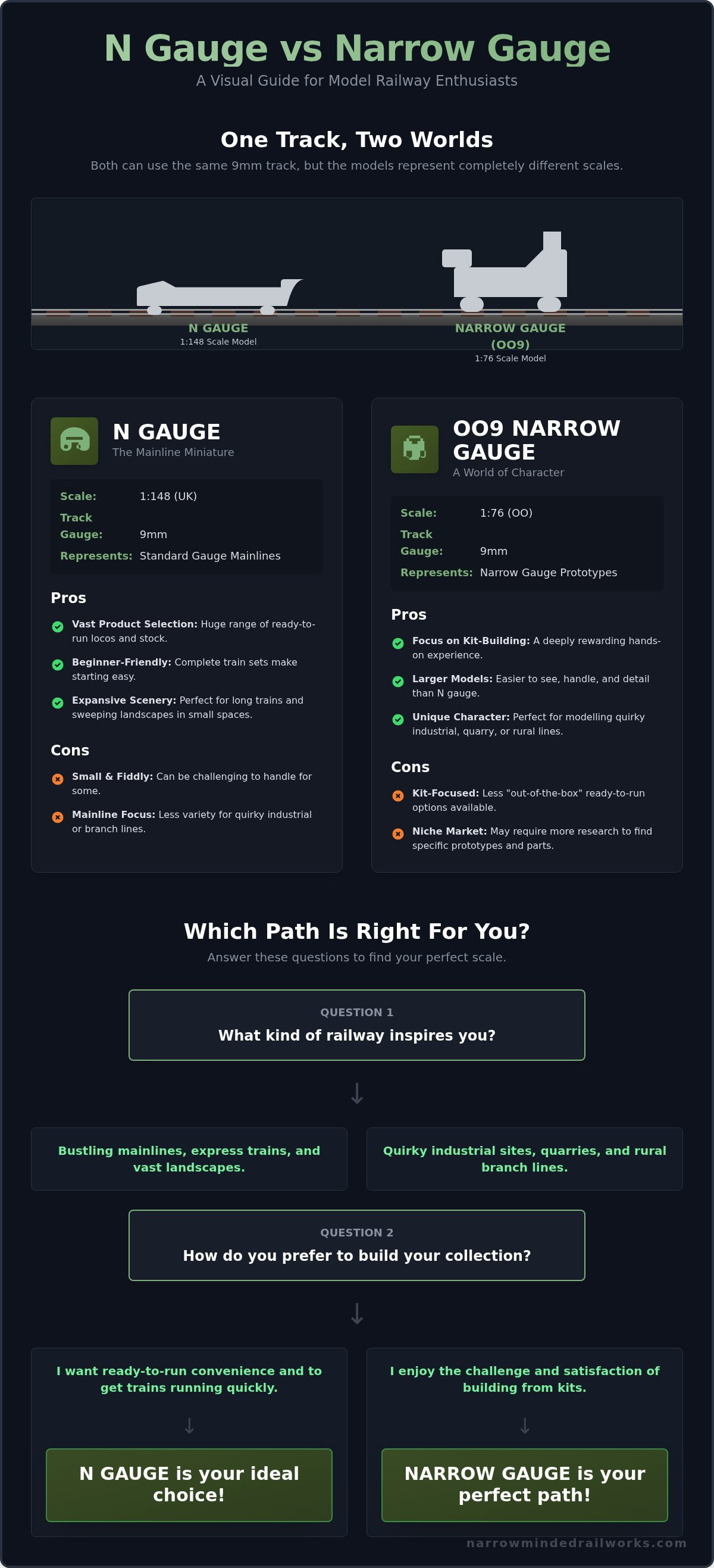
Key Differences: N Gauge vs. Narrow Gauge at a Glance
While both N gauge and popular narrow gauge scales like OO9 use the same 9mm track, they represent vastly different types of railways. Understanding this distinction is key to choosing the right path for your layout. Here’s a quick comparison:
- N Gauge: Represents standard gauge railways (4ft 8.5in) at a scale of 1:148. Think mainline expresses and heavy freight.
- Narrow Gauge (OO9): Represents narrow gauge railways (approx. 2ft to 2ft 6in) at a scale of 1:76. Think small industrial locomotives in quarries or on country estates.
Prototype: Mainline Giants vs. Industrial Workhorses
The world you create is fundamentally different. N gauge allows you to model the iconic mainlines of Britain. Imagine running a detailed replica of the Flying Scotsman or a modern Class 66 freight train across a sprawling landscape. The focus is often on recreating the speed and scale of the national network.
Narrow gauge, by contrast, captures the charm of smaller, often forgotten industrial lines. These are the workhorses that served Welsh slate quarries, Cornish clay pits, or agricultural estates. The feel is more intimate and characterful, focusing on tight curves, steep gradients, and unique, often quirky, locomotives.
Scale vs. Gauge: The Most Important Distinction
This is where most of the confusion arises. Both N gauge and OO9 use 9mm wide track, but the models themselves are completely different sizes.
- N Gauge has a consistent scale (1:148) and gauge (9mm), which accurately represents a standard gauge track. This proportional accuracy is a key feature of n gauge model trains.
- OO9 uses the much larger OO scale (1:76) but runs it on 9mm N gauge track. This combination cleverly represents a small, narrow gauge railway in the larger, more detailed scale.
The difference is stark: an OO9 figure standing next to an N gauge one would appear almost twice as tall! A 1:76 scale locomotive looks far more substantial and imposing on that 9mm track than its smaller 1:148 counterpart.
Availability: Ready-to-Run vs. Kit Building
The market for n gauge model trains is dominated by high-quality, ready-to-run locomotives and rolling stock from major manufacturers like Graham Farish and Dapol. You can build an impressive collection straight from the box.
The narrow gauge world, particularly in OO9, is a haven for the modeller who enjoys construction. While some ready-to-run models exist, the heart of the hobby lies in kit building and scratch building. For many enthusiasts, the satisfaction of assembling a unique locomotive from a kit is unparalleled, offering a deeper connection to their models. Exploring the diverse range of kits from specialist suppliers is a rewarding journey in itself.
Which Path is Right For You? A Modeller's Decision Guide
You've explored the scales, the history, and the technical details. Now comes the most exciting part: choosing the path that resonates with your passion. The decision between standard N gauge and a narrow gauge like OO9 isn't just about size; it's about the kind of railway world you want to create and the experience you want to have as a modeller.
Choose N Gauge if You Want To...
The world of N gauge is one of grand scale and modern convenience. This is the right choice if your primary goal is to operate a large, impressive railway that mirrors the national network. Consider N gauge if you want to:
- Recreate the Icons: Run full-length, famous express trains like the Flying Scotsman or a modern InterCity 125 across sweeping landscapes. The small scale allows for realistically long trains and vast scenes.
- Get Started Quickly: Walk into a model shop and leave with a complete, ready-to-run train set. For those who want to get trains moving immediately, the vast ecosystem of n gauge model trains offers unparalleled choice.
- Build a Sprawling Empire: Dream of multi-track mainlines, complex junctions, and large marshalling yards? N gauge's compact footprint makes it the premier choice for building an expansive and operationally rich layout in a limited space.
- Enjoy Maximum Choice: Access the widest possible selection of off-the-shelf locomotives, rolling stock, buildings, and accessories from major manufacturers like Hornby, Bachmann, and Dapol.
Choose Narrow Gauge (like OO9) if You Want To...
Narrow gauge modelling is a journey into character, atmosphere, and craftsmanship. It’s for the modeller who is captivated by the story behind the railway, from industrial workhorses to quirky passenger lines. This path is for you if you'd rather:
- Model with Personality: Build unique, often eccentric trains that serviced quarries, mines, and rural estates. Each locomotive has a distinct character, a world away from a standardised mainline fleet.
- Embrace the Build: Experience the deep satisfaction of building your own locomotives and wagons from kits. This hands-on approach connects you directly to your models and makes every piece of rolling stock special.
- Create an Atmospheric World: Focus on a smaller, more intimate scene packed with detail and story. A narrow gauge layout invites viewers to look closer, discovering the rich narrative you've built into every corner.
- Get the Best of Both Worlds: Enjoy the larger, more visible and handleable model size of OO scale (4mm) while benefiting from the space-saving track plan of N gauge (9mm track).
Your Next Step into Narrow Gauge
If the charm of narrow gauge is calling to you, getting started is easier than you might think. The secret is that the most popular UK narrow gauge scale, OO9, runs on standard N gauge track! You can use the same track and baseboard principles you may already be familiar with.
This shared foundation makes the leap into a new world of modelling simple and accessible. Our 3D printed kits are designed for beginners and experts alike, providing a perfect entry point into creating your own characterful railway. Browse our OO9 range now.
Your Modelling Journey: Choosing Between N Gauge and Narrow Gauge
The choice between N gauge and narrow gauge ultimately comes down to your personal modelling aspirations. While standard n gauge model trains offer a fantastic, space-efficient way to create extensive layouts with readily available stock, narrow gauge invites you into a world of unique character and historical charm. It's the path for the modeller who enjoys the craft, relishes building from kits, and wants to create a railway with a distinct, captivating story.
If the allure of quirky locomotives and a more hands-on approach has captured your imagination, we invite you to explore further. Designed and produced by passionate narrow gauge modellers, our unique locomotive and wagon kits offer models you simply won't find elsewhere. We proudly offer worldwide shipping to the global modelling community, ensuring every enthusiast can access these special designs.
Ready to build something truly different? Discover the character of narrow gauge-explore our range of 3D printed kits. Whatever track you decide to follow, the most important thing is to enjoy the journey. Happy modelling!
Frequently Asked Questions
Is OO9 the same as N gauge?
No, they are not the same, although they share one key dimension. OO9 models are built to a 4mm:1ft scale (the same as OO gauge), but they run on 9mm wide track to represent narrow gauge prototypes. N gauge uses a much smaller 2mm:1ft scale (1:148 in the UK) for both its models and its 9mm track. The crucial difference is the physical size and scale of the locomotives and rolling stock.
Can I use N gauge track for OO9 models?
Yes, you can. This is a major advantage for modellers starting in OO9. Because both OO9 and N gauge use a track gauge of 9mm, standard N gauge track from manufacturers like Peco is perfectly compatible. This gives you a wide and readily available selection of track sections, points, and crossings to build your layout without needing to source specialist narrow gauge track components, which can be more difficult to find.
What is the smallest model train scale?
The smallest commercially produced model train scale is T gauge, which is an incredibly small 1:450 scale and runs on a track just 3mm wide. While N gauge (1:148) and Z gauge (1:220) are well-known small scales, T gauge takes miniaturisation to another level, allowing for a complete, operational layout to be built inside something as small as a briefcase. The range of available models, however, is more limited.
Is narrow gauge modelling more difficult for a complete beginner?
Not necessarily. While it historically involved more kit-building, the growing range of ready-to-run OO9 models from brands like Bachmann and Peco has made it far more accessible. The ability to use standard N gauge track is a huge benefit for beginners. Furthermore, narrow gauge railways often allow for tighter curves and smaller layouts, making them an excellent choice if you are short on space or want a project that feels more manageable.
Where can I find unique narrow gauge model kits?
The UK has a fantastic 'cottage industry' for narrow gauge kits. Specialist suppliers like Dundas Models, Parkside Models, and Chivers Finelines offer a huge range of locomotive and wagon kits in OO9. Unlike the ready-to-run focus of many n gauge model trains, the narrow gauge world thrives on kit building. Attending model railway exhibitions is also a brilliant way to discover small, specialist manufacturers and find truly unique items for your layout.
What does 'gauge' mean in model trains?
In the world of model railways, 'gauge' refers specifically to the distance between the inside faces of the two running rails. For example, the track used for n gauge model trains has a gauge of 9mm. This is different from 'scale', which is the ratio of the model to its real-life counterpart (e.g., 1:148 for British N scale). This distinction is why OO9 (4mm scale) can run on N gauge track (9mm gauge).