

Did you know that 65% of narrow gauge enthusiasts now integrate 3D-printed kits into their fleets to capture the unique prototypes that major brands ignore? If you've spent hours scouring catalogues for ready-to-run gn15 sugar cane wagon models, you've likely realized the commercial market for these niche industrial workhorses is virtually non-existent. It's frustrating to have a vision for a sprawling plantation layout only to be halted by a lack of rolling stock or confusing information regarding chassis compatibility. Narrow gauge modelling often requires a more hands-on approach, but the results are far more rewarding than any off-the-shelf purchase.
We recognize these market gaps, so we've developed a proactive guide to help you navigate the world of high-quality resin kits and 3D prints. You'll discover how to select, build, and detail realistic GN15 sugar cane wagon models that bring authentic industrial grit to your layout. We'll explore how to source kits that fit standard commercial chassis, master assembly techniques, and create a cohesive fleet that looks right at home in the fields. By focusing on quality components and proven detailing methods, you can transform your industrial scene into a highly realistic representation of a working sugar estate.
Key Takeaways
- Understand how GN15 scale utilizes standard 16.5mm track to represent the unique, compact nature of industrial plantation railways.
- Learn to identify high-fidelity 3D-printed kits that provide superior detail and structural integrity compared to traditional resin alternatives.
- Recognize that while ready-to-run gn15 sugar cane wagon models are difficult to source, building specialist kits offers the most authentic path to a custom fleet.
- Discover the essential techniques for verifying chassis compatibility with commercial components to ensure reliable running on your industrial layout.
- Master professional assembly and weathering methods to transform bare kit components into realistic, hard-working plantation rolling stock.
Understanding GN15 Sugar Cane Wagon Models and Plantation Layouts
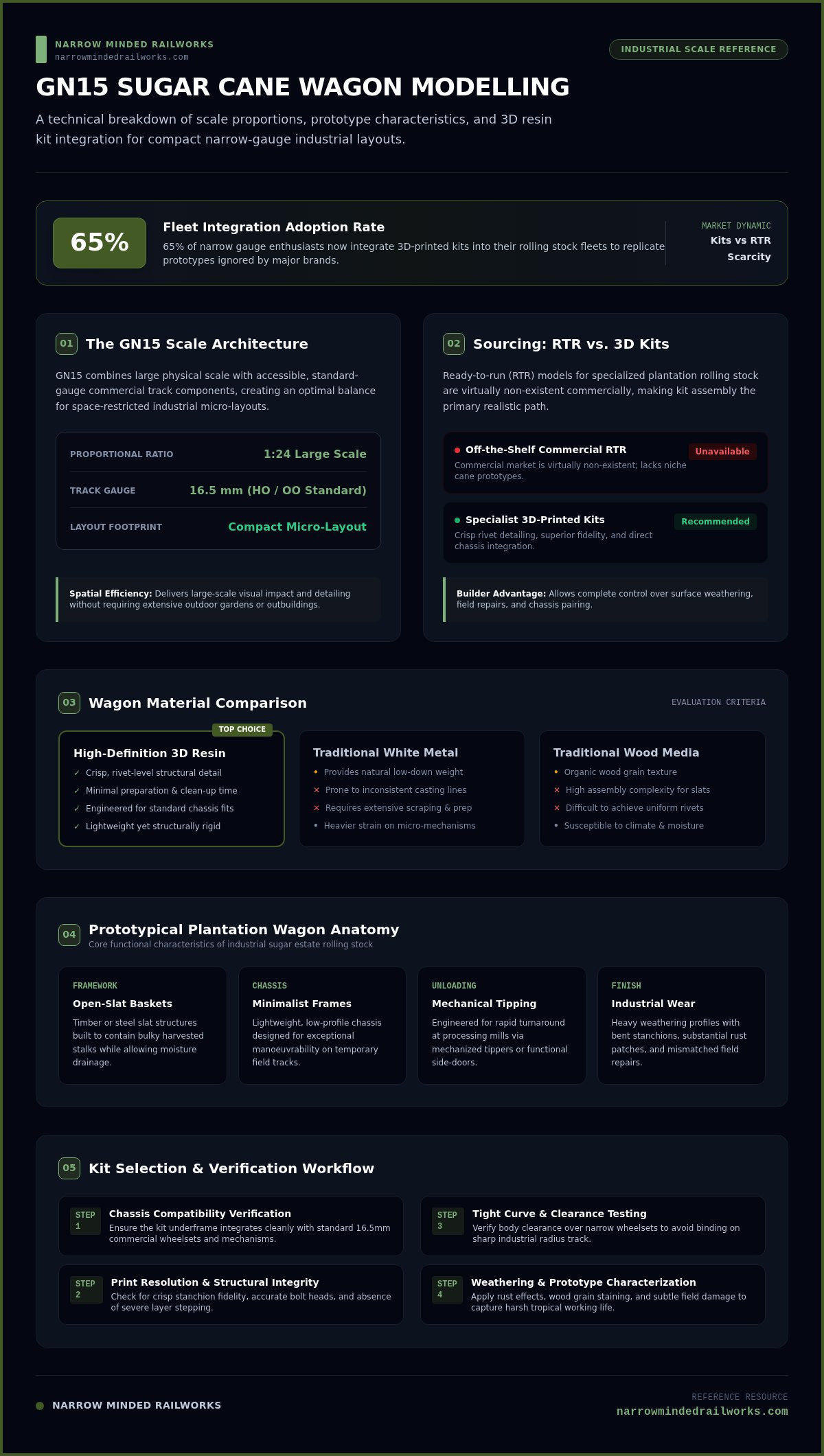
GN15 represents a fascinating intersection in the model railway hobby. It combines the substantial 1:24 scale with the accessibility of 16.5mm track, which is the standard gauge for OO and HO models. This allows you to build models with impressive physical presence without needing a massive garden or a dedicated outbuilding. For many enthusiasts, the draw lies in modelling gn15 sugar cane wagon models because these prototypes were inherently compact yet full of industrial character.
Sugar cane railways, often referred to as plantation lines, were built for utility rather than aesthetics. They functioned as the lifeblood of agricultural estates, moving massive quantities of harvested cane to processing mills. Because these lines often navigated tight curves and temporary tracks laid directly into the fields, they required rolling stock that was lightweight and incredibly manoeuvrable. This creates a unique aesthetic where large, detailed bodies sit atop narrow, functional wheelsets.
To better understand this concept, watch this helpful video:
The Appeal of GN15 Scale for Industrial Modelling
One of the primary advantages of this scale is the ability to create highly detailed micro-layouts. You don't need vast amounts of space to build a convincing industrial scene. Since the track gauge is standard, you have access to a wide range of affordable track components, though the rolling stock itself requires a more specialized approach. While you won't find these models sitting on the shelf of a local hobby shop as ready-to-run items, the scale offers endless opportunities for kit-modifying. It's a scale that rewards the builder who enjoys adding fine details like bolt heads, wood grain, and realistic weathering.
Prototypical Features of Sugar Cane Rolling Stock
Authentic gn15 sugar cane wagon models are defined by their open-slat baskets and minimalist frames. These vehicles were designed for heavy agricultural use, often featuring timber or steel frameworks that could withstand the rigours of tropical environments. On real-world industrial narrow-gauge railways, these wagons were frequently subjected to extreme wear. You'll often see prototypes with bent stanchions, mismatched field repairs, and significant rust.
The wagons were built for rapid turnover. They were loaded manually in the fields and then hauled to the mill, where they were often tipped mechanically or unloaded via side-doors. When you're modelling these, you're looking for a balance between the large-scale detailing of the basket weave or slats and the spatial efficiency required for narrow-gauge operation. This specific combination makes plantation modelling one of the most visually engaging niches in the hobby.
Key Criteria for Selecting the Best GN15 Sugar Cane Wagon Kits
Selecting high-quality gn15 sugar cane wagon models requires a proactive approach to technical specifications. Since the commercial market doesn't offer ready-to-run plantation stock, you must evaluate kits based on how they integrate with standard components and their level of prototypical detail. A good kit shouldn't just look realistic; it needs to function reliably within the constraints of a narrow gauge industrial layout.
Material Considerations: 3D Prints vs. Traditional Media
Material choice directly impacts the longevity and appearance of your rolling stock. While traditional white metal or wooden kits provide natural weight, they often suffer from inconsistent casting or require extensive cleaning before assembly. High-definition 3D-printed resin kits offer a proactive solution by delivering crisp, rivet-level detailing without the excessive weight or preparation time associated with traditional media. According to industry trends, approximately 65% of narrow gauge enthusiasts now integrate 3D-printed kits into their fleets to capture unique prototypes. This material is particularly useful when building a large fleet, as it ensures visual consistency across every vehicle you produce.
Ensuring Proper Running Gear and Chassis Alignment
Your wagons must run smoothly on standard 16.5mm track, which is the foundation of the GN15 scale. While we don't sell the chassis or motors ourselves, we design our kit bodies to accept common commercial wheelsets. You should verify the internal dimensions of any kit before purchase to ensure the wheelsets run freely without binding. Proactive alignment checks during the bonding process prevent tracking issues on the tight curves typical of industrial layouts. If you're looking for a straightforward path to an authentic fleet, exploring specialized GN15 wagon kits is the most efficient way to secure high-fidelity components that fit standard commercial parts.
Researching the specific era of your layout is also essential for a cohesive look. Whether you're modelling timber-framed wagons from the early 20th century or later steel-framed versions, accuracy matters. For those seeking deeper historical context on the evolution of these industrial lines, The Railway & Locomotive Historical Society provides excellent resources on general railroad development. By focusing on kits that offer a balance of fine detailing and mechanical compatibility, you ensure your plantation layout remains both visually striking and operationally sound.
Building Wagon Kits vs. Searching for Ready-to-Run Models
Mainstream model railway manufacturers focus almost exclusively on standard gauge or highly popular narrow gauge scales like OO9. Because of this commercial focus, ready-to-run gn15 sugar cane wagon models are virtually non-existent on the high street. While the lack of off-the-shelf rolling stock can be frustrating initially, assembling high-quality kits provides a proactive path to creating an authentic fleet with complete creative control.
When you build your own wagons, you ensure mechanical consistency across your entire layout. You can standardize your choice of couplings, maintain uniform ride heights, and guarantee smooth track performance across tight industrial points. Attempting to source mismatched second-hand items often results in erratic running, whereas kit building allows you to establish a reliable baseline for your fleet's operation.
The Reality of the GN15 Commercial Market
The niche nature of sugar cane railways means that enthusiasts rely heavily on independent, specialist suppliers. You won't find large production runs of plantation stock from major brands, but this constraint has fostered a creative cottage industry. If you're new to this scale and want a comprehensive overview of how to get started, you can read our Getting Started in GN15 Scale: Your Complete Guide. Accepting the lack of ready-to-run options allows you to embrace the assembling process, which is where the true character of industrial modelling is forged.
Why Kit Building Wins for Industrial Fleets
Real-world industrial railways rarely operated pristine, uniform sets of rolling stock. In the fields, wagons were subjected to harsh agricultural environments, resulting in mismatched repairs, dented frameworks, and varying levels of decay. Building from kits empowers you to introduce this prototypical variety directly into your fleet. You can easily modify individual models by adding unique cargo loads, simulating sagging timber frames, or creating varying degrees of rust and wear.
Assembling your own rolling stock also provides a practical solution to the challenge of chassis adaptation. While we don't supply chassis or motors, our high-fidelity 3D-printed bodies are specifically designed to accept reliable, standard wheelsets. This design philosophy ensures that you can build a highly detailed body without worrying about complex scratchbuilding calculations. Ultimately, kit building doesn't just solve the availability problem; it gives you a deeper understanding of narrow gauge mechanics and a more rewarding modelling experience.
Step-by-Step Assembly and Weathering for Realistic Cane Wagons
Creating a convincing fleet of gn15 sugar cane wagon models is as much about the final finish as it is about the initial build. While 3D-printed resin offers unmatched detail resolution, it requires a specific workflow to achieve a professional result. You must start by ensuring the surfaces are chemically clean and physically smooth before any paint touches the model. Taking a proactive approach to preparation saves time and prevents frustration during the weathering stages.
Preparing and Priming 3D-Printed Resin Components
Residual support marks are a natural part of the 3D printing process. You can remove these carefully using fine-grit abrasive paper or miniature files. Once you've smoothed the surface, wash every component in warm, soapy water. This step is vital because manufacturing residues can cause paint to peel or bubble later. After drying, apply a high-quality primer. This provides the "tooth" necessary for your top coats to bond securely. For detailed finishing advice, consult our guide on Painting 3D Printed Models: A Beginner's Guide.
Bonding resin components requires high-strength adhesives like cyanoacrylate, commonly known as super glue, or two-part epoxy. Standard solvent-based plastic cements won't work on these materials. You should assemble the core chassis first, ensuring it remains square and level. Proactive alignment at this stage prevents tracking issues when the wagon is in motion. Once the framework is secure, you can proceed to the more creative aspects of the build.
Replicating Industrial Wear, Rust, and Grime
Sugar cane railways are synonymous with grit and hard labour. To replicate this, start with a dark base coat and layer rust-toned washes over metal-effect areas. Dry-brushing is particularly effective for gn15 sugar cane wagon models; it highlights structural edges, rivets, and the natural grain of timber textures. This technique brings out the fine details that 3D printing captures so well. It's a simple way to add depth to your models without requiring advanced airbrushing skills.
Don't forget the load. You can add realistic sugar cane loads using natural dried grasses or specialized scenic materials. These loads aren't just for show. They can also disguise internal weights needed to improve track performance on uneven industrial lines. If you're ready to begin your build, you can explore our range of GN15 wagon kits today. A multi-layered weathering approach ensures your fleet looks cohesive yet individual, transforming a bare kit into a piece of rolling stock that tells a story of years of service in the tropical sun.
Sourcing Your GN15 Sugar Cane Fleet from Narrow Minded Railworks
Finding authentic gn15 sugar cane wagon models shouldn't be a search for the non-existent. While the mainstream market focuses on standard prototypes, Narrow Minded Railworks specializes in designing high-fidelity 3D-printed kits for narrow gauge enthusiasts. We provide structurally sound wagon bodies that serve as the benchmark for industrial layout builders. Our proactive approach ensures that even though ready-to-run models are unavailable commercially, you have a straightforward path to an authentic fleet through our specialist designs.
Precision 3D-Printed GN15 Rolling Stock Solutions
Our kits are engineered to deliver crisp detail straight from the printer. We focus on rivet-level resolution and structural integrity, ensuring each wagon body stands up to the rigours of an active layout. While we don't supply chassis or motors, we optimize our designs for easy assembly with standard commercial wheelsets and coupling systems. This transparency allows you to select the power units and running gear that best fit your operational needs while relying on us for the prototypical aesthetic. It's a system designed to reduce the risk often associated with varying quality in 3D prints.
Enhancing Your Plantation Layout with Authentic Scenery
A realistic sugar cane line requires more than just high-quality rolling stock; it needs a convincing environment. We supply a complementary range of diorama tools and scenic accessories designed to bring your industrial yard to life. From unique figures to specific scenery kits, we help you build a cohesive plantation scene that feels lived-in. These additions are vital for capturing the grit and character of a working estate railway. You can explore the full range of possibilities on the Narrow Minded Railworks Homepage.
We offer worldwide shipping from our UK base, providing a reliable path for fleet expansion regardless of your location. By choosing our specialist kits, you aren't just buying a model; you're investing in a design specifically tailored for the unique challenges of the GN15 scale. Whether you're starting your first micro-layout or expanding a complex industrial scene, our gn15 sugar cane wagon models provide the detail and durability your layout deserves. Our focus remains on providing the building blocks for a realistic, cohesive plantation fleet.
Build Your Prototypical Sugar Cane Fleet
Ready-to-run commercial stock for plantation lines remains elusive, but building a realistic industrial railway is entirely achievable through specialist 3D-printed kits. High-definition resin prints capture the fine textures of timber and steel that traditional media often misses. By selecting kits designed for standard commercial wheelsets, you solve the problem of chassis compatibility while maintaining complete creative control over your fleet's weathering and load states.
Narrow Minded Railworks focuses exclusively on specialist narrow gauge 3D designs. We provide the structural foundation for your industrial yard, ensuring every model meets the high-detail resin print finish required for professional-grade layouts. We offer worldwide shipping available on all orders, so you can begin expanding your roster regardless of your location. Our proactive design approach removes the guesswork from building niche rolling stock.
Ready to transform your industrial micro-layout with authentic rolling stock? Explore our full range of GN15 narrow gauge kits today and start building the unique gn15 sugar cane wagon models your plantation scene requires. The path to a cohesive, realistic fleet starts with the right components.
Frequently Asked Questions
What track does GN15 scale sugar cane wagons run on?
GN15 wagons run on standard 16.5mm track, which is the same gauge used for OO and HO scale railways. This allows modellers to utilize widely available and affordable track systems for their industrial layouts. While the gauge is the same, the sleepers on standard track might look too small for the 1:24 scale of GN15. Some modellers choose to re-sleeper their track or use specialized narrow gauge versions to improve the visual authenticity of their plantation lines.
Do GN15 sugar cane wagon kits include the wheels and chassis?
Our wagon kits consist of high-detail 3D-printed bodies and components, but we don't sell chassis or motors. While some of our specific kits are supplied with compatible wheelsets, you generally need to source a donor chassis or independent wheels to complete the build. This proactive approach allows you to select the specific running gear that meets your operational requirements while relying on us for accurate, structurally sound gn15 sugar cane wagon models.
How do I clean and prepare 3D-printed resin wagon models before painting?
You should begin by washing all 3D-printed resin components in warm, soapy water to remove any manufacturing residues or oils. Once dry, carefully inspect the parts for support marks and remove them using fine-grit abrasive paper or miniature files. Applying a robust primer coat after cleaning is essential, as it creates the necessary bond for your final paint layers and weathering effects to adhere correctly to the resin surface.
Can I use standard Hornby track for a GN15 plantation layout?
You can certainly use standard Hornby track for a GN15 plantation layout because it uses the required 16.5mm gauge. This makes starting an industrial layout highly accessible and cost-effective compared to other large-scale systems. To improve the visual authenticity, many modellers choose to bury the track in scenic materials like dirt or ballast. This hides the standard gauge sleeper spacing and replicates the gritty, overgrown appearance of real field lines.
What type of glue is best for assembling 3D-printed wagon kits?
Cyanoacrylate, commonly known as super glue, or two-part epoxy resins are the best choices for assembling 3D-printed wagon kits. Standard solvent-based plastic cements used for injection-moulded kits won't create a bond with resin materials. For structural areas like the main frame, a high-strength epoxy provides a durable connection, while thin super glue is ideal for attaching fine details. Always ensure parts are properly aligned before the adhesive sets to prevent tracking issues.
How do I add realistic weight to lightweight 3D-printed cane wagons?
Adding weight to lightweight gn15 sugar cane wagon models is best achieved by hiding lead or tungsten weights within the cargo load or beneath the chassis. Because sugar cane wagons often have open-slat designs, you can disguise small weights inside a bundle of harvested cane. Ensuring your wagons have sufficient mass improves their tracking performance and prevents derailments on the uneven track often found on industrial micro-layouts or temporary plantation lines.
Does Narrow Minded Railworks ship GN15 kits internationally?
Narrow Minded Railworks provides worldwide shipping on all orders from our base in the United Kingdom. We recognize that narrow gauge modelling is a global hobby, so we ensure our kits are packaged securely for long-distance transit. Whether you're building a layout in Europe, North America, or Australasia, you can access our specialist range of 3D-printed bodies and scenery items to expand your industrial fleet with confidence.