

Dreaming of a detailed model railway but find yourself staring at a small spare room, a bookshelf, or even just a corner of your desk? The world of model trains can feel overwhelming, a confusing alphabet soup of scales like N, Z, OO9, and T. It's easy to wonder if your ambition is bigger than your available space. This common dilemma often leads enthusiasts on a quest to find the absolute smallest model train scale, hoping to fit a world of detail into a tiny footprint.
You've come to the right place. This definitive guide will cut through the confusion and give you a clear answer. We'll not only reveal the world's tiniest commercially available railway scale but also compare it directly with other popular micro-gauges. We'll explore the pros and cons, help you visualise just how small these trains really are, and give you the confidence to choose the perfect option for your compact layout. Get ready to discover that a lack of space doesn't have to mean a lack of railway.
The Definitive Answer: T Gauge is the Smallest Model Train Scale
Let's cut straight to the chase: the smallest model train scale commercially available today is T Gauge. At an incredible 1:450 scale ratio, it holds the official world record. To put that into perspective, a real-life locomotive is a staggering 450 times larger than its T Gauge counterpart. The track itself has a gauge-the distance between the rails-of just 3mm, the narrowest you can buy.
To truly appreciate how minuscule this scale is, especially when compared to popular scales like OO and N gauge, this video provides an excellent visual comparison:
Developed by the Japanese company Eishindo and first released in 2007, T Gauge models are astonishingly small. A typical locomotive is barely larger than a 10p coin, making it a true marvel of miniature engineering. This scale pushes the boundaries of what's possible in model railways, offering a unique experience for hobbyists looking for the ultimate challenge in compact design.
What is T Gauge?
The name "T Gauge" is derived from its Three-millimetre track gauge. Its 1:450 scale ratio makes it significantly smaller than the previous record-holder, Z Gauge (1:220). Unlike traditional models that draw electrical power through the wheels, these tiny trains are propelled by a unique magnetic system. The wheels are magnetised, and a variable magnetic field from the powered track pulls them forward. First introduced in 2006, T gauge quickly claimed the title of the smallest commercially produced model railway scale in the world.
Pros and Cons of Modelling in T Gauge
While fascinating, working with the world's smallest model train scale has its unique set of challenges and rewards. It's crucial to consider both before investing your time and money into this niche corner of the hobby.
- Pro: Unbeatable Space-Saving: The most obvious advantage is the minuscule footprint. You can build a complete, detailed layout inside a briefcase, on a small shelf, or even in a diorama the size of a shoebox.
- Con: Extremely Fiddly: Working with components this small requires immense patience, steady hands, and excellent eyesight (or a good magnifier). Simply placing trains on the track can be a significant challenge.
- Con: Limited Product Range: Compared to mainstream scales like N or OO gauge in the UK, the selection of locomotives, rolling stock, and accessories is very limited. Sourcing items can be more difficult and may require ordering from specialist suppliers.
- Con: Novelty Factor: For some traditional modellers, T Gauge is seen more as a novelty or a technical curiosity rather than a practical scale for serious, operational railway modelling due to its operational quirks and tiny size.
The Small Scale Contenders: How T Gauge Compares to Z, N, and TT:120
While T Gauge currently holds the title for the smallest model train scale, it's important to understand where it fits among other popular compact choices. For decades, other scales have offered modellers the chance to build expansive layouts in limited spaces. The differences come down to scale ratio and track gauge-standards defined and maintained by organisations like the National Model Railroad Association (NMRA). Each scale offers a unique balance of size, detail, and product availability.
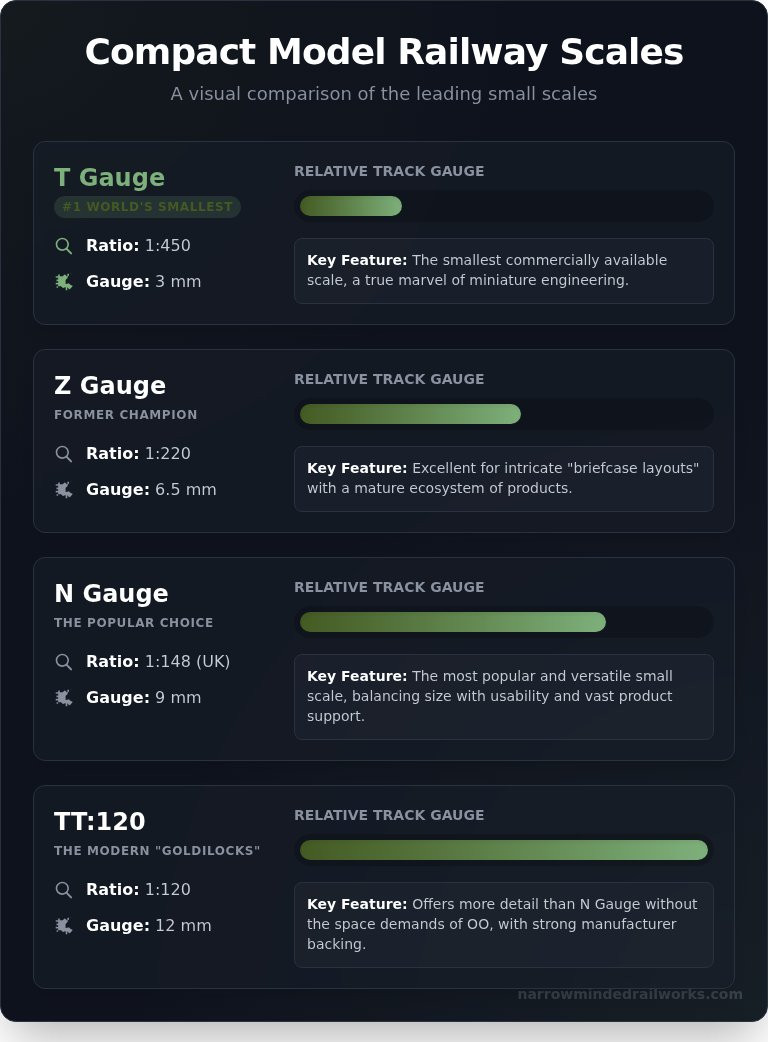
Here is a quick comparison of the leading small scales:
- Scale Name: T Gauge | Ratio: 1:450 | Track Gauge: 3 mm | Key Feature: The world's smallest commercially available scale.
- Scale Name: Z Gauge | Ratio: 1:220 | Track Gauge: 6.5 mm | Key Feature: The former smallest, known for intricate "briefcase layouts."
- Scale Name: N Gauge | Ratio: 1:148 (UK) | Track Gauge: 9 mm | Key Feature: The most popular and versatile small scale.
- Scale Name: TT:120 | Ratio: 1:120 | Track Gauge: 12 mm | Key Feature: A modern "Goldilocks" scale with growing support.
Z Gauge (1:220): The Former Champion
Introduced by Märklin in 1972, Z Gauge was the undisputed smallest model train scale for over 30 years. It developed a dedicated following for its ability to fit incredibly detailed scenes into tiny spaces, like briefcases and coffee tables. While T Gauge is smaller, Z Gauge boasts a significantly larger and more mature ecosystem of locomotives, rolling stock, and accessories from various manufacturers, making it a very viable and well-supported micro-scale.
N Gauge (1:148 UK / 1:160 Global): The Popular Choice
For most UK modellers seeking a space-saving option, N Gauge is the go-to choice. It hits the sweet spot between compact size and practical usability, allowing for grand, sweeping landscapes that would be impossible in larger scales. The support for British N Gauge (at a 1:148 ratio) is immense, with a vast range of ready-to-run models from brands like Graham Farish and Dapol, ensuring you can model almost any era of British railway history.
TT:120 (1:120): The Newcomer
Spearheaded by Hornby, TT:120 is a modern revival of the classic TT scale, positioned perfectly between N and the much larger OO Gauge. It aims to be the "best of both worlds," offering a noticeable increase in detail and heft over N Gauge without requiring the significant space commitment of OO. As a growing system with strong manufacturer backing, it's quickly becoming a compelling new option for modellers wanting detail-rich layouts in a moderate space.
Scale vs. Gauge: The Secret to Fitting More Detail into Less Space
To truly understand how to maximise detail in a minimal footprint, we need to grasp two fundamental terms that beginners often use interchangeably, but which mean very different things: scale and gauge. While T gauge is officially recognised by Guinness World Records as the smallest commercially produced model railway at a tiny 1:450 ratio, understanding this distinction unlocks clever ways to build impressive layouts in tight spaces.
Here’s the simple breakdown:
- Scale is the ratio of the model to its real-life counterpart. For example, OO scale in the UK is 4mm:1ft, or a ratio of 1:76.2.
- Gauge is the physical measurement between the inside edges of the two rails on the track. Standard N gauge track, for instance, is 9mm wide.
In most cases, scale and gauge are paired. N scale models run on N gauge track. But what if they weren't? This is the core principle behind narrow gauge modelling, a popular method for fitting more characterful railway scenes into a small space without resorting to the absolute smallest model train scale.
Why This Distinction Matters for Small Layouts
Narrow gauge modelling allows you to run a larger scale model on a track gauge that is narrower than the standard for that scale. This represents real-life railways that were built to a "narrow gauge" to save money or navigate difficult terrain. For the modeller, this means you get the best of both worlds: larger, easier-to-handle locomotives and rolling stock with more detail, all fitting onto a compact track plan. It opens up a world of unique modelling opportunities, from rustic quarry lines and industrial tramways to charming countryside railways.
Introducing OO9: Big Detail on Tiny Track
A perfect example of this principle in action is OO9. This clever combination uses the popular 4mm:1ft scale of British OO gauge models but runs them on 9mm wide track-the same gauge used for the much smaller N scale. The result is a wonderfully characterful appearance, where chunky, detailed locomotives chug along on petite track. It’s an ideal solution for creating intricate, story-rich dioramas and micro-layouts on a bookshelf or desk. See how it works with our range of OO9 model kits and start your own small-space adventure.
Is the Tiniest Scale Right For You? Practical Considerations
Understanding the different sizes is one thing, but choosing to build a layout in the smallest model train scale is a significant commitment. While the appeal of a complete railway on a coffee table is strong, T and Z gauges come with unique practical challenges that every modeller should consider before taking the plunge.
Skill Level and Dexterity
Working in T gauge (1:450) or even Z gauge (1:220) demands a steady hand and excellent eyesight. Tasks like placing models on the track, coupling carriages, and cleaning wheels are incredibly fiddly. A good pair of tweezers and a magnifying lamp are not optional extras; they are essential tools from day one. For most beginners looking to start small, N gauge (1:148) offers a much more forgiving experience, while still allowing for complex layouts in limited spaces.
Availability and Range
In the UK, the N gauge market is vast, with major brands like Graham Farish and Dapol offering an extensive range of ready-to-run British locomotives, carriages, and wagons. The ecosystem of track, scenery, and electronics is immense. In contrast, T and Z gauge are highly specialised niches. The selection of ready-to-run British-outline models is extremely limited, meaning you will likely be running European or Japanese trains. This is where kit-building becomes essential, allowing you to create unique models that simply aren't available off the shelf.
Your Modelling Goals
The best scale for you depends entirely on what you want to achieve. There is no single "right" answer, only the right fit for your project, space, and skills.
- The 'Wow-Factor' Diorama: If your goal is a stunning, self-contained scene in a briefcase or display box, T gauge is perfect. Its sheer novelty makes it an incredible conversation piece.
- The Operational Railway: For those dreaming of running long trains through detailed scenery with complex track plans, N gauge is the ideal choice for small-space operational modelling.
- The Characterful Branch Line: For a detailed, character-rich layout on a bookshelf, consider narrow gauge like OO9. It uses N gauge track but with larger, easier-to-handle OO scale models, offering a superb balance of detail and compact size.
Ultimately, while the allure of the world's smallest model train scale is undeniable, it's often a better choice for an experienced modeller seeking a new challenge rather than a newcomer's first layout.
Small Space, Big Character: The Advantage of Narrow Gauge Modelling
While the quest for the absolute smallest model train scale is often driven by a lack of space, there is another, characterful solution: narrow gauge modelling. This approach offers a brilliant compromise, allowing you to enjoy larger, more detailed models without requiring a sprawling layout. Instead of modelling mainline railways, you can create intricate scenes based on industrial, quarry, or private estate lines that used narrower tracks in real life.
The principle is simple: use a popular, larger scale for the models (like OO or G scale) but run them on smaller, narrower track (like N gauge). This immediately creates the impression of a quaint, specialised railway and allows for tighter curves and more compact track plans. At Narrow Minded Railworks, we specialise in bringing these unique prototypes to life with our range of high-quality 3D printed kits.
Exploring OO9 Scale
OO9 is the most popular narrow gauge scale in the UK. It perfectly combines the familiar, detailed world of 4mm:1ft (OO scale) models with the compact footprint of 9mm gauge track-the same track used for N gauge. This opens up a world of modelling possibilities, from Welsh slate quarry engines to tiny industrial shunters. Supported by a vibrant community, it's an accessible way to begin your narrow gauge journey. Start your journey with a beginner-friendly OO9 kit and discover a new dimension of the hobby.
Discovering GN15 Scale
If you crave maximum detail in a minimum space, GN15 is an enchanting option. Affectionately known as 'Gnome-scale', it places large G scale models (around 1:22.5) onto tiny 15mm gauge track. The result is a whimsical, highly detailed world perfect for creating captivating micro-layouts and dioramas. GN15 encourages immense creativity, allowing you to build everything from a fantastical workshop railway to a detailed agricultural line on a shelf. Explore our unique range of GN15 kits and scenery to build your own miniature world.
Ultimately, while not the smallest model train scale in absolute terms, narrow gauge modelling provides a powerful way to pack incredible character and operational interest into a space of any size.
Small Scale, Big Potential: Your Next Modelling Adventure
We've journeyed through the world of miniature railways, confirming that T gauge holds the title for the smallest commercially available scale. Yet, we've also discovered that finding the smallest model train scale isn't always the only answer for a compact layout. Understanding the difference between scale and gauge unlocks the secret to packing incredible detail and character into the space you have, which is where the unique charm of narrow gauge truly shines.
If you're inspired to build a rich, detailed world on a minimal footprint, your journey starts here. As specialists in 3D printed narrow gauge kits, we offer unique models you simply won't find anywhere else. We're passionate about helping modellers bring their vision to life, with worldwide shipping for enthusiasts everywhere. Explore our unique narrow gauge kits for your small space layout and find the perfect centrepiece for your project.
Your miniature masterpiece is waiting to be built.
Frequently Asked Questions
What is smaller, N gauge or Z gauge?
Z gauge is significantly smaller than N gauge. Z gauge models are built to a scale of 1:220, meaning that every 220 units in real life are represented by 1 unit on the model. In the United Kingdom, N gauge is typically a 1:148 scale. This makes Z gauge trains and scenery noticeably more compact, allowing for a complete and complex layout in a very small space, such as a briefcase.
What is the most popular model train scale in the world?
Globally, HO scale (1:87) is the most popular model train scale due to its vast range of available locomotives, rolling stock, and accessories from manufacturers worldwide. However, here in the United Kingdom, the most popular scale is OO scale (1:76). While it runs on the same track gauge as HO, the models themselves are slightly larger, which many British modellers prefer. The wide availability of UK-specific models solidifies its top position.
Is T gauge expensive to get started with?
Getting started with T gauge, the world's smallest model train scale, can be a specialist investment. Because it is a niche market, the initial outlay is often higher than for more mainstream scales like N or OO. A basic starter set, including a small loop of track, a controller, and a train, can cost anywhere from £200 to £350. The limited range of manufacturers also means individual locomotives and rolling stock can be comparatively pricey.
Can you get steam locomotives in T gauge?
Yes, you can get steam locomotives in T gauge, but the selection is quite limited compared to diesel and electric models. The primary focus for T gauge manufacturers has historically been on modern Japanese and European trains. However, a small number of steam locomotives are available, such as the German BR 89 tank engine. Specialist suppliers and 3D printing services are also expanding the options for dedicated micro-modellers seeking classic steam power.
What basic tools do I need to work with very small model train scales?
Working with the smallest model train scale requires precision and the right equipment. Essential tools include a good pair of fine-tipped tweezers for handling tiny components, and a magnifying lamp or a wearable headset magnifier to see what you are doing. You will also need a sharp hobby knife, precision sprue cutters for removing parts from frames cleanly, and a set of mini files for any adjustments. A steady hand is your most valuable asset!
What is the difference between OO9 and H0e?
The main difference between OO9 and H0e is the scale of the models, even though they both run on the same 9mm gauge track to represent narrow-gauge railways. OO9 uses the British 4mm:1ft scale (1:76), making it a popular choice for modelling UK narrow-gauge lines alongside standard OO scale layouts. H0e uses the European and American 3.5mm:1ft scale (1:87), so the models are slightly smaller and are in scale with standard H0 layouts.