

Have you ever found the perfect GN15 kit, your imagination already picturing it chuffing along your layout, only to be stopped dead by one daunting question: 'Which chassis will actually fit?' You're not alone. The world of donor chassis can feel like a minefield, filled with confusing technical terms and the nagging fear of spending your hard-earned cash on a model that simply won't work. That's why we've created this ultimate gn15 chassis guide - to give you the confidence to build.
Consider this your definitive roadmap. We'll demystify everything from wheelbase to wheel arrangement, providing a clear list of the most popular and readily available donor models here in the UK. You'll learn exactly how to measure your kit for a perfect match, discover which chassis are compatible with our Narrow Minded Railworks range, and find out where to source these vital components. Say goodbye to guesswork and hello to a perfectly powered model. Let's get started.
What is a Chassis? The Beating Heart of Your GN15 Locomotive
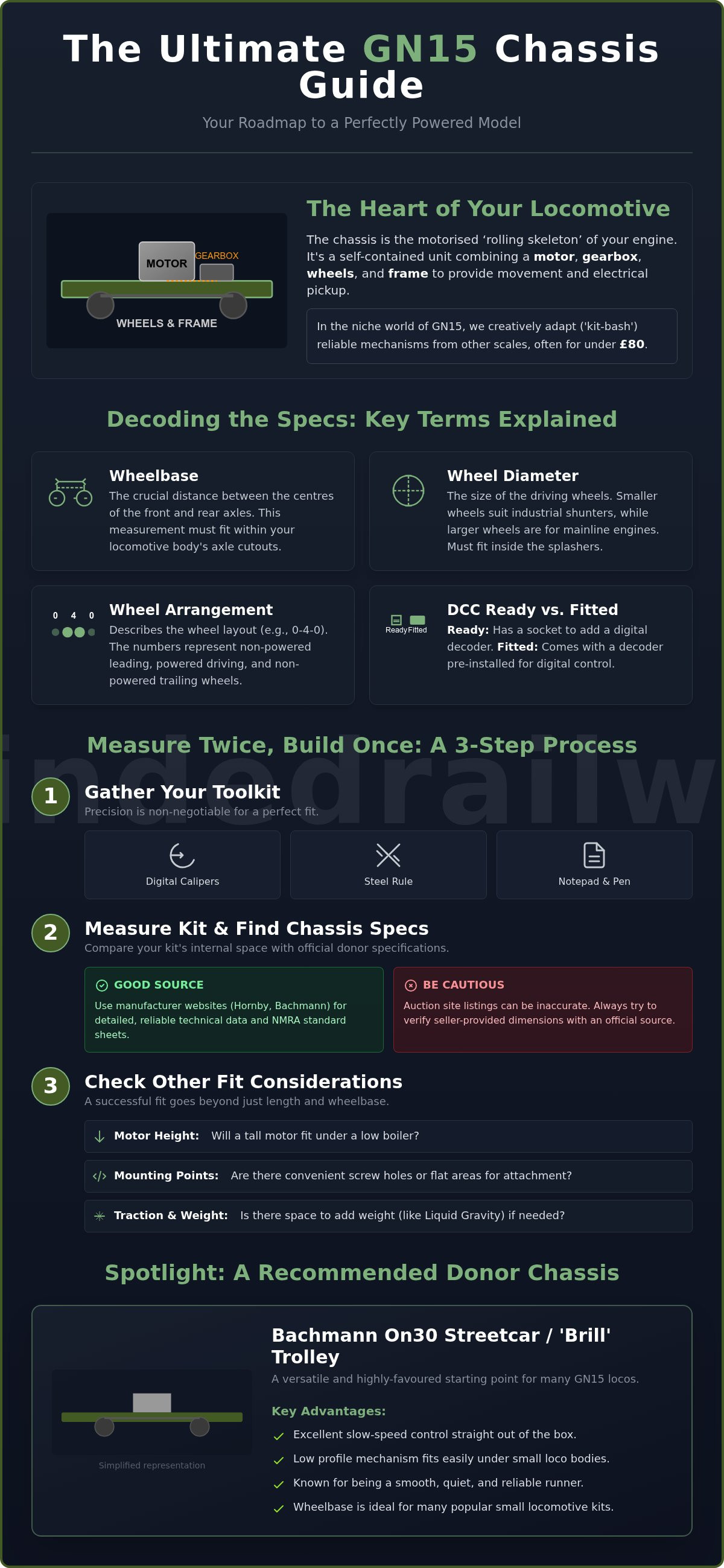
Think of the chassis as the motorised ‘rolling skeleton’ of your locomotive. It’s the complete, self-contained mechanical underframe that provides both movement and electrical pickup. This critical component combines a motor, a gearbox, wheels, and a frame into a single functional unit. In the unique world of the Gn15 scale, where large G scale (1:22.5) narrow gauge models run on 16.5mm track (the same as OO or HO gauge), the choice of chassis is paramount. It dictates not only how smoothly your engine runs but also defines its core visual characteristics.
To see how a popular donor chassis from another scale can be adapted, the video below provides an excellent overview of the modification process:
Getting this choice right is the first step in any successful build, and this gn15 chassis guide is here to help you navigate the options. Since GN15 is a modeller's scale, you won't find off-the-shelf chassis. Instead, we creatively adapt, or 'kit-bash', mechanisms from other, more common scales like OO, On30, or even N gauge.
Key Chassis Terminology Explained
Understanding these terms will help you choose the right foundation for your project:
- Wheelbase: The crucial distance between the centres of the front and rear axles. This measurement must fit within your locomotive's body.
- Wheel Diameter: The size of the driving wheels. Larger wheels suit mainline engines, while smaller wheels are typical for industrial shunters and critters.
- Wheel Arrangement: A series of numbers (e.g., 0-4-0, 0-6-0) describing the wheel layout. The numbers represent non-powered leading wheels, powered driving wheels, and non-powered trailing wheels, respectively.
- DCC Ready vs. DCC Fitted: 'DCC Ready' means the chassis has a socket to easily add a digital decoder chip. 'DCC Fitted' means it comes with a chip pre-installed for digital control.
Why GN15 Relies on Donor Chassis
The niche appeal of GN15 is part of its charm, but it means manufacturers don't produce ready-to-run chassis specifically for it. This opens up a wonderfully creative aspect of the hobby: kit-bashing. By using a 'donor' chassis from a mass-market model, like a Hornby 'Pug' or a Bachmann On30 Davenport, you get a reliable mechanism at an affordable price, often under £80. Don't be intimidated; many popular conversions are straightforward and well-documented by the modelling community.
The Modeller's Toolkit: How to Measure for a Perfect Fit
In the world of model railways, the old carpenter's adage "measure twice, cut once" is gold. Before you spend a single penny on a potential donor chassis, taking precise measurements of your locomotive kit body is the single most important step. This prevents costly mistakes and ensures your project gets off to a smooth start. This part of our gn15 chassis guide is all about precision.
Your essential toolkit is simple but non-negotiable:
- Digital Calipers: For accurate internal and external measurements.
- Steel Rule: A reliable tool for measuring longer dimensions like overall length.
- Notepad & Pen: To record everything as you go.
Measuring Your Locomotive Kit Body
First, focus on the internal space. Use your calipers to measure the maximum available internal length and width where the chassis will sit. Remember to account for any intruding details inside the body shell. Next, identify the wheelbase by measuring the distance between the centre of the axle cutouts in the kit's frames or footplate. Finally, check the wheel diameter; measure the inside of the splashers or the space within the frames to determine the largest wheel size that will fit without fouling.
Finding Dimensions for a Donor Chassis
With your kit's dimensions recorded, it's time to hunt for a matching chassis. Manufacturer websites (like Bachmann or Hornby) are the best source, often providing detailed technical specification sheets. These documents list key data like wheelbase, wheel diameter, and overall length. When reading them, ensure you're comparing like-for-like measurements. Many of these specifications follow established NMRA standards, which provides a degree of reliability. Be very cautious of auction site listings; dimensions provided by sellers can be inaccurate, so always seek official data to verify a potential purchase.
Beyond the Basics: Other Fit Considerations
A successful fit goes beyond just length and wheelbase. Check the motor height on the donor chassis; a tall, vertically-mounted motor might not fit under your kit's low boiler. Also, consider how you will attach the body. Does the chassis have convenient mounting points or screw holes that align with solid parts of your kit? Finally, think about traction. A lightweight N-gauge chassis may need extra weight, so look for empty spaces on the chassis where you can add products like Liquid Gravity or lead shot.
Popular & Recommended Donor Chassis for GN15
Once you have a project in mind, the next step is finding the right motor to bring it to life. The world of ready-to-run models offers a fantastic source of reliable and affordable mechanisms. This section of our gn15 chassis guide breaks down the most popular donor chassis, highlighting their strengths and weaknesses to help you make an informed choice.
The Bachmann On30 Range: A Versatile Starting Point
For modellers seeking excellent performance straight out of the box, the Bachmann On30 range is a prime choice. The chassis from the Streetcar (or 'Brill' Trolley) is particularly favoured for its low profile, smooth running, and ideal wheelbase for many small locomotives. Similarly, the mechanisms from the Gas Mechanical and other small On30 locos are robust and reliable.
- Pros: Excellent slow-speed control, readily available in the UK, correct gauge without modification.
- Cons: Can be more expensive, with prices often starting around £50-£70 for a donor model.
- Typical Use: Small diesel shunters, steam trams, and characterful freelance locomotives.
Classic Hornby & Bachmann OO Gauge 0-4-0s
A staple of the UK modelling scene, the humble 0-4-0 tank engine chassis from Hornby (like the 'Smokey Joe') or Bachmann (found under 'Percy' or 'Thomas' bodies) is a budget-friendly gateway into GN15. These are perfect for smaller, more whimsical projects and can often be found second-hand for under £25. They provide a solid foundation for learning conversion techniques.
- Pros: Very affordable, widely available at swapmeets and online, simple and robust design.
- Cons: Running quality can be variable; often requires modification of the oversized coupling rods for a finer-scale appearance.
- Typical Use: Light industrial steam engines, quirky "critters," and first-time scratch-building projects.
N Gauge Mechanisms for Smaller Locomotives
For truly tiny locomotives, an N gauge chassis is the perfect solution. Power units like the Kato 11-105 or various Tomytec 'Tomy-tram' chassis are compact, reliable, and surprisingly powerful. Working at this scale requires precision, but the results are rewarding. For inspiration on what can be achieved with detailed small-scale modelling, viewing the intricate layouts at places like the San Diego Model Railroad Museum can be highly motivating.
- Pros: Extremely compact size allows for very small locomotive designs; often excellent performers.
- Cons: Wheels are undersized for true 15-inch scale prototypes; can be fiddly to work with and mount a body to.
- Typical Use: Micro-locos, small internal combustion engines, and railcars for very tight radius layouts.
Preparing Your Chassis for a New Body
Once you've selected your donor mechanism, the next step is preparing it to accept a new kit. Rarely will a commercial chassis be a perfect drop-in fit. This stage of modification is where your model truly becomes unique, and it’s a simple, rewarding part of the process. Don't be daunted; this part of our gn15 chassis guide is where the real customisation begins. Always remember to wear safety glasses when cutting or filing, and take care if using a soldering iron.
Stripping Down the Original Body
Your first task is to carefully remove the manufacturer's body shell. Start by looking for small screws, often hidden on the underside or behind bogies. Many modern models also use plastic clips moulded into the body that snap onto the chassis. Use a small, flat-bladed screwdriver or a plastic spudger to gently pry these apart. Work slowly to avoid snapping any delicate parts. Once removed, store the old body and any associated screws in a labelled bag - they are perfect for future kit-bashing projects!
Common Chassis Modifications
With the chassis exposed, you can see what needs changing. The goal is to create a flat, unobstructed platform for your new kit. Common adjustments include:
- Trimming the Frame: Use a sharp craft knife or a set of files to carefully remove any plastic lugs, clips, or sections of the frame that foul the new body. For metal frames, a small hobby saw may be needed.
- Removing Details: Unwanted moulded details like steps, tanks, or cab supports can be shaved or filed away for a clean fit.
- Extending Wires: If your new kit includes lighting, you may need to extend the chassis wires to reach new LED locations. Solder new lengths of wire, ensuring you insulate the join with heat-shrink tubing for a safe and reliable connection.
Creating New Mounting Points
Your new body needs a secure way to attach to the modified chassis. A popular method is to use styrene strips, glued with plastic cement, to build new mounting posts that align with your kit. For more complex shapes, an epoxy putty like Milliput can be moulded into place to create bespoke supports. For a robust connection, you can drill a small pilot hole into your new mounts and tap it for a screw. Alternatively, small, strong neodymium magnets or double-sided adhesive pads offer a less permanent but effective solution.
Ready to build? Check out our essential diorama tools.
Pairing Guide: Narrow Minded Railworks Kits & Their Chassis
There's nothing more satisfying than seeing your new locomotive run smoothly on its chassis for the first time. To help you get to that moment faster, we've taken the guesswork out of the equation. Our kits are meticulously designed around specific, readily available chassis to ensure a smooth and enjoyable build. This compatibility list is the final, practical piece of our gn15 chassis guide, giving you the confidence to purchase the right components from the start and avoid costly mistakes.
NMRW Kit & Chassis Compatibility
Use this quick-reference table to find the perfect pairing. The chassis listed here have been chosen for their reliability, good running qualities, and general availability within the UK market. We've noted the level of modification required, from simple direct fits to more involved, but manageable, adjustments.
| NMRW Kit Name | Recommended Chassis | Notes |
|---|---|---|
| The Gnatterbox | Bachmann On30 Streetcar | A direct fit. The kit is designed to sit perfectly on this chassis with minimal modification required. |
| The Gnat | Hornby 'Smokey Joe' 0-4-0 | Requires trimming of the chassis frame and removal of the original cylinders for a snug fit. A classic bit of kit-bashing. |
| The Wasp | Kato 103 or 104 N-Gauge Chassis | An excellent slow-speed runner. Requires a simple mounting block (included) to be glued to the chassis. |
| The Horwich | Peco/Kato "Ffestiniog" 0-4-0 Chassis | A robust and reliable choice from a well-respected brand. Some minor filing of the chassis block may be needed for clearance. |
Featured Build: The Gnatterbox on a Bachmann Chassis
To illustrate how seamlessly our kits work with their intended donors, let's look at one of our most popular combinations: The Gnatterbox loco kit and the Bachmann On30 Streetcar chassis.
[Image: Side-by-side view of the Gnatterbox kit parts and the donor Bachmann chassis]
The beauty of this pairing is its simplicity. The Bachmann chassis is a reliable performer straight out of the box. The first step is to simply remove the original streetcar body, which is usually held by a few small screws. Once the body is off, you are left with a flat, ready-to-use motorised platform. We recommend a quick test run at this stage to ensure everything is working correctly.
[Image: The Gnatterbox body being lowered onto the prepared chassis, showing alignment points]
Our Gnatterbox kit is designed with specific mounting points that align perfectly with the chassis structure. After cleaning up any print supports from the resin parts, you can perform a test fit. You'll see there's no need for complex cutting or drilling. The main body simply sits over the motor block, and the footplates align with the chassis frame, creating a secure fit that can be fixed with a small amount of superglue or epoxy. This intentional design makes it an ideal project for anyone following this gn15 chassis guide and looking for a fantastic entry into the scale.
Ready to start your own project? Find the perfect GN15 kit for your chassis here!
Your Journey to the Perfect GN15 Locomotive Starts Here
Choosing the right chassis is the most critical first step in building a reliable and characterful GN15 locomotive. As we've explored, understanding core measurements and identifying popular donor models provides a solid foundation for any project. We hope this gn15 chassis guide has armed you with the confidence to select a smooth-running mechanism, ensuring your finished model is a true performer on your layout.
Now that you're ready to find the perfect body for your chosen chassis, it's time for the exciting part. At Narrow Minded Railworks, our kits are specifically designed to fit popular, easy-to-find chassis. Each kit comes with detailed instructions and offers a unique, characterful 3D printed design you simply won't find elsewhere.
Take the next step and bring your vision to life. Explore Our Full Range of GN15 Locomotive Kits and discover the inspiration for your next masterpiece. Happy modelling!
Frequently Asked Questions
Where is the best place to buy donor chassis like the Bachmann Streetcar?
In the UK, the best places to find donor chassis are model railway exhibitions and swapmeets, where you can often find them second-hand for a good price. Online marketplaces like eBay UK are also excellent sources, but be sure to check seller ratings. For new chassis, specialist narrow gauge suppliers such as Backwoods Miniatures or Parkside Dundas may stock suitable mechanisms, or you can check with larger model railway retailers for currently available N or OO9 scale models to adapt.
What does it mean if a chassis is a 'split frame' design?
A split frame chassis is a design where the metal frame is constructed in two halves, left and right. Each half is electrically connected to the wheels on its side and acts as a conductor, carrying power from the track to the motor. The two halves are separated by insulating spacers. This was a common manufacturing method for older models but can make converting to DCC more complex as the motor must be completely isolated from both halves of the frame.
Can I use a 3D printed chassis for my GN15 model?
Yes, absolutely. Using a 3D printed chassis is a popular and flexible option for GN15 modelling. This approach allows you to create a chassis with a specific wheelbase and design features to perfectly match your prototype. You will need to source a suitable motor, gearbox, wheels, and axles separately to complete it. While it requires more assembly, this method is a key part of any modern gn15 chassis guide for achieving truly bespoke and accurate models.
Is it difficult to convert a chassis to DCC (Digital Command Control)?
The difficulty varies greatly with the chassis design. Modern "DCC-ready" chassis often have a simple socket to plug a decoder into, making conversion very easy. However, older designs, particularly split-frame chassis, can be very challenging. These require completely isolating the motor from the frame, which may involve intricate rewiring or even carefully milling parts of the metal frame. Always assess the motor connections before starting a conversion on an older mechanism.
What's the difference between a chassis for a steam loco vs. a diesel loco?
The primary difference is mechanical and visual. A steam locomotive chassis typically features exposed driving wheels connected by coupling rods, such as an 0-4-0 or 0-6-0 wheel arrangement. A diesel chassis, or "power bogie," usually has its mechanism contained within a solid block with gears driving the axles directly. The choice depends entirely on the type of locomotive you intend to build, as the chassis provides the characteristic look and motion of the prototype.
How do I clean and lubricate my new chassis before use?
First, gently wipe down the chassis and wheels with a cotton bud lightly dampened with isopropyl alcohol to remove any factory grease or dust. Inspect the gears for any plastic flashing and carefully remove it with a craft knife. Then, apply a minuscule amount of high-quality model lubricant to the axle ends and motor bearings using a pin or oiler. Remember, less is more; too much oil will attract dirt and hinder performance rather than improve it.