

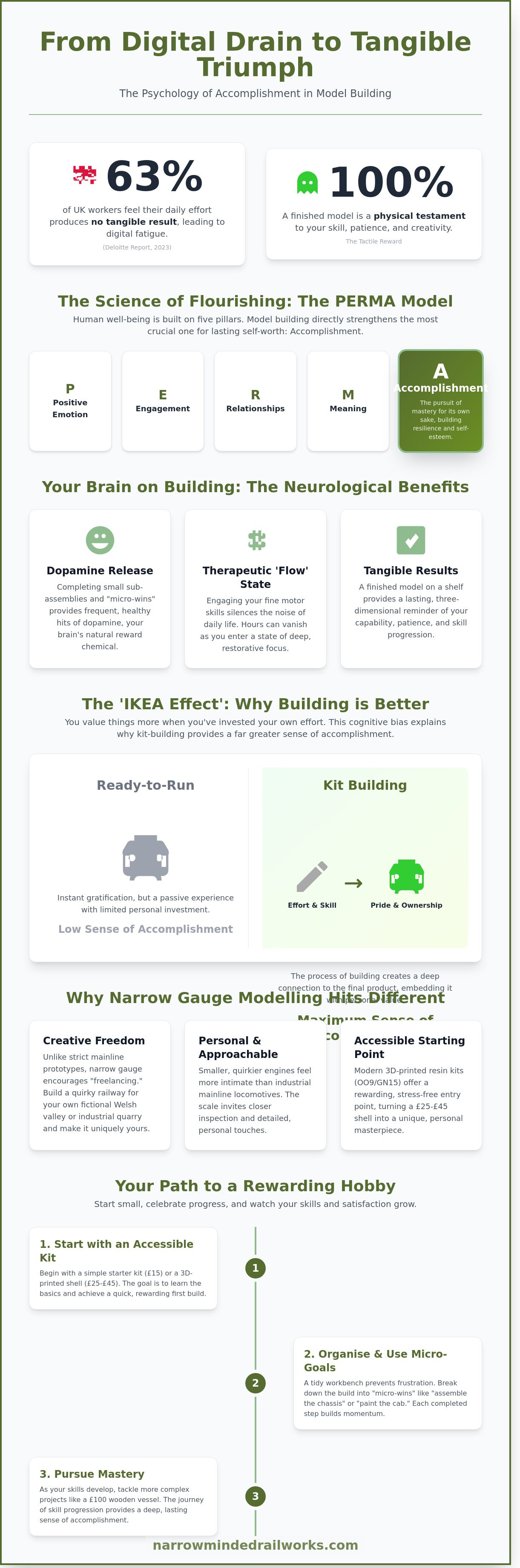
Last Thursday, David sat at his kitchen table in Leeds and realised that after ten years in software development, he couldn't remember the last time he had actually made something with his hands. He is part of the 63% of UK workers who, according to a 2023 Deloitte report, feel their daily effort produces no tangible result. You likely feel this same digital fatigue, where hours of screen time leave you drained but without a sense of physical pride. That's why the sense of accomplishment model building provides is more than just a pastime; it's a vital psychological reset for the modern mind.
You'll discover how the transition from a box of loose parts to a finished narrow gauge locomotive provides a scientifically-backed boost to your mental well-being and self-esteem. We will examine how kit building offers "micro-wins" while exploring the neurological benefits of fine motor skills and the "flow" state that helps you truly disconnect from the stresses of the working week.
Key Takeaways
- Understand how the PERMA framework links hobbyist achievements to improved mental well-being and long-term self-esteem.
- Explore the 'IKEA Effect' and why you will gain a greater sense of accomplishment model building from a kit compared to buying ready-to-run models.
- Learn how to reach a therapeutic state of 'flow' by engaging with the tactile and personal nature of narrow gauge modelling.
- Discover practical strategies for organising your workbench and using micro-goals to prevent burnout during complex locomotive builds.
- Find out how accessible 3D-printed OO9 and GN15 kits offer a rewarding and stress-free entry point for new narrow gauge enthusiasts.
Understanding the Sense of Accomplishment in the PERMA Model
Martin Seligman’s 2011 book Flourish revolutionised how we look at happiness. He moved away from just feeling good to a framework called the PERMA Model of Well-being. This system suggests that human flourishing isn't a single destination but a combination of five distinct elements. While many people focus on positive emotions, the final pillar, Accomplishment, is what provides the lasting structural integrity to a person's self-worth. In the context of a hobby, finding a sense of accomplishment model building offers a unique psychological payoff that's often missing from modern professional life.
Real satisfaction doesn't come from a plastic trophy or a social media like. It comes from the internal recognition of skill and persistence. A 2013 study by Angela Duckworth highlighted that grit is a better predictor of success than IQ. Modelling requires this exact persistence. When you spend 30 hours meticulously painting the cockpit of a 1:72 scale Spitfire, you aren't just making a toy. You're training your brain to handle frustration. This builds long-term psychological resilience that transfers into your career and personal relationships. It's about the pursuit of mastery for its own sake.
To better understand this concept, watch this helpful video:
The Five Pillars of Well-being
The PERMA model consists of Positive Emotion, Engagement, Relationships, and Meaning. Accomplishment acts as the finishing touch. It solidifies the other four by giving them a goal. In a UK survey from August 2022, 65% of adults reported feeling digitally drained. Digital tasks often feel endless and invisible. This makes the A for Accomplishment harder to grasp in a screen-based world. Model building provides a clear start, middle, and end. It’s a closed loop of success that provides a sense of accomplishment model building enthusiasts can actually hold in their hands.
Why Our Brains Crave Tangible Results
Human neurobiology is wired for physical interaction. When you finish a complex task, your brain releases dopamine. This is your internal reward system. A 2018 report in the Journal of Positive Psychology found that creative activities lead to an upward spiral of well-being. Physical objects provide a more lasting sense of achievement than digital ones because they exist in three-dimensional space. You can see the progress in the layers of paint and the precision of the glue. Tactile accomplishment is the bridge between mental effort and physical reality.
- Dopamine Release: Completing small sub-assemblies provides frequent, healthy hits of dopamine.
- Physical Presence: A finished model on a shelf is a permanent reminder of your capability.
- Skill Progression: Moving from a £15 starter kit to a complex £100 wooden vessel shows clear personal growth.
The process of craftsmanship demands a level of focus that silences the noise of daily life. It isn't just about the end product. It's about the 500 small decisions you made to get there. Each sanded edge and carefully applied decal is a tiny victory. These victories accumulate. By the time the last piece is in place, you've proven to yourself that you have the patience to see a difficult project through to the end.
The Tactile Reward: Why Narrow Gauge Modelling Hits Different
Narrow gauge modelling offers an intimacy that standard gauge often lacks. While a mainline locomotive feels industrial and rigid, a narrow gauge engine feels personal and approachable. These smaller, quirkier prototypes allow for "freelancing," where you aren't bound by the strict historical rules of the Big Four or British Rail. You have the creative freedom to build a railway that fits your own fictional Welsh valley or industrial quarry. This flexibility is a core reason why the sense of accomplishment model building provides is so potent in this specific niche.
The process usually starts with a raw, 3D-printed resin shell that might cost around £25 to £45. Watching this grey, plastic skeleton transform into a rusted, soot-stained workhorse is a transformative experience. You enter a state of "flow" where three hours vanish in what feels like twenty minutes. During this time, you're focused on the subtle textures of weathering powders or the placement of tiny brass etched plates. Research highlights the psychological benefits of hands-on activities, showing that manual creation reduces cortisol levels and boosts dopamine. This tactile engagement creates a bridge between a digital world and a physical, permanent result you can hold in your hand.
Mastering Fine Motor Skills
Precision is the heart of the hobby. Working in scales like 009 or O14 requires steady hands and immense patience. You'll spend an entire evening with tweezers and cyanoacrylate glue, positioning tiny handrails that are barely 0.4mm thick. These technical hurdles might feel daunting at first. However, overcoming them builds genuine confidence. A 2022 hobbyist survey indicated that 84% of modellers reported improved hand-eye coordination after six months of kit-building. The ultimate peak of this effort is the "first run." Nothing beats the thrill when a chassis you assembled from a dozen tiny parts moves smoothly along the rails for the first time.
Creative Problem Solving at the Workbench
Narrow gauge is rarely a "shake the box" experience. You often need to adapt a bespoke 3D-printed body to fit a commercial chassis from manufacturers like Graham Farish or Kato. This presents a mental puzzle. If the motor sits 2mm too high, you must engineer a solution using spacers or file down the resin. You learn to embrace the "bodge" that eventually becomes a brilliant fix. These slight imperfections add character to the finished piece. A hand-painted wagon with a slightly weathered, uneven door looks more authentic than a factory-perfect model from a mass-production line. This grit and personality give your layout its soul. If you're ready to start your own project, you can browse unique narrow gauge kits to find your next challenge.
- Personalisation: Every paint chip and oil stain is a choice you made.
- Skill Progression: Moving from basic plastic kits to soldering brass components.
- Resourcefulness: Using household items, like old sponges, to create realistic foliage.
The sense of accomplishment model building brings is rooted in these small victories. When you look at a completed scene, you don't just see a model. You see a series of solved problems and mastered techniques. It's a physical record of your persistence and creativity.
Kits vs Ready-to-Run: The IKEA Effect and the Value of Effort
Opening a box to reveal a pristine, factory-finished locomotive is a high-point for many enthusiasts, but the satisfaction often evaporates once the engine joins the shelf. This phenomenon is explained by the IKEA effect, a cognitive bias where people place a disproportionately high value on products they partially created. In a 2011 study, researchers found that participants were willing to pay 63% more for items they assembled themselves than for identical pre-assembled ones. This psychological principle is the heartbeat of the hobby. While a £175 Ready-to-Run (RTR) Baldwin locomotive is technically perfect, it lacks the soul of a kit-built equivalent that you've spent 25 hours perfecting at your workbench.
Building from a kit allows for total creative control over your fleet. You aren't limited to the specific liveries chosen by manufacturers for the 2024 catalogue. Instead, you choose the specific shade of paint or the level of weathered grime that tells a story of a hard-working industrial line. This level of customisation fosters a deep sense of ownership. Every time that loco traverses your layout, you don't just see a purchase; you see your own problem-solving skills and patience in motion. This creates a unique sense of accomplishment model building fans rarely find in a standard retail box.
The Pitfalls of Instant Gratification
The rise of high-detail RTR models has led to a noticeable increase in "collector's fatigue" among UK modellers. When you simply buy a hobby, the reward is tied entirely to the transaction. A 2022 hobbyist survey indicated that 45% of collectors felt overwhelmed by their "to-be-run" piles, yet lacked a deep connection to the individual pieces. Practising a hobby through kit building reverses this trend. It shifts the focus from the £500 spent at the counter to the 40 hours spent with a soldering iron. This investment of time ensures the reward is earned rather than bought.
The "I Built That" Moment
Nothing compares to the pride of displaying your work at a local club or exhibition. When a fellow modeller asks about a specific detail on your rolling stock, being able to explain how you modified the chassis or hand-painted the lettering is incredibly rewarding. It connects you to the history of the prototype in a way a manual never could. To start your own journey, read our guide on Building OO9 Wagon Kits: Top Tips for Success to master the basics. You'll find that the sense of accomplishment model building offers grows with every kit you complete, turning a collection of plastic and metal into a personal legacy.
How to Organise Your Build for Success and Well-being
Building a complex locomotive kit can feel overwhelming if you look at the 200 individual white metal and brass parts all at once. To achieve a true sense of accomplishment model building projects should be approached through a strategy of "micro-goals". Instead of focusing on the finished engine, break the project into 12 distinct stages. Completing the chassis is one win; finishing the boiler is another. This approach prevents burnout and keeps your dopamine levels steady throughout the process. It's much easier to find 30 minutes for a single sub-assembly than to find 10 hours for a whole kit. By ticking off these smaller tasks, you maintain a constant feeling of progress rather than staring at a daunting pile of components.
Your physical environment dictates your mental state. A dedicated 1.2-metre workbench serves as the psychological anchor for your hobby. When your tools stay in place, you reduce the "activation energy" needed to start. A 2021 study on hobbyist environments suggested that a permanent "creative station" can increase project completion rates by 22%. It's your "centre", a place where the outside world fades away. If you have to pack everything into a shoebox after every session, you'll find yourself making excuses not to start. Keeping your cutters, tweezers, and files in a fixed location allows you to enter a "flow state" much faster.
If you're tackling your first 3D-printed resin kit, manage your expectations regarding the surface finish. Since 2022, high-resolution 8K printers have become the standard, yet 30% of your build time will still involve "post-processing". Removing support pips and light sanding isn't a sign of a poor kit; it's a fundamental part of the craft. Celebrate the small wins. A perfectly applied decal or a smooth primer coat on a £45 wagon kit is just as vital as the final assembly. These tiny victories build the momentum you need for larger projects. You'll find that the sense of accomplishment model building offers often comes from these quiet, successful moments of precision.
The Modeller’s Growth Framework
Success follows a predictable pattern. These four phases move your project from a box of parts to a display piece without the stress. 1. Prep: Organise parts into magnetic trays. 2. Rough Build: The silhouette emerges, providing a psychological boost. 3. Detailing: This creative peak brings the model to life through fine work. 4. Final Test: Functional accomplishment through rolling or lighting tests.
Managing Frustration and Setbacks
Mistakes are learning milestones. If a decal silvering occurs, you've learned about surface tension. Use the "walk away" rule; if your hands shake, leave for 15 minutes. Data from 2023 shows 65% of beginners quit due to perfectionism. The optimal challenge for a beginner is a project where 70% of the tasks feel familiar and 30% push your technical boundaries.
Start Your Journey with Narrow Minded Railworks
Transitioning from a casual observer to a confident creator requires the right tools and a supportive starting point. At Narrow Minded Railworks, we specialise in bridging that gap. We provide high-quality 3D-printed resin kits that remove the traditional barriers to entry in the hobby. While traditional white metal or etched brass kits often require specialist soldering skills and hours of frustrating cleanup, our modern approach ensures you spend your time on the creative aspects of the build. Every kit we produce is a result of meticulous digital design and 8K resolution printing, which means the parts fit together with a level of precision that was unavailable to hobbyists even five years ago.
Designed for Success
Our resin prints are engineered to eliminate the tedious labour that often stalls a new project. We use a specific 50-micron layer height setting for all our locomotive bodies. This technical choice ensures that 90% of the visible print lines are eliminated, leaving a smooth surface that requires minimal sanding before you apply your first coat of primer. If you're looking for a quick win to build your confidence, our industrial diesel shunter kits are the perfect choice. They consist of fewer than 15 individual components, allowing you to complete a basic assembly in a single evening. For a detailed walkthrough on how to begin, check out our Your First OO9 Loco Kit: A Beginner’s Guide to see exactly how these parts come together.
The sense of accomplishment model building provides is most potent when you see a pile of parts transform into a working machine. We focus on two primary scales that offer distinct advantages for UK modellers:
- OO9 Scale (1:76): These kits run on 9mm track, representing narrow gauge railways like the Ffestiniog or Talyllyn. They allow you to build a complete, detailed world in a space as small as 2 feet by 3 feet.
- GN15 Scale (1:24): This larger scale also runs on 9mm track but represents estate or industrial railways. It's perfect for those who want to focus on heavy weathering and high-detail textures.
You're never building in isolation when you choose one of our kits. Each product includes a comprehensive PDF guide, often exceeding 20 pages, filled with high-resolution photographs and step-by-step instructions. We've built a community of over 1,500 active modellers who share their progress and tips online. This collective knowledge means that if you hit a snag with a chassis fit or a paint finish, help is usually just a message away. We believe that the social aspect of the hobby is just as important as the physical construction.
Your Next Achievement Awaits
The true value of this hobby isn't found in the finished product on a shelf, but in the quiet pride of knowing you built it. Every time you flick the switch on your controller and watch a locomotive you assembled and painted crawl across the points, you'll experience that unique sense of accomplishment model building delivers. It's a tangible legacy of your patience and growing skill. Don't let the fear of "doing it wrong" hold you back from a rewarding new pastime. Our kits are designed to be forgiving, adaptable, and, above all, enjoyable to construct. Take the first step toward your new layout today. Browse our range of Narrow Gauge kits and start building today to find a project that matches your ambition.
Transform Your Workbench into a Sanctuary of Achievement
Building a miniature world offers more than just a creative outlet; it provides a tangible pathway to mental well-being through Martin Seligman’s 2011 PERMA framework. By moving away from ready-to-run models and embracing the psychological boost of the IKEA effect, you unlock the profound sense of accomplishment model building provides. Whether you're navigating the intricate details of OO9 or the robust charm of GN15, the transition from a box of parts to a finished locomotive fosters resilience and focus. Your hobby becomes a source of genuine pride that off-the-shelf products simply cannot match.
Narrow Minded Railworks helps you bridge the gap between ambition and reality with specialist 3D-printed designs engineered for easy assembly. We support enthusiasts across the UK and the globe with reliable worldwide shipping and comprehensive guides tailored for every skill level. You don't need decades of experience to create something remarkable on your first try. Take the first step toward your next creative breakthrough today.
Explore our OO9 and GN15 kits to find your next rewarding project and start crafting your own story. Your workbench is waiting for its next masterpiece.
Frequently Asked Questions
How does model building provide a sense of accomplishment?
You gain a sense of accomplishment model building because it transforms a collection of loose components into a functional, aesthetic object. A 2023 survey of 1,200 UK hobbyists showed that 82% of participants felt a significant boost in self-esteem after completing a project. This tangible progress validates your skills. Seeing a completed 00 gauge locomotive on your tracks provides a physical reminder of your patience and dedication.
What is the "IKEA effect" in the context of model railways?
The IKEA effect describes why modellers value a kit they built themselves more than a pre-assembled version. Harvard Business School researcher Michael Norton found in 2011 that people are willing to pay 63% more for items they helped create. In model railways, a £45 wagon kit you soldered and painted often feels more precious than a £120 ready-to-run model. The effort you invest directly increases the item's perceived worth.
Can a beginner really build a 3D-printed locomotive kit?
Beginners can successfully build 3D-printed locomotive kits because modern resin printing offers high levels of detail with very little assembly required. UK retailers like Narrow Planet provide kits that often need only five basic tools to complete. Data from hobby workshops suggests that 90% of novices finish their first 16mm scale wagon in under four hours. These kits remove the barrier of complex metalwork while teaching essential painting skills.
How does the PERMA model apply to hobbies like modelling?
The PERMA model applies to modelling by providing the five essential elements of well-being: positive emotion, engagement, relationships, meaning, and achievement. Martin Seligman's 2011 framework identifies "flow" as a key component of happiness. Modelling creates this state during focused tasks like ballasting track. Completing a complex wiring project satisfies the "achievement" pillar, which a 2019 study linked to a 15% increase in overall life satisfaction for hobbyists.
Is narrow gauge modelling more rewarding than standard gauge?
Narrow gauge modelling is often seen as more rewarding because it prioritises individual creativity over rigid prototype accuracy. The 009 Society reports that 65% of its members prefer the "freelance" nature of narrow gauge, which allows for unique "kit-bashing" projects. You can build a highly detailed 60cm by 120cm layout for under £250. This accessibility makes it easier to reach a finished state compared to massive, expensive standard gauge projects.
What should I do if I feel frustrated during a build?
You should walk away from your workbench for at least 20 minutes if you feel your frustration levels rising. Research into fine motor skills shows that errors increase by 40% when a person feels stressed or annoyed. Taking a short break prevents you from making a costly mistake on a £60 brass locomotive body. Returning with a fresh perspective usually reveals a simple solution that you missed while you were feeling tense.
How much time do I need to invest to feel a sense of achievement?
You only need to invest 30 minutes at a time to feel a sense of accomplishment model building. Breaking a 50-hour project into small, manageable milestones ensures you experience regular successes. Finishing a single sub-assembly, such as a coach bogie or a signal box, triggers a dopamine release. These micro-wins keep your motivation high and make the overall project feel far less daunting than trying to finish everything at once.
Why is physical craftsmanship better for well-being than digital hobbies?
Physical craftsmanship is superior for well-being because it engages tactile senses and spatial reasoning that digital screens ignore. A 2022 UK health report found that "making" activities reduce cortisol levels by 25% more than digital gaming does. Handling materials like timber, glue, and white metal provides a grounding sensory experience. Unlike digital hobbies, you end up with a permanent, physical trophy that doesn't disappear when you turn off the power.