

Type 'K-27' into a search engine, and you might find yourself diving deep into the world of Soviet submarines. But for railfans and modelers, that designation belongs to something far more fascinating: the legendary Denver & Rio Grande Western K-27 'Mudhen'. For too long, piecing together the story of these iconic narrow gauge workhorses has meant trawling through dusty forums and fragmented websites, leaving many to wonder what truly made these locomotives so special.
This definitive guide changes all that. Here, you will discover the complete history of the 'Mudhen' class, from their ground-breaking design by the Baldwin Locomotive Works to their gruelling service life in the Rocky Mountains. We'll break down the technical specifications that set them apart, explore their enduring legacy, and reveal exactly where you can see these magnificent survivors in person today. Whether you're a seasoned railway enthusiast or planning your next model project, prepare to become an expert on one of America's most beloved steam locomotives.
Origins of a Legend: The Birth of the D&RGW K-27 Class
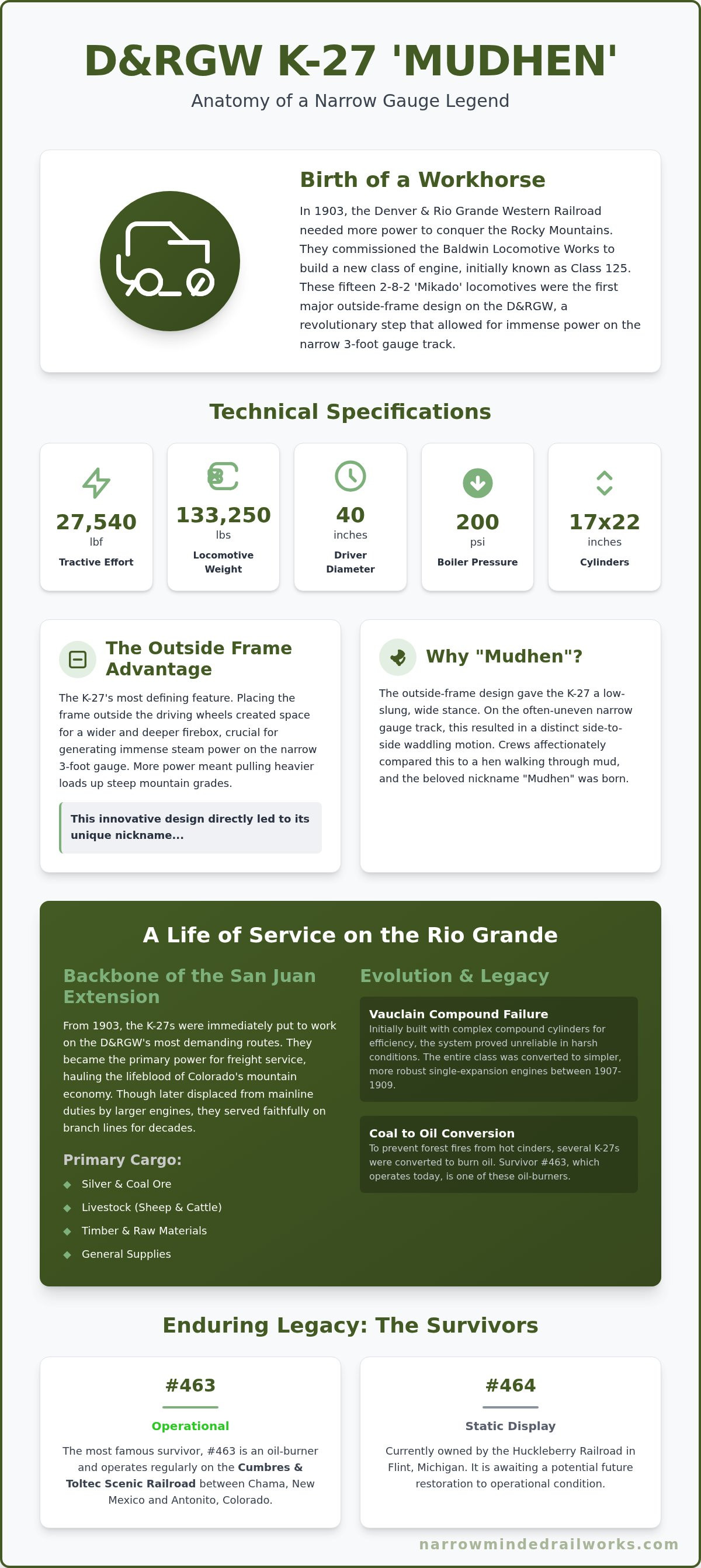
By the turn of the 20th century, the Denver & Rio Grande Western Railroad (D&RGW) faced a growing challenge: its ageing fleet of narrow gauge locomotives was struggling to move ever-increasing freight tonnage over the formidable mountain passes of the Rockies. To solve this, the railway turned to the Baldwin Locomotive Works, which delivered a new, more powerful class of engine in 1903. Initially designated Class 125, these fifteen locomotives would become legendary. The D&RGW K-27 Class was the first major outside-frame design on the D&RGW, a significant departure that allowed for a larger firebox and boiler, generating far more power than their predecessors.
These 2-8-2 Mikado-type locomotives were true workhorses, capable of tackling steep grades and tight curves while pulling heavy loads of coal, ore, and livestock. Their arrival heralded a new era of efficiency and capability for the D&RGW's narrow gauge operations, particularly on demanding routes like the San Juan Extension. The introduction of the k 27 marked the beginning of the end for the smaller, older engines, solidifying the D&RGW's reputation for operating some of the most impressive narrow gauge machinery in the world.
The Vauclain Compound Experiment
Initially, the K-27s were built with Baldwin's Vauclain compound cylinder system, which used steam twice-once in a high-pressure cylinder and again in a low-pressure one-to improve fuel efficiency. However, this complex technology proved ill-suited to the harsh, dirty conditions of mountain railroading. The intricate machinery was difficult to maintain, leading to frequent breakdowns. Recognising the issue, the D&RGW converted the entire class to simpler, more robust single-expansion engines between 1907 and 1909.
Why 'Mudhen'? The Story Behind the Nickname
The K-27s quickly earned the affectionate nickname 'Mudhens'. This name came from their distinctive appearance and movement. The outside-frame design placed the driving wheels and counterweights outboard of the frame, giving the locomotives a wide, low-slung stance. On the often uneven narrow gauge track, this resulted in a pronounced side-to-side waddling motion that crews likened to a hen walking through a muddy field. The name stuck, becoming a beloved part of the engine's identity.
Anatomy of the Mudhen: K-27 Design and Specifications
The Denver & Rio Grande Western's K-27 locomotives, affectionately nicknamed "Mudhens," were a masterclass in purpose-built engineering. Designed by Baldwin Locomotive Works in 1903, they represented a significant leap in power for the narrow gauge railway. Their design philosophy was simple: maximise pulling power on twisting, steep mountain track. This was achieved through a combination of a powerful boiler, a robust frame, and the classic 2-8-2 'Mikado' wheel arrangement, which provided excellent traction from its eight driving wheels while leading and trailing trucks offered stability on sharp curves.
Key Technical Specifications
The numbers behind the k 27 tell a story of immense strength for its size. Unlike earlier, smaller locomotives on the D&RGW, the Mudhens were built to move heavy freight with authority. Their specifications allowed them to haul longer and heavier trains, dramatically improving operational efficiency.
- Tractive Effort: 27,540 lbf (pounds-force)
- Locomotive Weight: Approx. 133,250 lbs (60,440 kg)
- Driver Diameter: 40 inches
- Boiler Pressure: 200 psi
- Cylinders: 17 x 22 inches
In practical terms, this high tractive effort meant the K-27 could grip the rails and pull tremendous loads up grades that would have stalled its predecessors. Over their long service lives, many were also fitted with larger tenders to increase their range between water and fuel stops.
Accurately measuring such immense weights, both then and now, requires specialized industrial equipment. For those interested in the modern application of heavy-duty weighing technology, resources like independentscale.au provide insight into the services that support today's heavy industries.
The Importance of the Outside Frame
One of the most defining visual and mechanical features of the K-27 is its outside-frame design. By placing the locomotive's main frames and counterweights outside the driving wheels, designers freed up crucial space between them. This allowed for a much wider and deeper firebox than an inside-frame design could accommodate on the narrow 3-foot gauge. A larger firebox meant more coal could be burned more efficiently, generating more steam and, consequently, more power-an essential advantage for mountain railroading. This design also contributed to its distinctive, waddling gait that earned it the "Mudhen" moniker.
From Coal to Oil Burners
Originally built as coal-burning locomotives, several K-27s were converted to burn oil during their careers. This change was driven primarily by the need for fire prevention, as hot cinders ejected from a coal engine's smokestack posed a significant risk of starting lineside fires in the dry, forested terrain of the Rocky Mountains. Of the two surviving operational examples, this legacy continues; locomotive #463, which operates today as an oil-burner on the famous Cumbres & Toltec Scenic Railroad, was one such engine converted for safety and efficiency.
A Life of Service: The K-27s on the Rio Grande
Upon their arrival in 1903, the K-27 locomotives were immediately put to work on the most demanding sections of the Denver & Rio Grande Western's narrow-gauge network. Nicknamed "Mudhens" for their outside frames and waddling gait, these engines quickly earned a reputation among crews as powerful, if somewhat temperamental, workhorses. They were the backbone of the San Juan Extension, hauling everything the Colorado mountains could produce.
The primary role of a k 27 was freight service. Their daily duties involved pulling long, heavy trains loaded with:
- Silver and coal ore from the high-altitude mines.
- Livestock, primarily sheep and cattle, to market.
- Timber and raw materials for construction and industry.
- General supplies and merchandise for the isolated mountain communities.
Despite their success, their reign was not absolute. The arrival of the larger K-36 and K-37 locomotives in the 1920s displaced the Mudhens from the heaviest mainline duties. They were relegated to branch line services and helper duties, a role they served faithfully until the eventual decline of steam in the face of dieselisation.
Tackling the Mountain Passes
The K-27s were built for the grind of mountain railroading. They were a common sight battling the 4% grades of Cumbres Pass and the winding route over Marshall Pass. Winter operations were particularly brutal, with crews fighting deep snow and treacherous ice on the rails. Their impressive tractive effort made them essential as "helper" engines, added to the front or rear of a train to provide the extra power needed to conquer the steepest sections.
Modifications and Upgrades Over the Years
Over their five decades of service, the D&RGW's Burnham Shops in Denver made numerous modifications to the fleet. No two engines remained identical for long. Changes included installing new smokestacks, replacing original slide valves with more efficient piston valves, and adding superheaters. Enthusiasts can track these individual changes through resources like the detailed K-27 Locomotive Roster, which is invaluable for creating historically accurate models reflecting a specific locomotive at a particular time.
Preservation: Where to See a K-27 Today
While the majority of the Denver & Rio Grande Western's "Mudhens" met the scrapper's torch, a handful of these iconic locomotives were saved through the foresight of railways and preservationists. For railfans in the United Kingdom planning a trip to the United States, seeing a genuine k 27 is a tangible link to the golden age of steam in the Rocky Mountains. Today, these survivors can be found in various states of preservation, from fully operational engines to cherished static displays.
Operational Survivors: Living History on the Rails
For the ultimate experience, nothing beats the sight, sound, and smell of a working Mudhen under steam. Two heritage railways offer this incredible opportunity. The Cumbres & Toltec Scenic Railroad, operating between Colorado and New Mexico, is home to #463. Riding behind this locomotive through the stunning mountain scenery it was built for is an unforgettable, authentic experience. Further east, the Huckleberry Railroad in Flint, Michigan, operates #464, giving visitors a chance to see a Mudhen working far from its original territory.
Static Displays and Restoration Projects
Not every surviving k 27 is operational, but static displays offer a fantastic opportunity to appreciate their impressive engineering up close. These preserved engines serve as important historical artefacts, showcasing the technology of their time. The immense effort required by volunteers and historical organisations to maintain these machines is a testament to their enduring appeal.
You can find these survivors at the following locations:
- No. 461: On display at the Colorado Railroad Museum in Golden, Colorado.
- No. 469: Preserved at the Knott's Berry Farm theme park in Buena Park, California.
For those inspired by these magnificent machines, creating a detailed model can be the next best thing to seeing one in person. If you're looking to build your own piece of narrow-gauge history, you can find high-quality kits and parts at narrowmindedrailworks.com.
Modeling the K-27: Bringing the Mudhen to Your Layout
The rugged charm and distinctive appearance of the D&RGW K-27 "Mudhen" have made it an enduring favourite among railway modellers. Its outside frame and bulky boiler capture the essence of hard-working narrow gauge steam, making a model k 27 a fantastic centrepiece for any layout. Whether you're an experienced builder or just starting, there are several ways to bring this iconic locomotive to your home railway.
Choosing a Scale: On3 vs. HOn3
The most popular scales for modelling American narrow gauge in the UK are On3 and HOn3. Your choice largely depends on available space and desired level of detail. On3 (O scale, 3ft gauge) offers a larger model, providing an excellent canvas for super-detailing and weathering. Its sheer size gives it a powerful presence. In contrast, HOn3 (HO scale, 3ft gauge) is perfect for modellers with limited space, allowing for more extensive layouts in a smaller room without sacrificing the narrow gauge feel. For those with a garden, G scale models offer a commanding, robust option for outdoor railways.
Ready-to-Run vs. Kit Building
Once you've chosen a scale, the next decision is whether to buy a ready-to-run (RTR) model or build from a kit. Each path offers a different experience:
- Ready-to-Run (RTR): These models are pre-built, painted, and often equipped with DCC and sound. They offer instant gratification-simply unbox it and place it on the track. The main drawback is less opportunity for customisation and sometimes a higher initial cost.
- Kit Building: Building a k 27 locomotive from a kit is an incredibly rewarding process. It allows you to understand the machine's mechanics and provides complete control over the final finish, from specific liveries to realistic weathering. The sense of accomplishment from seeing a model you built yourself pull its first train is unmatched.
Building a kit connects you to the history of the locomotive in a way that an RTR model cannot. It's a journey of skill, patience, and creativity, resulting in a truly unique piece for your collection. If you're ready to take on this fulfilling challenge, you can find the perfect project to start your journey.
Ready to build? Explore our narrow gauge locomotive kits and start your next masterpiece today.
The Mudhen's Enduring Legacy
From its groundbreaking arrival on the Denver & Rio Grande Western to its cherished status on heritage lines today, the K-27 'Mudhen' has truly earned its iconic reputation. We've journeyed through its distinctive outside-frame design, recounted its rugged service life, and seen where these magnificent machines can still be admired. The story of the k 27 is a powerful testament to the ingenuity and endurance of narrow gauge steam power, a legacy that continues to inspire enthusiasts and historians alike.
Now, you can bring that history to life on your own layout. Inspired by the Mudhen? Start your own project with our narrow gauge kits! As specialists in narrow gauge model railway kits, we offer unique 3D-printed designs to help you build a stunningly accurate model. With worldwide shipping for modellers everywhere, including right here in the UK, your next great project is just a click away.
Embrace the challenge and keep the spirit of narrow gauge alive. Happy modelling!
Frequently Asked Questions About the K-27 Locomotive
What's the difference between a K-27 and a K-36 locomotive?
The primary difference between a K-27 and a K-36 is their age, size, and power. The K-27s were built in 1903 and are smaller, lighter outside-frame Mikados. The K-36s, built in 1925, are significantly larger, heavier, and more powerful locomotives. While both are 2-8-2s designed for heavy mountain work, the K-36 represents a later, more advanced stage of narrow-gauge steam power, capable of hauling longer and heavier trains than its predecessor.
Why is the K-27 locomotive called a 'Mudhen'?
The K-27 earned the nickname 'Mudhen' due to its distinctive, waddling gait on the often uneven narrow-gauge track. The combination of its outside frame, large counterweights, and relatively high centre of gravity caused it to rock side-to-side when running. This swaying motion reminded railway crews of a hen walking through mud, and the affectionate, memorable nickname stuck throughout its long service life and into preservation.
How many D&RGW K-27s were built, and how many still exist?
The Baldwin Locomotive Works built a total of 15 K-27 locomotives for the Denver & Rio Grande Western Railroad (D&RGW) in 1903. Of that original fleet, a remarkable number have survived into preservation. Today, five original K-27s still exist. Two of these, numbers 463 and 464, are privately owned and not on public display. The other three are located at various heritage sites, with two remaining operational.
Was the K-27 considered a successful steam locomotive?
Yes, the K-27 was considered a highly successful locomotive for its time. When introduced, these engines were a significant step up in power for the D&RGW's narrow-gauge lines, allowing for heavier freight trains in the challenging Rocky Mountains. Their robust design and reliability meant they served for nearly 50 years. The fact that several have been preserved and are still operating over a century later is a testament to their successful engineering.
What model railway scales are best for a K-27 model?
For modelling American narrow gauge in the UK, the most popular scales are On30 and HOn3. On30 models run on the same track as O gauge, making it accessible. Several manufacturers produce high-quality, ready-to-run K-27s in these scales. Prices for a detailed model can range from around £250 to over £600 depending on features like sound and specific details. Some dedicated modellers also adapt them for British-style OO9 layouts.
Can you still ride behind an operational K-27 steam engine?
Yes, you can! For UK enthusiasts planning a trip to the United States, two heritage railways operate these historic locomotives. You can ride behind K-27 No. 463 on the Cumbres & Toltec Scenic Railroad in Colorado and New Mexico. Additionally, the Huckleberry Railroad in Michigan operates No. 464. These railways offer an authentic experience, allowing passengers to hear and feel the power of a 'Mudhen' at work in a scenic setting.