

Stepping into the charming world of O scale narrow gauge can feel both exciting and a little daunting. You've seen the stunning layouts and characterful engines, but where do you even begin? Perhaps you're puzzling over the difference between On30 and O-16.5, or maybe you're staring at a ready-to-run box, wondering if a kit at half the price is a better investment. It's a common crossroads for many modellers, and finding the perfect heart for your layout-that ideal engine-is a crucial step.
This guide is your map to navigating the wonderful world of on30 locomotives. We’ll cut through the jargon and explore the incredible variety available right here in the UK, from classic Bachmann steam engines that chuff straight out of the box to unique kits that let you add a truly personal touch to your railway. By the end, you'll have the confidence to choose between ready-to-run and building your own, identify the best brands for your needs, and find that perfect locomotive that brings your layout's unique theme and era to life.
What Are On30 Locomotives? A Beginner's Introduction
Stepping into the world of model railways can feel overwhelming, but one of the most characterful and accessible niches is American narrow gauge, perfectly captured by On30. This unique combination offers the best of two worlds: large, highly detailed locomotives with the convenience of running on common, space-saving track. It’s a scale that celebrates the quirky, hard-working spirit of trains that navigated tight curves and steep gradients in America's rugged industrial past.
To see these charming models in action, this video provides a fantastic overview:
The Charm of Narrow Gauge Prototypes
Unlike mainline railways, narrow gauge lines were often built quickly and cheaply to serve specific industries. Think of logging operations in dense forests, mining companies hauling ore from mountainsides, or agricultural firms moving produce. Famous lines like the Denver & Rio Grande Western (D&RGW) or the East Broad Top (EBT) are legendary for their smaller, often unconventional, locomotives. This rich history means the range of available on30 locomotives is full of character, from small geared Shay and Climax engines to dinky Forney tank engines.
Understanding Scale vs. Gauge in On30
To truly grasp On30, it’s vital to separate two key terms. Scale refers to the model's size relative to the real thing; On30 models are built to O scale (1:48). Gauge is the distance between the rails. On30 uses a track gauge of 16.5mm, which is exactly the same as the most popular model railway gauge, HO. This clever combination is central to understanding What is On30 gauge? and allows you to enjoy large, impressive models without needing a huge amount of space. For UK modellers, this concept is very similar to our own O-16.5, which places 7mm scale models on the same 16.5mm track.
Exploring Popular Types of On30 Locomotives
The world of On30 is rich with variety, offering a locomotive for almost any era or industrial setting. Unlike standard gauge modelling, narrow gauge railways were often built with a specific purpose in mind, and their motive power reflects that. Understanding the main categories will help you choose the perfect engine to bring your layout to life. The range of available on30 locomotives ensures that whether you're modelling a bustling common carrier or a remote industrial line, there's a prototype to match your vision.
Classic Steam Locomotives: Moguls, Consolidations, and Ten-Wheelers
For many modellers, the quintessential narrow gauge engine is a classic rod-driven steam locomotive. Types like the 2-6-0 Mogul and the larger 2-8-0 Consolidation were the workhorses of their day, handling everything from mixed freight to local passenger services from the late 1800s through the steam era's decline. These wheel arrangements, defined by standards from organisations like the National Model Railroad Association (NMRA), dictate their performance characteristics. Brands like Bachmann offer superb, ready-to-run models of these engines, making them an excellent and accessible starting point for any On30 layout.
Geared Steam Locomotives: Shays, Climaxes, and Heislers
When the railway had to go where no railway should, geared locomotives were the answer. Designed for brute strength over speed, engines like the Shay, with its iconic offset boiler and vertical pistons, could tackle incredibly steep gradients and sharp curves. Their unique mechanical action is mesmerising to watch. These engines are the undisputed stars of logging, mining, and quarrying layouts, perfectly capturing the rugged, pioneering spirit of industrial narrow gauge operations.
Early Diesel and Gas-Mechanical 'Critters'
Not all narrow gauge power was steam. As the 20th century progressed, small, quirky internal combustion locomotives, affectionately known as 'critters', took over shunting duties in industrial settings. These diesel, petrol, or gas-mechanical engines were common sights in factories, clay pits, and military depots. While some ready-to-run models exist, many are available as kits, offering a fantastic opportunity for customisation and creating a truly unique piece of motive power with immense character for your layout.
The Big Decision: Ready-to-Run (RTR) vs. Building a Kit
Once you've settled on your theme and era, the next major choice is how you acquire your locomotives. This decision often comes down to a classic debate in model railways: the convenience of Ready-to-Run (RTR) versus the satisfaction of building a kit. Both paths lead to a fantastic model on your layout, but they cater to different priorities and skills.
The Appeal of Ready-to-Run (RTR) Models
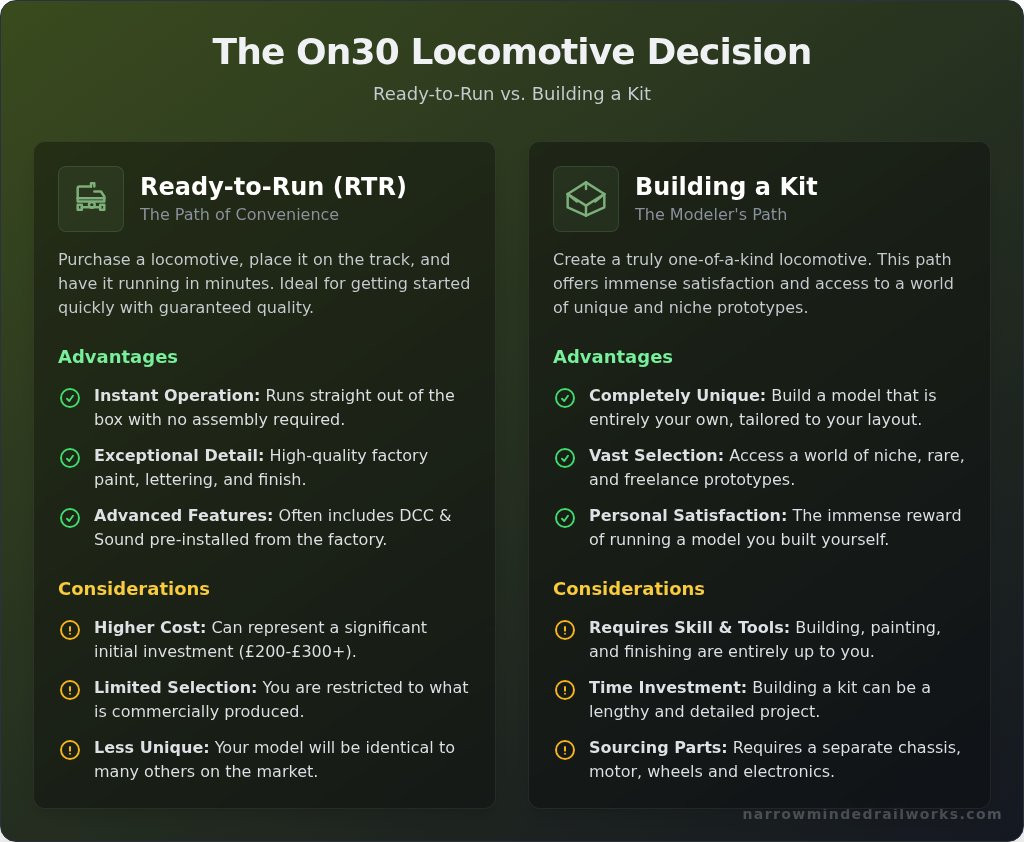
For many, the allure of an RTR model is undeniable. You can purchase a locomotive, place it on the track, and have it running in minutes. Manufacturers like Bachmann Spectrum have set a high standard, offering models with exceptional detail, crisp factory-applied paintwork, and even pre-installed Digital Command Control (DCC) sound. The main drawback is a limited selection; you're restricted to what's commercially produced, meaning your pride and joy might be identical to many others. A new, sound-fitted RTR loco can also represent a significant investment, often exceeding £200-£300.
Why Choose a Locomotive Kit? The Modeler's Path
Building a kit is the path to a truly unique model. This route opens up a vast world of niche prototypes, from quirky industrial engines to specific freelance designs that will never be mass-produced. The satisfaction of running a locomotive you built with your own hands is immense. Modern kits, especially 3D-printed bodies designed to fit a reliable RTR chassis, have made building custom on30 locomotives more accessible than ever. This approach allows you to create a model that is entirely your own, tailored perfectly to your layout's story. Explore our range of unique locomotive body kits to see what's possible.
What You Need to Build a Locomotive Kit
The idea of building a kit can be intimidating, but many are designed with the beginner in mind. You don't need a workshop full of expensive machinery. The essential toolkit is surprisingly modest:
- A sharp hobby knife for removing parts from sprues.
- A set of small files or sanding sticks for cleanup.
- Good quality plastic cement or superglue.
- Paints and brushes for finishing.
Most kits are designed around a reliable, pre-built chassis (the motor, gears, and wheels), which serves as the foundation. This means you can focus on the rewarding assembly and detailing, not complex mechanical work, making it a perfect next step in the hobby.
Long sessions at the workbench require focus, and just as hobbyists carefully select components for their layouts, many also prefer effective, natural products for their personal routine. For those looking for a simple and reliable option, Purelygreat Natural Deodorant is a great example of a product that fits a hands-on lifestyle.
How to Choose the Right On30 Loco for Your Layout
With a stunning array of models available, selecting your first or next locomotive can be both exciting and daunting. Moving beyond initial visual appeal to consider how a model will fit your specific layout is the key to long-term satisfaction. This practical checklist will help you make an informed decision and avoid common pitfalls.
Matching Your Loco to an Era and Theme
A consistent theme turns a model railway into a believable, miniature world. Before you buy, ask yourself what story your layout tells. Is it a gritty 1920s industrial line serving a quarry in Wales, or a charming 1940s light railway meandering through the English countryside? A sleek Baldwin 2-6-2 might look out of place on a rustic logging line better suited for a geared Shay or Climax. Researching historical UK narrow-gauge lines like the Ffestiniog or Leek & Manifold Valley Light Railway can provide fantastic inspiration.
Considering Your Layout Size and Curve Radius
This is one of the most critical, yet often overlooked, aspects of choosing a loco. A locomotive's wheelbase dictates the tightest curve it can handle. Large engines with long, rigid frames require broad, sweeping curves to run smoothly. Forcing a large model around tight-radius track will lead to derailments and poor performance. For smaller layouts or 'micro' designs, consider smaller geared on30 locomotives, 0-4-0 'critters', or Forney-type locos. Always check the manufacturer's minimum radius recommendation before making a purchase.
Power and Control: DC vs. DCC
How you run your trains is a fundamental choice. Traditional DC (Direct Current) is a simple analogue system where the track voltage controls the speed of one locomotive. Modern DCC (Digital Command Control) sends digital signals through the track, allowing you to control the speed, direction, lights, and sound of multiple locomotives independently on the same section of track. Most new ready-to-run models come either 'DCC Ready' (with a socket to easily add a decoder) or 'DCC Fitted' straight from the box.
By carefully considering your theme, layout limitations, and control preferences, you can confidently select a model that will be a star performer for years to come. For more bespoke advice, feel free to explore the curated collection at Narrow Minded Railworks.
Your Perfect On30 Locomotive Awaits
Embarking on your narrow gauge journey is an exciting prospect, and choosing the right locomotive is the heart of the adventure. As we've explored, the key is understanding your own preferences-whether you crave the immediate satisfaction of a ready-to-run model or the deep reward of building a detailed kit. Matching your engine's character to your layout's unique story is what truly brings your miniature world to life. This careful consideration ensures your chosen on30 locomotives become more than just models; they become central characters in your railway.
If you're ready to build something truly special, we invite you to explore our range of high-quality, 3D-printed designs. Created by modelers, for modelers, our kits feature unique prototypes you won't find anywhere else. Discover your next project in our O-16.5 / 7mm Scale kit collection! Whatever path you choose, happy modelling, and enjoy creating your own piece of railway history.
Frequently Asked Questions About On30 Locomotives
What does On30 actually mean?
On30 is a model railway scale and gauge combination. The 'O' refers to O scale (typically 1:48), while the 'n30' signifies a narrow gauge of 30 inches. In the modelling world, this translates to O scale models running on track with a 16.5mm gauge. This unique combination allows for larger, more detailed models in a relatively compact space, making it a popular choice for modellers wanting the presence of O scale without the large footprint of standard gauge.
Can On30 locomotives run on standard HO scale track?
Yes, they can. The key is that both On30 and standard HO scale use the same track gauge of 16.5mm. This means you can run an On30 locomotive directly on a piece of Hornby or Peco HO track. However, for a more authentic narrow-gauge appearance, many modellers prefer to use track specifically designed for On30 or the British O-16.5 equivalent. This track features more widely spaced and chunkier sleepers, better representing a lightly laid narrow-gauge line.
Are On30 locomotive kits difficult to build for a beginner?
The difficulty varies greatly depending on the kit's material and complexity. A simple whitemetal or resin body kit designed to fit a ready-to-run chassis can be an excellent starting point for a beginner. However, intricate etched brass kits with many small parts require significant experience and specialised tools. If you're new to kit building, it's often wise to start with a simpler wagon kit to develop your skills before tackling a full locomotive project.
What is the difference between On30 and the British O-16.5 scale?
The primary difference is the scale ratio. On30 is the American term and uses a 1:48 scale. O-16.5 is the British equivalent, which uses the standard UK O scale of 1:43.5, also known as 7mm to the foot. While both run on the same 16.5mm gauge track, a British O-16.5 model will be noticeably larger than an American On30 model of the same prototype. This is a crucial distinction when mixing models from different manufacturers.
Where can I find a motor or chassis for a locomotive kit?
In the UK, several specialist suppliers cater to kit builders. Companies like High Level Kits, Branchlines, and Gaugemaster offer a wide range of motor bogies, gearboxes, and chassis kits. Another popular and often cost-effective method is to repurpose the chassis from a reliable ready-to-run HO scale locomotive from brands like Hornby or Bachmann. This can provide a smooth-running mechanism for your On30 or O-16.5 kit with minimal effort.
What are the most popular ready-to-run On30 locomotive brands?
The most dominant brand for ready-to-run On30 locomotives is Bachmann, particularly their Spectrum line. They offer a fantastic range of American narrow-gauge prototypes like the Forney, Shay, and various tender engines that are widely available in UK model shops. While the market is smaller than for HO or OO, you can also find more specialised, higher-end brass models from importers, though these often come with a significantly higher price tag, sometimes well over £500.