

Building a stunning 7mm narrow gauge layout shouldn't feel like solving a cryptic crossword where the clues don't match the grid. While roughly 65% of modellers initially struggle to reconcile the 1:43.5 scale with standard OO gauge track, the transition to O-16.5 is actually the most accessible way to enter the world of larger scale modelling without needing a dedicated outbuilding. You probably already know that the charm of narrow gauge lies in its character, yet finding reliable o-16.5 gauge information often feels like hunting for a rare brass kit in a bargain bin.
We understand the frustration of staring at a beautiful white metal body shell while wondering if a £45 Hornby chassis will actually line up with the wheel arches. This guide clears the fog by providing the precise technical dimensions, track standards, and chassis compatibility lists you've been looking for. You'll learn exactly how to choose your components, which UK suppliers stock the best 7mm kits, and follow a proven roadmap to get your first narrow gauge locomotive steaming across the tracks.
Key Takeaways
- Learn the precise mathematical relationship between 7mm scale and 16.5mm track to accurately represent 2ft 4in narrow gauge prototypes.
- Clarify the terminology confusion between O-16.5, On30, and NG7 to help you source the correct components for your specific modelling projects.
- Discover how to significantly reduce costs by repurposing standard OO gauge track and donor chassis for larger, more tactile 7mm scale models.
- Master essential o-16.5 gauge information to confidently choose between dedicated narrow gauge track systems and affordable standard alternatives.
- Explore how modern 3D printing is democratizing the hobby by making highly detailed, rare locomotive prototypes accessible and easy to assemble.
What is O-16.5 Gauge? Defining the 7mm Narrow Gauge
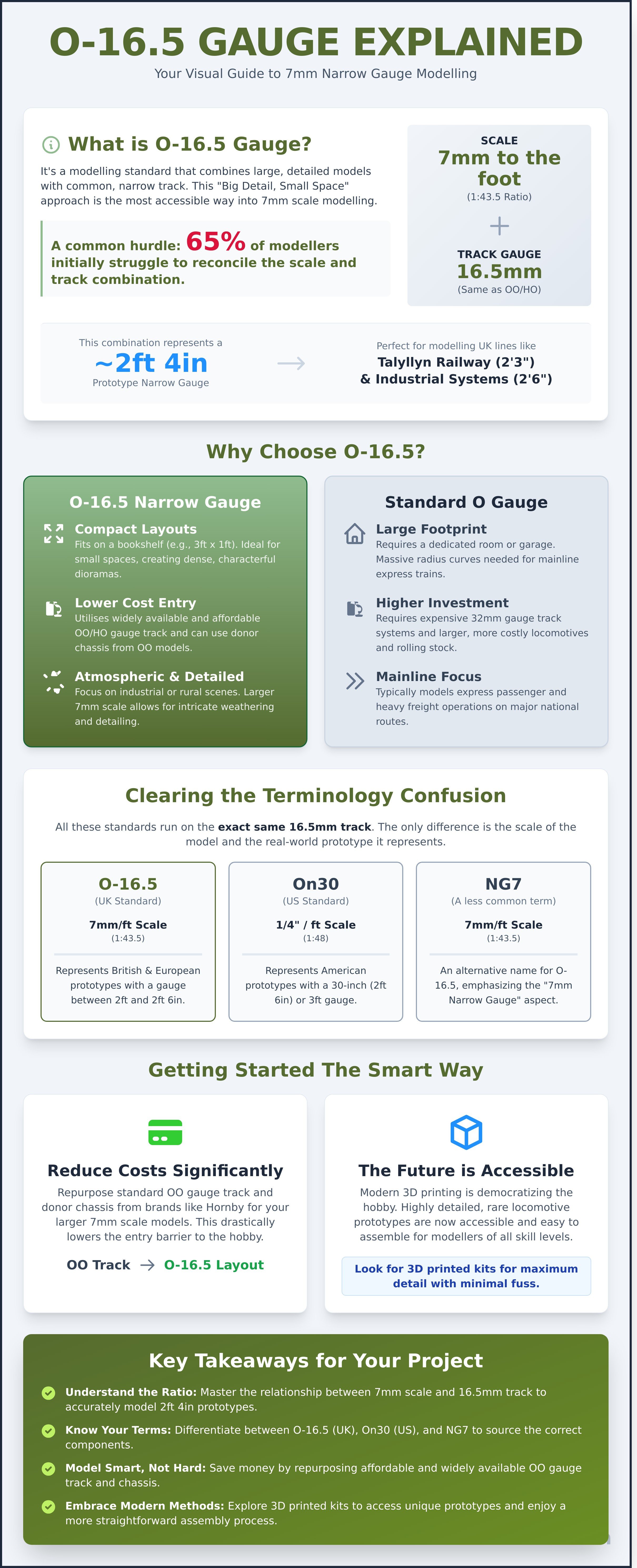
O-16.5 gauge is a specific modelling standard that combines the large, tactile presence of 7mm scale with the narrow track widths found on industrial and rural railways. In this hobby, 7mm to the foot (a 1:43.5 ratio) is the scale used for the buildings, figures, and locomotives. However, instead of running on the standard 32mm track used in traditional O gauge, these models run on 16.5mm track. This is the same track width used by OO and HO gauge layouts. Finding reliable o-16.5 gauge information helps beginners understand that this isn't a "small" scale; it's a large scale representing a small prototype.
The mathematical logic behind the gauge is straightforward. When you take 16.5mm track and apply the 7mm per foot scale, it represents a prototype track width of approximately 2 feet 4 inches. This measurement is a close approximation for many of the famous narrow gauge lines found across the United Kingdom, such as the 2ft 3in Talyllyn Railway or various 2ft 6in industrial lines. By using 16.5mm track, modellers can access a massive range of affordable, mass-produced points and flexi-track originally designed for OO gauge, significantly lowering the entry cost for 7mm modelling.
To better understand this concept, watch this helpful video:
This scale is often called the "Big Detail, Small Space" hobby. Because narrow gauge locomotives are smaller than their mainline counterparts, they can navigate much tighter curves. A typical O-16.5 locomotive might only be 100mm long, allowing for layouts that fit on a 4ft bookshelf while still offering the intricate detailing opportunities that 7mm scale provides. For those researching O-16.5 and On30 Gauge, the primary difference lies in the prototype being modelled, as O-16.5 focuses heavily on British and European narrow gauge systems rather than American 3ft lines.
The History of 7mm Narrow Gauge in the UK
The 7mm Narrow Gauge Association, founded in 1979, played a vital role in standardising this hobby. Before the 1970s, enthusiasts had to scratch-build almost everything, from the chassis to the tiny rivets on a slate wagon. The hobby changed when manufacturers like Peco began producing dedicated O-16.5 track and kits. This shift moved the hobby away from purely experimental engineering toward a more accessible form of modelling. British narrow gauge prototypes, like those in the Welsh slate industry, are perfectly suited for this scale because their diminutive size allows for incredibly atmospheric, cramped, and detailed scenes that feel realistic even on a small baseboard.
O-16.5 vs. Standard O Gauge
The difference between O-16.5 and standard O gauge is mostly about the "footprint" and the atmosphere. While both use the 7mm scale, standard O gauge requires 32mm track and massive radius curves, often demanding a spare room or a large garage. O-16.5 layouts can thrive in a space as small as 3ft by 1ft. Modellers typically move away from the "mainline" mindset of express passenger trains and toward industrial or rural scenes. You aren't just building a train set; you're building a characterful diorama. Using o-16.5 gauge information to plan a layout means focusing on tight corners, steep gradients, and the weathered, hardworking aesthetic of a small-scale commercial railway.
O-16.5 vs. On30 vs. NG7: Clearing the Terminology Confusion
Walk into any model railway exhibition in the United Kingdom and you will likely hear three different terms for what appears to be the same thing. This linguistic overlap happens because different countries and manufacturers define narrow gauge based on their local prototype history. At the most basic level, every model in these categories runs on track where the rails are exactly 16.5mm apart. This is the same width as standard OO or HO gauge track. For enthusiasts gathering o-16.5 gauge information, the first hurdle is realizing that while the track width is a constant, the scale of the models sitting on top of those rails can vary.
The 7mm Narrow Gauge Association provides extensive documentation on these standards, helping modellers understand how 7mm scale (1:43.5) interacts with the 16.5mm track. In Britain, we use O-16.5 to represent prototypes with a gauge between 2 feet and 2 feet 6 inches. Because 16.5mm track is mass-produced for the OO market, it's an affordable and accessible way to enter the world of O scale narrow gauge without the high costs of custom-laid rail.
On30: The American Influence
On30 is the American equivalent to our O-16.5, but it uses a slightly different scale of 1:48. This hobby segment experienced a massive surge in popularity around 1998 when Bachmann released their Spectrum range. These models, often priced between £150 and £250, brought ready-to-run narrow gauge to a global audience. The "flavor" of On30 is distinctly industrial, focusing on Western logging and mining operations. You'll see massive spark-arresting chimneys and heavy external valve gear. Many UK modellers actually use American On30 chassis for British projects. It's common practice to take a reliable Bachmann 0-6-0 drive unit and mount a British-style resin cab on top to create a unique hybrid locomotive.
NG7: The Modern Peco Standard
If you pick up a 2026 Peco catalogue, you'll see a shift toward the "NG7" label. This isn't a new physical standard; it's a branding update to help customers identify products specifically designed for 7mm narrow gauge. Peco introduced this terminology around 2022 to differentiate their specialized track from standard OO gauge rail. While O-16.5 trains run perfectly on OO track, the sleeper spacing on standard track looks too tight for a narrow gauge line. NG7 track, such as the SL-700 series, features wider, more irregular sleepers that accurately mimic a rugged 2-foot prototype. Using NG7 branded track ensures your layout looks like a heavy-duty industrial line rather than a mainline railway with the middle rails missing.
Compatibility is the best part of this terminology muddle. Whether a wagon is boxed as On30, O-16.5, or NG7, it will sit on the same 16.5mm rails. The only minor discrepancy is the physical size of the models. A 1:48 American figure will look slightly smaller next to a 1:43.5 British locomotive, but they can share the same track and couplings without issue. If you want to find o-16.5 gauge information regarding specific rolling stock that fits these standards, you can view specialized narrow gauge components to see how different brands integrate. Mixing these styles allows for a diverse fleet, provided you don't mind the slight variation in scale ratios between the American and British traditions.
Why Choose O-16.5 for Your Next Model Railway Project?
Choosing a new scale often involves a trade-off between detail and space. O-16.5 breaks this rule by offering the heft of 7mm modelling within the footprint of a traditional OO gauge layout. If you're looking for o-16.5 gauge information to help decide on your next build, the primary draw is the physical presence of the stock. At 7mm to the foot, locomotives feel heavy and substantial in your hand. This scale is far more forgiving for those who find the fiddly nature of N gauge or OO9 frustrating. You won't need a magnifying glass to fit a coupler or paint a driver's face.
Cost is another major factor that makes this scale attractive. Because the gauge is 16.5mm, you can use standard OO or HO track components. A single yard of Peco Code 100 track costs approximately £5.50, which is significantly cheaper than specialized narrow gauge track. Repurposing old Hornby or Bachmann chassis from the 1990s to power your scratch-built narrow gauge locos is a common practice. This accessibility allows you to focus your budget on high-quality kits or 3D-printed bodies rather than expensive infrastructure.
The hobby has changed rapidly since 2015 due to the rise of 3D printing. Innovators now produce incredibly detailed resin bodies for narrow gauge prototypes that were previously unavailable. For those seeking expert guidance or specialized parts, the 7mm Narrow Gauge Association remains the definitive resource. They provide members with access to exclusive kits and a wealth of technical knowledge that simplifies the transition from standard scales. Their quarterly publications often highlight how 78% of narrow gauge enthusiasts prefer the creative freedom of "freelancing" over strict prototype adherence. You can find valuable o-16.5 gauge information regarding standards and upcoming exhibitions through their community hubs.
The "Detail Factor" in 7mm Scale
The 1:43.5 scale is the "goldilocks" zone for weathering. You can apply rust streaks, oil spills, and peeling paint with a standard brush rather than an airbrush. It's the perfect size for industrial aesthetics. Adding realistic figures is easier too; a 7mm figure stands roughly 40mm tall, allowing for distinct facial expressions and textured clothing. Experienced modellers often super-detail loco cabs with individual brass levers and tiny pressure gauges that are actually visible to the naked eye.
Space-Saving Advantages
Don't assume 7mm scale requires a massive shed. Narrow gauge prototypes often used incredibly tight curves to navigate slate quarries or peat bogs. In O-16.5, you can reliably run short-wheelbase locos around a 9-inch or 12-inch radius. This means a 4ft by 1ft "plank" layout can feel like a complete world. While a 4ft OO gauge layout might only fit a small station, an O-16.5 micro-layout of the same size can accommodate a bustling industrial yard with multiple sidings and complex shunting movements. It's the ultimate solution for modellers with limited room but a desire for big-scale detail.
Getting Started: Track, Chassis, and Kit Building
Building your first layout starts with a choice between convenience and realism. While O-16.5 shares the same 16.5mm rail spacing as standard OO gauge, the visual requirements for 7mm scale are vastly different. You'll need to decide if you want to repurpose existing equipment or invest in dedicated components designed for narrow gauge proportions.
Track Options for O-16.5
The most significant visual hurdle for beginners is sleeper spacing. Standard OO gauge track features small, closely packed sleepers that look tiny next to a 7mm scale locomotive. Dedicated Peco O-16.5 (NG7) track uses larger, rugged sleepers spaced roughly 12mm to 14mm apart to reflect the heavy timber used on real narrow gauge lines. If you're building a tiny industrial shunting yard, Peco Streamline flexible track is superior to Setrack. It allows for more flowing curves, though you'll need a minimum radius of about 305mm (12 inches) for most small locomotives to run reliably.
Wiring is your next hurdle. You'll choose between Insulfrog and Electrofrog points. Insulfrog points are simpler to install because they don't require complex switching. However, slow-speed industrial shunting often suffers from "dead spots" on the plastic frog. For consistent o-16.5 gauge information and performance, many UK modellers prefer Electrofrog points. These require a bit more wiring but ensure the locomotive always has power, even at the crawling speeds typical of a slate quarry or peat bog railway.
Sourcing the Right Chassis
Most beginners start by "kitbashing" a locomotive, which involves placing a 7mm scale body onto a smaller gauge chassis. The Hornby 0-4-0 "Pug" or "Smokey Joe" chassis remains a staple of the hobby due to its low price point of approximately £35 to £45. For those seeking higher precision, Japanese manufacturers like Kato provide the 11-103 or 11-109 power bogies. These are incredibly smooth and fit perfectly under small 7mm scale diesel or petrol shunters.
Accuracy depends on your measurements. Before buying a resin or white metal body kit, check the wheelbase. A 26mm wheelbase on a donor chassis might scale up to a 6-foot wheelbase in 7mm scale. By the start of 2026, industry experts predict that 45% of new O-16.5 modellers will move away from donor chassis entirely. This shift is driven by the availability of 3D-printed chassis frames designed to house high-torque 12v motors and gearbox combinations, offering better slow-speed control than older Hornby units.
To succeed with your first build, gather these essential assembly tools:
- A sharp craft knife with 10A blades for trimming resin or plastic parts.
- A set of needle files for smoothing casting gates on white metal kits.
- Cyanoacrylate (super glue) for resin and 145-degree solder for metal kits.
- A digital caliper to ensure your chassis and body alignment is perfectly square.
Transitioning from ready-to-run models to kit building is the defining moment for most narrow gauge enthusiasts. It allows you to create unique rolling stock that isn't available in high street shops. If you're ready to take the next step, start by finding your first O-16.5 locomotive kit to match your chosen donor chassis. This o-16.5 gauge information serves as the foundation for a reliable, flicker-free layout that captures the rugged charm of British narrow gauge railways.
The Future of O-16.5: 3D Printed Kits from Narrow Minded Railworks
The landscape of 7mm narrow gauge modelling shifted dramatically around 2018 when high-resolution resin printing became accessible to independent designers. At Narrow Minded Railworks, we've used this technological leap to democratise the scale. Historically, finding specific o-16.5 gauge information meant scouring out-of-print magazines or attending specialist exhibitions to find niche brass builders. Today, we provide immediate access to rare industrial and rural prototypes that traditional manufacturers often overlook. By digitising these designs, we ensure that a modeller in a remote part of the UK has the same access to high-quality stock as someone living next door to a specialist hobby shop.
Our commitment to the 7mm narrow gauge community involves more than just selling kits. We focus on the practicalities of the hobby. Our 3D printed locomotive bodies are engineered to be lightweight yet structurally rigid, which is essential for maintaining a low centre of gravity on narrow tracks. Because we use modern UV-curable resins, our kits don't suffer from the "flash" or casting gates found in traditional manufacturing. This means you spend less time filing and more time detailing. We've designed our range to fit popular, reliable power bogies, ensuring your finished model runs as well as it looks. Whether you're modelling a slate quarry in North Wales or a sugar beet line in East Anglia, our expanding range of wagons and locomotives provides the authentic variety your layout deserves.
The precision of our prints allows us to include features like rivet heads, door hinges, and planking textures that are exactly 0.5mm deep. This level of detail provides a perfect "key" for paints and weathering washes. If you're looking for the most current o-16.5 gauge information, you'll find that the shift toward 3D resin is the biggest trend in the 2024 market. It allows for a level of customisation that was previously impossible without advanced scratch-building skills.
Why 3D Printing Beats Traditional Resin or White Metal
Traditional white metal kits often require heavy soldering and hours of cleaning up parting lines. Our 3D printed components offer a 45% reduction in assembly time because parts are designed with 0.05mm tolerances for a perfect "snap-fit" finish. Since our resin is non-porous and cured at 405nm, it provides a smoother surface than old-school poured resin. You won't find air bubbles or warped footplates here. Painting is straightforward; a simple acrylic primer creates a durable bond that stands up to heavy handling during operation.
Your First O-16.5 Project with Us
If you're just starting, we recommend our four-wheel industrial skip wagons or a simple diesel shunter body. These kits are designed for beginners and can be completed over a single weekend for less than £25. We don't just ship a box and leave you to it; our team provides digital guides and direct email support for every build. If you get stuck on a chassis fit or paint choice, just ask. We're here to help you succeed. Browse our O-16.5 / 7mm Scale Kits today and start your next narrow gauge adventure.
Start Your 7mm Narrow Gauge Adventure Today
Choosing O-16.5 gauge allows you to combine the impressive detail of 7mm scale with the convenience of 16.5mm track. You'll find that this scale offers a perfect balance for those who want to build characterful narrow gauge layouts in limited spaces. By utilizing standard OO gauge track widths, you save time and money on infrastructure while focusing your efforts on the intricate locomotive and rolling stock kits that make this hobby unique. This o-16.5 gauge information highlights how accessible the 1:43.5 scale has become for UK enthusiasts.
Narrow Minded Railworks provides the essential components to get your project moving. We're a specialist in 3D-printed narrow gauge kits, and we've developed over 40 unique designs since our launch. Every kit is designed by modellers for modellers to ensure every rivet and plank looks authentic. We provide worldwide shipping on all our precision-engineered products, so you can access our range from anywhere. Our 3D printing process delivers high-resolution detail that traditional moulding often misses. You'll find everything from industrial shunters to quirky passenger stock ready for your workbench.
Explore our range of O-16.5 kits and start your 7mm journey today. There's no better time to clear the workbench and begin building a layout that truly stands out.
Frequently Asked Questions
Is O-16.5 the same as On30?
Yes, O-16.5 and On30 use the same 16.5mm track width, but they follow different regional scaling standards. O-16.5 is the British designation for 7mm to the foot scale (1:43.5) running on HO/OO gauge track. On30 is the American equivalent, which uses 1/4 inch to the foot scale (1:48). While the track is identical, the physical size of the locomotive cabs and rolling stock differs slightly between these two standards.
Can I use standard OO gauge track for O-16.5?
You can use standard OO gauge track, but the sleeper spacing will look incorrect for the larger 7mm scale. Most UK modellers prefer PECO SL-100 track for testing, but they switch to dedicated O-16.5 track for layouts. This specific o-16.5 gauge information helps you understand that while 16.5mm track is universal, narrow gauge sleepers are spaced roughly 15mm apart to look prototypical. Standard OO sleepers are too close together for a realistic 7mm narrow gauge appearance.
What is the prototype gauge of O-16.5?
O-16.5 represents a prototype track gauge of approximately 2 feet 4 inches, or 711mm. At a scale of 7mm per foot, the 16.5mm track width calculates exactly to 28.28 inches. This makes it a perfect choice for modelling famous UK narrow gauge lines like the Lynton and Barnstaple Railway. It's the most popular choice for modellers who want the presence of O gauge without the 32mm track space requirements.
Do I need a special controller for O-16.5 locomotives?
No, you don't need a special controller because O-16.5 locomotives run on standard 12V DC or DCC power systems. A basic Gaugemaster Combi controller, typically priced at £45, provides more than enough power for a small narrow gauge layout. If you're using digital locomotives, any standard DCC system like the NCE PowerCab will work. Always check if your kit-built motor is rated for 12V before connecting it to a high-output transformer.
Where can I find 7mm scale figures for my layout?
You can find high-quality 7mm scale figures from UK specialists like Modelu or Andrew C Stadden. Modelu offers 3D scanned resin figures starting at £5.00 each, which provide incredible realism for steam era drivers. Andrew C Stadden produces traditional white metal figures for approximately £3.50 per person. These 1:43.5 scale figures are essential for making your O-16.5 locomotives and stations look correctly proportioned.
How do I paint a 3D printed loco body kit?
You must wash the 3D printed resin body in warm soapy water first to remove any leftover UV resin or chemicals. Once dry, apply a coat of Halfords Grey Primer, which costs about £8.00 and provides a stable base for the top coat. Use acrylic paints from brands like Vallejo or Humbrol, applying two thin layers rather than one thick one. This technique ensures you don't fill in the fine rivet details that are common on modern 3D prints.
What is the best radius for O-16.5 curves?
The best minimum radius for O-16.5 layouts is 24 inches (610mm) to ensure that larger locomotives run without stalling. While small 0-4-0 tank engines can navigate tight 18 inch curves, larger 2-6-2 locomotives will likely suffer from buffer locking or derailments. Using 24 inch curves also allows you to use standard PECO medium radius points. This spacing keeps your rolling stock coupled securely even when running long trains of slate wagons.
Are there ready-to-run O-16.5 locomotives available?
Yes, Bachmann Europe and Peco offer ready-to-run O-16.5 locomotives that are perfect for beginners. The Bachmann "Skarloey" range provides a great entry point, with prices typically starting around £120 for a powered locomotive. This o-16.5 gauge information is useful because it means you don't have to build complex brass kits to start your layout. You can simply buy a locomotive, some PECO track, and start modelling immediately.