

A compact continuous-run layout can still ask a lot of its curves. For modelling the Ffestiniog Railway in OO9, use 1:76 scale on 9mm-gauge track to represent the railway’s 597mm gauge; a 14-inch (355mm) radius is recommended for an exhibition-quality layout running Ffestiniog Bowsiders.
Getting the track and scale right is only part of the challenge. The railway’s distinctive locomotives and varied coaches give a model its character, while the space available and the stock you want to run shape the layout plan.
This guide explains how OO9 scale and gauge translate to the Ffestiniog prototype, what curve radii mean for continuous running, and how to choose locomotives and rolling stock for a coherent model. It also considers practical layout choices, from planning the loop to balancing operational needs with the railway’s recognisable look, so you can make informed decisions before building.
Key Takeaways
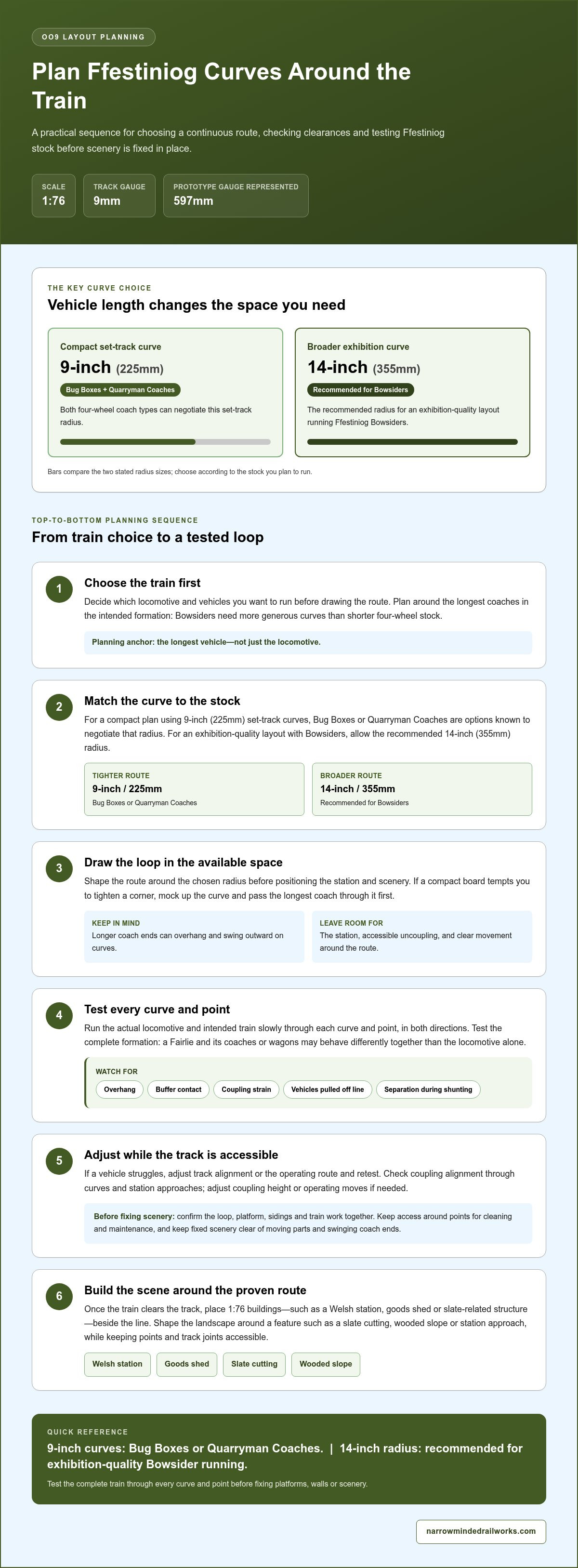
- Plan the loop around the longest vehicles you want to run, since Bowsiders call for more generous curves than shorter four-wheel stock.
- Use Bug Boxes or Quarryman Coaches as options for tighter curves; both can negotiate 9-inch (225mm) set-track curves.
- Choose locomotives and coaches that reflect a particular Ffestiniog era, then match their colours and formations to create a consistent train.
- Use prototype details such as the Bug Box’s distinctive width and seating arrangement to add character when modelling coaches.
Creating a continuous-run Ffestiniog Railway layout in OO9
Start with the train you want to run, then draw its route around the available space. For an exhibition-quality layout running Ffestiniog Bowsiders, a 14-inch (355mm) radius is recommended. Situation: a compact loop has tight corners. Action: plan broader curves before positioning the station and scenery. Result: longer coaches can travel around the layout with less risk of overhang or visual crowding. Keep the station accessible for uncoupling and make the continuous route easy to follow.
Use 1:76 buildings to connect OO9 track with familiar OO-scale structures. A Welsh station, goods shed or slate-related building can help establish the setting without making the railway feel oversized. Place buildings beside the track, then view them from normal operating height. If a structure dominates the coaches, adjust its position or use surrounding walls and vegetation to soften the transition. This gives the narrow gauge railway a clearer place within the scene.
For a Welsh landscape, plan the route around a recognisable feature, such as a slate cutting, wooded slope or station approach. A bare loop can look disconnected from its setting, so shape the ground first, then add rock faces, paths and planting around the track. This helps the railway appear to pass through a place rather than sit on a board. Keep scenery clear of moving parts, and leave access to points and track joints. Narrow Minded Railworks’ Diorama Tools & Scenery can help with the hands-on work of shaping and detailing the landscape.
Plan couplings alongside the track arrangement, not as a final detail. Check that adjacent vehicles sit consistently and that couplings stay aligned through curves and station approaches. If a train negotiates the loop but separates during shunting, test each vehicle combination on the tightest curve and through every point before fixing nearby scenery. You can then adjust coupling height, track alignment or operating moves while access remains clear. A simple test train also helps confirm that the loop, platform and sidings work together.
Modelling Ffestiniog Railway locomotives and rolling stock
Era and livery choices help define a Ffestiniog model. For a Victorian look, pair Bug Box or Bowsider coaches with a locomotive; for a later appearance, choose a named engine and its documented livery. OO9 models include Double Fairlie ‘Merddin Emrys’ in lined maroon, and Mainline Hunslets ‘Blanche’ and ‘Linda’ in green.
Available OO9 examples include those three locomotives and Ffestiniog coaching stock in five vehicle types. Bug Boxes, Bowsiders, Quarryman Coaches, Curly Roof Vans and Tin Cars offer different shapes and periods to represent. Choose a consistent formation rather than mixing vehicles simply because they appeal individually.
Prototype details can guide that choice. Eight Bug Box coaches were built between 1863/4 and 1867, and seven survive in service. Four Bowsiders were built between 1876 and 1879. The railway built 36 Quarryman Coaches by 1901, while its three Curly Roof Vans are 27ft long. These distinctions help match a train to a chosen period.
If a kit contains separate metal parts, clean and prepare the mating surfaces, then use a suitable soldering iron and solder to join the components according to the kit instructions. This creates firm joints before painting. For a coach kit, keep the sides square and check that the floor fits before soldering permanently. Work carefully, as heat can damage small parts or nearby details.
Ffestiniog and Welsh Highland Railway subjects should be selected as distinct prototypes. Start with the locomotive’s outline, wheel arrangement and livery, then compare the coaches and wagons intended to run behind it. The OO9 model numbers identify useful examples: 391-101 is ‘Merddin Emrys’, 391-136 is ‘Blanche’, and 391-135 is ‘Linda’. These details make it easier to plan a coherent train.
Locomotive kit prices vary by product and should not be compared directly with ready-to-run model prices. Compare the kit’s stated contents with the work involved, including body assembly, finishing and the running components required. This keeps your budget realistic and avoids treating a body kit as a complete locomotive.
Minimum curve radii
For Ffestiniog stock, the useful minimum depends on the vehicle. The railway’s four-wheel Bug Boxes and Quarryman Coaches can negotiate 9-inch (225mm) set-track curves; an exhibition-quality layout running Bowsiders is recommended to use a 14-inch (355mm) radius. Choose OO9 track and compatible points, then test the actual locomotive and train through them before fixing the track.
Situation: a small plan uses 9-inch curves to fit a continuous loop. Action: use Bug Boxes or Quarryman Coaches as the test vehicles, since both are known to negotiate that set-track radius. Result: you can assess whether the compact route suits the stock you intend to run. Check each point and curve in sequence, because a vehicle that passes through one curve may behave differently through a point or an adjacent reverse curve.
Longer coaches need more planning. A Bowsider train calls for a 14-inch radius recommendation, so allow the wider sweep when arranging the loop, station and nearby scenery. Situation: the available board tempts you to tighten a corner. Action: mock up the curve and pass the longest coach through it before building platforms or walls. Result: you can spot overhang and clearance problems while the track remains easy to adjust.
A Fairlie locomotive adds another reason to test the complete formation, rather than selecting curves by locomotive alone. Couple it to the intended coaches and wagons, then run the train slowly through every point and curve in both directions. Watch for buffer contact, coupling strain and vehicles being pulled off line. Adjust track alignment or the operating route if problems appear. Keep access around points for cleaning and maintenance, and avoid placing fixed scenery where a coach’s ends swing outward. This practical test links the chosen OO9 geometry to the specific Ffestiniog train, rather than assuming every model handles the same curve equally well.
OO9 scale and track gauge
OO9 combines a larger model scale with narrow-gauge track. It represents prototypes at 1:76 scale on 9mm-gauge track, while the Ffestiniog Railway’s track gauge is 1ft 11½in (597mm). The result is a model that uses compact track but keeps the proportions of OO-scale figures, buildings and rolling stock.
OO9 and N gauge both use compact modelling formats, but they represent trains at different scales. OO9 models Ffestiniog stock at 1:76, so locomotives such as a Mainline Hunslet and coaches appear larger than N-gauge models. Choose OO9 when the priority is showing narrow-gauge vehicles at OO proportions; consider N gauge when smaller models better suit the space or scene.
Situation: an OO layout already has buildings or scenery. Action: check their proportions against OO9 coaches and locomotives before fixing the track. Result: structures can sit naturally beside the narrow gauge line, rather than appearing undersized or oversized. A station building, platform and train should read as parts of the same scene when viewed from the layout’s normal viewing position.
For a new plan, make the scale and track choices before drawing the route. Mark the 9mm track centreline, then position platforms, buildings and access points around it. Test the footprint with a locomotive and coach, since a structure that clears the track may still crowd the vehicle visually. If a scene combines OO9 with other scales, use a clear boundary, such as a road, wall or change in ground level, to separate their visual contexts.
These distinctions also help when choosing a modelling project. OO9 suits Ffestiniog trains in OO proportions, while O-16.5 represents a different scale and track arrangement. If you’re planning a larger-scale narrow-gauge project, explore 7mm scale kits as a separate option. Keeping scale, gauge and scene proportions aligned makes each model easier to place and interpret.
Narrow Minded Railworks: OO9 Locomotive & Wagon Kits
Narrow Minded Railworks offers OO9 Locomotive & Wagon Kits for modellers developing a narrow-gauge project with kit-built stock. These kits are a relevant next step when you’ve settled on your layout’s scale and want locomotive or wagon components to support the scene. The range also includes GN15 Locomotive & Scenery Kits, O-16.5 / 7mm Scale Kits, and Diorama Tools & Scenery, giving modellers options across different narrow-gauge scales and scenic projects.
Choose according to the work your layout still needs: locomotive and wagon kits for OO9 stock, or scenery items and tools for shaping the setting. This keeps the next purchase connected to your modelling plan rather than adding unrelated equipment. To explore the range and decide which kit category suits your project, visit narrowmindedrailworks.com.
Take Your Ffestiniog Model to the Next Stage
The next step in modelling the Ffestiniog Railway in OO9 is to decide what you want your model to express. It might centre on a particular train, the character of a station scene, or the movement of a continuous-run railway through a Welsh landscape. A clear focus helps you make consistent choices as the layout develops, from the stock you build to the details you add around the track.
Let the project grow in manageable stages. Establish the operating plan, test the train, then add scenery where it supports the scene rather than competing with it. If you’re choosing kit components or planning a narrow-gauge project, contact Narrow Minded Railworks for advice. A considered starting point can make the next modelling decisions easier, and help you create a railway that feels distinctly your own.
Frequently Asked Questions
What is OO9 scale and what track gauge does it use?
OO9 represents narrow-gauge railway prototypes at 1:76 scale and uses 9mm-gauge track. This lets modellers represent narrow-gauge trains alongside OO-scale buildings and figures. For example, an OO station building can sit beside an OO9 locomotive, though the scene should be arranged so the structure and train look proportionate. Consider both track gauge and model scale when selecting buildings, figures and rolling stock.
What OO9 models best represent Ffestiniog Railway locomotives such as Prince, Linda and Blanche?
Named OO9 examples include Mainline Hunslets ‘Linda’ and ‘Blanche’, both modelled in green, and the Double Fairlie ‘Merddin Emrys’ in lined maroon. Their standard model numbers are 391-135, 391-136 and 391-101 respectively. These provide specific choices for a Ffestiniog-themed train. For a locomotive such as Prince, compare its prototype details with the model you’re considering before choosing a matching formation.
What is the Ffestiniog Railway’s prototype track gauge and how is it modelled in OO9?
The Ffestiniog Railway’s prototype track gauge is 1ft 11½in (597mm). OO9 represents it using 9mm-gauge track at 1:76 scale, so the model’s track is narrower than a direct scale measurement of the prototype gauge. This combination lets the railway’s narrow-gauge character fit an OO-scale model scene. Keep the track standard consistent across the route, points and sidings.
How can I build an OO9 Ffestiniog Railway layout in a small space?
Start by drawing the complete route on paper, including the station, points and any sidings, before committing to a baseboard shape. A continuous loop keeps trains moving without needing a long point-to-point route. Shorter four-wheel Bug Boxes and Quarryman Coaches can negotiate 9-inch (225mm) set-track curves. Leave access to points and track joints, and test the longest planned train around the full route.
Where can I buy Ffestiniog Railway OO9 kits, ready-to-run models and accessories in the UK?
Narrow Minded Railworks sells OO9 Locomotive & Wagon Kits, alongside scenery and diorama items. Its locomotive kits are body-only, so the buyer supplies a suitable chassis and motor; they aren’t ready-to-run models. Parts arrive unpainted, unprimed and with supports removed. Resin can be fragile, especially around thin sections, so handle parts carefully during assembly and finishing.
How much does it cost to model the Ffestiniog Railway in OO9?
Your total depends on the layout and stock you choose. A kit is one part of the budget; track, points, a suitable chassis and motor, rolling stock, scenery and tools also affect the final cost. Compare the parts needed for your chosen train and route before buying. Body-only kits require separate running components, while a simpler scenic plan can reduce the number of items you need.