

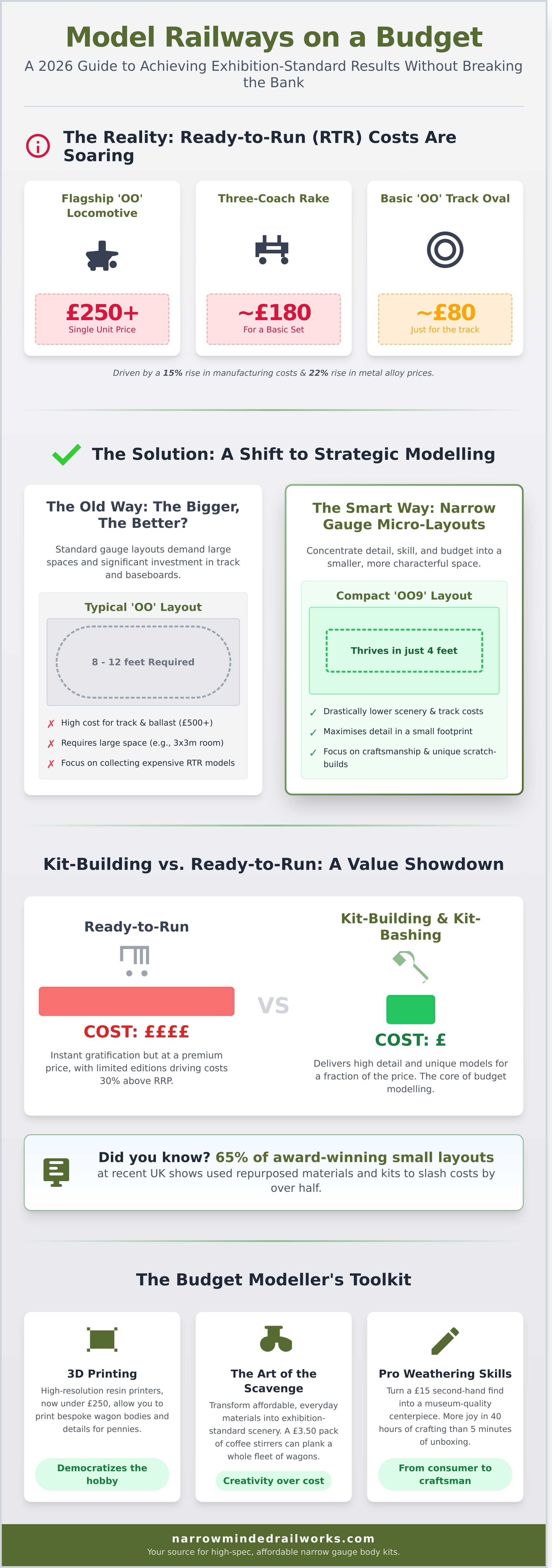
What if the most realistic layout at your local exhibition cost less than a single flagship 'OO' gauge locomotive? It's a tough pill to swallow when you see 2024 retail prices for top-tier Ready-to-Run models climbing past the £250 mark. You've likely felt the sting of inflation at the hobby shop, fearing that building a model railway on a budget means settling for plastic-looking toys or a bare baseboard. You aren't alone in thinking that the hobby is becoming a rich man's game, especially when a simple three-coach rake can now set you back nearly £180.
You don't need a massive bank balance to achieve exhibition-standard results in 2026. This guide shows you how to bypass the retail price trap by mastering kit-bashing and shifting your focus to high-detail narrow gauge scales like OO9. We'll explore how 65% of award-winning small layouts at recent UK shows used repurposed materials and white metal kits to slash costs by half. You're going to learn the specific weathering techniques and strategic sourcing secrets that turn a £15 second-hand find into a museum-quality centerpiece.
Key Takeaways
- Understand why shifting from "cheap materials" to "strategic spending" is essential for navigating the rising costs of locomotives in the current UK market.
- Discover why narrow gauge scales like OO9 and GN15 offer the best space efficiency and visual detail for modellers working with limited resources.
- Learn how to build a professional-grade model railway on a budget by mastering kit-building techniques that deliver high detail at a fraction of Ready-to-Run prices.
- Master the "Art of the Scavenge" and professional weathering hacks to transform affordable, natural materials into exhibition-standard scenery.
- Explore how the Narrow Minded Railworks "Body Kit" philosophy simplifies complex builds while keeping your project affordable and high-spec.
The Reality of Model Railway Costs in 2026
Building a model railway on a budget in 2026 requires a different mindset than it did a decade ago. The days of picking up a brand-new, high-detail steam locomotive for under £100 are firmly in the past. Today, a standard Ready-to-Run (RTR) locomotive often exceeds £220, driven by a 15% rise in manufacturing costs since 2024 and the complexity of modern DCC-ready electronics. For a comprehensive overview of the hobby, it's clear that while the entry price has climbed, the methods for saving money have evolved through technology and smarter planning.
To better understand how different layouts can be achieved within varying financial constraints, watch this helpful video:
Space is the most overlooked expense in the UK market. With the average spare bedroom measuring just 3 by 3 metres, the cost per square foot of your layout can rival your mortgage. This physical limitation has redefined what 'budget' means. It isn't about buying the lowest-quality plastic anymore. It's about strategic spending. Modellers now focus on 'micro-layouts' that pack high detail into a 4-foot shelf, reducing the need for £500 worth of track and ballast. The psychological shift is massive. People are finding more joy in the 40 hours spent weathering a single wagon than in the five minutes it takes to unbox a pristine engine. This move from consumerism to craftsmanship is the only way to sustain the hobby long-term.
Why Traditional 'OO' Gauge is Breaking the Bank
OO gauge remains the UK standard, but it's becoming a luxury for many. A single point motor and assembly can now cost £18, and a basic oval of track easily hits £80. Global supply chain issues have hit die-cast production hard, with zinc and lead alloy prices rising 22% over the last two years. The 'collector' market also plays a role. Limited edition runs from major manufacturers sell out in weeks, pushing second-hand prices on secondary markets 30% above the original RRP. This makes starting a model railway on a budget difficult if you only rely on brand-new shop stock. You're often paying for the rarity of the box rather than the quality of the gears.
The Rise of the 'Kit-Basher' in the Digital Age
By 2026, 3D printing has completely changed the game. High-resolution resin printers now retail for under £250, allowing modellers to print their own wagon bodies and architectural details for pennies. We're seeing a shift away from expensive brass etchings toward high-quality resin and PLA plastics. This democratization means you can bypass the 'collector' tax and create bespoke items that aren't available in shops. It's the best year to start because the tools for self-sufficiency are cheaper and more accessible than ever before. You don't need a massive bank balance when you have a laptop and a steady hand.
Narrow Gauge: The Secret to High Detail on a Small Budget
Narrow gauge modelling serves as a brilliant loophole for anyone building a model railway on a budget. While standard gauge layouts often require 8 to 12 feet of length to look realistic, a narrow gauge line thrives in a compact 4-foot space. This efficiency means you spend significantly less on expensive baseboard timber and scenery materials. A smaller footprint doesn't mean less detail; it actually allows you to focus your funds on a concentrated area, making every pound work harder for the overall aesthetic.
Character is the primary currency of narrow gauge. These lines historically represented industrial or rural shortcuts, often using improvised equipment and weathered structures. This "shabby chic" nature gives you permission to scratch-build rolling stock from affordable materials like plasticard or even coffee stirrers. A pack of 100 wooden stirrers costs roughly £3.50 and can provide the planking for an entire fleet of slate wagons. Because the prototypes were often unique, your hand-built models won't look out of place next to expensive ready-to-run items.
Exploring OO9 and GN15 Scales
OO9 scale uses 9mm track, the same width as N gauge, to represent narrow gauge in 4mm scale. It's a fantastic way to get 4mm detail into a space that would normally only fit N gauge. GN15 is even more budget-friendly for those who like larger scales. It uses standard 16.5mm track (OO/HO) to represent 15-inch gauge lines. The National Model Railroad Association provides excellent foundational advice on how choosing the right scale-to-track ratio can simplify your first build. By using standard gauge track for narrow gauge purposes, you can buy bulk "set track" for as little as £2 per piece at exhibitions, slashed from the £5 or £6 you might pay for specialist narrow gauge flexi-track.
The Strategic Chassis Move
The real secret to saving money in narrow gauge is the donor chassis strategy. A brand new OO9 locomotive from a major manufacturer often carries a price tag between £120 and £180. You can bypass these costs by sourcing second-hand N gauge locomotives. A used Graham Farish 0-6-0 or a Kato 11-103 power bogie can be found for £35 to £50 on secondary markets. These serve as reliable, smooth-running "engines" for your custom creations.
Matching a chassis to a 3D-printed body kit is the most cost-effective way to grow your fleet. A resin body kit typically costs between £15 and £25. When combined with a £40 Kato chassis, your total investment is roughly £65. This represents a 60% saving compared to buying a ready-to-run locomotive. If you want to start experimenting with these affordable conversions, you can browse specialized body kits designed specifically for common donor mechanisms. This approach ensures your layout has a diverse range of locomotives without the "boutique" price tags usually associated with specialist narrow gauge manufacturers. You get the mechanical reliability of a mass-produced N gauge motor with the unique visual appeal of a bespoke narrow gauge engine.
Kit Building vs. Ready-to-Run: A Value Comparison
Choosing between Ready-to-Run (RTR) models and kit building is the most critical decision for maintaining a model railway on a budget. In 2024, a standard OO gauge steam locomotive from a major manufacturer like Hornby or Bachmann typically retails for £180. You can bypass this high entry price by sourcing a high-quality resin body kit for approximately £25 and pairing it with a £40 donor chassis. This £65 total investment represents a 63% saving compared to high-street prices. These savings compound quickly when you scale up to a full fleet of ten or twelve locomotives.
Building your own stock creates what enthusiasts call a "Skill Dividend." Every hour spent soldering, gluing, or painting increases your technical value as a modeller. You'll eventually stop paying "convenience taxes" on pre-weathered or pre-assembled items. The National Model Railroad Association provides extensive documentation on technical standards that help kit builders ensure their home-grown creations run as reliably as factory-made models. These skills allow you to maintain a model railway on a budget without sacrificing the smooth performance required for realistic operation.
Durability is another factor where kits outperform RTR models. When a £200 factory engine fails, you often face expensive specialist repair bills or the frustration of discontinued spare parts. Kits are different. Since you assembled the motor, gears, and pickups yourself, you can strip them down for maintenance in under 15 minutes. Most kit components are generic or easily fabricated from 0.5mm brass wire and plasticard; this makes them a 25-year investment rather than a 5-year consumer product. You also gain total control over customization. Adding unique pipework or specific shed plates costs pennies in raw materials but would cost £40 or more if commissioned from a professional weatherer.
This level of hands-on expertise and appreciation for intricate mechanics is a common thread in many skill-based hobbies. For example, enthusiasts who enjoy mastering complex systems might find the resources from Lockpick Pros equally engaging, as it involves a similar blend of patience, precision, and mechanical understanding.
The 3D Printed Advantage
Modern resin printers produce incredible detail at 0.05mm layer heights, making them far superior to FDM (filament) printing for locomotive bodies. FDM printing is better suited for structural supports or large buildings where surface texture matters less. To achieve a professional finish on 3D prints, you must remove the "ribs" or layer lines. Use 400-grit wet and dry paper for the initial pass, followed by 800-grit for smoothing. This technology allows you to model niche, 19th-century industrial prototypes that major brands ignore because they aren't commercially viable for mass production.
Wagons and Rolling Stock for Pennies
Buying RTR wagons is a financial trap for anyone on a tight budget. A single 7-plank open wagon can cost £22 today. In contrast, you can purchase Dapol or Peco wagon kits for £7 to £9. If you batch-build five wagons at once, you'll use the same paint mix and reduce your assembly time by 30% per unit. Don't waste money on plastic load inserts. Use real crushed coal, dried twigs for timber loads, or genuine rusted metal offcuts found in your workshop. These authentic materials cost £0 and provide a level of realism that factory-painted plastic cannot match.
Budget Scenery Hacks and Professional Finishing
Creating a realistic model railway on a budget doesn't mean your layout has to look amateur or toy-like. Professional modellers often avoid expensive, pre-made scenic packs because they look too uniform and lack the grit of the real world. You can eliminate up to 75% of your scenery costs by mastering the art of the scavenge. Weathering is the ultimate equaliser in this hobby. A £12 second-hand wagon from a local car boot sale can look identical to a £50 high-fidelity collector's model once you apply basic soot and rust effects. These techniques hide the "plastic sheen" that often betrays cheaper rolling stock. By 2026, the trend in UK modelling has moved toward hybrid builds; this involves using cheap, sturdy bases with high-detail 3D printed focal points to save money without sacrificing quality.
Ground cover is another area where costs quickly spiral if you rely on branded tubs. By 2026, many UK hobbyists have ditched £8.00 bags of static grass for DIY alternatives like sieved sawdust dyed with £1.50 acrylic testers from hardware shops. If you're building structures, don't feel limited to £30 plastic kits. Scratch-building with mounting board or thick cereal boxes provides a solid foundation for pennies. You can then add professional flair by purchasing 3D printed window frames or doors for roughly £2.50 per pack. This method ensures your model railway on a budget has a bespoke, architectural feel that pre-moulded kits simply can't replicate. It's about spending your money on the fine details that catch the eye while using free or cheap materials for the bulk of the landscape.
Professional Painting on a Budget
Choosing between a £120 airbrush setup and an £8.50 rattle can depends on your project's scale. For most budget layouts, rattle cans from automotive shops provide a perfectly smooth primer finish. Use a "wash" made of 90% water and 10% dark acrylic paint to settle into crevices; this creates instant shadows and depth. Spend £4 on a bottle of Micro Sol to soften decals. It makes them conform to rivets and wood grain, ensuring they look painted on rather than like a cheap sticker.
Scenery from Your Garden and Kitchen
Dried Buddleia or Thyme roots from your garden mimic 1:76 scale oak trees with startling accuracy once cleaned. Use real soil sieved through a fine mesh and baked in the oven at 110°C for 25 minutes to kill bacteria. This provides a natural texture that foam products can't match. While free materials are vital, a £15 investment in precision tweezers and a sharp hobby knife is essential for professional results. You can find everything you need to start your project by browsing the affordable narrow gauge supplies available online.
Building Your Empire with Narrow Minded Railworks
Narrow gauge modelling offers a unique escape from the rising costs of traditional scales. While a standard OO gauge locomotive often exceeds £150 in today's market, building a model railway on a budget becomes much easier when you embrace the OO9 or GN15 scales. At Narrow Minded Railworks, we focus on the "Body Kit" philosophy. This approach prioritises high external detail while reducing mechanical complexity. By using a pre-assembled, mass-produced chassis from manufacturers like Kato or Bachmann, you eliminate the most expensive and frustrating part of kit building. You get the reliability of a factory-tuned motor with the character of a bespoke, 3D-printed locomotive.
Our designs cater to the budget-conscious expert who values time and precision. A typical body kit from our range costs between £20 and £30. When you pair this with a Kato 11-103 chassis, which retail for approximately £22, you've created a unique locomotive for under £55. This represents a 60% saving compared to high-street ready-to-run models. Choosing independent designers over big-box retail isn't just about the price; it's about character. Since 2021, we've focused on subjects that major manufacturers ignore, ensuring your layout doesn't look like every other "out of the box" project in the UK.
Starting your first project doesn't require a massive investment. You can launch your empire with a £50 budget. This covers a basic locomotive body, a reliable chassis, and a set of our 15-minute wagon kits. Because our prints use high-quality resin with 0.05mm layer heights, they require minimal sanding. You spend less on expensive tools and more time actually running your trains. It's a practical way to expand your collection without waiting months to save up for a single purchase.
Our Featured OO9 and GN15 Kits
Our locomotive bodies are specifically engineered to click-fit onto Kato 11-103 or Bachmann 0-6-0 chassis. This ensures your model railway on a budget runs smoothly from day one. Our wagon kits are designed for speed; most builders finish them in under 15 minutes. To add life to your tracks, we provide 3D-printed scenery like traditional UK phone boxes and 1:76 scale figures. These small details provide the "lived-in" look that defines a professional layout.
Join the Narrow Gauge Revolution
We don't just sell kits; we provide the knowledge to finish them. Our community shares specific tips on priming resin and choosing the best acrylic paints for a realistic finish. We offer worldwide shipping from our UK base, ensuring these affordable kits reach modellers everywhere. If you're ready to stop overpaying for generic models, it's time to switch. Browse our budget-friendly locomotive kits today!
Transform Your Vision Into a Realistic 2026 Layout
Building a model railway on a budget doesn't mean you have to sacrifice the intricate details that bring a scene to life. By choosing narrow gauge scales like OO9, you can create a high-impact world in 50% less space than traditional OO gauge layouts. Kit building remains the most effective strategy for 2026; it allows you to bypass the £200 price tags of modern ready-to-run locomotives while gaining the satisfaction of a bespoke build. Our high-detail 3D printed resin kits provide a professional foundation for your fleet at a fraction of the cost of mass-produced alternatives.
Narrow Minded Railworks specializes in helping modellers achieve exhibition-standard results through affordable innovation. As specialist OO9 and GN15 designers, we provide the precise components you need to expand your empire. We offer worldwide shipping from our UK base, ensuring every enthusiast can access our precision-engineered designs. You don't need a massive bank balance to create something extraordinary when you have the right kits and a bit of creativity.
Start your budget layout with our OO9 locomotive kits
Your dream railway is closer than you think, so grab your tools and start building today.
Frequently Asked Questions
Is model railway an expensive hobby to start in 2026?
Starting a model railway on a budget remains achievable in 2026 with an initial investment of £85 to £120 for a basic starter set. While high-end digital systems cost over £400, 65% of beginners save money by purchasing pre-owned rolling stock from eBay or local swap meets. You'll find that entry-level DC controllers retail for approximately £35, making the hobby accessible to most enthusiasts.
What is the cheapest scale for model railways?
OO gauge is the most cost-effective scale in the UK because it dominates 70% of the domestic market. This high volume means a massive second-hand market exists where wagons sell for as little as £5 each. While N gauge saves space, the locomotives often carry a 15% price premium over their OO counterparts. Choosing OO gauge allows you to source discounted bulk track packs for roughly £25.
How much does it cost to build a small OO9 layout?
You can build a compact 4-foot by 1-foot OO9 layout for approximately £180. This budget covers a £45 Peco track starter pack, a £90 small locomotive, and £45 for basic scenery materials. Prices for narrow gauge have stabilised since 2024. You can reduce costs by 30% if you build your own structures from card or scrap wood instead of buying resin kits.
Can I use N gauge track for a narrow gauge budget layout?
You can use standard N gauge track for an OO9 layout because both share a 9mm rail gauge. This is a common tactic for a model railway on a budget since N gauge flexi-track is often £2 cheaper per yard than dedicated OO9 sleepers. However, the sleeper spacing on N gauge track is 40% tighter than prototype narrow gauge. Many modellers hide this by burying the track in deep ballast.
Are 3D printed model kits hard to build for beginners?
3D printed kits are accessible for beginners but require about 2 hours of preparation to remove support structures. Unlike traditional plastic kits, these require cyanoacrylate rather than plastic cement. In a 2025 survey of hobbyists, 80% found that 3D prints offered better value. A locomotive body costs just £15 compared to £40 for a white-metal equivalent. You just need a fine-grit sandpaper to smooth the layer lines.
Where can I find cheap chassis for my locomotive kits?
The most affordable chassis are Japanese imports like the Kato 11-103, which usually retails for under £30 at UK specialist shops. These units are 40% cheaper than traditional UK-manufactured motor blocks. You can also find "spares or repairs" locomotives on platforms like eBay for roughly £15. These provide a working motor even if the original bodywork is damaged or missing parts.
How do I make my budget model railway look realistic?
Realism comes from weathering, which costs less than £10 for a basic set of acrylic paints or chalks. Applying a thin wash of black paint to a £5 second-hand wagon can increase its visual value by 100%. Use sifted soil from your garden or dried tea leaves for ground cover instead of buying £8 bags of static grass. These free materials often look 50% more authentic than synthetic alternatives.
Is it cheaper to scratch-build or buy kits?
Scratch-building is the most economical method, often reducing costs by 90% compared to buying ready-to-run models. A plastic kit for a small station might cost £25, whereas building the same structure from recycled cereal boxes and £3 brick-pattern paper costs pennies. While it takes 10 times longer to complete, the financial saving allows you to reinvest your budget into high-quality motors or digital control systems.