

You’ve found the perfect locomotive for your layout, but now you face a classic modeller's dilemma. Do you choose the gleaming, ready-to-run model, perfect right out of the box? Or do you pick up the kit, a collection of parts that promises a unique build but whispers of complex instructions and the need for specialist tools? If you're feeling intimidated by the prospect of building from scratch, or wondering if the time and potential hidden costs in pounds and pence are truly worth it, you're not alone. This is the heart of the great model railway kits vs ready to run debate, a crossroads every enthusiast reaches.
In this guide, we'll demystify the entire process. We will explore the key differences between both paths, weighing up the pros and cons of everything from initial budget and time investment to the skills required and the immense satisfaction of creating something truly your own. By the end, you’ll have the clarity and confidence to choose the right option for your layout and your enjoyment of the hobby, and perhaps discover that building a unique model is more achievable than you ever imagined.
What is Ready-to-Run (RTR)? The Path of Instant Gratification
In the world of model railways, 'Ready-to-Run' (RTR) means exactly what it says on the tin. These are models that arrive fully assembled, expertly painted, and decorated, ready to be placed on your track and enjoyed immediately. This approach is perfect for beginners eager to get started, collectors who appreciate fine detail without the build time, or anyone who wants to quickly expand their collection. It's the dominant force in the UK market, with brands like Hornby and Bachmann offering an incredible range of highly detailed locomotives and rolling stock.
For those just starting, understanding the landscape of the hobby is crucial; Wikipedia provides a comprehensive overview of the hobby, explaining the difference between toy trains and the scale models we are discussing. The core of the model railway kits vs ready to run decision often comes down to time and desired experience.
To see this concept in action, take a look at this helpful video:
The Pros of Choosing Ready-to-Run
- Immediate Use: There's no waiting. You can unbox your new locomotive and have it hauling trains on your layout in minutes.
- Professional Finish: Manufacturers use advanced techniques to achieve a consistent, high-quality finish with crisp lettering and fine details that are difficult for a novice to replicate.
- No Special Tools or Skills Required: You don't need an airbrush, soldering iron, or intricate knowledge of adhesives to get started. The hard work is already done for you.
- Build a Fleet Quickly: RTR is the fastest way to assemble a varied collection of locomotives, coaches, and wagons to bring your layout to life.
The Cons of the RTR Approach
- Limited Variety: While the range is vast, you are restricted to what manufacturers produce. Finding niche prototypes, obscure liveries, or certain narrow-gauge models can be challenging.
- Lack of Personalisation: Your new LNER A4 Pacific will look identical to the thousands of others sold. Creating a unique, weathered, or specific model requires aftermarket modification.
- Less Personal Connection: Many hobbyists find immense satisfaction in the building process. With RTR, you miss out on that sense of achievement from creating something with your own hands.
- Higher Upfront Cost: A single, highly detailed RTR locomotive can be a significant investment, often costing upwards of £150-£250, which can be more expensive than a basic kit.
What are Model Railway Kits? The Creative Modeller's Journey
Unlike their pre-assembled counterparts, a model railway kit is a collection of parts that you, the modeller, assemble, paint, and finish. It’s an invitation to engage with the hobby on a deeper, more hands-on level. Kits come in a variety of materials, each offering a different experience:
- Plastic: Often injection-moulded and the most common starting point, similar to Airfix kits.
- Resin: Allows for very fine detail but can require more careful preparation.
- White Metal & Etched Brass: Traditionally used for high-detail kits, often requiring soldering and advanced skills.
- 3D Prints: A modern and rapidly growing category, offering access to an incredible range of prototypes.
Crucially, many locomotive and rolling stock kits are designed to fit onto a separate, commercially available motorised chassis from manufacturers like Hornby or Bachmann. This process transforms the hobby from simple operation to an act of creation, a journey that taps into the deep artistry and cultural significance of model railways celebrated worldwide.
The Rewards of Building a Kit
For many, the process is the prize. The primary appeal of kit-building lies in the immense satisfaction of creation. There is unparalleled pride in watching a locomotive you built from scratch pull its first train. Kits are a blank canvas, allowing for limitless customisation, from a perfect replica of a specific GWR engine in 1938 to a heavily weathered industrial shunter. They also provide the only route to modelling the thousands of unique and obscure prototypes from the UK’s rich railway history that are simply not available ready-to-run.
This dedication to capturing a perfect, detailed moment is a passion shared by artisans in many fields. It's the same artistic drive that you might see from a team like One Vision Photography | South Wales Wedding Photographer, who specialise in preserving the unique, personal details of a wedding day-another craft where capturing a specific moment in time is everything.
The Challenges to Consider
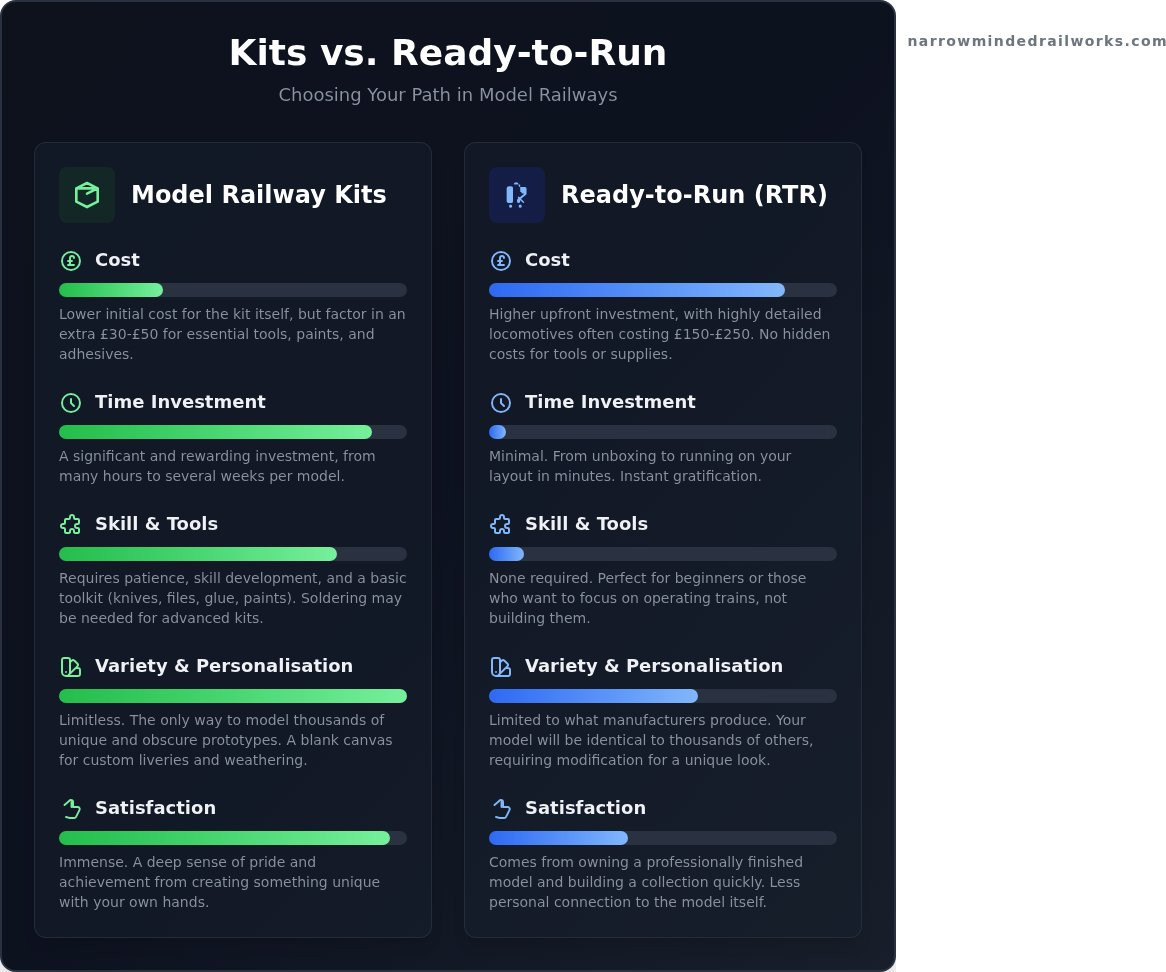
The journey from a box of parts to a finished model requires commitment. The key consideration in the model railway kits vs ready to run debate is the investment of time, patience, and resources. You will need a dedicated workspace and a basic toolkit including craft knives, files, glues, and paints, which can be an initial outlay of £30-£50. The final quality is entirely dependent on your own skill and care, which can be daunting for absolute beginners. A complex kit can take many hours over several weeks, and your first few attempts may be a learning experience rather than a masterpiece.
This is where the DIY approach shows its challenges, a consideration that applies to many complex tasks around the home. While some enjoy the process, for critical jobs like ensuring your property is secure, it's often best to rely on experts. For professional help with this in the UK, you can visit Home Security Installations.
Head-to-Head Comparison: Kits vs. Ready-to-Run
When it comes to the great model railway kits vs ready to run debate, there is no single "better" option. The right choice depends entirely on your goals, budget, and what you want to get out of the hobby. Let's break down the key differences to help you decide.
| Factor | Model Railway Kits | Ready-to-Run (RTR) |
|---|---|---|
| Initial Cost | Generally lower | Generally higher |
| Time Investment | Significant (hours to weeks) | Minimal (minutes) |
| Skill Required | Varies from beginner to expert | None |
| Uniqueness | Very high; one-of-a-kind finish | Low; identical to others |
| Prototype Variety | Vast, including obscure and niche models | Limited to popular, mainstream models |
Factor 1: Cost Breakdown
At first glance, kits appear cheaper. A plastic wagon kit might cost £15, while its RTR equivalent could be £35. However, you must consider the total cost. For a kit, you'll need to budget for tools, adhesives, paints, and potentially a chassis or wheels. A basic starter set of paints and tools could add £30-£50 to your initial project. Over time, a well-built, unique kit can become a high-value centrepiece of your collection, often holding its value better than a mass-produced item.
This focus on protecting valuable assets is a sentiment many enthusiasts share, extending from prized models to everyday vehicles. For a detailed guide on modern vehicle security in the UK, you can visit Safe & Sound Mobile.
Factor 2: Time and Effort
This is where the two paths diverge most sharply. Ready-to-run offers instant gratification; you can have a new locomotive running on your layout within minutes of opening the box. Building a kit is a project. A simple wagon might take a few enjoyable hours, whereas a complex etched brass locomotive kit could be a rewarding challenge spanning several weeks. For many enthusiasts, this time investment isn't a cost-it is the hobby.
Factor 3: Uniqueness and Variety
RTR manufacturers focus on popular, commercially successful prototypes like the Flying Scotsman or a Class 66 diesel. If you want to model something more obscure, such as a specific pre-grouping industrial shunter or a unique piece of rolling stock, a kit is often the only way. This allows for unparalleled variety and personalisation. Two modellers can start with the same kit and produce entirely different results-one pristine and ex-works, the other heavily weathered and customised, each a unique reflection of the builder's skill.
Is Kit Building Right for You? A Modeller's Self-Assessment
The debate of model railway kits vs ready to run often comes down to one thing: personal satisfaction. While the immediate gratification of an RTR model is appealing, the deep sense of accomplishment from building your own rolling stock is unmatched. But the thought of glue, paint, and tiny parts can be daunting for newcomers. The truth is, the skills required are learned, not innate. This self-assessment will help you decide if the rewarding path of kit building is the right one for your hobby journey.
Ask Yourself These Questions
Consider your personality and what you truly want from the hobby. If you answer 'yes' to most of these, kit building could be a perfect fit for you:
- Do you enjoy hands-on projects and working with tools? If you find satisfaction in the process of making things, you'll likely love the meticulous and rewarding nature of kit building.
- Is creating something unique more important than instant results? A kit allows you to add your personal touch-from custom weathering to specific liveries-resulting in a model that is truly yours.
- Are you looking for a deeper, more involved hobby experience? Building a kit connects you to the model in a way that simply unboxing it cannot. It's an immersive experience that extends your time at the workbench.
- Do you want to model a specific prototype that isn't sold RTR? Many fascinating and obscure prototypes, especially in narrow gauge, are only available in kit form, opening up a whole new world of modelling possibilities.
Overcoming the Beginner's Hurdle
Every expert modeller started with their first kit and likely made a few mistakes. The key is to start small to build your confidence. Don't jump straight to a complex steam locomotive; a simple wagon is the perfect first project to learn the fundamental skills of assembly, painting, and finishing.
Modern kits are more accessible than ever. Our 3D printed kits, for example, often feature a one-piece body and fewer separate parts than traditional plastic kits, simplifying construction without sacrificing detail. Remember, you're not alone. The UK model railway community is incredibly supportive, with online forums and local clubs full of members happy to share advice.
Ready to take that first, rewarding step? Explore our range of beginner-friendly wagon kits and begin your journey into the satisfying world of kit building.
Getting Started: Your First Model Kit Project
If you've decided to move beyond the shelf, the final consideration in the model railway kits vs ready to run debate is often the perceived difficulty. But building your first kit is a hugely rewarding experience and far more accessible than you might imagine. The key is to break the process down into simple, manageable stages and start with the right project.
Essential Beginner's Toolkit
You don’t need a fully-equipped workshop to get started. A small, dedicated space with good lighting and a handful of affordable tools is all it takes. Most of these items can be bought for under £40, providing everything you need for your first few projects.
- Assembly Tools: A sharp craft knife, a set of small files or sanding sticks, a pair of fine-point tweezers, and a good quality super glue (cyanoacrylate) are the absolute basics.
- Finishing Supplies: A grey or white primer in a 'rattle can' provides a perfect base for paint. A small starter set of acrylic paints and a couple of fine brushes will bring your model to life.
- Workspace: A self-healing cutting mat is essential to protect your table and your knife blades.
Choosing Your First Project
The secret to a successful first build is to start simple. A small wagon or a basic lineside building kit is an ideal choice. Look for kits with a low part count and clear, well-illustrated instructions. This allows you to learn core skills like cleaning up parts, gluing, and painting without feeling overwhelmed.
Many modern kits make assembly even easier. For instance, our 3D printed OO9 kits are specifically designed to fit popular, reliable ready-to-run chassis from manufacturers like Kato. This approach is a kit-basher's best friend, as it removes the most complex mechanical work, letting you focus on the enjoyable construction and finishing. It's the perfect middle ground in the model railway kits vs ready to run world, giving you a custom model with a reliable mechanism.
Once you've mastered the basics, you can explore more advanced techniques. For in-depth tutorials, be sure to check out modelling forums and YouTube for guides on painting, applying transfers, and weathering.
Ready to take the plunge and experience the satisfaction of building your own unique rolling stock? Browse our full range of model kits and start your modelling journey today.
The Final Destination: Choosing Your Model Railway Journey
Ultimately, the choice between ready-to-run models and building from a kit hinges on what you value most in the hobby. RTR offers the instant gratification of seeing your layout come to life quickly, while kits provide a deeply rewarding, hands-on experience and a profound sense of accomplishment. The great debate of model railway kits vs ready to run isn't about which is better, but which is better for you and your creative aspirations.
If the modeller's journey calls to you, and you're ready to build something truly unique, we're here to help. Our kits are designed by passionate modellers, for passionate modellers. We offer unique 3D printed designs you won't find anywhere else, with a wide range of scales including the popular OO9 and GN15. Ready to take the next step?
Find your next creative project in our collection of narrow gauge kits. Whatever path you choose, the destination is always enjoyment. Happy modelling!
Frequently Asked Questions
Is it cheaper to build a model railway kit than buy ready-to-run?
Initially, a kit's ticket price of £30-£50 seems cheaper than a ready-to-run (RTR) model at £100-£200. However, you must factor in the additional costs of paints, glues, transfers, and essential tools. If you're starting from scratch, these extras can add up. The debate of model railway kits vs ready to run often comes down to long-term value. Once you own the tools, subsequent kits become significantly more cost-effective than buying multiple RTR models.
What are the most common mistakes beginners make when building kits?
The most frequent mistake is rushing the process. Beginners often skip crucial preparation steps like washing parts to remove mould release agent, which results in poor paint adhesion. Other common errors include using too much glue, which can damage fine details, and failing to test-fit components before applying adhesive. Taking your time, reading the instructions thoroughly, and practicing on scrap material first will help you avoid these frustrating and costly mistakes.
How do 3D printed kits differ from traditional plastic or resin kits?
3D printed kits often boast incredibly fine, integrated details that are difficult to achieve with traditional injection-moulded plastic. However, they can be more brittle and require careful removal of print supports. Traditional plastic kits are generally more robust and forgiving for beginners. Cast resin kits sit in the middle, offering excellent detail but sometimes requiring more cleanup of 'flash' (excess material) than their plastic counterparts, and they must be assembled with superglue.
Can I convert a ready-to-run model to make it more unique?
Absolutely. Customising ready-to-run (RTR) models is a huge part of the hobby in the UK. Common modifications include weathering the model to give it a realistic, in-service look, renumbering it to represent a specific prototype, or even a full repaint into a different historical or fictional livery. You can also add finer details like real coal loads, crew figures in the cab, and etched brass nameplates to create a truly one-of-a-kind piece for your layout.
What is the hardest part of building a model railway kit?
For many modellers, the most challenging stage is achieving a high-quality paint finish and correctly applying the transfers (decals). Getting a smooth, even coat of paint without obscuring surface detail requires patience and practice, especially without an airbrush. Applying tiny, delicate transfers so they are straight and free of trapped air bubbles (a problem known as 'silvering') is a skill that demands a steady hand and a great deal of precision.
Where do I find the right chassis for a locomotive body kit?
The kit's instructions are your primary guide; they will almost always specify a recommended ready-to-run 'donor' chassis from a major manufacturer like Hornby, Bachmann, or Dapol. These can be purchased new from model shops or second-hand online. For more advanced or obscure kits, you may need to source a chassis from a specialist UK supplier or even construct one from a separate etched brass kit, which is a project in itself.