

Is there anything more frustrating than spending hours building and painting a beautiful model, only for the decals to ruin the final look? That tell-tale shiny edge, the dreaded 'silvering', or a decal that stubbornly refuses to settle over a rivet can make your masterpiece look more like a toy. It’s a common headache that leaves many model makers feeling defeated. But what if you could make those markings look like they were painted on, perfectly conforming to every curve, panel line, and complex surface?
The secret weapon used by professionals is a powerful decal setting solution, and this guide will demystify the entire process. We'll show you exactly how to use Micro Sol and its partner, Micro Set, to achieve that flawless, 'painted-on' finish. You'll learn the step-by-step method to banish silvering forever, confidently apply decals to corrugated surfaces, and understand the crucial role each chemical plays. Get ready to transform your decaling work from a source of anxiety into a rewarding final step.
Understanding Decal Solutions: What is Micro Sol vs. Micro Set?
One of the most common frustrations in model making is applying a decal only for it to look exactly like what it is: a sticker. That shiny, raised edge and the dreaded "silvering" effect from trapped air can ruin an otherwise perfect paint job. The secret to achieving a professional, painted-on finish lies in using decal solutions. The two most popular products on the market are Micro Set and Micro Sol, and while they come in similar bottles, they serve two very different purposes.
Before we dive in, it helps to understand the basics of the material itself. If you're new to the hobby, this excellent overview of What is a decal? provides essential background. Understanding how they're constructed makes it clear why these solutions are so effective. The good news is that using them correctly is far easier than you might think.
Micro Set: The 'Setting' Solution
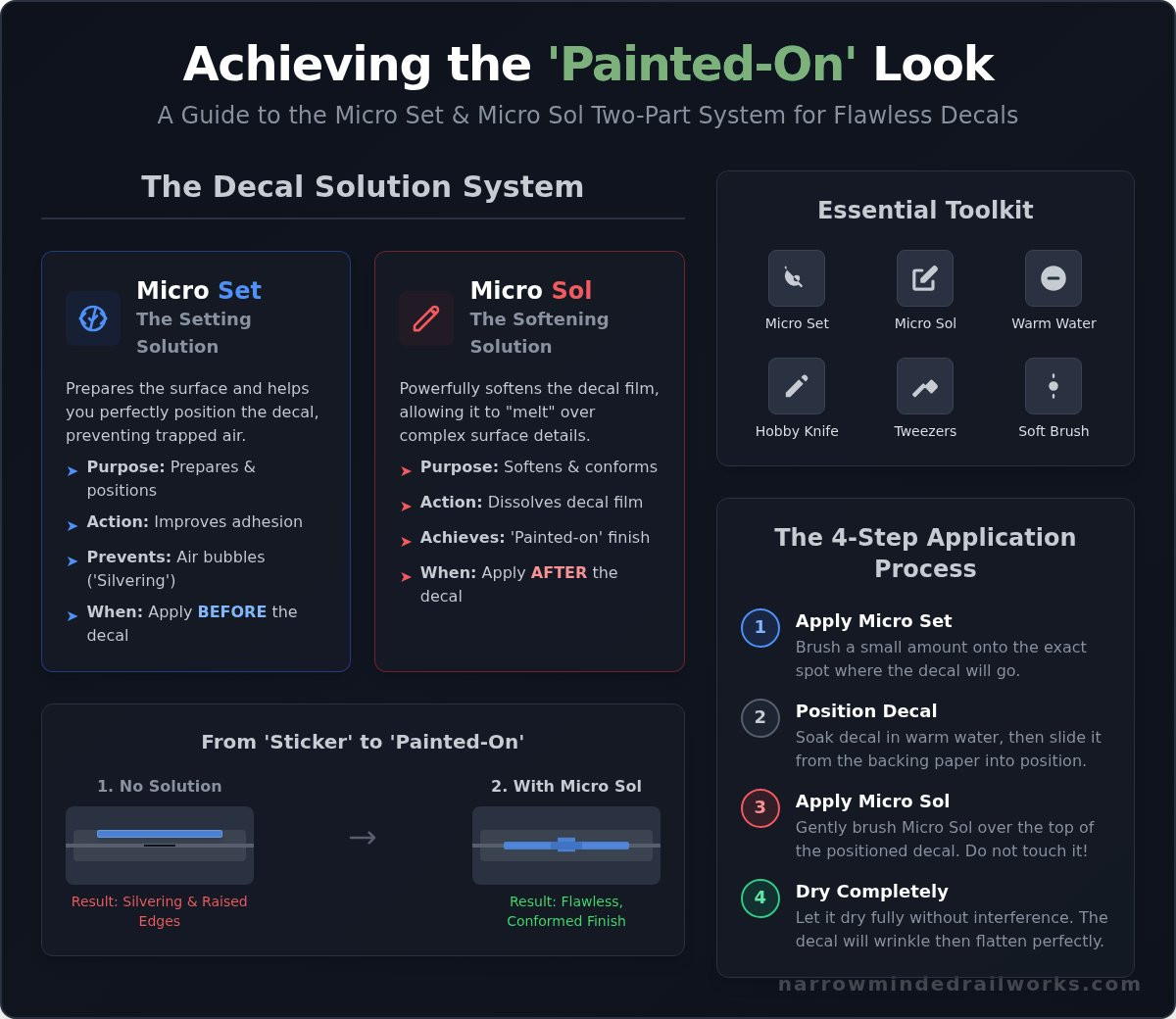
Think of Micro Set as the primer and placement fluid. Its primary job is to prepare the model's surface for the decal. It contains a mild wetting agent that improves adhesion and helps you slide the decal into the perfect position. Crucially, it also helps push out any tiny air bubbles trapped underneath, which is the main cause of silvering. It contains a touch of acetic acid to slightly soften the decal, making it more pliable for the next step. This is always the first solution you use.
Micro Sol: The 'Softening' Solution
This is the magic that makes your decals look painted on. Micro Sol is a much stronger softening agent designed to be applied after the decal is in its final position and has been treated with Micro Set. It works by temporarily dissolving the decal film, allowing it to conform perfectly to any irregular surface details on your model. This is the solution that makes a decal "melt" into deep panel lines, settle realistically over rivets, and wrap around curved surfaces without creasing.
Do You Need Both? A Simple Comparison
For the best possible results, you absolutely should use both products together. They are designed as a two-part system where one prepares the way for the other. Micro Set ensures a perfect placement, while Micro Sol delivers the flawless, integrated finish. Using one without the other is like trying to paint a wall without priming it first-you might get an acceptable result, but you're missing out on a truly professional finish.
Here’s a simple breakdown:
-
Micro Set
- Purpose: Prepares the surface, improves adhesion, and helps position the decal.
- When to Use: Before applying the decal to the model.
- How to Apply: Brush a small amount onto the exact spot where the decal will be placed.
-
Micro Sol
- Purpose: Drastically softens the decal to conform to surface details.
- When to Use: After the decal is in its final position.
- How to Apply: Gently brush over the top of the decal. Do not touch it again until it is completely dry.
Your Decal Application Toolkit: Gathering the Essentials
Achieving a perfect, painted-on decal finish begins long before the decal touches the model. A successful outcome starts with preparation and having the right tools on hand. By gathering your equipment beforehand, you create a smooth, efficient workflow that minimises mistakes and allows you to focus on precision.
This section provides a simple checklist for your workspace. The good news is that you probably own most of these common hobby tools already. Let’s get your station set up for success.
Chemicals and Consumables
These liquids are the core of the decal setting process. They work together to prepare the surface, secure the decal, and make it conform to every detail of your model.
- Micro Set (Blue Label): This is your setting solution. It's applied to the model's surface before the decal. It helps the decal slide into place and improves adhesion, which is key to preventing the dreaded 'silvering' effect.
- Micro Sol (Red Label): This is the powerful softening solution that gives professional results. Applied after the decal is positioned, micro sol softens the decal film, allowing it to melt down into panel lines, rivets, and complex curves. For a visual guide, this excellent video tutorial for decal solutions from FineScale Modeler clearly demonstrates how these two products work in tandem.
- A Small Dish of Warm Water: Clean, warm (not hot) water is essential for releasing the decal from its paper backing.
- Lint-Free Cloth or Paper Towels: Use these to gently blot away excess water and solutions without leaving behind any unwanted fibres.
Essential Hobby Tools
With your solutions ready, a few precision tools will make handling and placing delicate decals much easier. Using the right tool for the job prevents frustrating tears and misalignments.
- A Sharp Hobby Knife: A scalpel or craft knife with a fresh, sharp blade is needed to cut the decal cleanly from the main sheet.
- A Self-Healing Cutting Mat: This protects your work surface and provides a safe, stable base for cutting out your decals.
- Fine-Tipped Tweezers: An absolute must-have for lifting the decal from the water and guiding it onto the model. Using tweezers avoids transferring oils from your fingers, which can interfere with adhesion.
- A Small, Soft-Bristled Paintbrush: A dedicated, clean brush (a size 0 or 1 is ideal) is the perfect tool for positioning the decal and gently applying the micro sol. It’s vital to keep this brush separate from your painting brushes to avoid any chemical contamination.
The Step-by-Step Guide to Using Micro Sol for Flawless Decals
This is where the magic happens. Following this tried-and-tested process will ensure your decals conform perfectly to every curve and rivet, looking as if they were painted on. The most important tool you need is patience; rushing the drying times is the number one cause of poor results. Let's walk through the process from a bare surface to a professionally finished model.
Step 1: Prepare the Model Surface
Decals hate rough surfaces. To guarantee a smooth application and prevent a common issue called 'silvering' (where tiny air bubbles get trapped), you must start with a gloss finish. Apply a thin, even coat of gloss varnish, such as an acrylic gloss, directly where the decal will be placed. Allow this to cure completely according to the manufacturer's instructions-often 24 hours. This smooth foundation is non-negotiable for a professional look.
Step 2: Apply the Decal with Micro Set
With your surface prepared, it's time to apply the decal. This step uses Micro Set, the companion solution to Micro Sol.
- Cut the decal from the sheet, keeping the cut as close to the design as you can.
- Soak it in a shallow dish of lukewarm water for about 20-30 seconds until it slides freely on the backing paper.
- While it soaks, brush a small amount of Micro Set onto the model's glossy surface.
- Gently slide the decal from the backing paper into the pool of Micro Set. Position it carefully with a soft brush or cotton bud, then gently blot away excess water and solution.
Step 3: Apply Micro Sol and Let It Work
Once the decal is in its final position and excess water is removed, it's time to apply the micro sol. Using a soft, clean brush, apply a generous coat over the entire decal. You will likely see the decal wrinkle and distort-this is completely normal! Do not touch it, press it, or try to smooth it out. As the solution dries, it will pull the decal down, making it conform perfectly to panel lines, rivets, and any complex shapes beneath it.
Step 4: Seal Your Work
Patience is key. Allow the decal and solution to dry completely, which can take several hours or even overnight. Once you are certain it is dry and perfectly conformed, you must seal it to protect your hard work. Apply another thin layer of gloss varnish over the decal. This locks it in place and hides the decal film's edges. After that has cured, you can apply your model's final finish, whether it's matte, satin, or another layer of gloss, to unify the entire surface. This final step makes the decal look like an integral part of the paintwork. For a selection of high-quality varnishes, explore the range at Narrow Minded Railworks.
Troubleshooting and Advanced Tips
Even with the best technique, problems can sometimes occur when applying decals. Don't worry, most issues are easily fixed. This section covers the most common challenges model makers face and provides clear solutions. Mastering these techniques will help you tackle even the most difficult surfaces and elevate your decaling skills from good to truly professional.
Tackling Difficult Surfaces: Rivets, Panels, and Corrugations
Complex surfaces with rivets, deep panel lines, or corrugations are where decal solutions truly shine. For these areas, a single application may not be enough. Apply a second, gentle coat of micro sol and allow it to work. You can use a soft, damp brush or a cotton bud to carefully press the softened decal into the details. If a stubborn air bubble gets trapped under a rivet, prick it with the tip of a sharp hobby knife or a fine pin, then apply another touch of the solution. Patience is your greatest tool; give the decal time to settle completely between applications.
Common Problems and Their Solutions
Encountering an issue is part of the learning process. Here’s a quick guide to fixing the most frequent decal problems:
- Silvering: This is a silvery sheen under the decal, caused by tiny air pockets trapped on a non-glossy surface. The fix is preventative: always apply decals to a smooth, gloss-varnished surface.
- Wrinkles Won't Settle: After applying the solution, the decal may wrinkle dramatically. This is normal. The key is to not touch it. The wrinkles are a sign the solution is working. If they persist after drying, a second light application will usually solve it.
- Decal Tears: A small tear isn't a disaster. Apply a little more decal solution to the torn area. As it softens, you can often use a fine brush to carefully nudge the edges back together, making the tear virtually invisible.
- Trapped Air Bubbles: For bubbles on flat surfaces, puncture them with a very fine needle. Then, apply a small drop of decal solution, which will seep into the hole and help the decal settle flat.
Using Micro Sol on 3D Printed Kits
The unique nature of 3D printed models, often with subtle layer lines, makes surface preparation critical for good decal results. Before you even think about decals, you must create a perfectly smooth foundation. Always start with a high-quality primer and sand it meticulously until the surface is flawless. Just as with traditional kits, you must then apply a coat of gloss varnish to prevent silvering and ensure the decal can move freely into position. With the right prep, your decals will look painted on. Ready to try these techniques on a new project? Our 3D printed kits are the perfect canvas for your next masterpiece.
From Novice to Pro: Perfecting Your Decal Finish
You've now seen that achieving that professional, 'painted-on' look is well within your grasp. The key lies in understanding the distinct roles of your decal solutions and patiently applying them to make transfers conform perfectly to every rivet and panel line. Remember that a gentle touch and allowing the micro sol to do its work are the secrets to avoiding silvering and wrinkles, transforming your models from good to truly exceptional.
Feeling inspired? There's no better way to master these techniques than with a new project. Ready to practice your new skills? Explore our range of detailed model railway kits. As specialists in 3D printed narrow gauge kits, we offer unique locomotive and wagon bodies that provide the perfect canvas. With worldwide shipping for modellers everywhere, you can start your next masterpiece today.
Go on, grab that bottle of decal solution and bring your next model to life with confidence.
Frequently Asked Questions
What happens if I apply Micro Sol before Micro Set?
Applying Micro Sol first is generally not recommended. Micro Set is a setting solution designed to be applied to the model's surface before the decal. It helps the decal slide into place and begin adhering. Micro Sol is a much stronger softening solution. If used first, it can make the decal excessively soft and fragile, making it nearly impossible to position correctly without it wrinkling, tearing, or even dissolving completely. Always follow the two-step process: Set first, then Sol.
How long does Micro Sol take to dry completely?
The solution itself will evaporate within 15-30 minutes, during which time you'll see the decal wrinkle and then smooth out. Do not touch it during this phase. For the decal to fully cure and bond with the surface, it's best to leave it undisturbed for at least 8 hours. For maximum durability before applying a clear coat or handling the model, allowing it to cure for a full 24 hours is the safest approach to ensure a perfect finish.
Can I use Micro Sol on any brand of decal?
Yes, it is formulated to work with the vast majority of water-slide decals from popular brands like Airfix, Tamiya, and Revell, as well as aftermarket sheets. However, decal thickness and quality can vary. Very thin decals may only need one light application, while older, thicker decals might require a second coat to conform properly. If you are unsure, it's always a good practice to test the solution on a spare decal from the sheet first.
Is Micro Sol the same as other decal softening products?
While they serve a similar function, they are not identical. Products like Humbrol Decalfix or Tamiya Mark Fit Strong have different chemical formulas and strengths. Micro Sol is widely regarded as a 'hot' or powerful solution, making it excellent for settling decals over complex shapes and into deep panel lines. Some other brands may offer a milder effect, so the choice often comes down to the specific challenge the decal presents and personal preference for a particular brand.
What should I do if my decal folds over on itself?
If a decal folds, act calmly and quickly. Use a soft brush to apply more Micro Set solution or a drop of water to the decal. This will lubricate it and allow you to gently work on the fold. Using the tip of your brush or a wooden toothpick, carefully try to uncurl the folded section. Avoid pulling, as this can stretch or tear the fragile decal. Once it is flat again, you can carefully position it and proceed.
Can I use vinegar or other household products instead of decal solutions?
While some modellers suggest using diluted white vinegar, it is not advisable for achieving professional, lasting results. The acetic acid in vinegar can have an unpredictable effect, potentially damaging the decal's printed ink or the underlying paint job. Purpose-made decal solutions are chemically balanced to be effective and safe on model paints and plastics. For a few pounds, a dedicated product provides consistency and peace of mind that a DIY alternative simply cannot guarantee. The principle of using a specialized kit for a reliable result is important in many fields, including personal health where services like mrsatest.co.uk offer specific at-home testing for peace of mind.