

The ticket with the widest time window isn’t always the right one. To decide how to choose a time period for your railway ticket, match its validity to when you’ll travel and how much flexibility you need. An Anytime return is valid until 04:29 on the day after its stated valid-until date.
It’s easy to focus on departure times and overlook restrictions that affect the rest of a journey. Off-Peak and Super Off-Peak tickets can limit which trains you may use, while break-of-journey conditions can affect whether you can pause before reaching your destination.
This guide explains Anytime validity, break-of-journey conditions and when Off-Peak restrictions may apply. It also covers why your route and ticket terms matter, so you can compare flexibility with your planned travel times and choose an option that suits your journey.
Key Takeaways
- Separate railway eras from ticket time periods so you can focus on the right clues for a model’s historical setting.
- Compare locomotives and rolling stock across eras to find a period with the variety that suits your layout.
- Use liveries alongside locomotive and carriage details to help narrow down when a train belongs.
- Match track, signals and infrastructure to the same period, then explore suitable narrow-gauge kits and scenery for your model.
How do railway eras and periods differ in the UK?
In UK railway modelling, an era is a broad historical setting, while a period narrows that setting to a more specific slice. The terms can overlap, and timelines don’t all use the same boundaries. A layout described as a “steam era” sets a general scene but doesn’t identify an exact year. Choosing a time period for your railway becomes easier when you first decide how precise the scene needs to be. A broad impression gives you more flexibility; a defined timeframe provides a clearer reference for choosing models and details.
Begin with a real railway, route or place to guide your design. Then decide whether you want a general atmosphere or a particular snapshot. For example, a fictional rural branch might suggest a broad steam setting without copying a specific station. A layout based on a named station benefits from a narrower timeframe. This choice can guide the trains, buildings, goods facilities and other features you include. It also gives your research a clear focus: assess each detail against the setting you’ve chosen.
Model descriptions often use era labels as helpful starting points, but a label doesn’t automatically make every item a match. A locomotive and carriage might both suit a broad setting yet reflect different railway identities or stages of change. To choose a time period for your railway, identify the details that matter most to your scene, then use them to narrow your options. Vehicle identity, station character and the route’s purpose can each help establish a coherent timeframe.
Write a short design brief before choosing more models. Describe the railway type, its setting and whether you want a broad era or a precise moment. For example: “a rural narrow-gauge line with passenger and goods traffic.” This gives your project direction without requiring an exact date. Compare each planned item with the brief. If a model changes the scene’s character, decide whether it fits your intended setting or is a deliberate exception. This simple test keeps the layout coherent while leaving room for personal choices.
Which UK railway period offers the widest choice of locomotives and rolling stock?
There isn’t one UK railway period that guarantees the widest choice across every scale and model range. Available locomotives and rolling stock depend on the subject, scale and manufacturers’ ranges. A broad British steam setting may offer different modelling options from a scene centred on diesel traction, but each has its limits. Decide first whether the locomotive, passenger service or goods traffic matters most. That priority gives you a practical way to compare periods without assuming one era has every model you want.
For example, a layout inspired by the Great Western Railway (GWR) or London, Midland and Scottish Railway (LMS) can focus on a pre-nationalisation identity. A British Railways setting offers a different railway context to research. These examples don’t prove that one period has more models available. They show how railway identity can shape which locomotives, carriages and wagons suit the scene. The same applies to narrow-gauge subjects: the railway and scale influence the range of suitable equipment.
Compare your options by listing the traffic and vehicles central to your layout:
- Passenger focus: decide whether a locomotive, carriage set or station scene will define the period.
- Goods focus: identify the wagons and freight activity your route needs to represent.
- Narrow-gauge focus: choose a scale and railway character before narrowing the historical setting.
This comparison shows whether a preferred period supports the whole scene, not just one attractive locomotive. A model that suits the GWR, for instance, won’t automatically fit a British Railways setting. Check each vehicle’s railway identity and intended timeframe against the rest of your planned train. If your preferred period leaves gaps in the specific models you want, consider adjusting the route, traffic or scope of the scene. That’s more useful than choosing a period based on an assumed abundance of models.
For a narrow-gauge project, OO9 locomotive and wagon kits can help establish the train around which you build the scene. GN15 Locomotive & Scenery Kits offer another scale direction to consider.
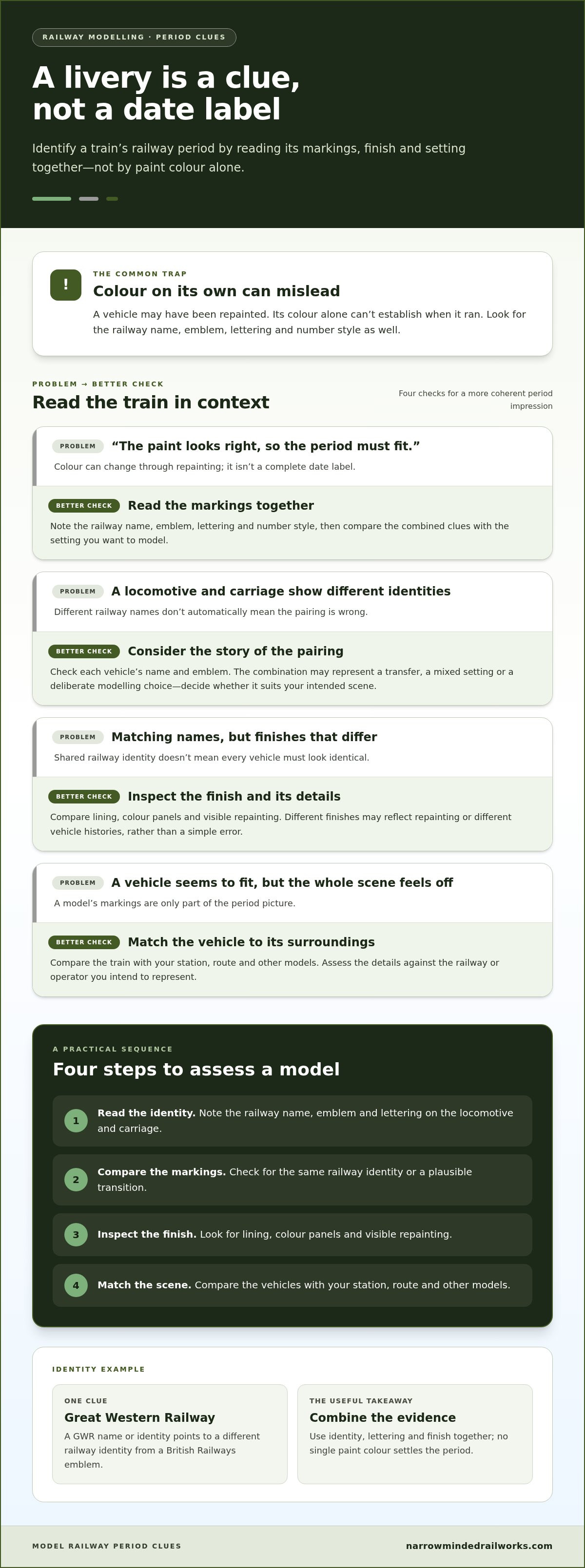
How can you identify the correct railway period from locomotive and carriage liveries?
A locomotive’s paint colour is a clue, not a complete date label. Compare it with the lettering, crest, number style and the vehicle’s identity. For example, a British Railways emblem points to a different railway identity from a Great Western Railway name. These markings can narrow your research, but repainting means colour alone can’t establish when a vehicle ran.
Look at carriages and locomotives together. A Great Western Railway locomotive beside a carriage bearing a different company’s name may represent a transfer, a mixed setting or a deliberate modelling choice. Don’t assume the pairing is wrong; consider whether it suits your intended scene. Check the lettering and emblem on each vehicle, then compare those details with the railway or operator you want to represent.
Use this practical sequence to assess a model:
- Read the identity: note the railway name, emblem and lettering on the locomotive and carriage.
- Compare the markings: check whether both vehicles represent the same railway identity or a plausible transition.
- Inspect the finish: look for lining, colour panels and visible repainting that could change the impression.
- Match the scene: compare the vehicles with your station, route and other models.
For example, a British Railways locomotive and carriage may share an identity yet show different finishes. That contrast could reflect repainting or different vehicle histories, rather than a simple error. Treat the emblem, lettering and finish as combined evidence. Several consistent details across a train are stronger evidence than a single matching colour.
Record the clues before choosing more models. Note the operator name, emblem, lettering style and finish visible on each vehicle. Then use the strongest shared evidence to define a suitable setting for your layout. If one carriage has a different identity, decide whether it belongs in the scene or distracts from it. This approach makes liveries useful without treating any single paint scheme as proof of an exact year.
What changes to track, signals and railway infrastructure define each UK period
Trackside details can date a railway scene as clearly as its locomotive. Compare the rails, signalling equipment, station fittings and visible power systems. A rural branch with semaphore signals creates a different impression from a modern route with colour-light signals. These features work together, so choose infrastructure that supports the period suggested by your trains and location.
Start with the track. Look at the whole layout, including sidings, platform lines and goods facilities. A short goods siding and small station tell a different story from a busy junction with several platforms. The track plan doesn’t prove a precise date, but it establishes the railway’s purpose. Match it to your intended setting, such as a rural passenger branch or an industrial route serving goods traffic.
Signals provide another visible clue. Semaphore arms give a traditional appearance, while colour-light signals suggest a different signalling style. Consider their position too: signals near a junction or station entrance help explain how trains move through the scene. Avoid adding equipment just to fill space. Each signal should make sense beside the track it controls.
Infrastructure can reinforce the same impression:
- Stations: compare platform design, footbridges, shelters and signs.
- Goods facilities: consider loading areas, warehouses and the sidings serving them.
- Power equipment: overhead wires can define an electrified route, while their absence suits other settings.
- Trackside features: include signal boxes, level crossings or retaining walls where they fit the location.
Use a simple consistency test. Put the track plan, signals and station features beside your chosen trains, then check whether they suggest the same railway setting. For example, a small rural station with a goods siding may suit a quieter branch-line scene better than a large junction. Adjust any feature that changes the setting unintentionally. To develop the surrounding landscape, explore railway scenery ideas for your layout.
Narrow Minded Railworks: OO9 Locomotive & Wagon Kits
Narrow Minded Railworks offers OO9 Locomotive & Wagon Kits for modellers building a narrow-gauge railway scene. They can help you develop a layout around the locomotive and wagons, then add matching scenery to support its setting. For a different scale direction, consider GN15 Locomotive & Scenery Kits or O-16.5 / 7mm Scale Kits. Diorama Tools & Scenery can help shape the surrounding scene.
Choose an offering that suits your planned scale and the role you want each model to play. A locomotive-led layout may call for a different starting point from a scene focused on scenery and atmosphere. Visit Narrow Minded Railworks to explore the kits and scenery, or contact the business with your railway modelling enquiry.
Turn Your Railway Idea into a Clear Modelling Plan
Choosing a time period for your railway model starts with a useful design brief, not a demand for perfect historical detail. Decide what you want viewers to notice first, then let that choice guide your next additions. A memorable layout can express a particular railway character while leaving room for your own interpretation.
Before expanding the scene, sketch its focal point and the atmosphere you want to create. It might be a small station, a working goods area or a locomotive moving through a landscape. Use the sketch to decide which details deserve attention now and which can wait. This keeps new choices purposeful and lets your layout develop without losing its intended character.
If you’re ready to shape a narrow-gauge project around that idea, get in touch with Narrow Minded Railworks. You can discuss the direction of your model railway project and explore a suitable starting point. Take the next step at your own pace, and enjoy making the scene your own.
Frequently Asked Questions
What factors should you consider when choosing a railway modelling period?
Consider your preferred railway setting, the trains you want to operate and the activity your layout should show. A compact goods yard designed around shunting, for example, has different needs from a route focused on passenger journeys. Also consider your available space, modelling skills and appetite for research. These choices help you set a practical scope before selecting models and scenery.
Where can you find reliable references for a UK railway period?
Start with a real railway, route or place, such as a named station. Use its trains, markings and infrastructure to guide your research.