

There's a unique thrill to unboxing a brand new model. The crisp detail, the weight of the components... and then, the sudden thought: 'Do I even have the right tools for this?' If you're tackling your first set of 7mm scale kits, or simply looking to upgrade your workbench, the fear of ruining an expensive model with the wrong equipment is a real concern. The sheer variety of files, cutters, and adhesives available can feel completely overwhelming, leaving you unsure where to even begin, especially when dealing with different materials like etched brass or resin.
That’s exactly why we’ve created this essential modeller's checklist. Consider this your definitive guide to assembling the perfect toolkit. We’ll walk you through everything from the absolute basics for cleanup and assembly to the more advanced tools needed for achieving a professional, exhibition-quality finish. Forget the guesswork and the risk of a costly mistake; by the end of this guide, you’ll have a clear, categorised list and the confidence to start your next project on the right foot.
Setting Up Your Workspace: The Foundation for Success
Before you even open the box of your first model, establishing a dedicated and organised workspace is the single most important step you can take. A well-prepared area is the foundation for success, preventing the frustration of lost components and ensuring your safety throughout the build. You don’t need a sprawling workshop; a sturdy desk in the corner of a room is perfectly adequate for building even the most complex 7mm scale models. The key is to have a space you can leave set up, allowing you to work in short bursts without a lengthy pack-up and set-up each time.
To see how a well-organised space can make a difference, take a look at this overview of building 7mm scale kits:
A successful modelling environment boils down to three core components: a reliable surface, excellent lighting, and a commitment to safety. Getting these right from the start will make your experience more enjoyable and your final results more professional.
The Workbench & Cutting Mat
Your primary surface must be stable, flat, and free from wobble. To protect it from stray knife cuts, glue spills, and paint, a self-healing cutting mat is non-negotiable. An A3 size mat provides ample room for most 7mm scale kits without being overly cumbersome. To keep tiny, delicate parts from vanishing into the ether, use small, shallow trays or magnetic dishes to organise components as you work.
Essential Lighting & Magnification
Poor lighting is a recipe for eye strain and inaccurate work. Invest in a good quality daylight lamp, which simulates natural light and ensures you see colours accurately - a crucial factor when painting and weathering. An adjustable angle-poise lamp is ideal as it allows you to direct light exactly where you need it. For intricate detailing, consider a desk-mounted magnifying lamp or a comfortable magnifying headset to make fine work a pleasure, not a chore.
Safety First: Personal Protective Equipment (PPE)
Modelling should be a relaxing hobby, and that means taking safety seriously. Always have the following personal protective equipment (PPE) to hand:
- Safety Glasses: Essential for protecting your eyes from flying debris when cutting, drilling, or sanding materials.
- Dust Mask: A FFP3-rated mask is vital when sanding resin or using an airbrush to prevent inhaling harmful dust and particles.
- Nitrile Gloves: Protect your skin from irritation when handling glues, solvents, and paints.
- Good Ventilation: Always work in a well-ventilated area, especially when using spray cans or airbrushes. Open a window or use an extractor fan.
Stage 1: The Cleanup & Preparation Toolkit
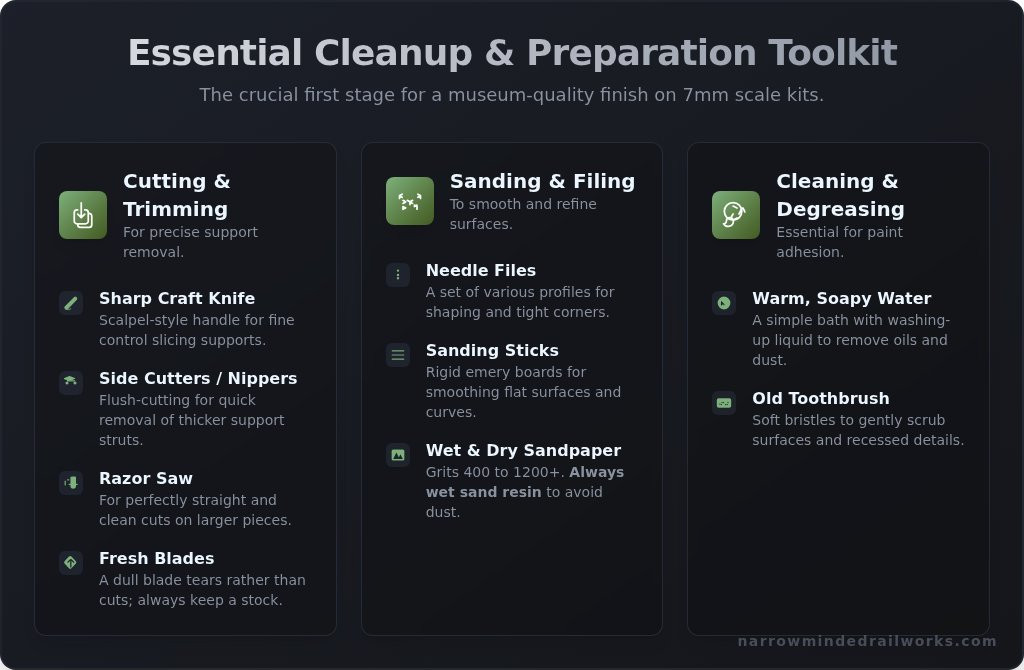
The foundation of any museum-quality model is laid long before glue or paint is opened. This preparation stage is absolutely crucial, especially for the highly detailed 3D printed resin 7mm scale kits we produce. Proper cleanup and preparation ensure that components fit together with precision, adhesive forms a strong bond, and your primer and paint adhere flawlessly. Mastering these foundational skills is key, and for a deeper dive into best practices, the National Model Railroad Association's Beginner's Guide is an invaluable resource. This section covers the essential tools you need to get your parts from the print bed to the assembly bench.
Cutting & Trimming Tools
Your first task is to carefully remove the support structures from the printed parts. The right tool for the job prevents accidental damage and reduces the amount of sanding required later.
- Sharp Craft Knife: An indispensable tool for any modeller. A scalpel-style handle with replaceable blades, such as those from Swann-Morton, offers the best control for slicing away fine supports close to the model's surface.
- Side Cutters / Sprue Nippers: For thicker support struts, a quality pair of flush-cutting side cutters allows you to snip away the bulk of the material quickly and safely, without putting stress on the part itself.
- Razor Saw: When you need a perfectly straight and clean cut on a larger piece or want to remove a substantial block of supports, a fine-toothed razor saw is the ideal choice.
- Fresh Blades: A dull blade is dangerous and will tear rather than cut. Always keep a healthy stock of fresh blades on hand for the cleanest results.
Sanding & Filing Tools
With the supports removed, the next step is to smooth any remaining nubs and refine the surfaces for a perfect finish. Working progressively through finer grits is the key to success.
- Needle Files: A set of small files in various profiles (flat, round, triangular) is essential for shaping small parts and getting into tight corners where sandpaper can't reach.
- Sanding Sticks & Emery Boards: These are excellent for smoothing flat surfaces and gentle curves. They are available in a wide range of grits and provide more rigidity than sandpaper alone.
- Wet & Dry Sandpaper: Use grits from 400 (for initial removal of marks) up to 1200 or higher (for a glass-smooth pre-primer finish). Always wet sand resin parts by dipping the paper in water; this prevents fine resin dust from becoming airborne and clogging the paper.
Cleaning & Degreasing
The final step before assembly or priming is a thorough cleaning. This removes skin oils, mould release agents (on cast kits), and the fine dust created during sanding, all of which can prevent paint from adhering properly.
- Warm, Soapy Water: A simple bath in warm water with a drop of washing-up liquid is the first step.
- Old Toothbrush: Use a soft-bristled toothbrush to gently scrub all surfaces, paying special attention to recessed details to remove any trapped dust.
- Isopropyl Alcohol (IPA): For a guaranteed pristine surface, a final wipe-down with IPA on a lint-free cloth will remove any remaining residue.
- Drying Time: Ensure every component is completely dry before applying any primer or glue. An overnight air dry is usually sufficient.
Stage 2: The Assembly & Construction Toolkit
With your components prepared, it’s time to bring your model to life. The assembly stage is where your kit transforms from a collection of parts into a cohesive whole, and the right tools are non-negotiable. Achieving a professional, museum-quality finish hinges on two key factors: creating strong, clean bonds and ensuring every part is perfectly aligned. This requires a dedicated set of tools designed specifically for joining, holding, and measuring with precision.
Adhesives for 7mm Kits
The diverse materials used in modern 7mm scale kits-from resin and whitemetal to etched brass and plastic-demand a versatile selection of glues. For most resin and metal parts, cyanoacrylate (CA or super glue) is the go-to choice. It's wise to have both thin viscosity for wicking into tight joints and medium viscosity for general-purpose bonding. An accelerator or 'kicker' spray can be invaluable for instantly setting the glue, but use it sparingly to avoid a brittle bond. For scenery, woodwork, or other porous materials, a good quality PVA glue is essential. Many experienced modellers share their adhesive tips for specific kits, and resources like the 7mm Scale Society are fantastic for community-sourced wisdom.
Holding & Clamping Tools
You can't glue what you can't hold securely. A reliable set of holding tools prevents frustration and ensures clean, accurate assembly. Your core holding toolkit should include:
- Tweezers: A pair of fine-point straight tweezers and a pair of angled or self-locking ones are vital for handling tiny components without fumbling.
- Clamps: Small spring clamps, alligator clips, or even simple clothes pegs are perfect for holding parts together securely while the adhesive cures.
- Temporary Aids: Blu-Tack or modelling clay is excellent for test-fitting and temporarily holding parts in place before you commit to glue.
- Pin Vice: A pin vice with a set of micro drill bits (0.5mm - 2mm) is crucial for drilling holes for handrails, pipes, and other fine details, adding another layer of realism.
Measuring & Alignment
Precision is the hallmark of a well-built model. Eyeballing measurements rarely works, especially when building complex rolling stock or structures. To ensure everything fits perfectly, your toolkit should include:
- Steel Rule: A small, 150mm (6-inch) steel rule with clear markings is indispensable for quick, accurate measurements.
- Digital Caliper: For ultimate precision when measuring component thickness or diameters, a digital caliper (costing around £15-£25) is a worthwhile investment.
- Engineer's Square: Ensuring wagon bodies, chassis, and building corners are perfectly square is critical. A small engineer's square guarantees true 90-degree angles.
- Flat Surface: Always assemble chassis and frames on a known flat surface, like a small sheet of glass or a granite chopping board, to prevent any twisting or warping.
Stage 3: The Painting & Finishing Toolkit
This is where your model transitions from a well-assembled collection of parts into a believable, miniature reality. A meticulous paint job, detailed finishing, and realistic weathering can elevate a good build into a true masterpiece. This final stage is crucial for bringing your 7mm scale kits to life, so gathering the right tools is essential for achieving a professional-looking result.
Primers & Brushes
Before any colour touches your model, it needs a solid foundation. A quality primer is non-negotiable, especially for 3D printed resin kits, as it provides a uniform surface for paint to adhere to. For beginners, aerosol spray primers in grey or white are an excellent starting point, offering even coverage with minimal fuss. You should also invest in a small selection of quality paint brushes. A broad, flat brush for base coats and a fine-tipped detail brush (size 0 or 00) for intricate work are the absolute minimum you’ll need.
Paints & Thinners
The choice of paint can define your modelling experience. We recommend starting with water-based acrylics, as they are low-odour, quick-drying, and easy to clean up. Brands like Vallejo or Humbrol offer extensive ranges. For a more robust finish, traditional enamel or lacquer paints are fantastic, though they require specific thinners and more ventilation. Whichever you choose, ensure you have the correct thinner for that paint type to achieve the right consistency. A simple ceramic tile or a dedicated palette is also invaluable for mixing custom shades.
Decals & Weathering
The final details add character and realism. To apply decals without silvering (the appearance of trapped air), a decal setting solution like Micro Sol and Micro Set is a must-have. To make your model look like it has a history, you can use a variety of weathering products.
- Weathering Powders: Ideal for creating dust, rust, and soot effects.
- Oil Paints: Thinned with white spirit, they are perfect for creating subtle streaks, grime, and panel line washes.
- Applicators: A simple cotton bud or a makeup sponge can be used to apply and blend weathering effects.
Once you are satisfied with the painting and weathering, a final coat of matt or satin varnish from a spray can will seal your hard work, protecting it from handling and dust. This final step unifies the finish and completes your model.
Ready to put these tools to use? Explore our range of 7mm scale kits now!
Beyond the Basics: Upgrading Your 7mm Toolkit
Once you have completed a few builds and are comfortable with the fundamental techniques, you may find yourself looking for ways to improve both your speed and the final quality of your models. The tools in this section are not essential for your first kit, but they represent a significant step up in precision and control. Consider these worthwhile investments when you feel ready to tackle more complex 7mm scale kits, especially those featuring brass, whitemetal, or intricate photo-etched components.
Advanced Modelling Tools
These tools are designed to handle specific, demanding tasks, offering a level of finesse that basic tools cannot match. They are game-changers for achieving a truly professional finish, and many of the skills learned are transferable to other detailed hobbies, including assembling devices from specialists like Electronic Kit Complete.
- Airbrush and Compressor: For a flawlessly smooth and even paint finish, nothing beats an airbrush. It is the key to achieving authentic liveries on locomotives and rolling stock, eliminating brush marks and allowing for subtle weathering effects. A basic setup can be found for under £100 and will revolutionise your painting.
- Rotary Tool (Dremel-style): A versatile powerhouse for your workbench. A rotary tool with various attachments can be used for grinding away excess metal, polishing surfaces to a mirror shine, and drilling precise holes.
- Resistance Soldering Unit (RSU): An essential upgrade for the serious metal kit builder. Unlike a standard soldering iron, an RSU provides instant, localised heat precisely where you need it. This minimises the risk of heat spreading and unsoldering adjacent joints-a common frustration with complex brass construction.
- Photo-Etch Bending Tool: If you work with kits containing fine brass details, a dedicated bending tool is indispensable. It allows you to create perfectly straight, crisp folds in delicate photo-etched parts, something that is nearly impossible to achieve with pliers alone.
Organisation & Storage
An organised workspace is an efficient workspace. Keeping your tools, paints, and projects in order not only saves time but also protects your valuable work from damage.
- Paint Racks: A dedicated rack keeps your paint pots visible and accessible. You’ll spend less time hunting for the right colour and avoid buying duplicates.
- Tool Organisers: Wall-mounted racks or benchtop caddies keep your most-used tools within easy reach, ensuring your workbench remains clear for the task at hand.
- Clear Storage Boxes: Ideal for protecting delicate works-in-progress and storing spare parts. Labelled boxes make it easy to find components for future projects or repairs.
- Wet Palette: A simple but brilliant tool for anyone using acrylics. A wet palette keeps your paints from drying out on the palette, allowing you to work for hours and saving both paint and money.
Investing in your toolkit is an investment in your hobby. As you grow your skills, upgrading your equipment will open up new possibilities and help you build the stunning models you've always envisioned. For advice on the right tools for your next project, feel free to explore our curated selection at narrowmindedrailworks.com.
Bringing Your 7mm Vision to Life
From establishing a well-organised workspace to assembling the right tools for each distinct stage-preparation, construction, and finishing-you now possess the ultimate checklist for modelling success. Remember, a solid foundation and the correct tools for cleanup and assembly are not just recommendations; they are the secrets to achieving a professional finish. A well-equipped workbench is the key that unlocks your potential, transforming high-quality 7mm scale kits from a box of parts into a miniature masterpiece you can be proud of.
With your toolkit complete, the only thing missing is your next challenge. Why not explore a project that truly stands apart? At Narrow Minded Railworks, we understand the passion behind the hobby. That’s why our unique narrow gauge prototypes are designed by modellers, for modellers, boasting incredible high-resolution 3D printed detail that brings every model to life with stunning accuracy.
Find your next project in our 7mm scale kit collection and discover the perfect model to put your new skills to the test.
Happy modelling!
Frequently Asked Questions
What is the absolute minimum I need to start my first 7mm kit?
To begin your first of many 7mm scale kits, you only need a few core items. A self-healing cutting mat is essential to protect your work surface. You will also need a sharp craft knife with spare blades (a Swann-Morton scalpel is a popular choice), a steel rule for straight cuts, and some quality tweezers for handling small parts. For assembly, a good quality cyanoacrylate (superglue) or a plastic solvent cement, depending on the kit material, will get you started.
What is the best type of glue for 3D printed resin models?
For 3D printed resin parts, cyanoacrylate (CA) adhesive, commonly known as superglue, is the best choice. It creates a strong, rapid bond. It's wise to have a couple of viscosities on hand: a thin CA for wicking into tight joints and a medium or gel-type CA for gap-filling. For large, heavy components that require maximum strength, a two-part epoxy adhesive provides a more robust and durable bond, though it has a much longer curing time.
Do I really need to wash the parts before I start building?
Yes, absolutely. Washing all kit parts is a crucial first step. Cast resin and plastic parts often have a greasy mould release agent on them, while 3D printed parts can have leftover resin residue. These substances will prevent glue and paint from adhering properly. A quick scrub in warm, soapy water with an old toothbrush, followed by a thorough rinse and allowing the parts to air-dry completely, will ensure a perfect foundation for building and painting your model.
Is an airbrush necessary for a good paint finish?
While not strictly necessary, an airbrush is highly recommended for achieving a smooth, professional-quality finish, especially on the larger surfaces of 7mm models. It provides thin, even coats that preserve fine detail. However, beginners can achieve excellent results using high-quality aerosol spray cans for priming and base coats (brands like Halfords are popular in the UK), combined with careful brush painting for the details. Practice and patience are key, regardless of the method you choose.
Are the tools for 7mm scale different from smaller scales like OO9?
The fundamental tools are largely the same, but you may find yourself needing more robust versions for 7mm scale kits. For instance, you might use larger files, stronger side-cutters for thicker brass or nickel-silver etches, and more powerful soldering irons for chassis construction. While your fine tweezers and small paintbrushes are still essential, the larger size of the models often calls for tools that can handle slightly heavier-duty work compared to those used for smaller scales like OO9.
Where is the best place to buy modelling tools?
In the UK, you have several excellent options. Specialist model railway shops like Hattons or Rails of Sheffield offer a wide range of tools, and for more specialised engineering items, suppliers like Eileens Emporium are invaluable. The principle of finding a trusted specialist for quality equipment applies to any hobby; for example, for those passionate about barbecue in the Netherlands, Tools & Grill is a go-to for high-end gear. Even general hobby stores and online marketplaces can be useful, but always check reviews for quality.